A felony drug charge in California means the prosecution is alleging conduct that goes beyond personal possession — typically that drugs were possessed for sale, transported, sold, or manufactured. These charges carry state prison or county jail sentences ranging from two to nine years before enhancements, and they trigger consequences in immigration, firearms rights, and professional licensing that can outlast the sentence by decades.
But the reality of how these cases actually resolve is more complicated than the maximum penalty on the statute. The statewide felony conviction rate is 60.0% — meaning four in ten felony arrests do not result in a conviction at all. Of those that do result in conviction, probation with jail time is the most common outcome. None of that means a felony drug charge isn’t serious — it absolutely is. It means the outcome depends heavily on the specific charge, the evidence behind it, and what the defense does with both.
Here’s what you need to know about where you stand.
What Makes a Drug Charge a Felony Instead of a Misdemeanor in California?
California draws a sharp line, and the distinction comes down to what the prosecution says you were doing with the drugs — not just whether you had them.
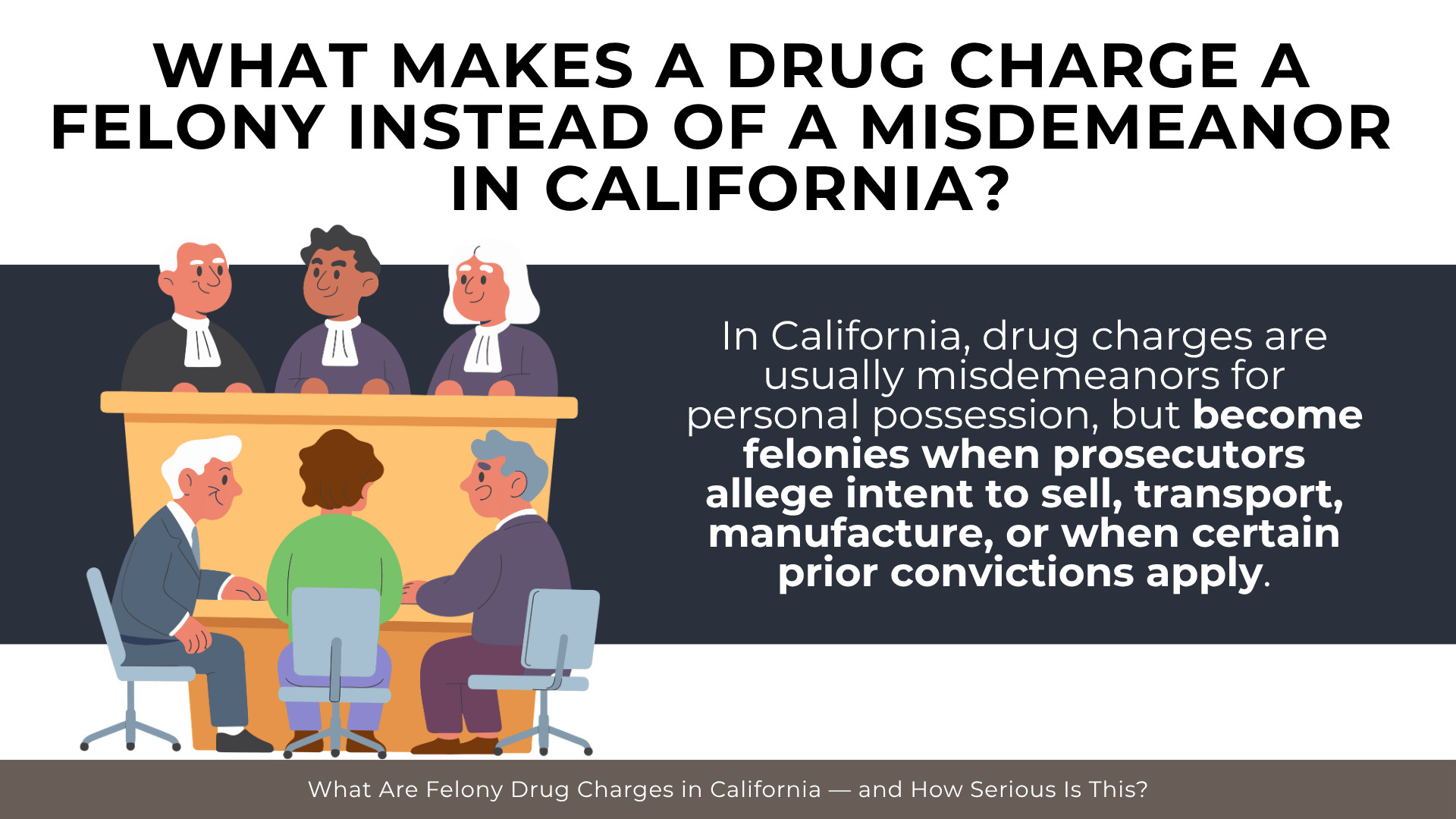
Since Proposition 47 reclassified simple drug possession in 2014, Health and Safety Code §§ 11350 and 11377 are generally misdemeanors — up to six months in county jail under Penal Code § 19 and/or a fine of up to $1,000 for most defendants.
The felony line begins at possession for sale. If the prosecution alleges that drugs were held with the intent to sell — or that they were transported, sold, furnished, or manufactured — the charge is a straight felony regardless of Prop 47. No quantity threshold triggers this automatically. California has no statutory weight-based presumption of intent. The prosecution has to prove the specific intent to sell beyond a reasonable doubt, which is why the distinction between personal possession and possession for sale is often the most contested issue in a California drug case.
There is one significant recent change. Proposition 36, which took effect December 18, 2024, created a new “treatment-mandated felony” under Health and Safety Code § 11395 for possession of hard drugs by someone with two or more qualifying prior drug convictions. This is a wobbler. For defendants facing felony drug charges, understanding whether Prop 36 applies — and what it changes about the case — is one of the first questions that needs an answer.
For defendants with prior “super-strike” convictions or those required to register under Penal Code § 290, even simple possession under §§ 11350 and 11377 can still be charged as a felony carrying 16 months, two years, or three years.
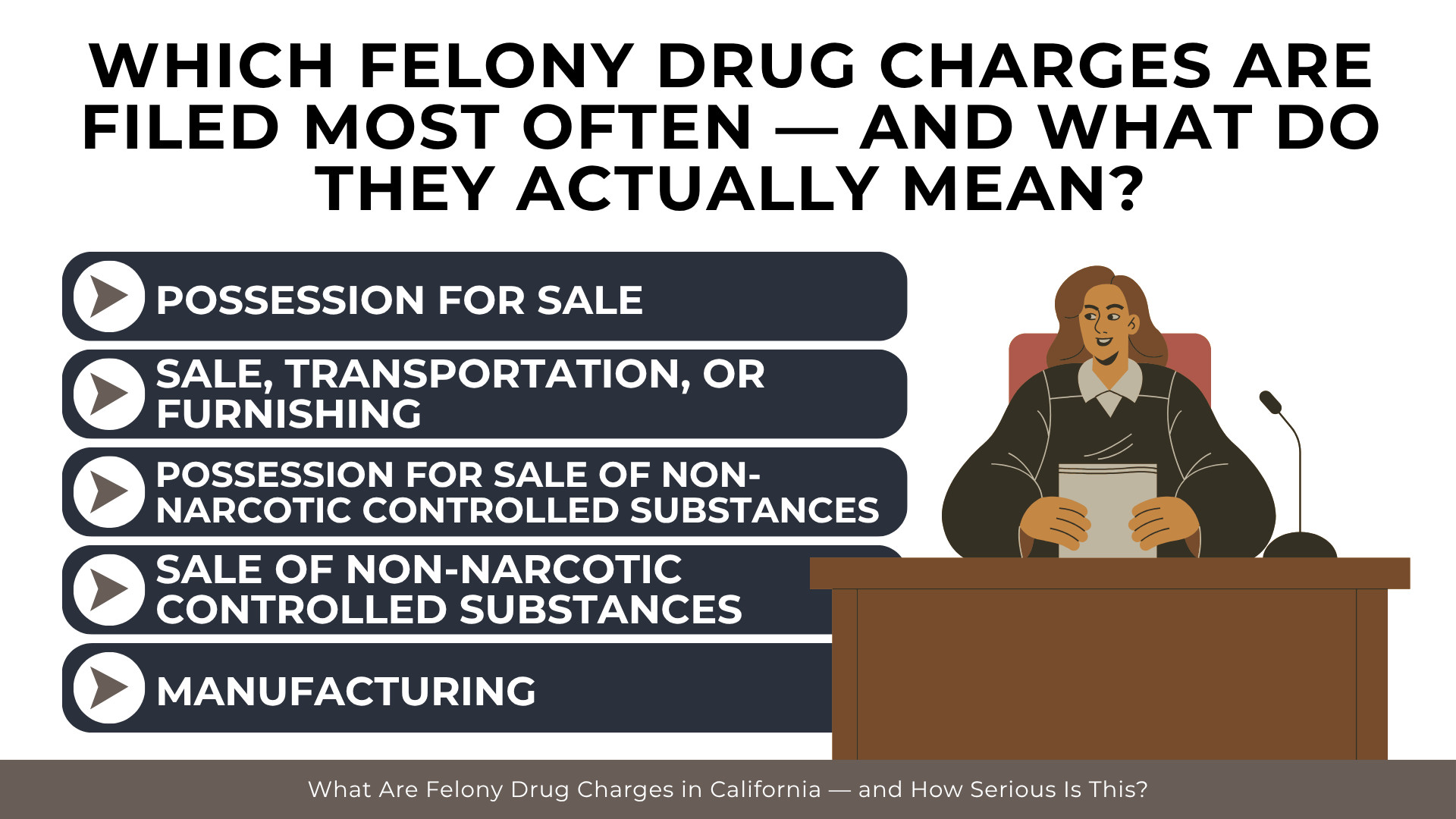
Which Felony Drug Charges Are Filed Most Often — and What Do They Actually Mean?
If you’re facing a felony drug charge in California, it almost certainly falls under one of these Health and Safety Code sections. Each one requires the prosecution to prove different things, and that matters because the gaps in what they can prove are where defense opportunities exist.
Health and Safety Code § 11351 — Possession for Sale. This is the charge when the prosecution alleges someone possessed a controlled substance (narcotics or Schedule III–V substances) with the intent to sell it. It requires the same elements as simple possession — dominion and control, knowledge, and a usable quantity — plus the specific intent to sell. There is no statutory weight threshold that automatically establishes intent. The prosecution must prove it through circumstantial evidence. Under People v. Parra (1999) 70 Cal.App.4th 222, experienced officers may opine that drugs were possessed for sale — but every one of those indicators can be challenged, contextualized, or explained.
Health and Safety Code § 11352 — Sale, Transportation, or Furnishing. This covers a broader range of conduct: actually selling, transporting, importing, furnishing, administering, or giving away a controlled substance, or offering or attempting to do so. Because the statute lists transportation as a separate act from sale, a charge based on transportation may not require the prosecution to prove intent to sell — only that the defendant transported a controlled substance with knowledge of its presence and narcotic character. If the transportation crosses from one county to a non-contiguous county, the sentencing range jumps significantly.
Health and Safety Code § 11378 — Possession for Sale of Non-Narcotic Controlled Substances. This is the methamphetamine possession-for-sale statute and applies to Schedule III–V controlled substances that are not narcotics. The elements mirror § 11351, but the substance category is different.
Health and Safety Code § 11379 — Sale or Transportation of Non-Narcotic Controlled Substances. The transportation and sale counterpart to § 11378, covering the same conduct as § 11352 but for non-narcotic substances like methamphetamine.
Health and Safety Code § 11379.6 — Manufacturing. Covers the manufacturing of any controlled substance. Manufacturing charges are categorically ineligible for diversion.
In every one of these charges, the prosecution must establish that the defendant had knowledge — both of the substance’s presence and of its character as a controlled substance. Constructive possession counts, but mere presence near drugs does not.
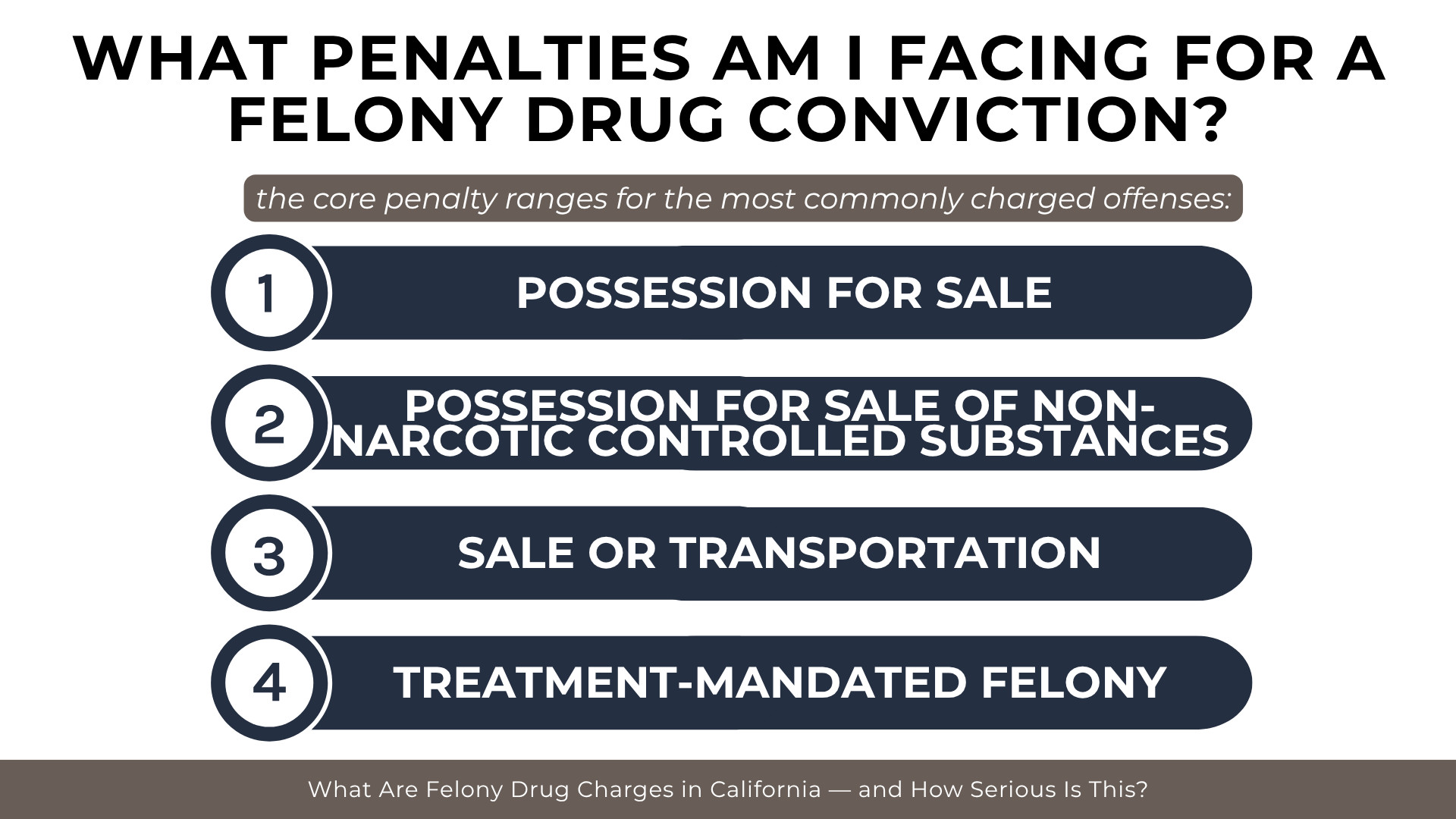
What Penalties Am I Facing for a Felony Drug Conviction?
California felony drug sentencing follows a tiered structure. Each offense carries a “triad” — three possible terms — and the court selects from that range based on the circumstances of the case, the defendant’s history, and any applicable enhancements.
The core penalty ranges for the most commonly charged offenses:
Possession for sale (§ 11351): Two, three, or four years, served in county jail under Penal Code § 1170(h) realignment, plus fines up to $20,000.
Possession for sale of non-narcotic controlled substances (§ 11378): Punishable pursuant to Penal Code § 1170(h).
Sale or transportation (§ 11352, § 11379): Three, four, or five years. For transportation across two non-contiguous counties under § 11352, the range jumps to three, six, or nine years.
The treatment-mandated felony (§ 11395, Prop 36 2024): Up to three years in state prison or county jail for defendants who fail the treatment pathway. Defendants who complete treatment have the felony dismissed.
These base terms can increase substantially with enhancements. Health and Safety Code § 11370.4 imposes weight-based enhancements adding three to twenty-five years for trafficking quantities — for example, one or more kilograms of heroin or cocaine. Health and Safety Code § 11370.2 adds a three-year enhancement for certain prior felony drug convictions. Prop 36 (2024) also added fentanyl to the list of substances that trigger firearm-related enhancements alongside cocaine, heroin, and methamphetamine.
A critical structural point: most felony drug sentences in California are now served in county jail, not state prison. AB 109 realignment, which took effect in 2011, routes less serious non-violent drug felonies to county jail under Penal Code § 1170(h). State prison applies when the defendant has prior serious or violent felony convictions or certain specified enhancements.
In practice, the numbers tell a story that’s less extreme than the statutory maximums suggest. Roughly 75% of felony dispositions are guilty pleas, about 20% are dismissals, and fewer than 3% go to trial. What those numbers mean in practical terms is that the vast majority of felony drug cases are resolved through negotiation, and the strength of the defense’s position during that negotiation is what determines where in the range of outcomes a case lands.
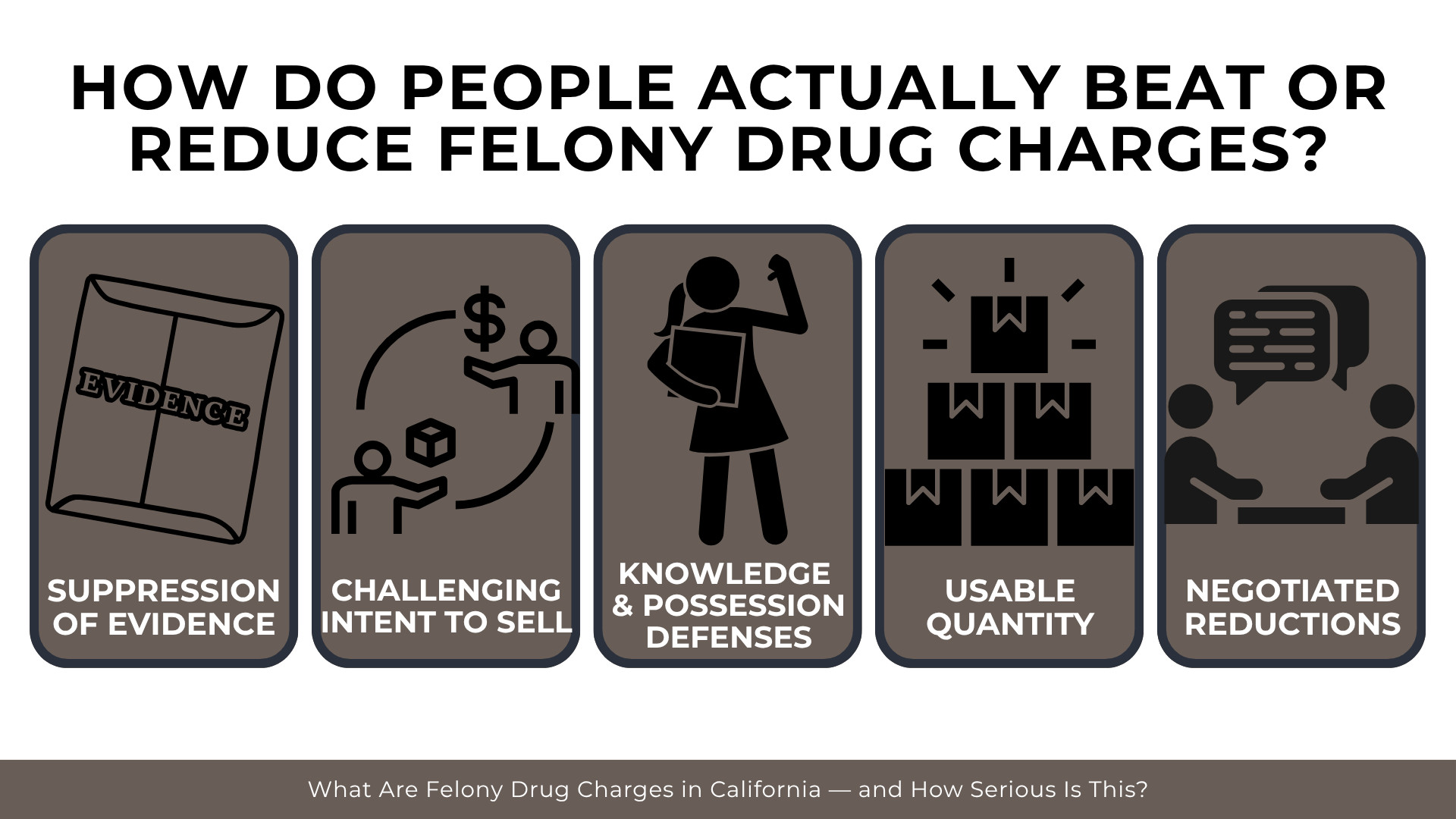
How Do People Actually Beat or Reduce Felony Drug Charges?
Defense in a felony drug case works on multiple levels, and the strongest results usually come from pressure applied well before trial.
Suppression of evidence. If the drugs were found through an unconstitutional search — a warrantless vehicle search without probable cause, a traffic stop extended beyond its lawful purpose, or a warrantless cell-phone search — a motion to suppress under Penal Code § 1538.5 may result in the exclusion of that evidence. Since California’s suppression standards generally track federal Fourth Amendment law following Proposition 8 (1982), the body of federal search-and-seizure case law applies directly in California courts.
Challenging intent to sell. Because California has no weight-based presumption of intent, the prosecution’s case for possession for sale rests on circumstantial evidence that a defense attorney can challenge, reframe, and contest. The difference between possession for sale and simple possession is the difference between a felony and a misdemeanor — which makes this the highest-leverage factual battle in many drug cases.
Knowledge, possession, and usable quantity defenses. The prosecution must prove knowledge, dominion and control, and a usable quantity. Constructive possession — where drugs are found in a shared space or a vehicle with multiple occupants — is particularly vulnerable to challenge. Mere proximity is not possession, and trace amounts or residue that cannot actually be used do not sustain a conviction.
Negotiated reductions. A felony charge reduced to a misdemeanor, a possession-for-sale charge negotiated down to simple possession, or a dismissal secured through pre-filing advocacy — these are the results that change the trajectory of a case. But negotiating leverage doesn’t come from asking for a deal. It comes from the prosecution knowing the defense is prepared to go to trial if the deal isn’t right.
Why Does the Attorney You Choose for This Actually Matter?
Everything above — the suppression opportunities, the intent challenges, the negotiated reductions that move a case from felony to misdemeanor — depends on whether the defense is actually built to exploit those openings.
Roughly 75% of California felony cases end in guilty pleas. That number reflects reality, but it doesn’t mean every plea is the same. The terms of a plea — which charge, which sentence, which consequences attach — are shaped by what the prosecution believes will happen if the case doesn’t settle. A defense that’s prepared for trial creates leverage. A defense that isn’t doesn’t.
At Angelo Reyes Law in Carlsbad, California, every case is prepared as if it’s going to a jury — because that preparation is what creates real negotiating power whether the case resolves through a plea or at trial. Attorney Angelo Reyes handles each case directly, not through a paralegal or associate, and brings a track record that includes a 25-to-life case dismissed, attempted murder reduced to battery, and felony strike exposures reduced to simple misdemeanors across thousands of criminal cases in San Diego County.
If you or someone close to you is facing a felony drug charge in California, the window to build the strongest possible defense starts now. Contact Angelo Reyes Law to discuss your case.