
If you’re reading this, there’s a good chance you already know how a DUI works in California. You’ve been through the arrest, the court dates, the classes, and the license suspension once before. Now you’re facing it again — and you already sense that this time is different.
You’re right. California treats a second DUI offense significantly more seriously than a first. The jail minimums are higher, the license suspension is longer, the DUI program stretches from months into years, and the financial cost increases substantially. But the situation is also more nuanced than most people realize, and understanding exactly what you’re facing is the first step toward making sound decisions about what comes next.
Here’s what you need to know.
The 10-Year Lookback Window: Does This Count as a Second Offense?
California uses a 10-year lookback period, measured from arrest date to arrest date, to determine whether a DUI qualifies as a repeat offense. If your first DUI arrest occurred within 10 years of this new arrest, the prosecution will charge this as a second offense with enhanced penalties under Vehicle Code § 23540.
What catches some people off guard: a prior “wet reckless” conviction under § 23103.5 counts as a prior DUI for enhancement purposes. The statistics bear this out — wet reckless convictions are specifically tracked as priorable offenses for future DUI cases.
You’re not alone in this situation. According to the California DMV, 27.2% of convicted DUI offenders in 2019 were repeat offenders. But the system draws a hard line between first-timers and everyone else — and you need to understand exactly where that line falls.
Criminal Penalties for a Second DUI
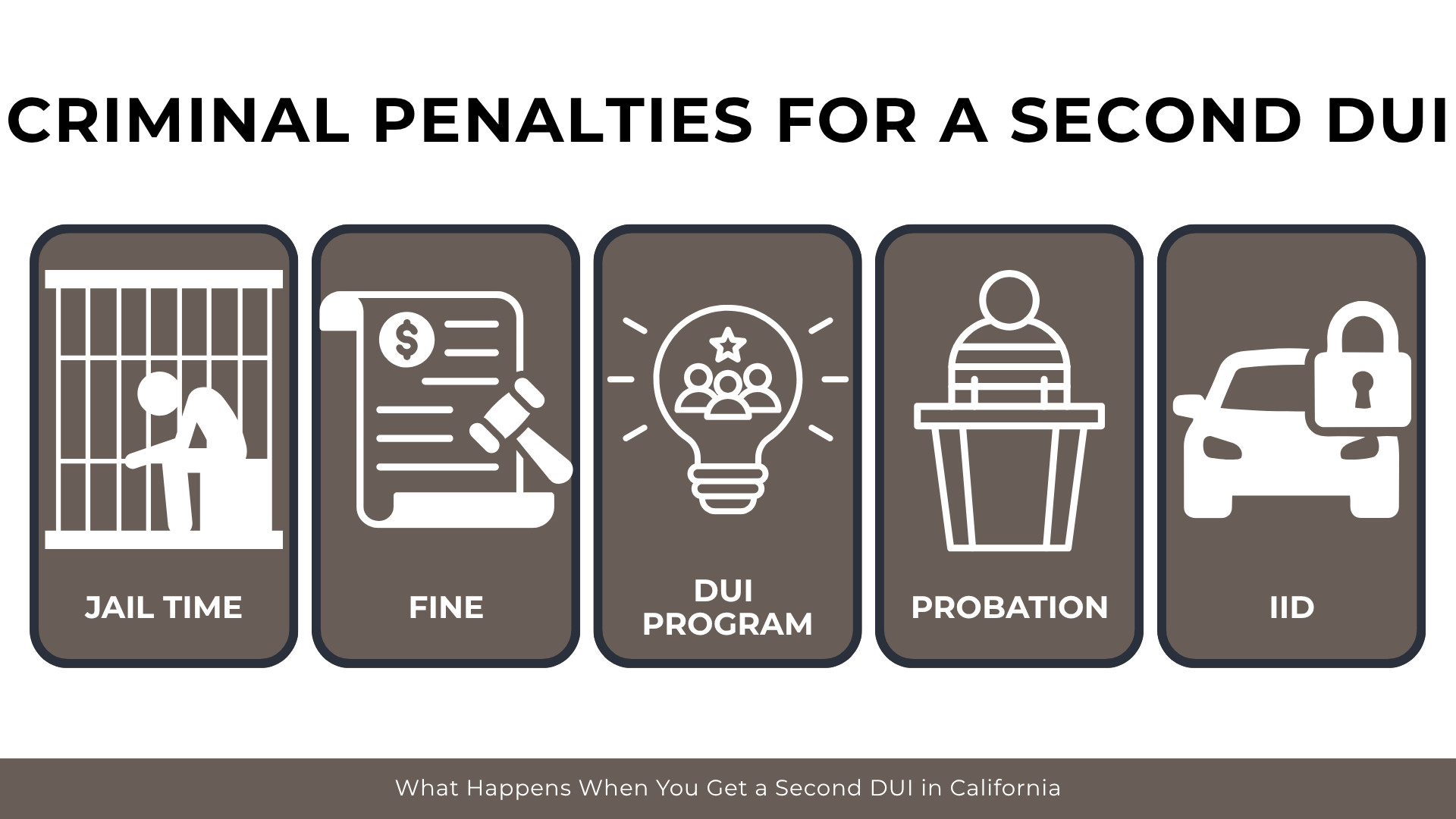
The criminal penalties under Vehicle Code § 23540 represent a significant escalation from a first offense. Here’s what the statute prescribes for a second DUI conviction within 10 years:
Jail time: 90 days to 1 year in county jail, with a mandatory minimum of 96 hours. This is not theoretical. 95.2% of repeat DUI offenders in California were sentenced to jail time, compared to 66.3% of first-time offenders.
Fines: $390 to $1,000 in base fines. California’s penalty assessment system increases the actual amount owed beyond the base fine range.
DUI program: An 18-month or 30-month licensed DUI education program. This is a major step up from the 3-month program required for most first offenses — and completion rates reflect that difficulty. Only 42.1% of second DUI offenders who enrolled in a court-ordered DUI program completed it, compared to 83.9% of first offenders.
Probation: 3 to 5 years of informal (summary) probation under § 23600(b)(1), with zero-tolerance alcohol conditions.
Ignition interlock device (IID): A mandatory 1-year IID installation on any vehicle you operate under § 23575.3.
Enhancement Factors That Make It Worse
Certain circumstances trigger additional penalties on top of the baseline:
A blood alcohol concentration at or above 0.15% gives the court discretion to impose additional penalties under § 23578. A BAC at or above 0.20% mandates a 9-month DUI school program under § 23538(b)(2). For context, the median BAC among convicted DUI offenders in California was 0.16% — already double the legal limit — so a significant number of defendants fall into this enhanced range.
If a child under age 14 was a passenger at the time of the offense, § 23572 adds a mandatory 10 consecutive days in jail for a second DUI.
Refusing the chemical test after a lawful arrest carries its own consequences under § 13353, including a 2-year license revocation with no restricted license eligibility — a harsher outcome than testing over the limit.
The DMV Fight and the 10-Day Deadline
This is where people make their most costly early mistake.
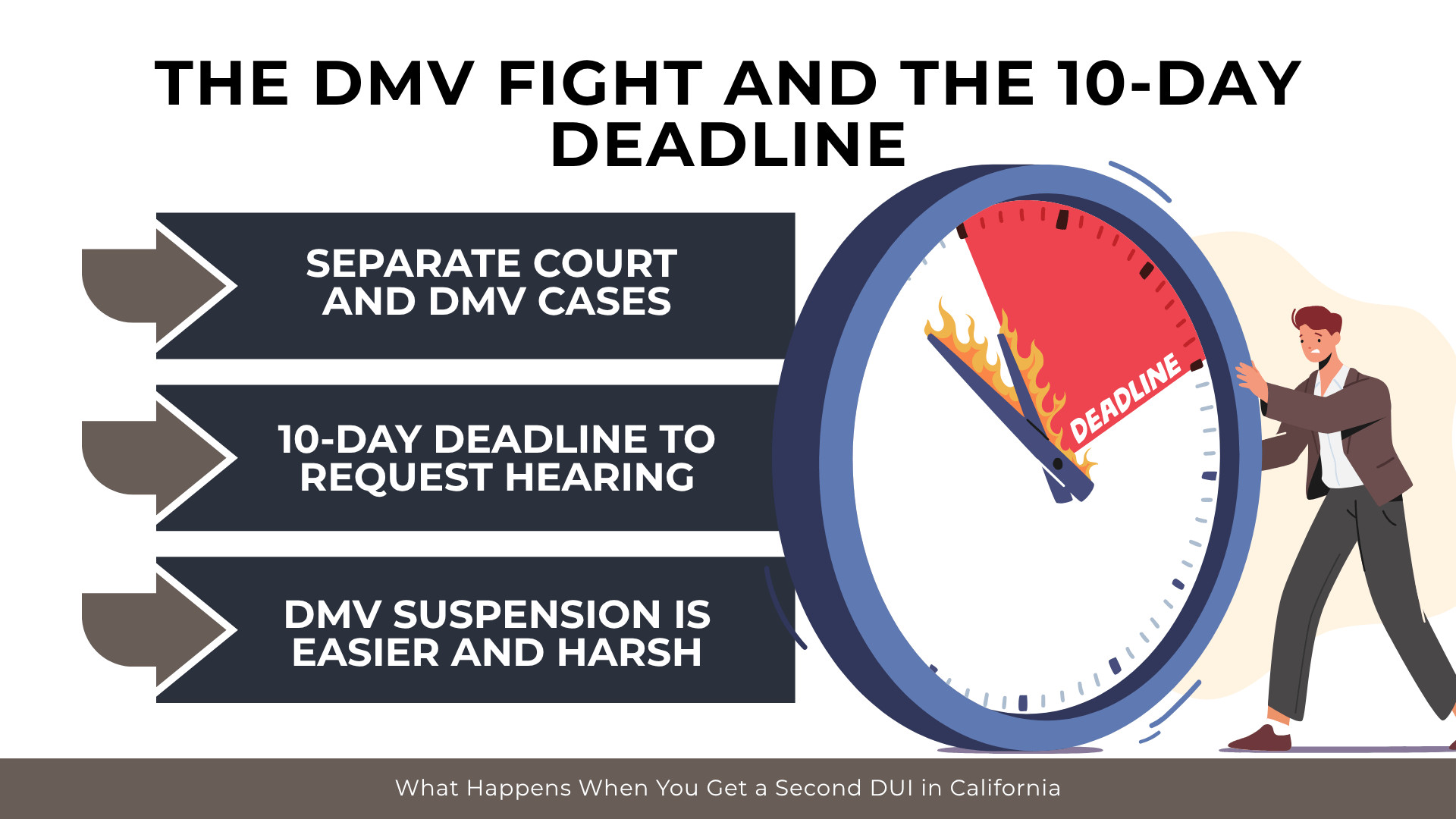
California runs two entirely separate proceedings after a DUI arrest: the criminal case in court and an administrative license action through the DMV. The DMV’s Administrative Per Se (APS) process is a civil proceeding with a lower burden of proof — preponderance of the evidence rather than beyond a reasonable doubt. The California Supreme Court confirmed in Lake v. Reed (1997) that this administrative suspension is a remedial measure, not criminal punishment, which means it proceeds on its own track regardless of what happens in your criminal case.
For a second offense, the court-ordered license suspension upon conviction is 2 years under § 13352. If you refused the chemical test, the suspension is also 2 years under § 13353, but with no eligibility for a restricted license.
The critical deadline: You have 10 days from the date you received the suspension notice to request an APS hearing under § 13558. If you miss this window, the suspension goes into effect automatically and you lose the right to contest it. Requesting the hearing also typically stays (delays) the suspension while the hearing is pending.
Here’s what makes this especially important to understand: even if you are acquitted in criminal court, that does not automatically vacate your DMV suspension. The DMV must independently determine whether the acquittal constitutes a factual finding that precludes administrative action. Under MacDonald v. Gutierrez (2004), the DMV carries its own burden to prove by a preponderance that the officer had reasonable cause to believe you were driving under the influence — but that’s a much easier standard to meet than the criminal burden.
The IID requirement creates a practical path forward for many second offenders. Installing an IID allows you to obtain a restricted license rather than serving the full suspension period, which for most people is the difference between maintaining employment and losing it.
What Happens If You’re Still on Probation from Your First DUI
This is the question most articles skip, and it may be the most important one for your situation.
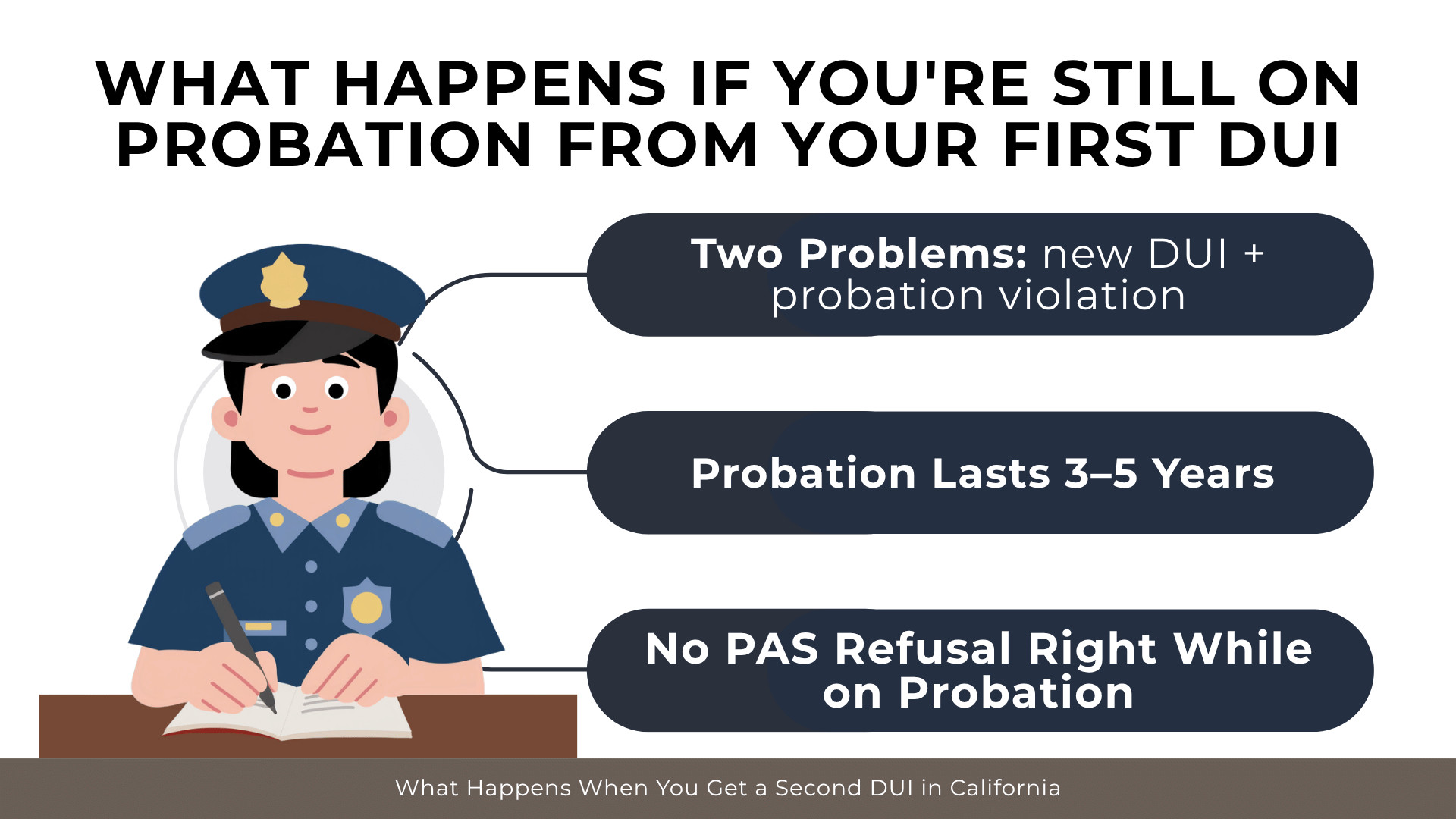
DUI probation in California runs 3 to 5 years under § 23600(b)(1). If your second arrest falls within that probation period — and statistically, it often does — you’re facing two problems at once: the new DUI charge and a potential probation violation on the original case. An attorney can help you understand how a new arrest may affect the terms of your existing probation.
There’s also a practical consequence during the investigation itself. Drivers who are not on DUI probation have the right to refuse the preliminary alcohol screening (PAS) test — the handheld breathalyzer used at the roadside — with no penalty, per § 23612(h)-(i). But if you’re on DUI probation, that exemption does not apply. This distinction can affect the evidence the prosecution has to work with.
Defense Strategies That Matter on a Second Offense
A second DUI is not simply a first DUI with bigger numbers. The stakes are higher, which means the value of identifying legitimate defense issues also increases. These aren’t theoretical loopholes — they’re doctrinal requirements the prosecution must satisfy.
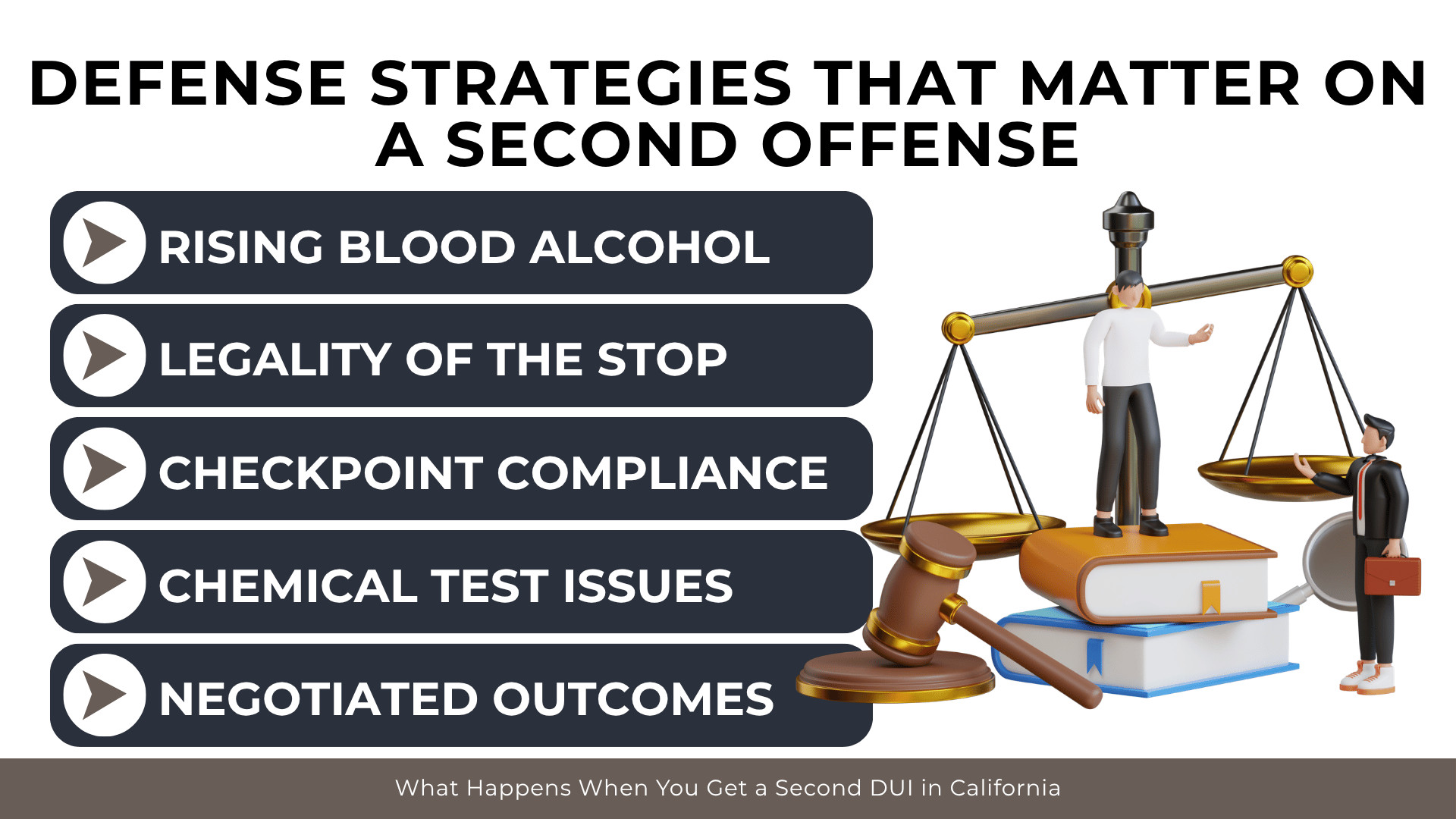
Rising blood alcohol. Under People v. McNeal (2009), the per se DUI statute under § 23152(b) requires the prosecution to prove your BAC was at or above 0.08% at the time of driving, not at the time of testing. If you consumed alcohol shortly before driving, your BAC may have still been rising when you were pulled over and could have been below the legal limit when you were actually behind the wheel. The gap between the traffic stop and the chemical test is where this defense lives.
The legality of the stop. Every DUI case begins with a traffic stop, and that stop requires reasonable suspicion based on specific, articulable facts suggesting a traffic violation or criminal activity. Under People v. Bell (1996), a hunch is not enough. If the stop lacked legal justification, everything that follows — the field sobriety tests, the chemical test, the arrest — may be subject to suppression.
Checkpoint compliance. If your arrest occurred at a DUI checkpoint, it must satisfy the eight-factor framework from Ingersoll v. Palmer (1987): supervision by command-level personnel, neutral vehicle selection criteria, adequate safety measures, a reasonable location, advance publicity, and minimal detention, among other requirements. Failure to meet these criteria can undermine the legality of the entire encounter.
Chemical test issues. Following Missouri v. McNeely (2013), a warrantless blood draw requires either actual consent or case-specific exigent circumstances — the natural dissipation of alcohol alone is not enough. And under Birchfield v. North Dakota (2016), warrantless breath tests incident to arrest are constitutional, but warrantless blood tests are not without consent or a valid exception. If your blood was drawn without a warrant and without proper consent, the result may be challengeable.
Negotiated outcomes. A plea reduction to “wet reckless” under § 23103.5 is a realistic possibility in some cases. 7.9% of DUI convictions statewide in 2019 were reduced to wet reckless. While a wet reckless is still priorable — meaning it counts as a prior for future DUI purposes — it carries significantly lower penalties than a second DUI conviction and avoids some of the harshest mandatory minimums.
One more thing worth understanding: outcomes vary enormously by county. DUI conviction rates across California counties ranged from 41.1% to 91.9%. Where your case is filed and who handles it are not minor details — they are among the most outcome-determinative factors in the process. The statewide average conviction rate for DUI arrests in 2019 was 68.9%, and 20.5% of DUI arrest cases showed no corresponding conviction on DMV records — a figure that has steadily increased over the past decade.
The Full Cost Beyond the Courtroom
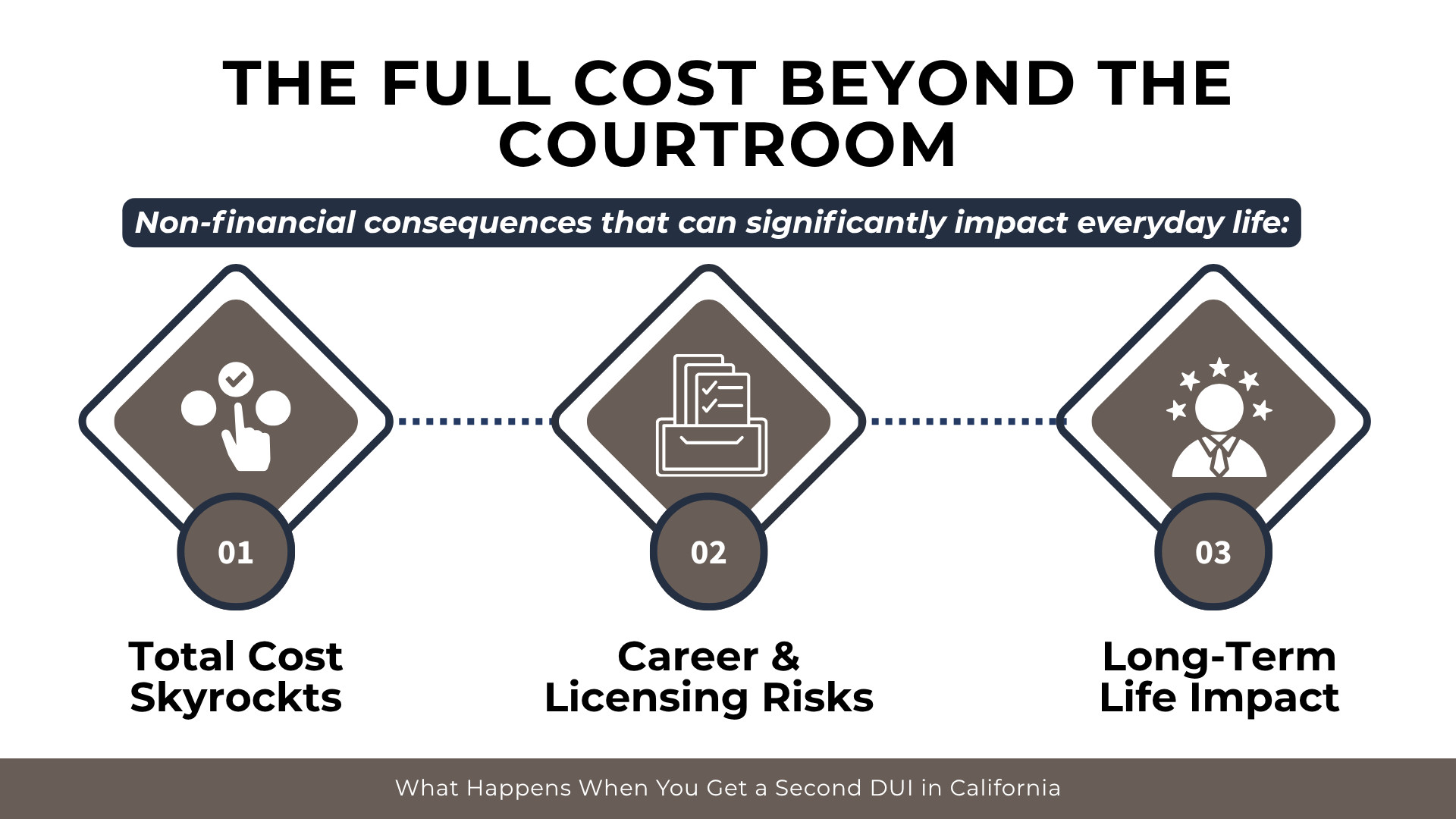
The financial impact of a second DUI extends far beyond the base fine. When you add up fines and penalty assessments, the 18- or 30-month DUI program fees, IID installation and monthly monitoring, SR-22 high-risk insurance (required for 3 years under § 13352.4), increased standard insurance premiums, attorney costs, and lost wages from court appearances and potential jail time, the total climbs well past what most people expect. A first-time DUI in California is estimated to cost approximately $13,500 when all direct and indirect expenses are accounted for. A second offense, with its longer programs, longer IID requirement, and more complex legal proceedings, will typically cost more.
Then there are the consequences that don’t carry a price tag but reshape daily life:
Commercial driver’s license (CDL) holders face a 1-year disqualification for a first DUI-related offense under federal regulations (49 C.F.R. § 383.51) and a lifetime disqualification for a second — effectively ending a trucking or commercial driving career.
Licensed professionals — physicians, attorneys, nurses, contractors, and others regulated by the California Department of Consumer Affairs — may have mandatory self-reporting obligations. Physicians must report a conviction within 30 days under Business & Professions Code § 802.1. Attorneys must report felony charges under § 6068(o). A second DUI conviction can trigger disciplinary review that a first offense might not have.
Immigration consequences depend on the specific facts. A simple DUI is generally not classified as a crime involving moral turpitude or an aggravated felony. But multiple DUI convictions can affect naturalization applications and may draw scrutiny in removal proceedings, particularly if there are aggravating factors.
What to Do in the Next 72 Hours
A second DUI requires faster, more deliberate decision-making than a first. Here are the immediate priorities:
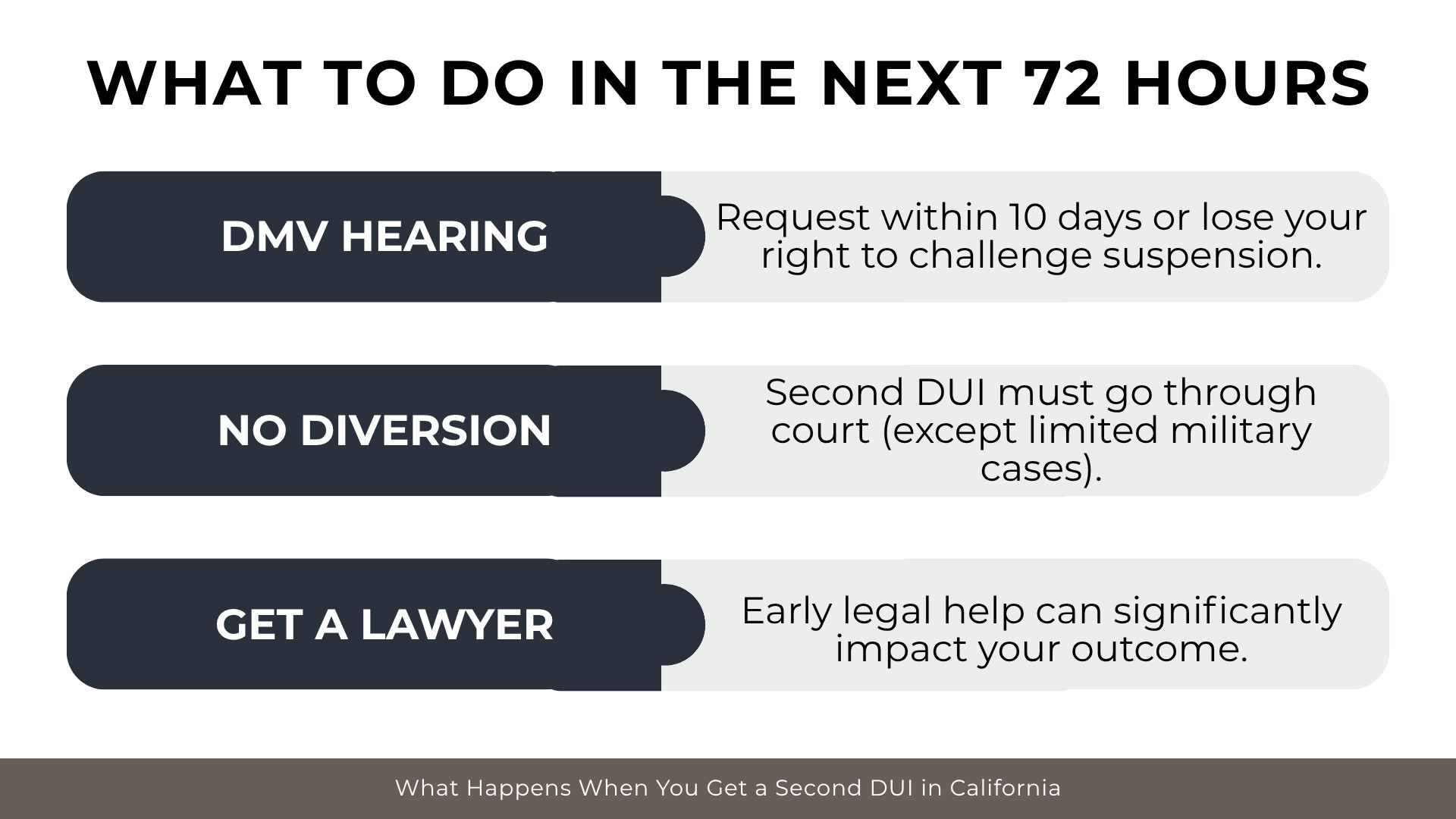
Request your DMV APS hearing before the 10-day deadline. This is non-negotiable. The deadline runs from the date on your temporary license/suspension notice, and missing it forfeits your right to contest the administrative suspension entirely.
Understand that diversion is not available. Unlike many other misdemeanor charges in California, DUI offenses are categorically excluded from judicial diversion programs. The court in Grassi v. Superior Court (2021) held that Vehicle Code § 23640 prohibits diversion for DUI despite the general authorization in Penal Code § 1001.95. This was confirmed in Tan v. Superior Court (2022). There is no procedural shortcut that makes this go away — it has to be resolved through the court process. The one exception is military diversion under Penal Code § 1001.80, which remains available for qualifying veterans and active-duty service members.
Consult with a DUI defense attorney who handles second-offense cases in your county. The county-level variation in conviction rates, the complexity of parallel DMV and criminal proceedings, the probation implications, and the enhanced penalties all point in the same direction: a second DUI is a case where the quality of legal representation has a measurable impact on the outcome.
If your arrest was in San Diego County, the Law Office of Angelo Reyes, APC in Carlsbad handles criminal defense and personal injury cases throughout San Diego County. Attorney Angelo J. Reyes is a courtroom advocate who prepares every matter for trial, admitted to the State Bar of California and the U.S. District Court for the Southern District of California, and recognized by the National Trial Lawyers as a Top 40 Under 40 attorney. That trial-preparation approach changes the dynamics of negotiation even in cases that ultimately resolve through plea.
A second DUI is serious. It is not, however, a foregone conclusion. The penalties are steep, but the prosecution still carries the burden of proving every element, and the legal framework contains meaningful procedural protections at every stage. The decisions you make in the next few days — especially requesting that DMV hearing and getting informed legal counsel — will shape how this plays out more than anything else.