

California drug sentences range from a simple misdemeanor with no jail time to decades in state prison. The difference comes down to three things: what substance is involved, what you’re accused of doing with it, and whether you have prior convictions. There is no single penalty for a “drug charge” in California. The state uses a step-by-step system where the specific combination of those three factors determines whether you’re looking at a fine, probation, county jail, or a state prison term with years of enhancements stacked on top.
This page breaks down how that system actually works. It covers the penalty ranges for possession versus sales charges, how the type of drug matters, how enhancements add time, whether your case would be served in county jail or state prison, and how a prior record shifts the entire calculation.
How Does California Decide What a Drug Charge Is Worth?
California classifies controlled substances through a five-schedule system under Health and Safety Code §§ 11054–11058, which largely mirrors the federal Controlled Substances Act. Schedule I includes substances like heroin, LSD, MDMA, and psilocybin. Schedule II includes cocaine, methamphetamine, oxycodone, and fentanyl. Schedules III through V cover less tightly controlled substances. Cannabis is carved out for adults 21 and older under Proposition 64, which permits possession of up to 28.5 grams of cannabis and 8 grams of concentrated cannabis.
But the schedule alone doesn’t set the sentence. California law separates drug conduct into separate offenses — simple possession, possession for sale, transportation or sale, and manufacturing — and each carries a different penalty range. The most important dividing line in the entire system is between simple possession and everything else. Proposition 47, which California voters passed in 2014, changed simple possession of a controlled substance from a felony to a misdemeanor. That single change is why most people facing a possession-only charge are not looking at prison time. Someone charged with possession for sale under the same circumstances could face years behind bars.
The third variable is criminal history. Prior convictions can restore felony exposure for charges that would otherwise be misdemeanors, trigger mandatory sentencing enhancements, and make you ineligible for diversion programs. In many cases, a prior record matters more to the sentencing outcome than the facts of the current offense.

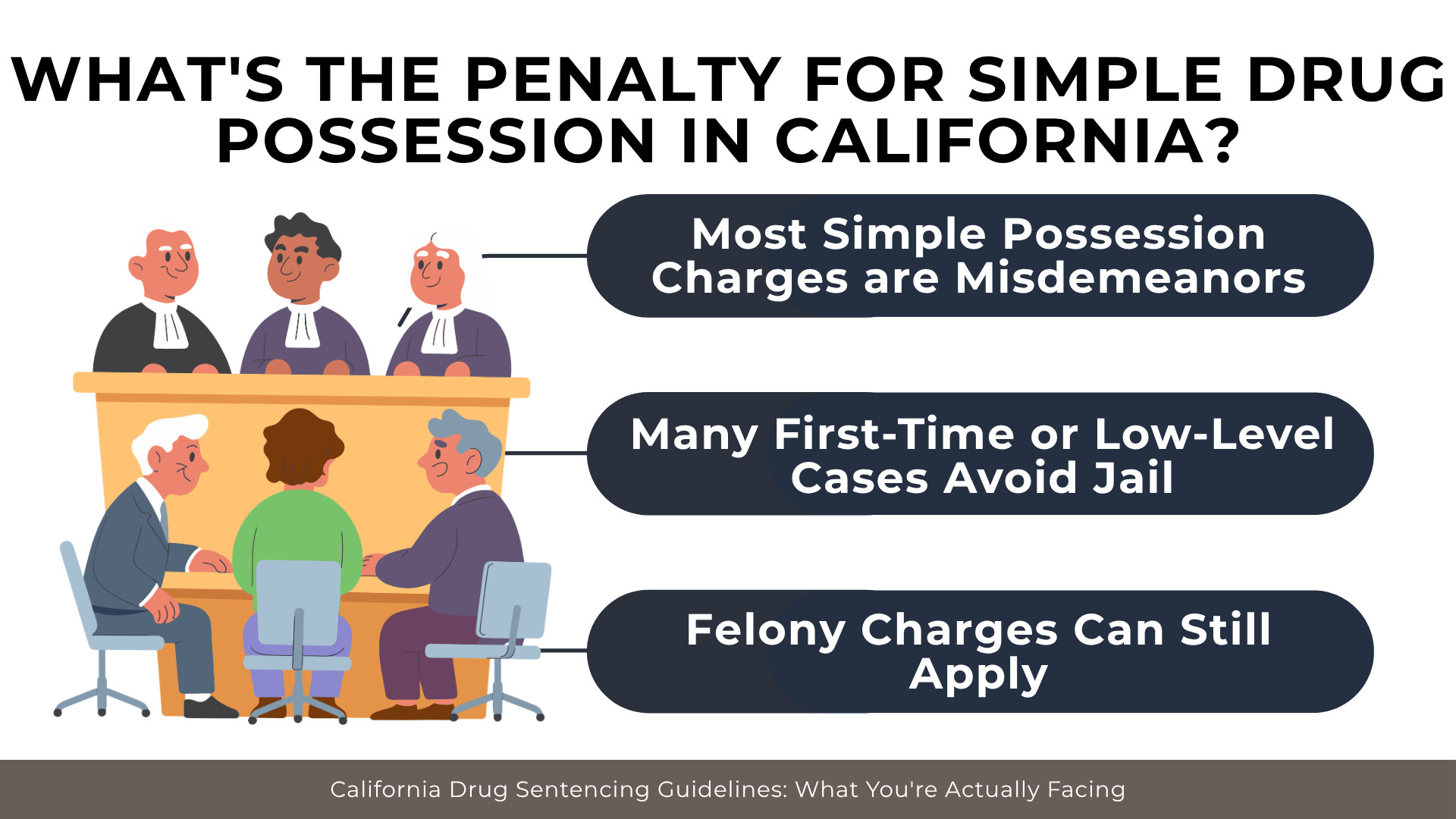
What’s the Penalty for Simple Drug Possession in California?
Under Health and Safety Code §11350 (narcotics) and §11377 (non-narcotic controlled substances like methamphetamine), simple possession is generally a misdemeanor — up to six months in county jail under Penal Code § 19 and a fine of up to $1,000. In practice, many simple possession cases end with probation, a diversion program, or a fine — no jail at all.
Felony exposure applies in limited circumstances. Prior “super-strike” convictions under Penal Code § 667(e)(2)(C)(iv) or sex-offender registration under Penal Code § 290(c) can elevate simple possession to a felony carrying 16 months, 2 years, or 3 years. The 2024 Proposition 36 created an additional felony pathway for repeat offenders, covered further below.
One important legal detail: conviction requires proof of a “usable quantity” — trace residue or amounts that cannot actually be consumed do not sustain a conviction under People v. Leal (1966) 64 Cal.2d 504.
What Happens If I’m Charged With Possession for Sale or Drug Trafficking?
This is where California drug sentencing gets significantly more serious. Possession for sale and transportation or sale charges are straight felonies that are not eligible for the diversion programs available to simple possession cases.
Health and Safety Code §11351 covers possession for sale of narcotics and certain other controlled substances, carrying a sentence of 2, 3, or 4 years. Section 11351.5 covers possession for sale of cocaine base with the same 2/3/4-year triad. Section 11378 covers possession for sale of non-narcotic controlled substances such as methamphetamine.
Transportation, sale, or furnishing of controlled substances under H&S §11352 carries 3, 4, or 5 years. If the prosecution proves transportation across two or more counties that don’t share a border, the range jumps to 3, 6, or 9 years.
Prosecutors don’t need to catch someone mid-transaction to file a sales charge. There is no statutory weight threshold that automatically triggers a possession-for-sale charge. The prosecution must prove specific intent to sell beyond a reasonable doubt, and they do so through circumstantial “indicia of sale” — quantity, packaging, scales, cash, and similar indicators — often supported by narcotics-expert testimony under People v. Parra (1999). This distinction is one of the most critical judgment calls in California drug cases, and it is frequently where defense work makes the greatest difference.

Does the Type of Drug Change My Sentence?
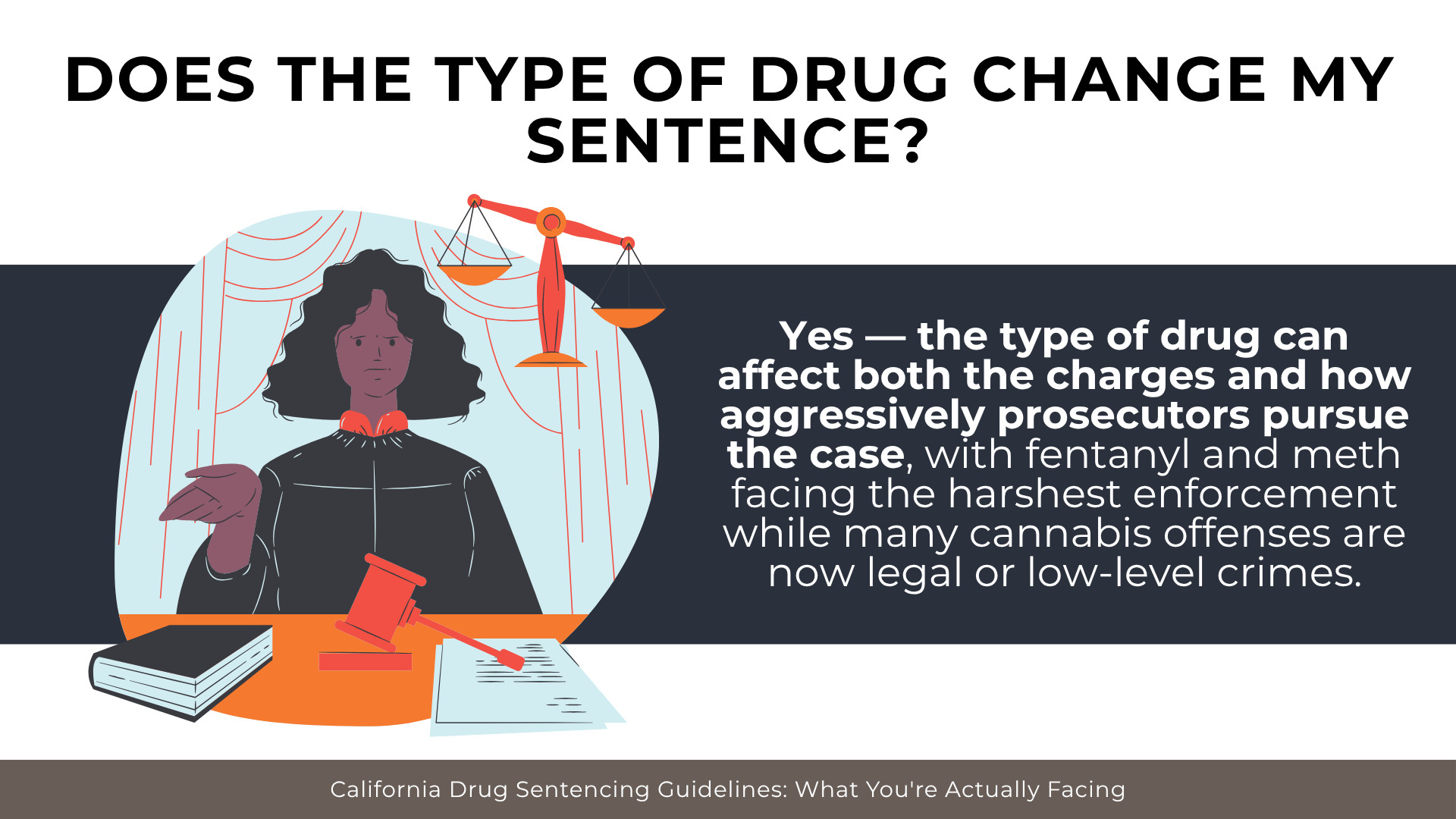
Yes, both in the statute that applies and in how aggressively the case is likely to be prosecuted. California’s controlled substance schedules assign different offenses to different code sections. Certain substances carry more aggressive enforcement that affects real-world outcomes even when the statutory range is the same on paper.
Fentanyl and methamphetamine dominate current enforcement priorities. Fentanyl was involved in 63% of all California overdose fatalities in 2023 — 7,137 deaths — and California DOJ has seized approximately 15.6 million fentanyl pills and 6,875 pounds of fentanyl powder between April 2022 and May 2025. That enforcement intensity translates directly into sentencing exposure. The 2024 Proposition 36 added fentanyl to the firearm-enhancement list alongside cocaine, heroin, and methamphetamine.
Cannabis stands in stark contrast. Under Proposition 64 and Health and Safety Code § 11362.1, adult possession of up to 28.5 grams of cannabis and 8 grams of concentrated cannabis is not a criminal matter. Felony marijuana arrests have fallen to just 440 statewide in 2024. Over-limit possession, unlicensed sales, and minor possession remain criminal under H&S §§ 11357–11360, but the volume of marijuana prosecutions has collapsed.
For everything between those extremes — cocaine, heroin, oxycodone, MDMA, prescription drugs possessed without a valid prescription — the sentencing range depends on what you’re accused of doing (possession versus sale) and follows the statutory triads described above.
What Are Sentencing Enhancements and How Much Time Do They Add?
Sentencing enhancements are additional prison terms stacked on top of the base sentence — they run as full, separate, consecutive terms. Two enhancement statutes apply specifically to drug cases and can dramatically increase the total time you face.
Health and Safety Code § 11370.2 imposes a three-year prior felony conviction enhancement.
Health and Safety Code § 11370.4 adds weight-based enhancements ranging from 3 to 25 years for trafficking quantities that meet specified thresholds — for example, 1 kilogram or more of heroin or cocaine. These enhancements are what transform mid-range felony drug cases into sentences that rival violent-crime terms.
These enhancements don’t replace the underlying sentence. They are added to it. If you’re convicted of transportation under §11352 (base term of 3, 4, or 5 years) and also face an applicable enhancement, your combined sentence could reach well into double digits.
Whether enhancements are actually imposed, however, involves judicial discretion and defense advocacy. Courts have the authority to strike or dismiss enhancements in the interests of justice, and this is one of the areas where effective defense representation can change the math of a sentence.

Will I Go to State Prison or County Jail?
For most drug felonies, the answer is county jail — not state prison. Under AB 109 realignment, which took effect in 2011, non-violent, non-serious, non-sexual drug felonies are served in county jail under Penal Code § 1170(h) rather than in CDCR state prison. This includes the standard felony drug offenses like possession for sale under §11351 and §11378, unless you have a prior serious or violent felony conviction or a specified enhancement that requires a state prison commitment.
The practical impact of realignment is visible in the numbers. Only about 3% of California’s state prison population in 2025 was imprisoned for drug crimes, and just 19.7% of drug-offense felony convictions in 2023 resulted in time in a state facility. The most common sentence for a California felony conviction — drug or otherwise — is probation with jail, not a prison term.
That doesn’t mean jail time is trivial. County jail sentences on felony drug convictions can run multiple years under the same triad structure. Conditions and programming vary significantly by county. But the distinction matters: county jail generally means local custody with the possibility of split sentences (a portion of time served followed by mandatory supervision). That’s a very different path than a state prison commitment.

How Does a Prior Record Affect My Drug Sentencing?
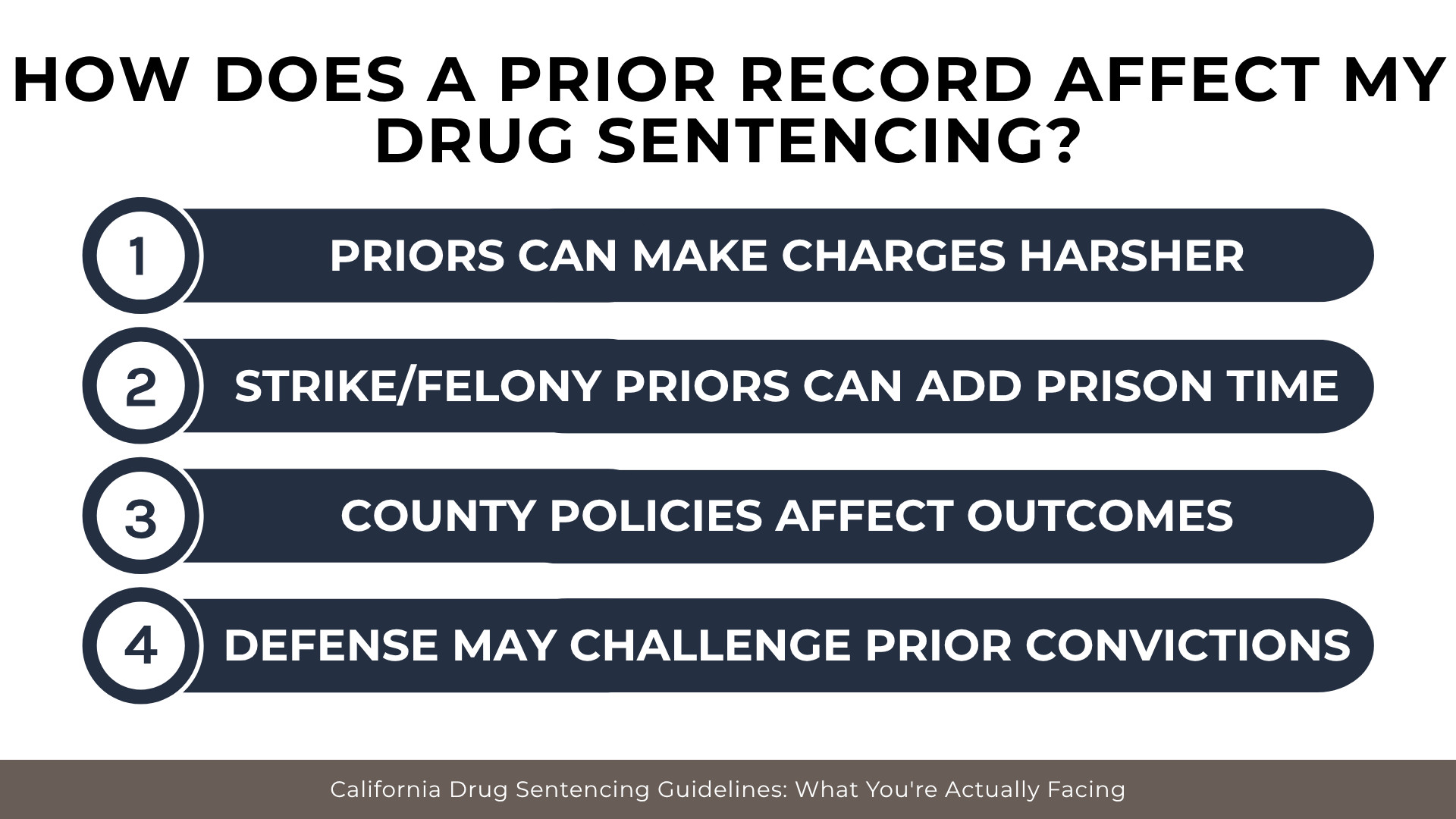
Criminal history is often the single variable that moves a case from one tier of the sentencing system to an entirely different one.
At the lowest level, two or more prior drug-related convictions now expose you to the treatment-mandated felony under the 2024 Prop 36. That means simple possession — otherwise a misdemeanor — can be charged as a felony. Implementation varies dramatically by county: in San Diego, Orange, and smaller counties, over 80% of Prop 36 felony filings are drug-related, while in Alameda, Sacramento, and Contra Costa, fewer than 20% are drug-related. Where the case is filed can matter as much as what the charge is.
Prior “super-strike” convictions under Penal Code § 667(e)(2)(C)(iv) restore felony exposure for offenses that Prop 47 otherwise made misdemeanors. Prior felony drug convictions trigger the three-year enhancement under H&S § 11370.2. And under California’s Three Strikes law, prior strike convictions can significantly increase the sentence on a new drug felony. However, in People v. Vargas (2014), the California Supreme Court held that the trial court was required to dismiss a prior strike where failure to do so would be inconsistent with the spirit of the Three Strikes law.
The combined result is that two people arrested under identical circumstances with identical quantities of the same substance can face wildly different sentencing exposure depending on what’s in their criminal history. If you have a prior record, the defense strategy often focuses as much on the priors — challenging their validity, arguing for their dismissal, or negotiating around them — as on the current charge itself.
What Should I Do Now?
The breakdown above gives you the structure of California drug sentencing — the penalty ranges, how enhancements add time, where a sentence is served, and how prior convictions shift the entire calculation. But the facts of a specific case — the substance, the quantity, the circumstances of the arrest, the defendant’s history, and the county where the case is filed — determine where within that system a case actually lands.
If you or someone you care about is facing a drug charge in California, a consultation with a defense attorney who handles these cases regularly is a direct way to understand your actual sentencing exposure. Contact Angelo Reyes Law in Carlsbad, California for a case evaluation.
