A false accusation of domestic violence does not automatically become a conviction. California law requires the prosecution to prove every element of a DV charge beyond a reasonable doubt. When an accusation is false, those elements often do not hold up under close examination. But the gap between accusation and resolution is where the damage happens if the right steps are not taken early.
This page covers what to do if you have been falsely accused, why false accusations happen, and how a criminal defense attorney builds a defense against one.
Does California Assume You’re Guilty When Someone Accuses You of Domestic Violence?
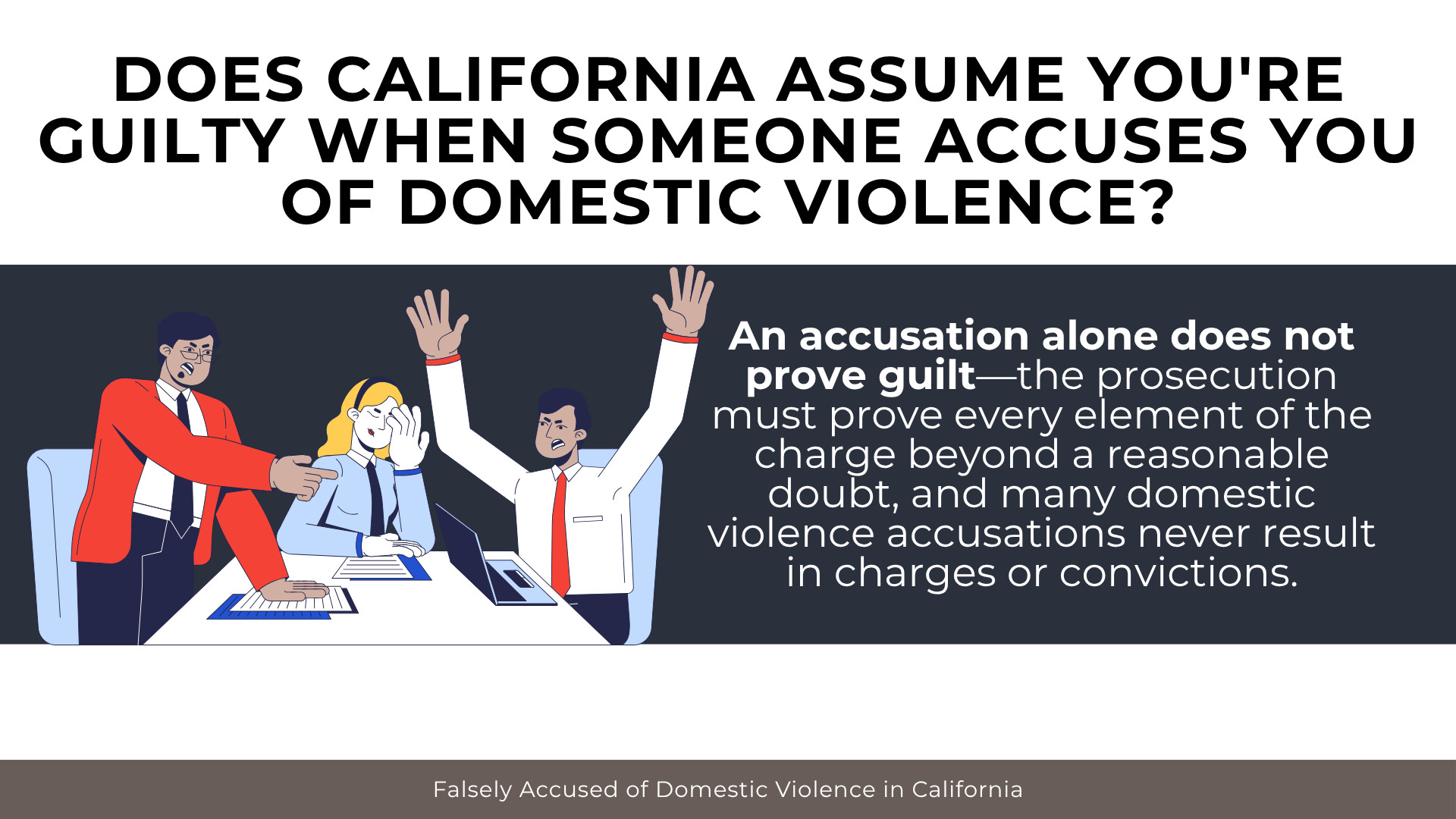
No. An accusation triggers a process — it does not determine an outcome. The prosecution carries the full burden of proving guilt beyond a reasonable doubt, and that burden applies to every element of the charge.
That matters because not every accusation leads to charges in the first place. When a first-responding officer conducts only a basic DV investigation, prosecutors do not file criminal charges approximately 70% of the time. A review of 135 studies found that approximately one-third of reported intimate partner violence offenses result in prosecution. These are not numbers that describe a system where an accusation alone is enough.
But the fact that many cases do not result in charges is not a reason to wait and hope. It is a reason to understand what the prosecution needs to prove — and where a false accusation falls short.
What Should You Do Right Now If You’ve Been Falsely Accused?
The earliest decisions in a DV case often have the most impact on how it ends. Several of them are not obvious, which makes them worth spelling out.
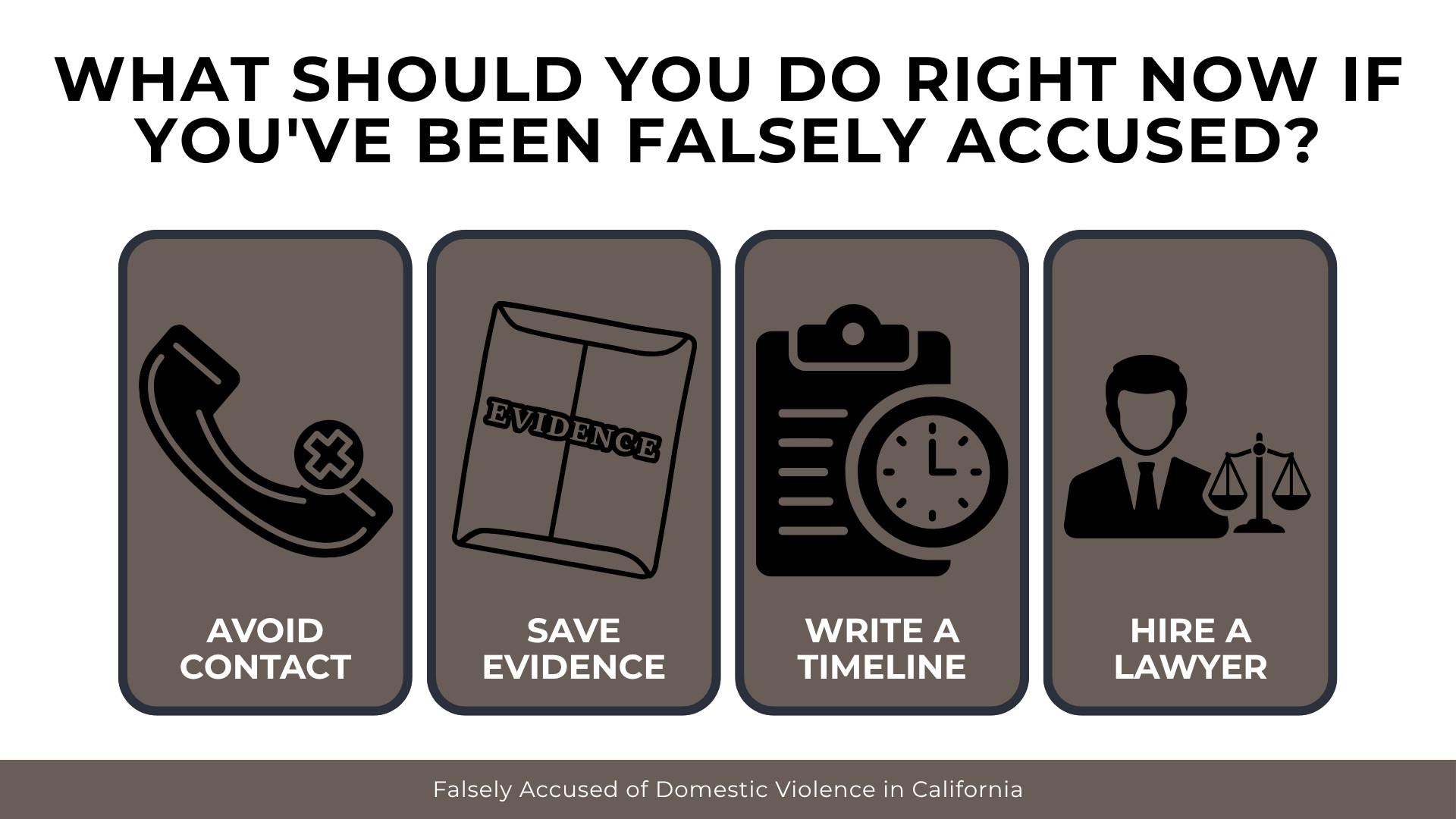
Do not contact the accuser. Even if no protective order has been issued yet, any contact — a text, a voicemail, showing up to talk — can be used against you. If a protective order is already in place, violating it is a separate criminal offense under Penal Code § 273.6. The penalty is up to one year in county jail and a fine of up to $1,000. A violation involving physical injury carries a mandatory minimum of 30 days. You do not want to face two charges when you are trying to fight one.
Preserve everything. Text messages, voicemails, emails, social media posts, photos, surveillance footage, receipts that show where you were — all of it. Digital evidence disappears. Accounts get deleted. Screenshots taken today may not be available next month. If there are witnesses who saw what happened — or who can speak to the accuser’s statements or behavior before or after the alleged incident — write down their names and contact information now.
Write down your timeline while memory is fresh. What happened, when it happened, where, who was present, and what was said — all in as much detail as possible.
Contact a criminal defense attorney before making any statements. What you say to police, to friends, or on social media can become evidence. A defense attorney can advise you on what to say, what not to say, and how to protect your position from the start.
Why Do False Domestic Violence Accusations Happen?
Defense attorneys who handle DV cases see false accusations arise in recurring patterns. Understanding those patterns is not about generalizing. It is about recognizing when the facts of a case fit a context that a defense attorney has seen before and knows how to investigate.
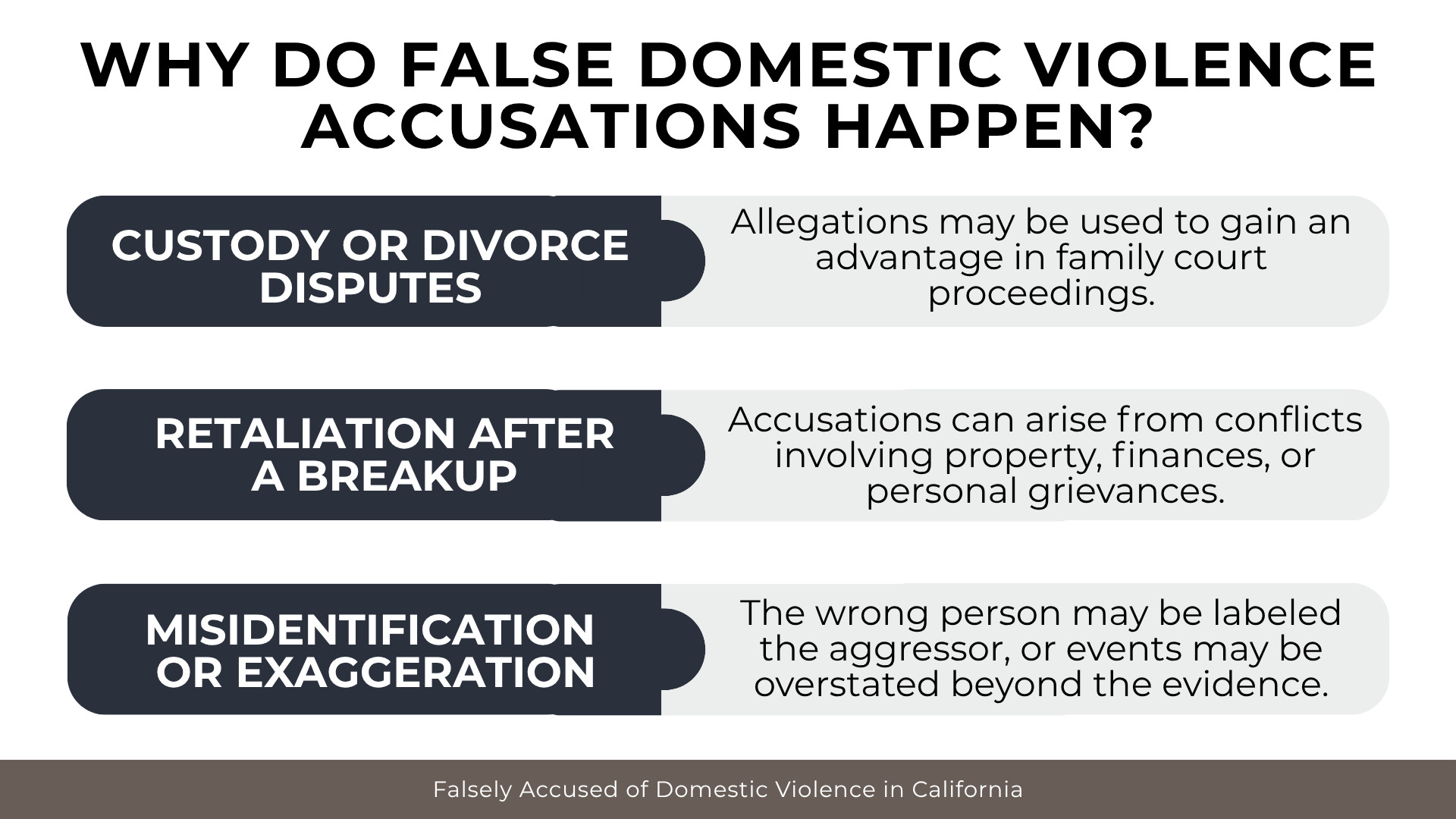
Custody and divorce proceedings are one of the most common contexts. A domestic violence finding triggers a rebuttable presumption under Cal. Family Code § 3044 that sole or joint custody is harmful to the child’s best interest. That presumption lasts five years. It can only be overcome if the court makes specific written findings or statements on the record on each statutory rebuttal factor. In contested custody disputes, a DV accusation can shift the entire proceeding. That shift creates an incentive that has nothing to do with whether the accusation is true.
Retaliation after a breakup is another. Accusations sometimes follow the end of a relationship, where one party uses the criminal justice system to gain leverage in disputes over property, housing, or shared finances.
Mutual confrontations where the wrong person is identified as the aggressor account for a significant share of false accusation cases. When police respond to a DV call, they must identify a primary aggressor. That decision is made quickly, often based on who called first, who appears more injured, or who is more visibly upset. It is not always correct. If you were defending yourself, you can still end up arrested and charged.
Exaggerated accounts also drive false accusations. A real incident may have occurred — a verbal argument, a door slammed. But the accuser’s description of what happened goes beyond what the evidence supports, turning a conflict into an allegation of physical violence.
None of these patterns are rare, and none of them are invisible to a defense attorney who knows what to look for.
How Does a Defense Attorney Fight a False Domestic Violence Accusation?
A defense against a false accusation is built on evidence, not on simply saying that it did not happen. The specific strategies depend on the facts of the case, but they typically involve several lines of investigation.
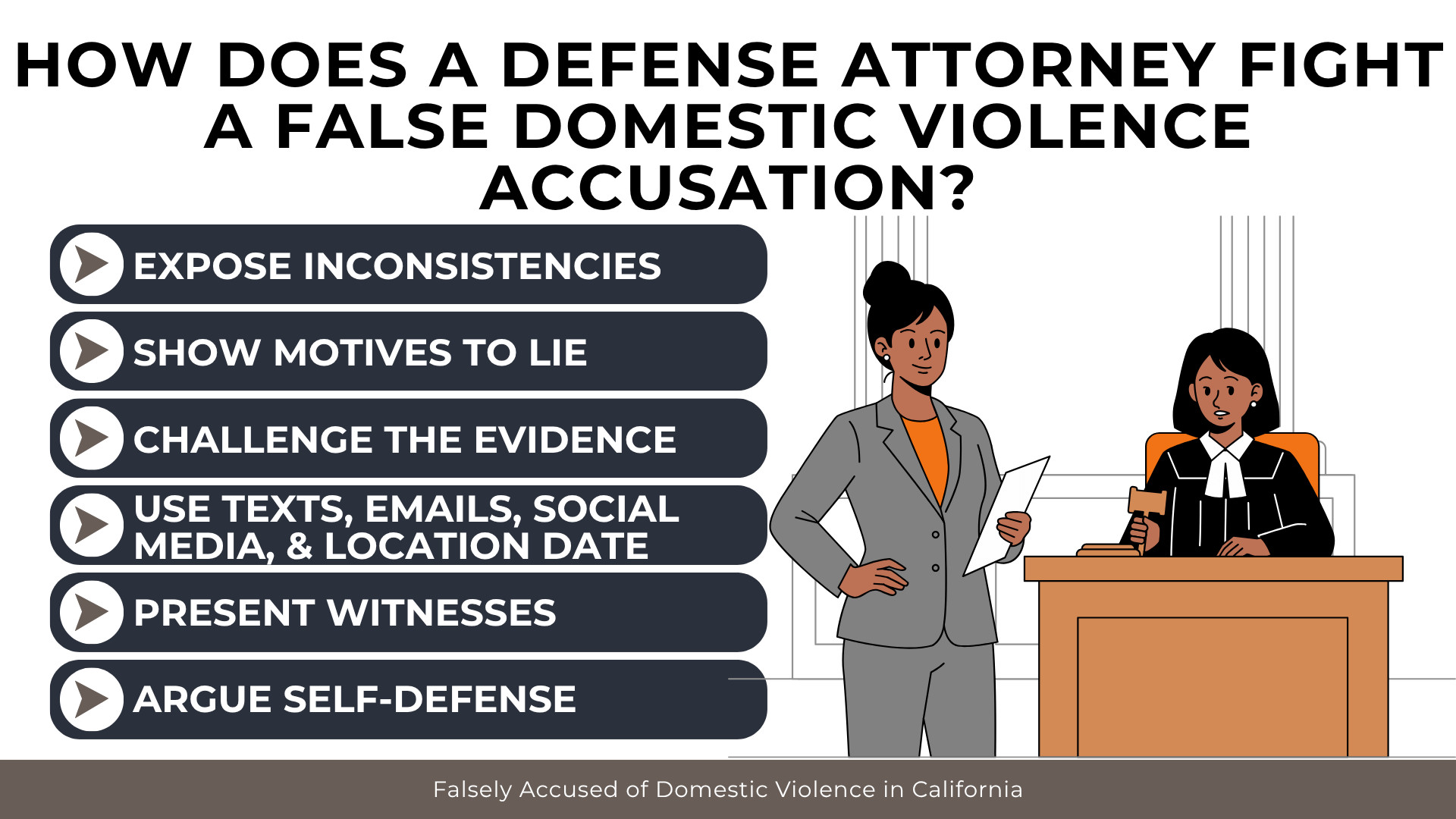
Inconsistencies in the accuser’s account. The 911 call, the initial police report, any written statements, and later testimony often contain differences when an accusation is false. What the accuser told the 911 operator may differ from what they told the responding officer, which may differ from what they later described in a protective order petition. A defense attorney identifies and documents those gaps.
Does the accuser have a reason to lie? If the accusation coincides with a custody dispute, a divorce filing, a breakup, or a financial conflict, that timing is relevant. Evidence of motive does not prove an accusation is false on its own — but it gives a jury context for weighing credibility.
Physical evidence — or the lack of it. False accusations often involve claims of injury that are not supported by medical records, photographs, or the observations of the responding officer. Where the traumatic-condition element under Penal Code § 273.5 is at issue, the lack of supporting physical evidence is significant. People v. Abrego established that pain alone is not enough — there must be evidence of an actual injury, however minor.
What can texts, emails, and social media prove? Text messages, emails, and social media posts from before and after the alleged incident can establish the accuser’s state of mind, contradict their account, or show a pattern of threats or manipulation. Location data can establish where you actually were.
Who can support your version of events? People who were present during or immediately after the alleged incident — or who can speak to the accuser’s statements, behavior, or motive — can provide testimony that weakens the accusation.
Body camera and surveillance footage. Officers responding to DV calls typically wear body cameras. That footage captures the scene, the statements of both parties, and the physical condition of everyone present. Surveillance cameras from residences, businesses, or doorbell systems may capture the incident itself or contradict the accuser’s timeline.
Self-defense and primary aggressor arguments. Where you were actually the victim or were defending yourself, California law provides specific tools. Expert testimony on intimate partner battering and its effects is admissible under Cal. Evidence Code § 1107. It can be used to explain the nature and effect of physical, emotional, or mental abuse on the beliefs, perceptions, and behavior of domestic violence victims. The California Supreme Court held in People v. Humphrey that this testimony is relevant to both the subjective existence and the objective reasonableness of a claimed need for self-defense.
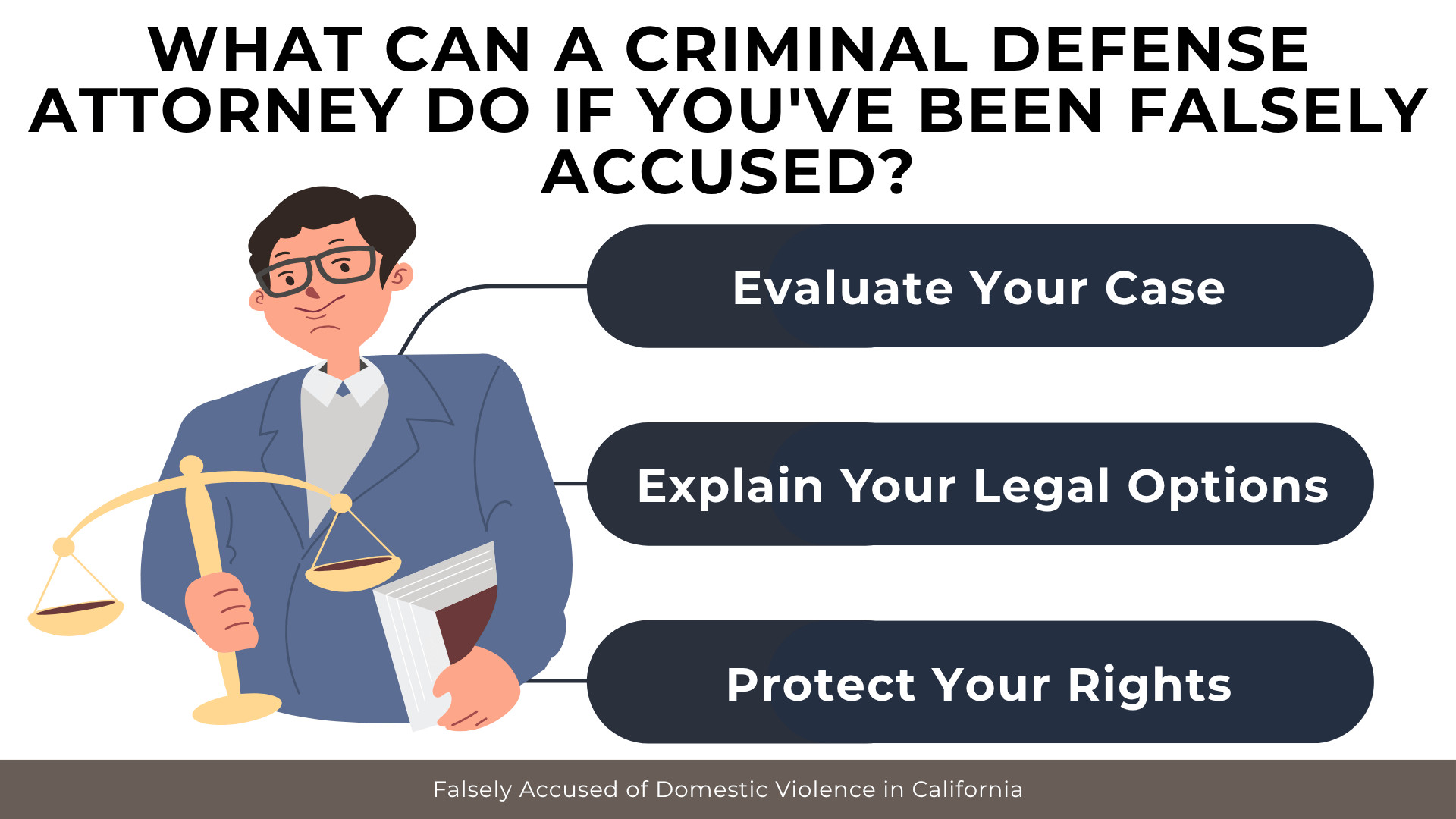
What Can a Criminal Defense Attorney Do If You’ve Been Falsely Accused?
At Angelo Reyes Law in Carlsbad, a false accusation defense starts with the facts of your case: what you have been accused of, what evidence exists, what the accuser’s account contains, and whether that account holds up.
A consultation is not about judgment. It is about getting a clear picture of where things stand and what can be done — before the case moves further. If you are facing a false accusation of domestic violence in California, contact Angelo Reyes Law to schedule a consultation.