
A domestic violence conviction in California stays on your criminal record permanently. There is no expiration date, no automatic drop-off period, and no number of years after which the record clears itself. That is true whether the conviction was for misdemeanor domestic battery under Penal Code § 243(e)(1) or misdemeanor or felony corporal injury to a spouse or cohabitant under Penal Code § 273.5. Either way, the conviction remains part of your criminal history unless you take specific legal steps to remove it.
Permanent by default, however, is not the same as permanent no matter what. California law provides a path to expungement under Penal Code § 1203.4. But expungement has real limits — certain consequences of a DV conviction survive it entirely. This page covers what stays on your record, what can be removed, and where the hard boundaries are.
Can You Get a Domestic Violence Conviction Expunged in California?
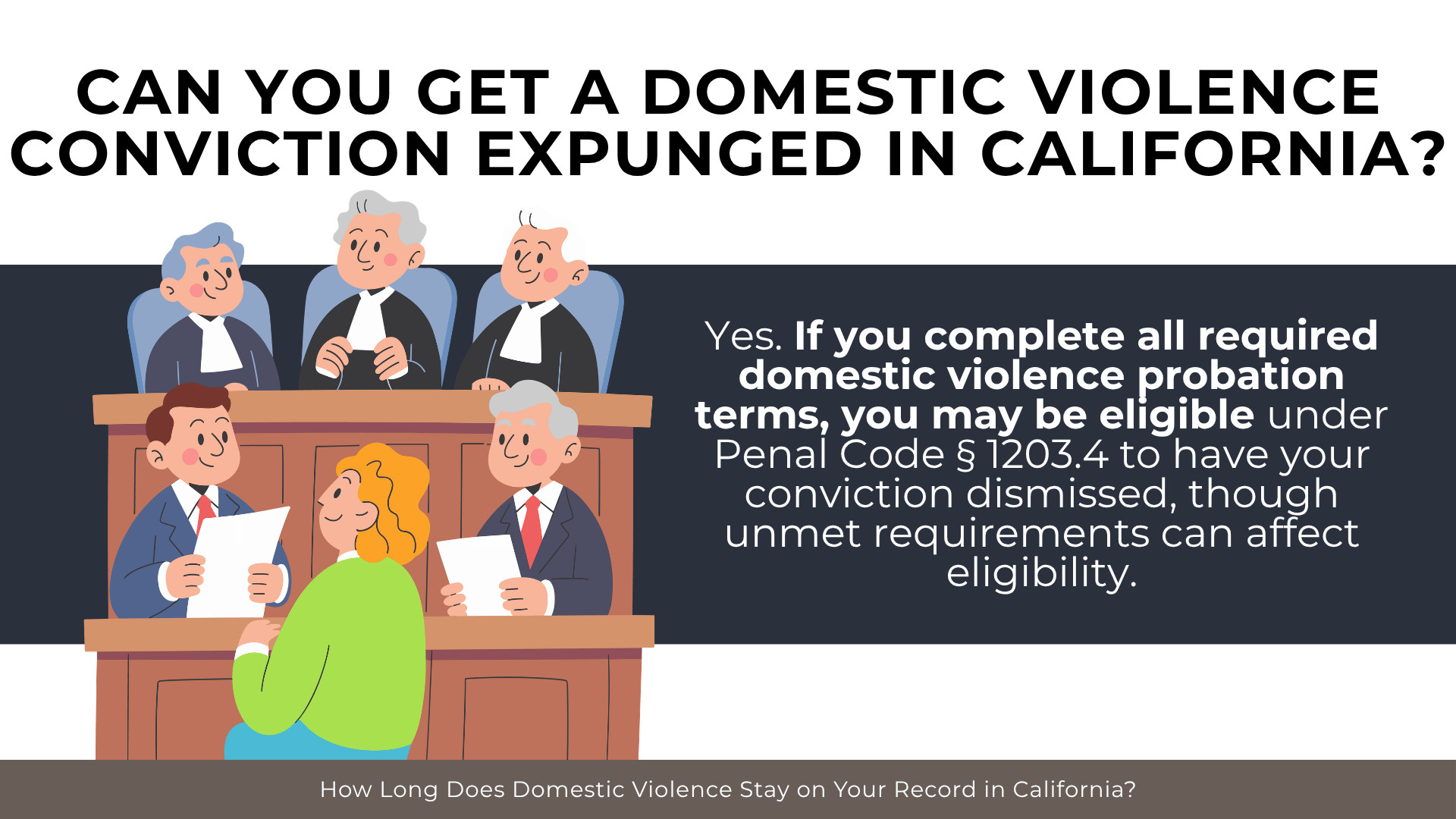
Yes. Penal Code § 1203.4 allows you to petition the court to withdraw your guilty or no-contest plea — or to set aside a guilty verdict after trial — and have the case dismissed.
Penal Code § 1203.097 requires specific probation conditions for DV offenses — including the full probation term, the batterer intervention program, the minimum $500 fine to domestic violence programs, restitution, community service, and a criminal protective order. Whether you completed all of those conditions is central to any expungement analysis under Penal Code § 1203.4.
That probation completion requirement is worth pausing on. A California State Auditor audit of six counties found that 46 out of 100 DV offenders did not complete the mandated batterer intervention program — ten never enrolled, seven were terminated by the program, twenty-one dropped out, and eight had the court eliminate the requirement. Courts imposed consequences for only 71 out of 756 known violations. Incomplete probation conditions can complicate an expungement petition, so checking where you stand on every requirement is a necessary first step.
What Does Expungement Actually Remove — and What Doesn’t It Fix?
This is where the gap between expectations and reality tends to be widest.
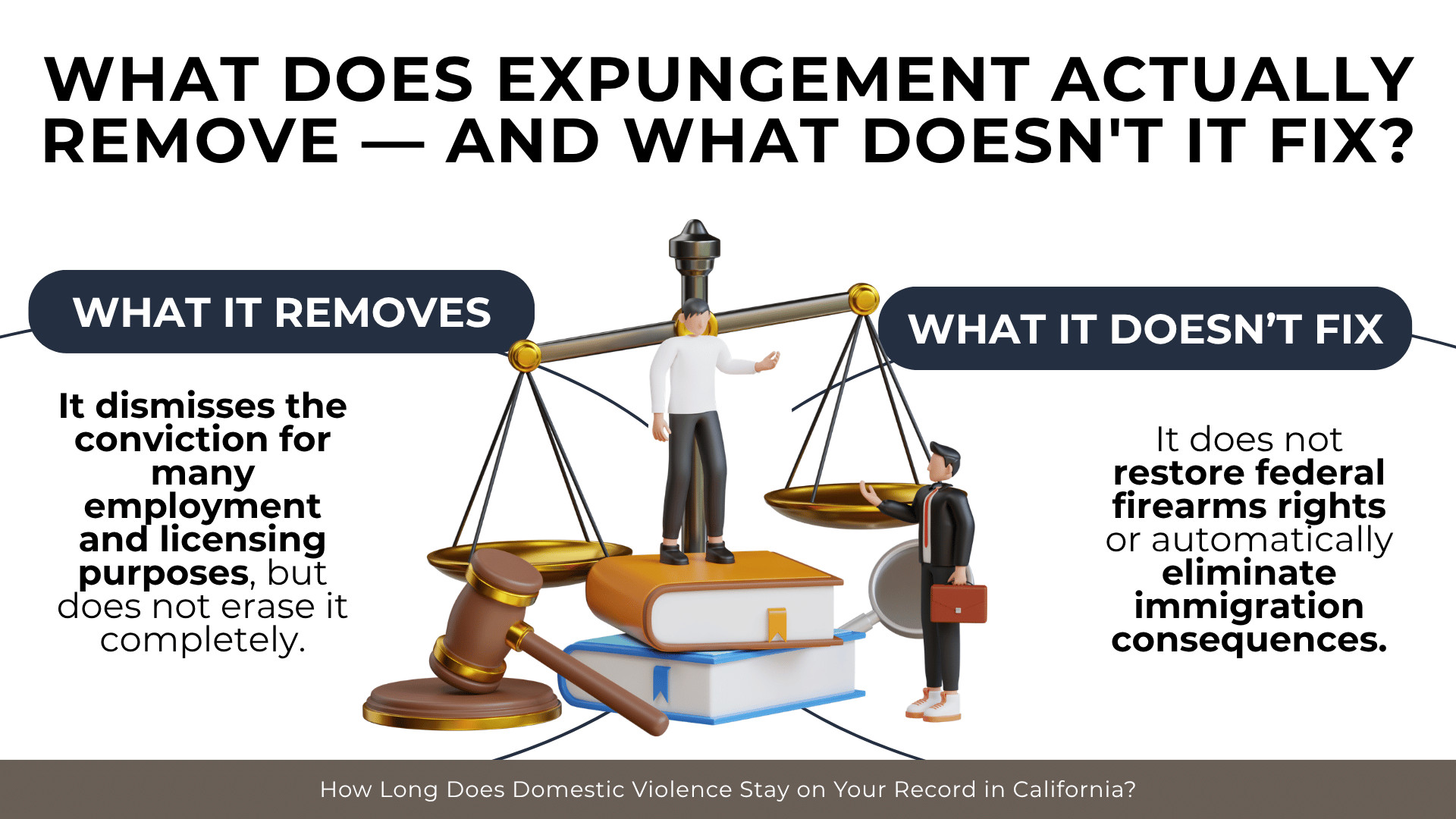
Expungement under Penal Code § 1203.4 leads to the withdrawal of your plea and a dismissal of the case. But § 1203.4 has a hard limit that no amount of time will change: it explicitly does not restore firearms rights. That makes the federal firearms prohibition under the Lautenberg Amendment — 18 U.S.C. § 922(g)(9) — effectively permanent after a California DV conviction. The Lautenberg Amendment does contain an exception for convictions that have been “expunged or set aside,” but only where the expungement restores the person’s firearms rights. Because California’s statute does not do that, the federal exception does not apply. The prohibition on possessing firearms or ammunition stays in place for life after a California expungement.
The paths to actually restoring federal firearms rights are narrow. The research available identifies a full and unconditional governor’s or presidential pardon, administrative relief from ATF, and in limited cases, court-based relief under a specific state program. None of these are routine or guaranteed.
For noncitizens, the consequences may be equally lasting. A domestic violence conviction triggers deportability under INA § 237(a)(2)(E)(i). If the offense also qualifies as a “crime of violence” carrying a sentence of one year or more, it may qualify as an aggravated felony under INA § 101(a)(43)(F). That triggers mandatory removal and a permanent bar to most types of immigration relief. California expungement does not necessarily resolve these consequences. Pretrial diversion programs that avoid a formal conviction altogether may prevent both the firearms disability and deportability. But diversion is a pre-conviction option, not a post-conviction one.
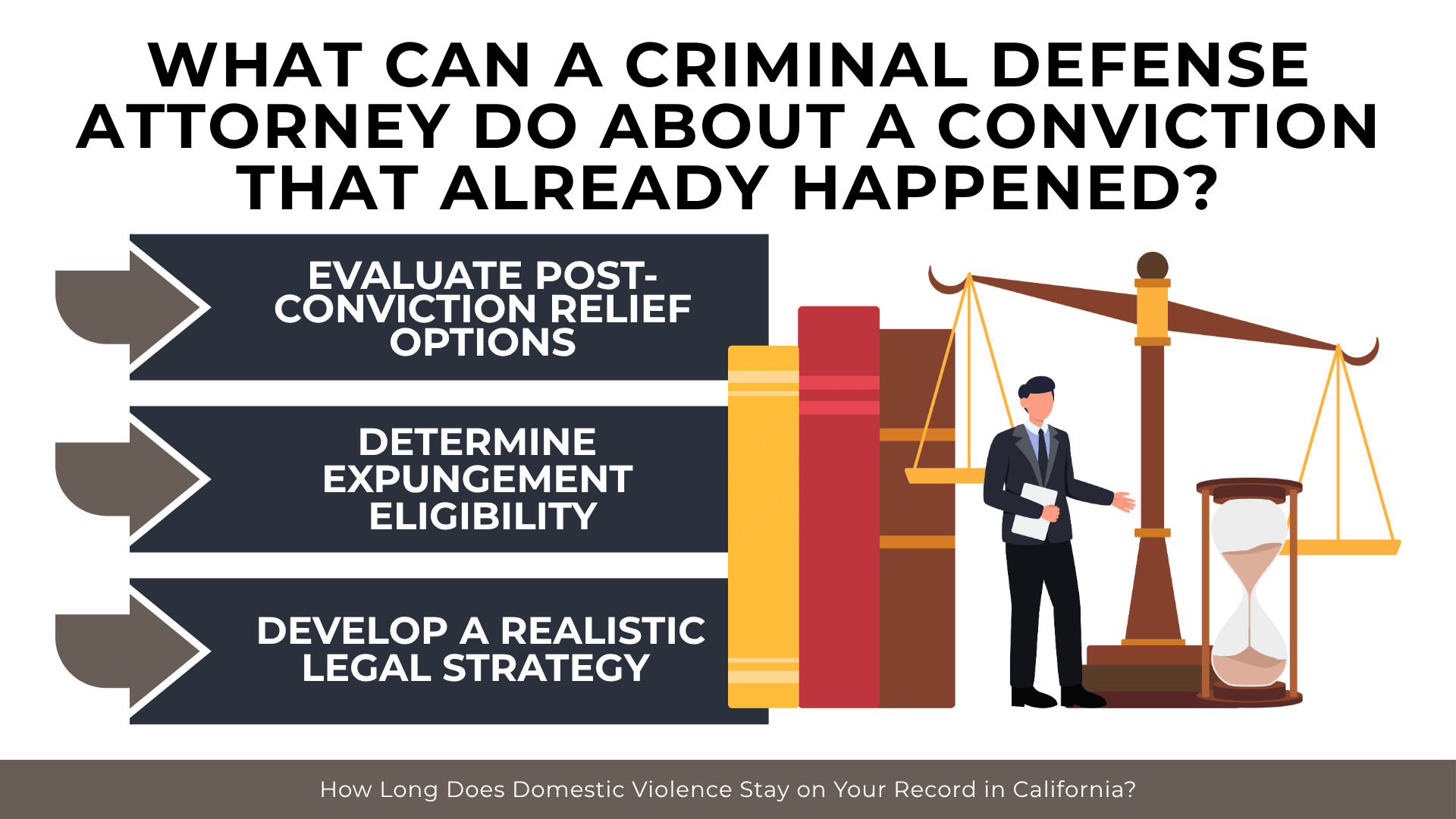
What Can a Criminal Defense Attorney Do About a Conviction That Already Happened?
Post-conviction relief is its own practice area. The same criminal defense attorneys who handle domestic violence cases at trial also evaluate and pursue the legal options available after a conviction. Those options are often more substantial than you might assume when you first start searching.
At Angelo Reyes Law in Carlsbad, a post-conviction evaluation starts with the specifics of the case: what the conviction was for, whether it was charged as a misdemeanor or felony, whether probation has been fully completed, whether every mandatory condition under Penal Code § 1203.097 — including the batterer intervention program — was satisfied, and which collateral consequences are currently creating problems. The analysis includes expungement eligibility under Penal Code § 1203.4 and a realistic assessment of what expungement will and will not resolve — including the federal firearms disability that survives it.
A consultation is not about promises. It is about getting a clear picture of where things stand and what moves are actually available under the law. A domestic violence conviction does not have to define the rest of your record. But finding out what can be done requires someone who handles these cases, knows where the lines are, and can assess your situation directly. If you have questions about expungement or post-conviction relief for a domestic violence conviction in California, contact Angelo Reyes Law to schedule a consultation.