

California legalized recreational marijuana for adults in 2016. But possession can still lead to an infraction, a misdemeanor, or a felony depending on how much you have, how old you are, and where you are when police make contact. The line between legal and criminal is more specific than most people realize, and crossing it — sometimes without knowing — is what leads to charges.
This page breaks down exactly what California law permits, what it punishes, and what your options are if you’re facing a marijuana possession charge right now.
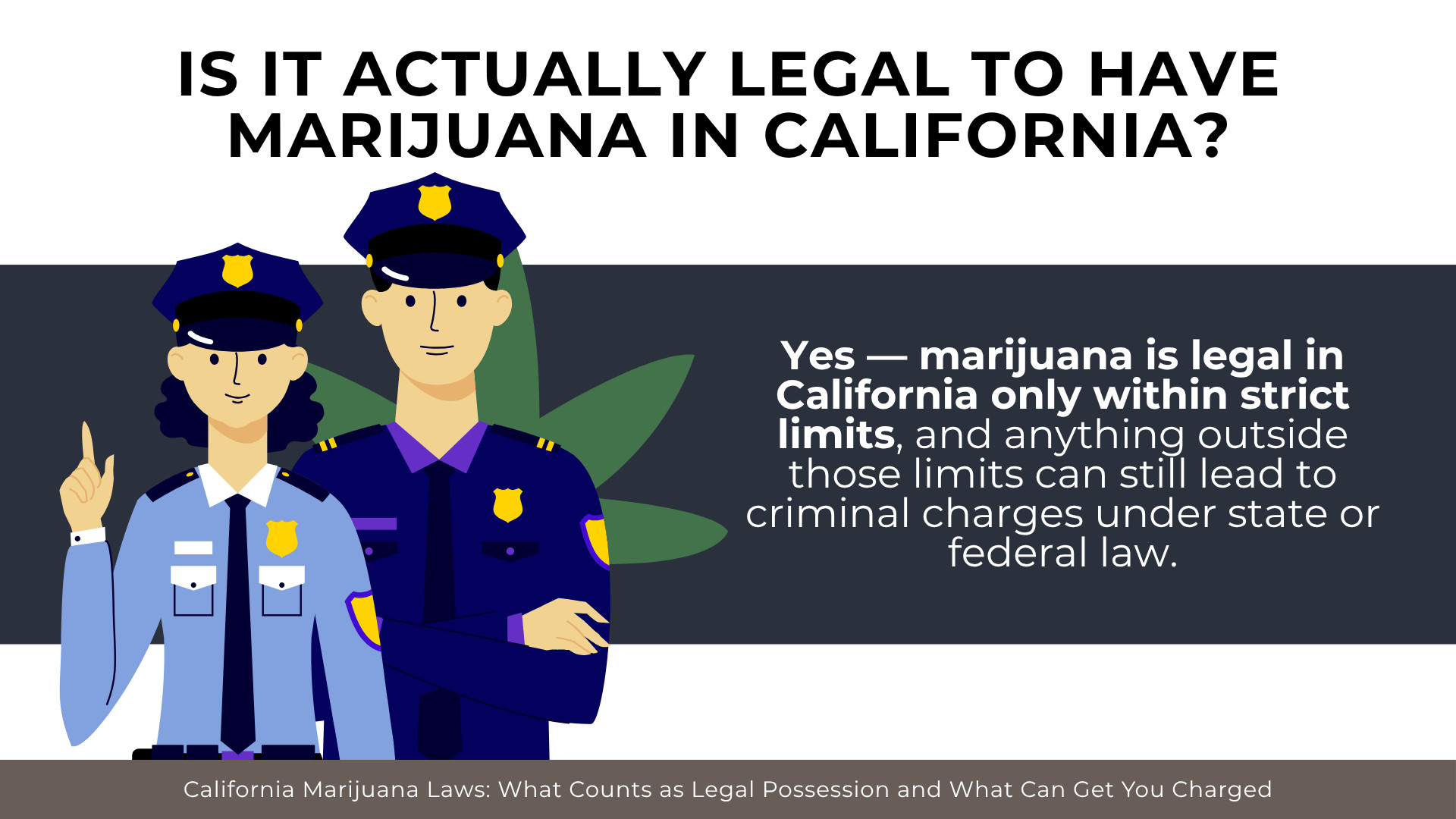
Is It Actually Legal to Have Marijuana in California?
Yes — with conditions. Proposition 64, the Adult Use of Marijuana Act, passed on November 8, 2016 and is found mainly in California Health and Safety Code § 11362.1. Under that statute, adults 21 and older may legally possess, process, transport, purchase, obtain, or give away to other adults 21 and older up to 28.5 grams of cannabis (not in concentrated form) and up to 8 grams of concentrated cannabis, including as contained in cannabis products.
That is the full scope of what Prop 64 protects. Everything outside those limits — more than those amounts, younger than that age, or in a prohibited location — remains a criminal matter under California law. And cannabis remains a federal Schedule I controlled substance regardless of what California permits. The federal Controlled Substances Act’s authority over even in-state marijuana possession and cultivation was upheld by the U.S. Supreme Court in Gonzales v. Raich, 545 U.S. 1 (2005), which held that Congress can prohibit local cultivation and use of marijuana under its commerce power.
So the short answer is that marijuana is legal in California within a very specific box. The charges people face almost always come from being outside that box in ways they didn’t expect.
How Much Marijuana Can I Legally Have Before It Becomes a Crime?
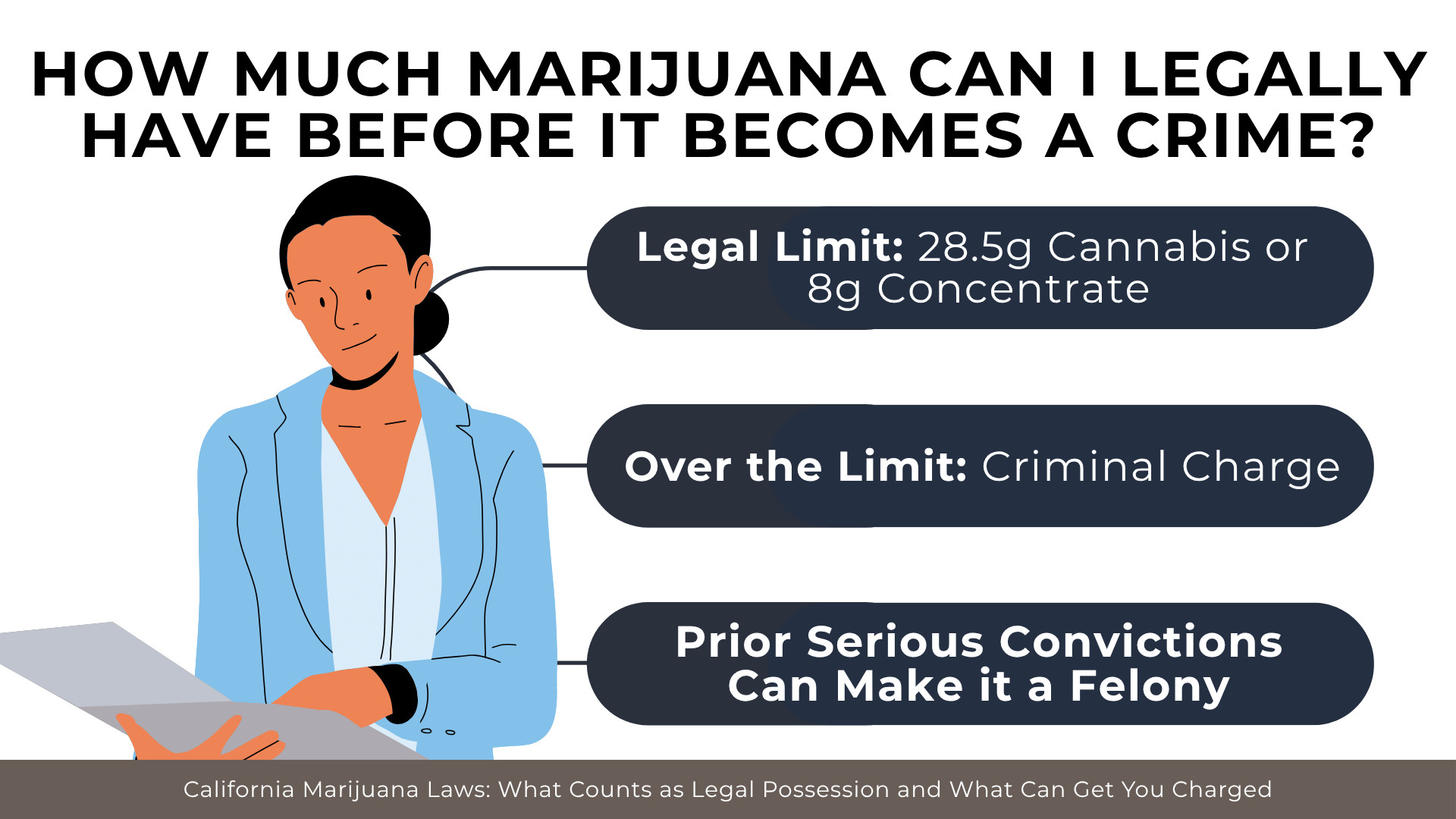
The thresholds are precise. Under Health and Safety Code § 11362.1, an adult 21 or older may possess up to 28.5 grams of cannabis flower and up to 8 grams of concentrated cannabis. Beyond those amounts, you move into criminal territory.
What people don’t always grasp is how the severity escalates. Possession over the legal limit by an adult can be charged as an infraction or misdemeanor depending on the amount and circumstances, with penalties under Health and Safety Code § 11357. For most adults, over-the-limit possession is a misdemeanor — up to six months in county jail under Penal Code § 19 and/or a fine of up to $1,000 — following Proposition 47’s reclassification. Felony exposure under current law applies only to defendants with prior “super-strike” convictions under Penal Code § 667(e)(2)(C)(iv) or those required to register under Penal Code § 290(c), carrying 16 months, 2 years, or 3 years.
If you assume these charges are rare, they are not. In 2024, California recorded 440 felony marijuana arrests and 1,929 misdemeanor marijuana arrests — years after legalization. The volume has dropped dramatically since Prop 64, but people are still being arrested and charged every week.
Can I Still Get Arrested for Marijuana if I’m Under 21?
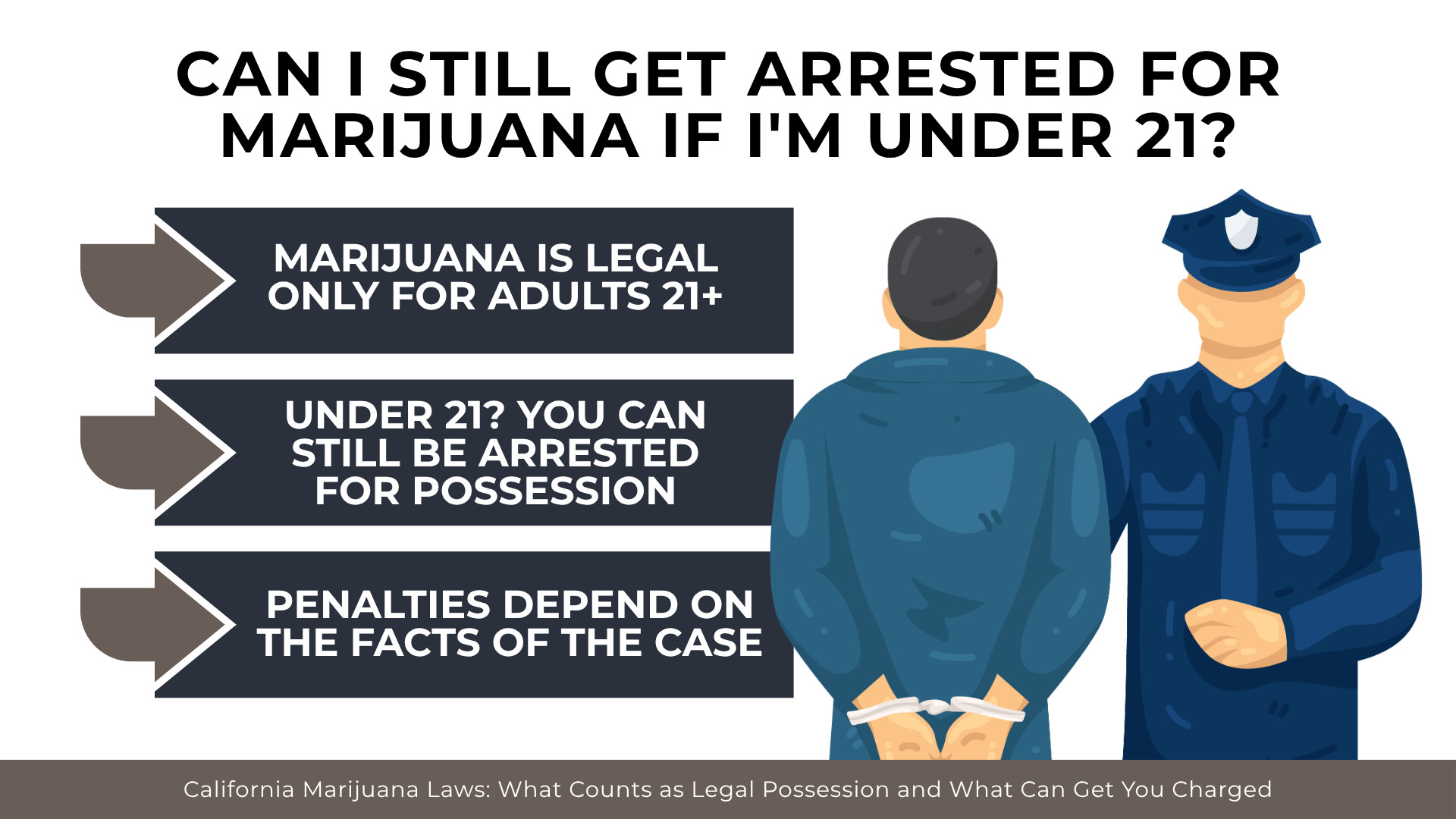
Yes. Proposition 64’s legalization rules apply only to adults 21 and older. If you are under 21, marijuana possession remains criminal under Health and Safety Code §§ 11357–11360, regardless of the amount.
Your specific penalties depend on your age, the quantity involved, and the circumstances. But the critical thing to understand is that age is not a technicality in this statute. It is the threshold that separates legal conduct from a chargeable offense. If you are under 21, or you’re a parent whose child was cited, the fact that California “legalized marijuana” does not apply to your situation. A criminal defense attorney can walk through the specific code section and penalty exposure based on the facts of the case.
Does It Matter Where I Had the Marijuana?
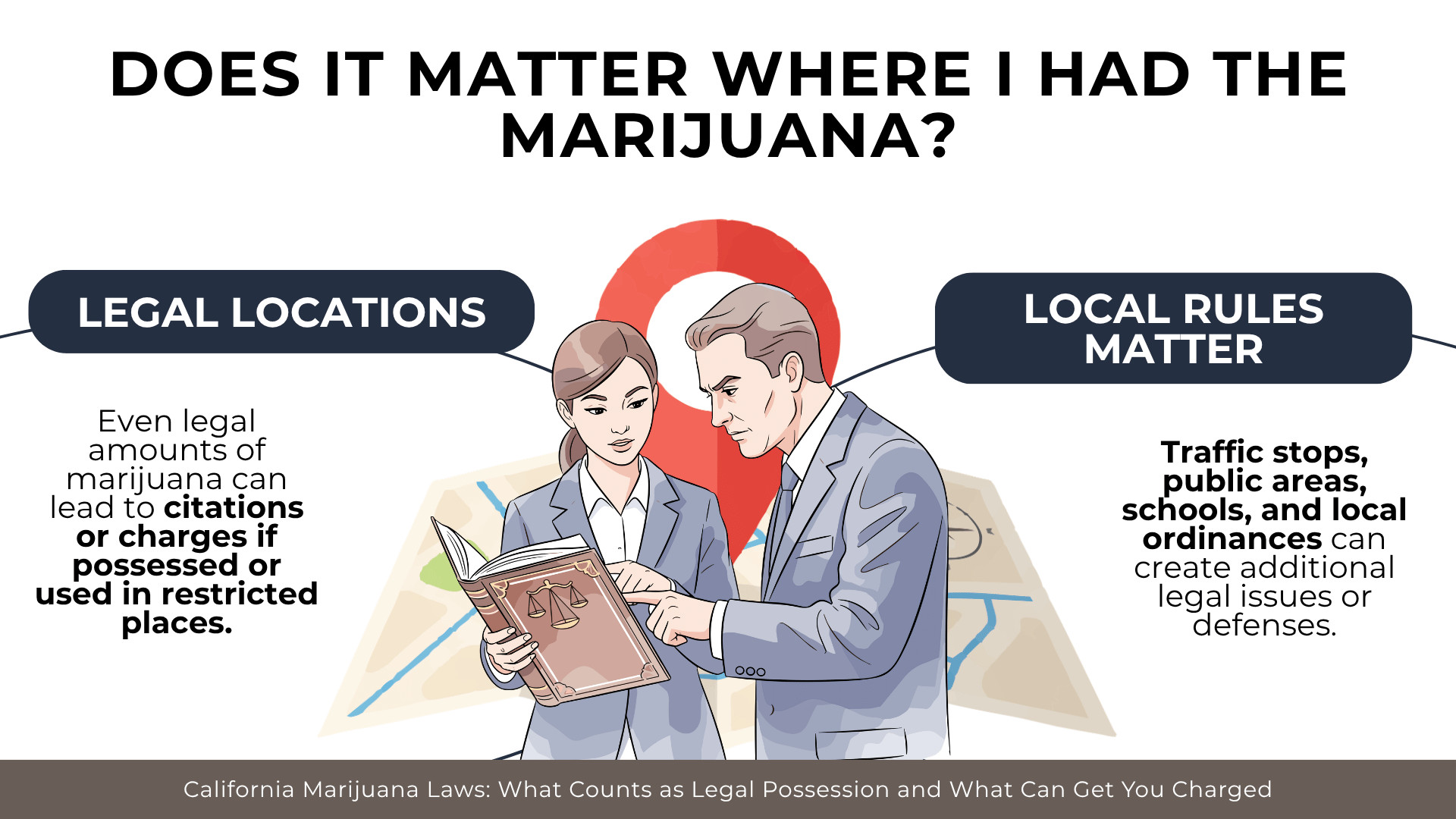
It can. Proposition 64 legalized possession within defined limits, but California law also restricts where marijuana can be possessed and consumed. Possessing an otherwise-legal amount in certain locations — or consuming it where the law prohibits — can turn what would be a non-issue into a citable or chargeable offense.
The specifics vary by code section, and the restrictions overlap with local ordinances that differ across jurisdictions. If your situation involved a traffic stop, a public encounter, or contact near a school or other restricted area, where you were may matter as much as what you had. An attorney familiar with your jurisdiction can assess whether the location creates separate criminal exposure or whether the circumstances support a defense.
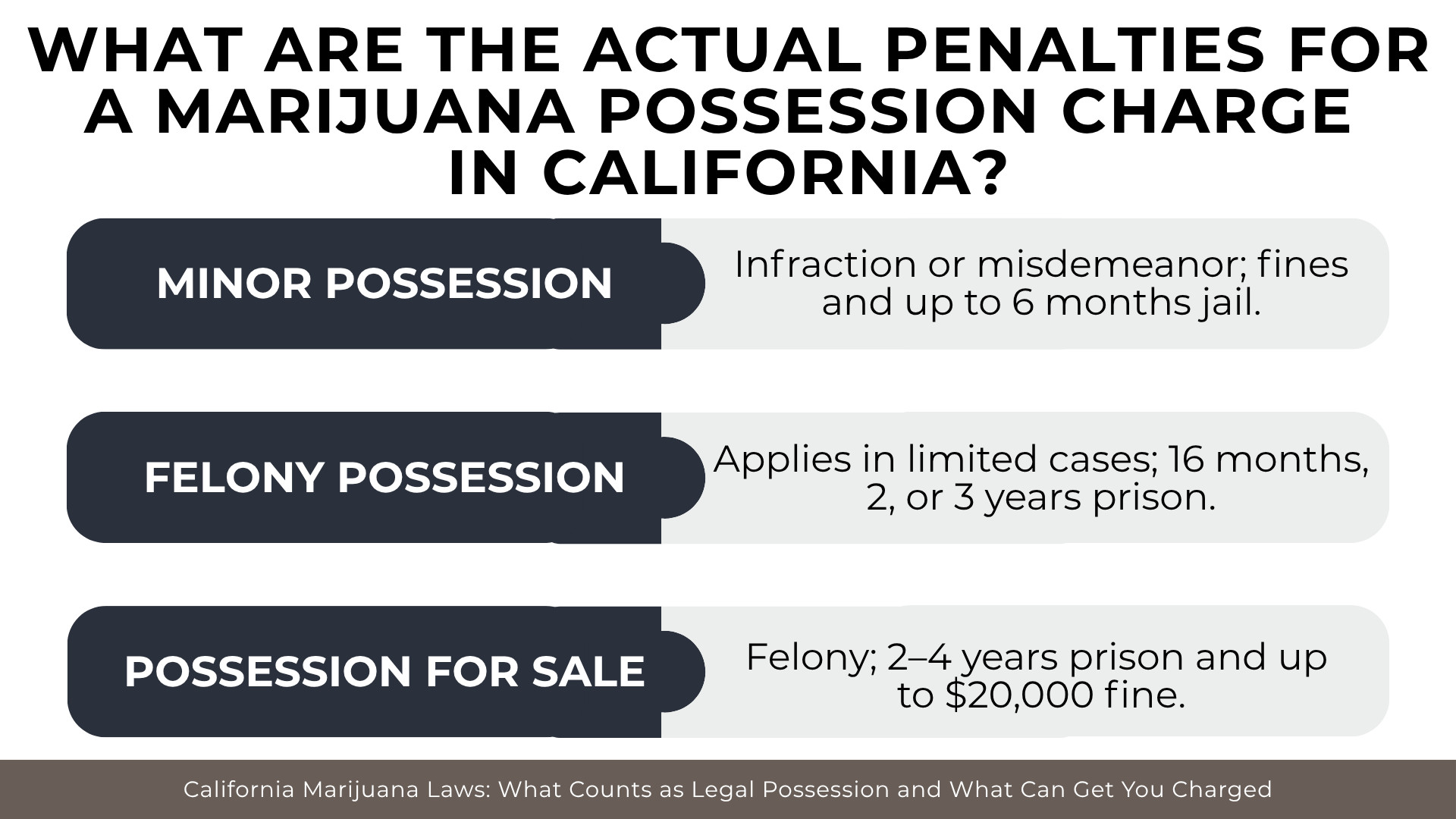
What Are the Actual Penalties for a Marijuana Possession Charge in California?
Penalties fall along a range. Where your case lands depends on the combination of quantity, your age, your criminal history, and the specific code section charged.
At the lowest end, minor possession violations are typically infractions carrying a fine. Above the Prop 64 thresholds, simple possession charges for adults are generally misdemeanors under Prop 47 — up to six months in county jail under Penal Code § 19 and/or a $1,000 fine. That is the baseline for most people reading this page.
Felony-level possession is narrower than it used to be but has not disappeared. If you have a prior “super-strike” conviction or are a registrant under Penal Code § 290(c), simple possession can still be charged as a felony with state prison exposure of 16 months, 2 years, or 3 years. Possession for sale is a separate and more serious charge. If the prosecution alleges that the quantity, packaging, or other circumstances suggest possession for sale under Health and Safety Code § 11351, the case becomes a straight felony carrying 2, 3, or 4 years and up to a $20,000 fine — an entirely different situation.
The system has multiple ways to resolve drug cases — and which one your case takes depends heavily on how it is handled from the start.
What Should I Do if I’ve Been Charged with Marijuana Possession in California?
If you’re reading this because you’re facing a charge right now, the most important thing to understand is that the outcome of a marijuana possession case in California is rarely predetermined. The difference between an infraction, a misdemeanor, and a felony often turns on facts that aren’t obvious — the exact weight, the circumstances of the stop, how the charge is filed, and whether the search that produced the evidence followed constitutional requirements. A motion under Penal Code § 1538.5 to suppress evidence from an unlawful search can change the direction of a case entirely.
At Angelo Reyes Law in Carlsbad, California, every case is prepared as if it’s going to a jury. That approach can create leverage whether the case resolves through negotiation or at trial. Angelo J. Reyes is a trial attorney licensed in California and Washington, admitted to the U.S. District Court for the Southern District of California, and recognized by the National Trial Lawyers Top 40 Under 40. He has handled thousands of criminal cases across San Diego County, including cases where felony strike exposures were reduced to simple misdemeanors and cases that were dismissed outright.
You work directly with Angelo — not a paralegal, not an associate. If your case involves a marijuana possession charge and you need to understand where you stand, contact Angelo Reyes Law for a consultation.
