Drug trafficking charges can be dropped, reduced, or dismissed — and in California, it happens far more often than most people assume. But it does not happen automatically. Whether a trafficking charge survives or falls apart depends almost entirely on the specific facts of the case and whether a defense attorney identifies the weaknesses in the prosecution’s evidence before those opportunities close.
This page covers the specific legal vulnerability that causes trafficking cases to collapse — the prosecution’s burden to prove intent to sell — and what happens when that evidence is challenged.
What Makes a Drug Trafficking Case Fall Apart?
Trafficking cases don’t get dismissed because prosecutors change their minds. They get dismissed because the evidence that holds the charge together has a flaw that a defense attorney exposes. In California trafficking cases, the most critical flaw is in the element that separates trafficking from simple possession: intent.
Can the Prosecution Actually Prove You Intended to Sell?
This is the dividing line between a trafficking charge and simple possession — and it is where trafficking cases are most vulnerable.
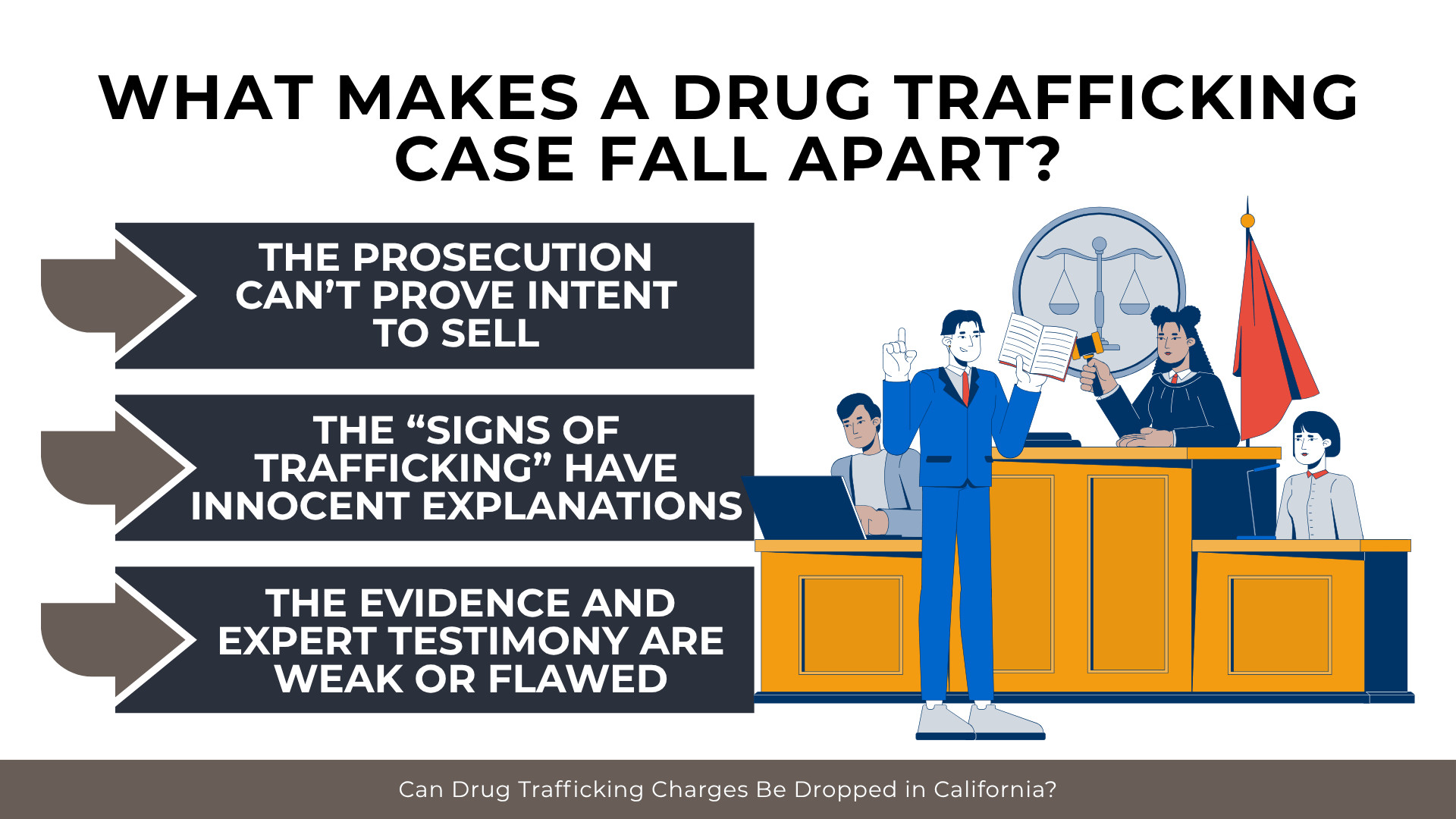
Under California law, possession for sale requires every element of simple possession plus a specific intent to sell. The prosecution typically tries to prove that intent through indirect “indicia of sale.” These indicators include quantity, packaging in individual bindles or baggies, the presence of scales, pay-owe ledgers, large amounts of cash, multiple cell phones, and the absence of paraphernalia associated with personal use. Narcotics-expert testimony interpreting these indicators is a standard part of the prosecution’s case, as recognized in People v. Parra (1999) 70 Cal.App.4th 222.
But here is the critical fact most people don’t know: California has no statutory weight-based presumption of intent. There is no amount of drugs that automatically makes a case “trafficking.” The prosecution must prove specific intent to sell beyond a reasonable doubt every time, regardless of quantity. That burden comes directly from the statute and was established in People v. Newman (1971) 5 Cal.3d 48. The court held that possession for sale requires physical or constructive possession coupled with knowledge of the presence and narcotic character of the drug — plus that additional layer of intent.
When a defense attorney dismantles the prosecution’s intent evidence, the trafficking charge may not stand as filed. That means showing the quantity is consistent with personal use, the packaging has an innocent explanation, and the “expert” testimony relies on assumptions rather than facts specific to this case. And the gap between trafficking and simple possession is enormous. Felony trafficking under Health & Safety Code §§ 11351, 11352, 11378, or 11379 carries years in custody. Most offenses mean sentences served in county jail under Penal Code § 1170(h). Certain aggravated circumstances — such as transport between non-neighboring counties — can mean state prison. Simple possession, after the passage of Proposition 47 in 2014, is generally a misdemeanor punishable by up to six months in county jail.
What If the Charges Can’t Be Dropped Entirely — Can They Be Reduced?
Full dismissal is the best outcome, but it is not the only good one. In many trafficking cases, the realistic path is reducing the charge to something with far different consequences.
The data confirm that negotiated outcomes account for the majority of California felony cases. According to the California Law Revision Commission, citing Judicial Council data, roughly 75% of felony dispositions are guilty pleas, approximately 20% are dismissals, and fewer than 3% go to trial. That means the vast majority of felony cases — including drug cases — resolve through negotiation between the defense and the prosecution.
In a trafficking case, the negotiation often centers on what the charge becomes. A possession-for-sale charge reduced to simple possession moves from a felony with potential custody time to a Prop 47 misdemeanor. A transportation charge under Health & Safety Code § 11352 carries three, four, or five years. But it may be negotiable to a lesser offense depending on the strength of the evidence.
The leverage in that negotiation comes from the same weakness described above. When the defense can convincingly show that the prosecution’s intent evidence is thin, the prosecution has a reason to negotiate rather than risk losing at a hearing or trial. Even when the evidence is not weak enough for outright dismissal, it may be weak enough that the prosecution would rather secure a conviction on a lesser charge than gamble on a greater one.
The sentencing data confirm why reduction matters. According to the California Department of Justice, only 19.7% of drug-offense felony convictions resulted in incarceration in a state institution in 2023. The majority resulted in county jail time or probation. The difference between the charge you are facing today and the charge you are ultimately convicted of can be the difference between custody and going home.

How Angelo Reyes Law Fights Drug Trafficking Charges in Carlsbad
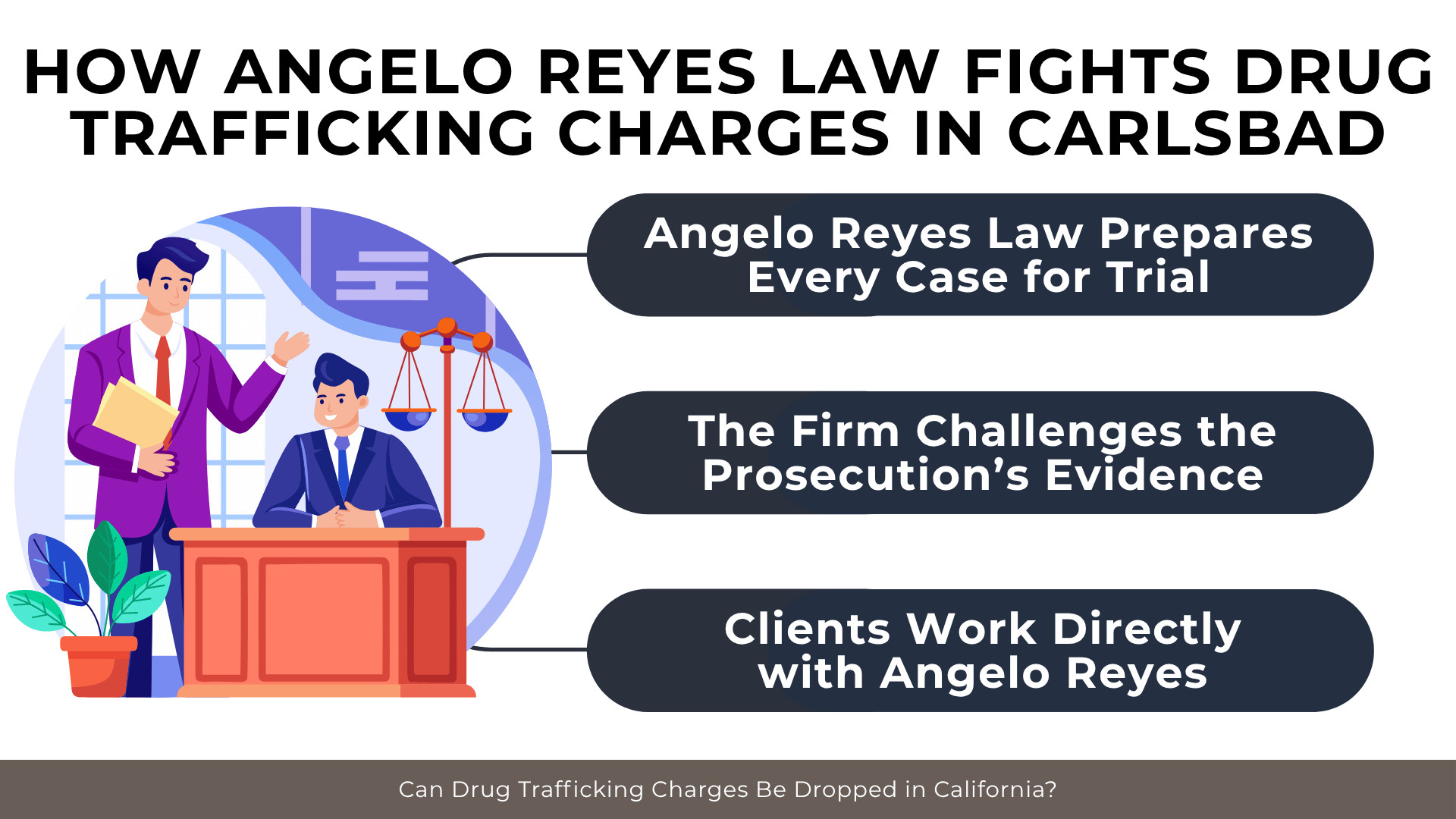
At Angelo Reyes Law in Carlsbad, California, every drug trafficking case is prepared as if it is going to a jury. That is not a slogan — it is a case-preparation approach that is designed to create leverage whether the matter resolves through negotiation or at trial.
When a case is built for trial from day one, the prosecution can see it. The intent evidence — the packaging, the quantity, the expert testimony — gets scrutinized for every weakness before the prosecution has a chance to lock its narrative in. Clients work directly with Angelo Reyes — not a paralegal, not an associate — from intake through resolution.
Angelo Reyes is licensed in California and Washington and admitted to the U.S. District Court for the Southern District of California. His track record across thousands of criminal cases handled in San Diego County includes a 25-to-life case dismissed, multiple DUI and grand theft dismissals, and felony strike exposures reduced to simple misdemeanors.
A drug trafficking charge is serious. It is not the same thing as a conviction. If you or someone close to you is facing trafficking charges in California, the first step is a case evaluation to determine whether the prosecution’s intent evidence can withstand the scrutiny it deserves.