

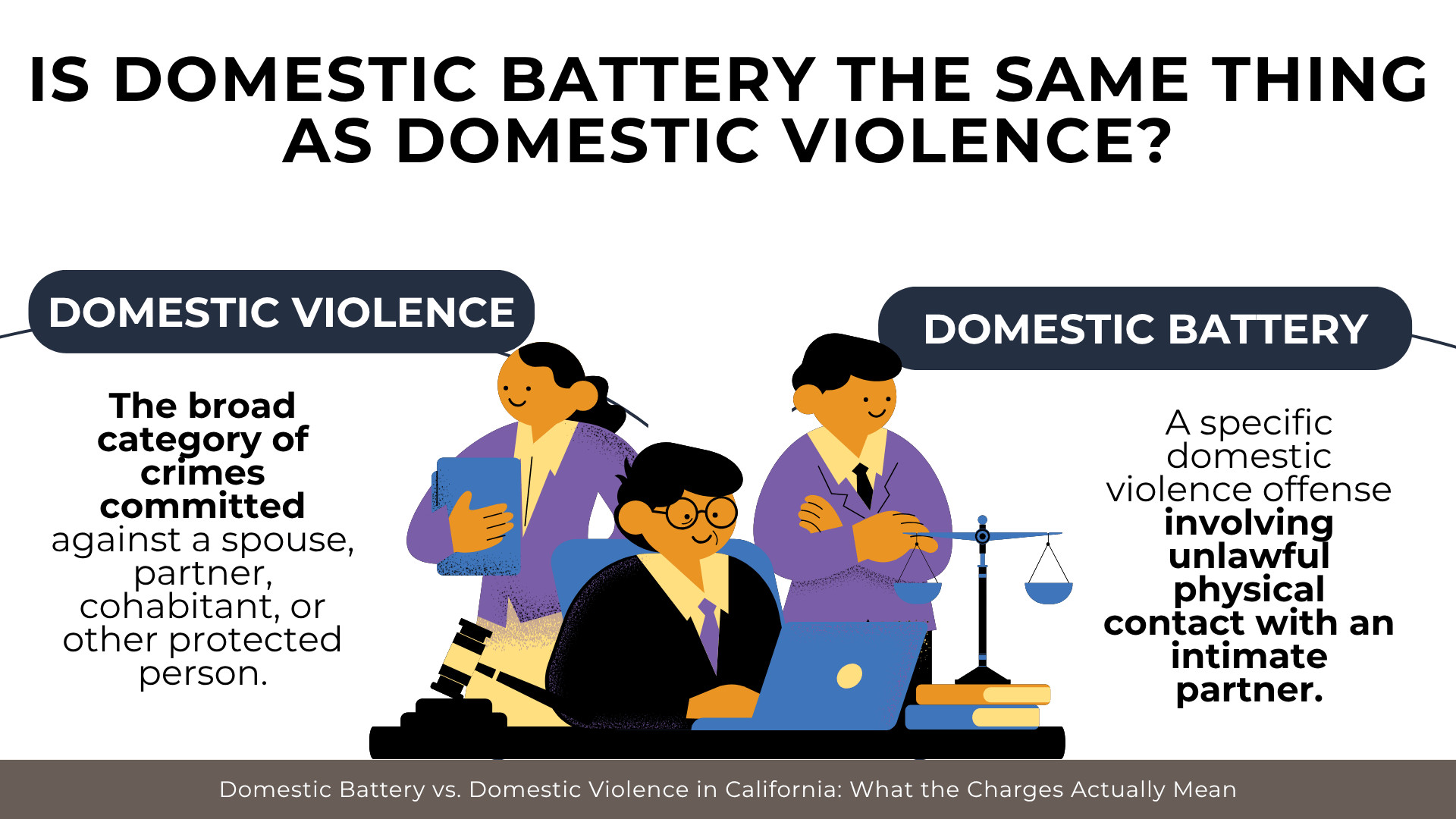
Domestic battery and domestic violence are not the same thing under California law. Police reports, court paperwork, and everyday conversation treat the terms as interchangeable, but the criminal code does not. Domestic violence is a broad legal category — an umbrella that covers several different criminal charges involving people in intimate or familial relationships. Domestic battery is one specific charge that falls under that umbrella. The distinction matters because the charge that gets filed determines the maximum penalties, whether the offense is a misdemeanor or a felony, and which defense strategies are available. This page breaks down exactly what each term means, where the legal line falls between them, and what the consequences look like on both sides of that line.
Is domestic battery the same thing as domestic violence?
No. The confusion is understandable because the terms overlap, but they describe two different things in California’s criminal code. “Domestic violence” is not a single charge that a prosecutor files. It is the category that California uses to group offenses committed against a spouse, partner, cohabitant, or other qualifying person. Multiple charges fall within that category, including domestic battery under Penal Code 243(e)(1), corporal injury to a spouse or cohabitant under Penal Code 273.5, stalking under Penal Code 646.9, and violation of a protective order under Penal Code 273.6.
When someone says they were “arrested for domestic violence,” what they usually mean is that they were arrested for a specific offense — most often domestic battery or corporal injury. The arrest report classified the incident under the domestic violence umbrella. The distinction between those specific charges is where the real consequences differ.
What is domestic battery under California law?
Domestic battery is defined under Penal Code 243(e)(1). It is a straight misdemeanor — meaning it can only be charged as a misdemeanor, never a felony. The legal threshold is lower than most people expect: no physical injury is required. Any willful and unlawful touching of a qualifying person, done in a rude or angry manner, is enough to prove the charge. A shove that leaves no mark, a grab that causes no bruise, a slap with no visible result — all of these can support a domestic battery conviction.
The penalties for domestic battery include up to one year in county jail, a fine of up to $2,000, or both. But the criminal sentence is only part of the picture. Probation is common for first offenses. When it is granted, Penal Code 1203.097 imposes mandatory conditions that apply to every domestic violence probation case — misdemeanor or felony. Those conditions reshape daily life for years. They apply just as fully to a domestic battery conviction as they do to a more serious charge.
The fact that domestic battery requires no injury is one of the most misunderstood aspects of California DV law. People assume that if there is no bruise, no hospital visit, and no visible harm, there is no case. That assumption is wrong. The “slightest touching” standard means the prosecution’s burden is low. Cases often come down to the testimony of the involved parties and any responding officers.

What does California actually charge as “domestic violence”?
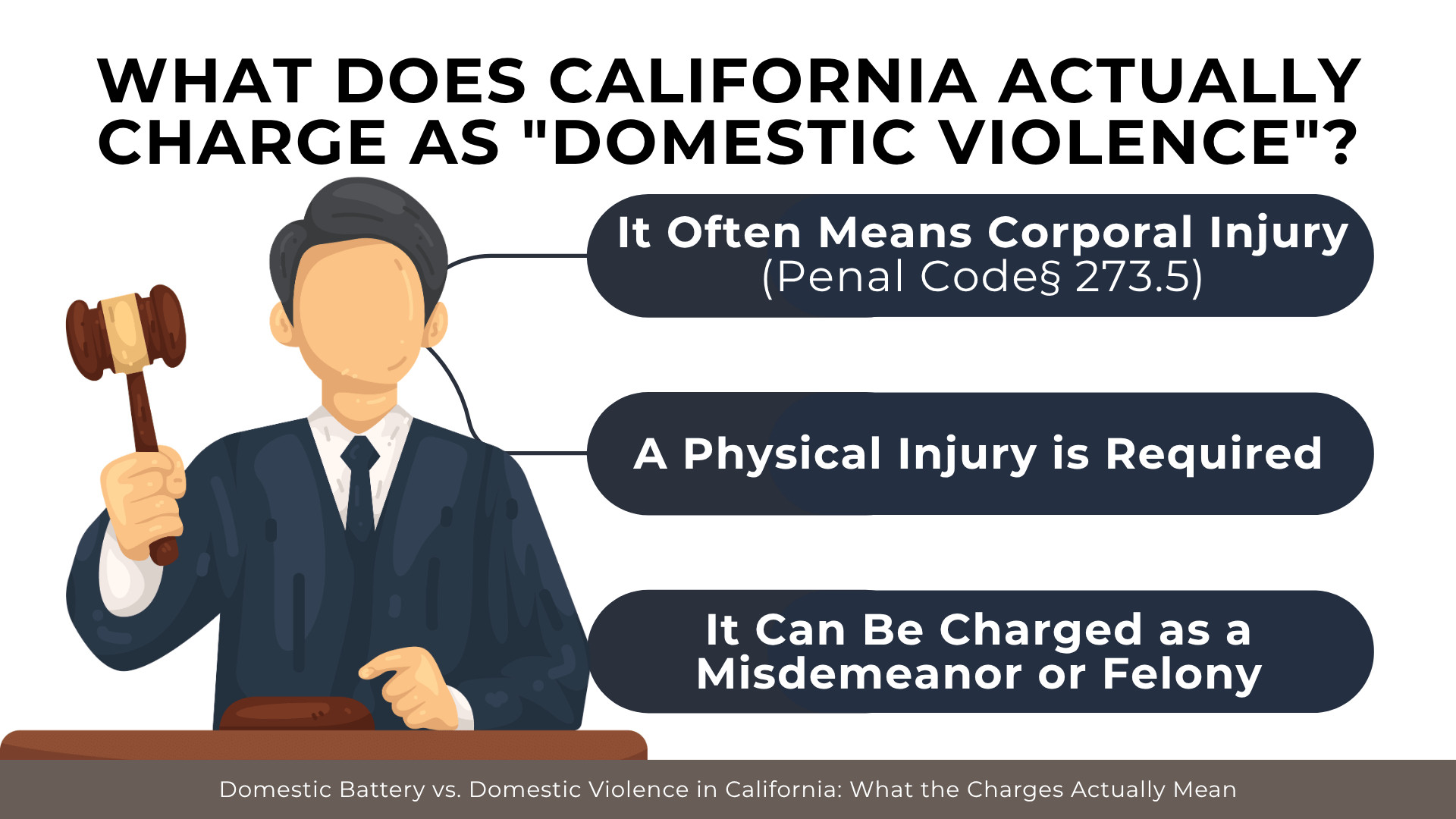
When people use the phrase “domestic violence charge,” they are most often referring to corporal injury to a spouse or cohabitant under Penal Code 273.5. This is the charge that typically carries the weight the term “domestic violence” implies in everyday language.
Unlike domestic battery, corporal injury is a wobbler — it can be filed as either a misdemeanor or a felony, at the prosecutor’s discretion. And unlike domestic battery, it requires the prosecution to prove that the defendant willfully inflicted a “traumatic condition” on a qualifying victim. The statute defines traumatic condition as a condition of the body, such as a wound or external or internal injury — including injury caused by strangulation or suffocation — whether minor or serious in nature, caused by physical force.
As a felony, corporal injury carries two, three, or four years in state prison, or up to one year in county jail, or a fine of up to $6,000, or both imprisonment and fine. If the defendant has a prior domestic violence conviction within seven years, the penalties increase to two, four, or five years in state prison, or up to one year in county jail, with fines up to $10,000. In People v. Thurston (1999), the court confirmed that this is a general-intent crime. The prosecution must prove the defendant intended to commit the act, but it does not need to prove a specific intent to cause the resulting injury.
The traumatic condition element is what separates this charge from domestic battery, and it is also what makes it defensible on different grounds. If the prosecution cannot prove an actual physical injury — however minor — the charge may not hold as a corporal injury offense.
What’s the line between a misdemeanor and a felony DV charge?
The traumatic condition is the dividing line. If the prosecution can establish a documentable injury — a bruise, redness, swelling, a scratch, soreness supported by medical records — the case can be filed under Penal Code 273.5 as a wobbler. That opens the door to felony penalties. If they cannot, the case is more likely filed as misdemeanor domestic battery under Penal Code 243(e)(1).
This line is not always clear, and two cases illustrate why. In People v. Abrego (1993), the court held that pain alone — soreness and tenderness without evidence of even a minor physical injury — is not enough to establish a traumatic condition under Penal Code 273.5. In People v. Jackson (2000), the court held that the corporal injury must result from a direct application of force upon the victim. An indirect injury — the victim falling while being pushed — was not enough. The conviction was reduced to domestic battery.
These cases matter because they show that the boundary between the two charges is disputed, fact-specific, and sometimes decided at trial. Domestic battery under Penal Code 243(e)(1) is a lesser included offense of corporal injury under Penal Code 273.5. That means a jury can convict on the lesser charge even when the felony is what was originally filed.
When prosecutors decide whether to file a wobbler as a misdemeanor or felony, the factors they weigh include the severity of the injury, whether a weapon was involved, whether strangulation occurred, the defendant’s prior DV history, whether children were present during the incident, and whether the injury qualifies as great bodily injury. Approximately 80 percent of domestic violence cases nationwide are filed as misdemeanors. But that statistic offers limited comfort when the remaining 20 percent carry state prison exposure.

What are the penalties for each charge side by side?
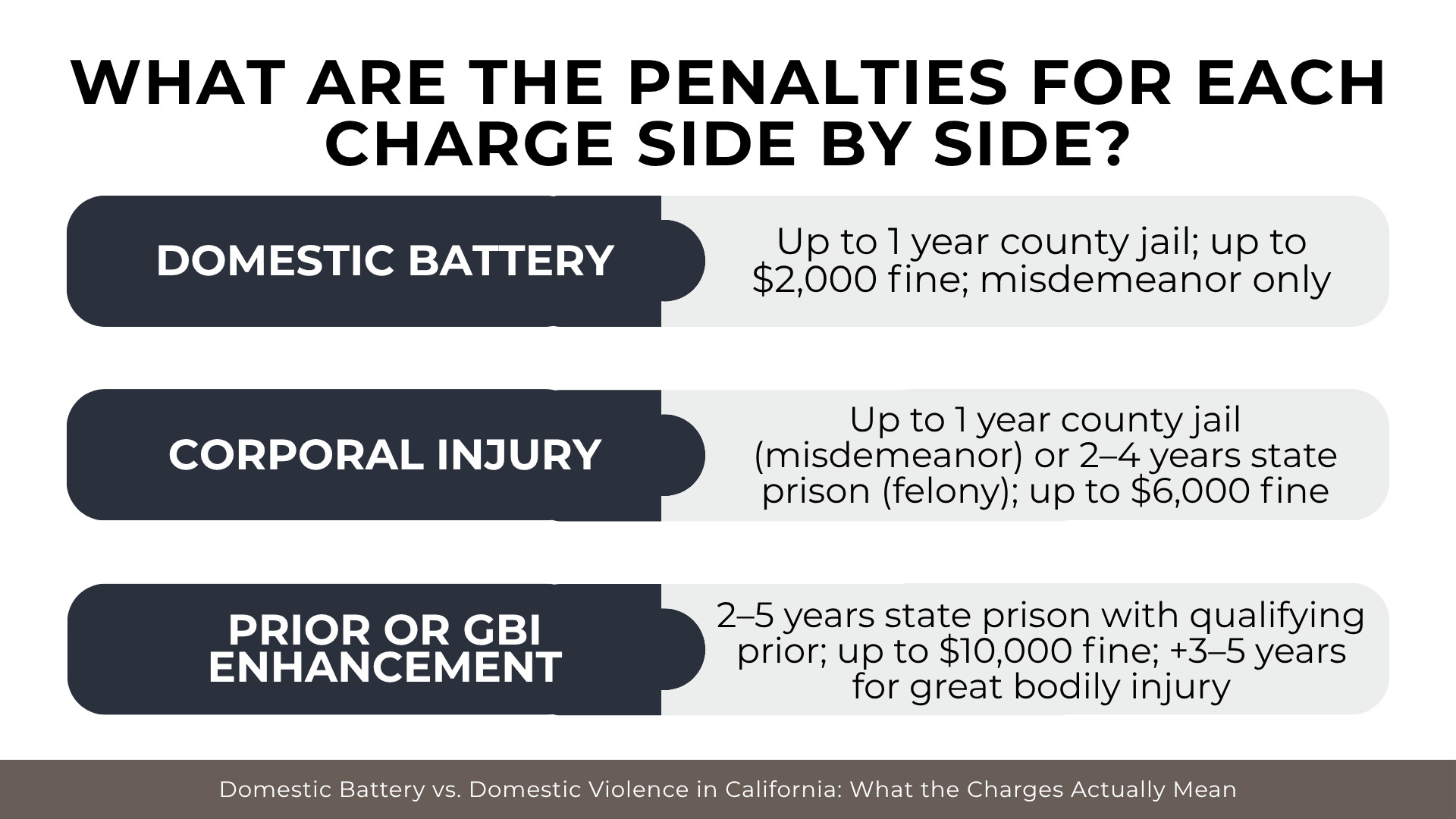
For domestic battery under Penal Code 243(e)(1), the maximum sentence is one year in county jail with a fine of up to $2,000. It is a misdemeanor only. There is no state prison exposure.
For corporal injury under Penal Code 273.5, the penalties depend on how the charge is filed. As a misdemeanor, the maximum is one year in county jail with a fine of up to $6,000. As a felony, the sentence is two, three, or four years in state prison, or up to one year in county jail, with fines up to $6,000. With a qualifying prior conviction within seven years, felony exposure increases to two, four, or five years in state prison, or up to one year in county jail, with fines up to $10,000. A great bodily injury enhancement under Penal Code 12022.7 can add three, four, or five additional years.
But those are just the criminal sentences. Whenever probation is granted on any domestic violence offense — whether it is a misdemeanor domestic battery or a felony corporal injury — Penal Code 1203.097 requires the court to impose a specific set of mandatory conditions. These include a minimum 36-month probation period, a criminal protective order, completion of a batterer’s intervention program lasting no less than one year with weekly sessions of at least two hours in same-gender group format, a minimum $500 fine paid to domestic violence programs, victim restitution, community service, booking within one week of sentencing if you have not already been booked, and victim notification of the case outcome.
The batterer’s intervention program alone is a serious commitment. It requires attending a two-hour group session every week for a full year, with quarterly progress reports sent to the court. A California State Auditor report found that 46 out of 100 DV offenders failed to complete the mandated program. Courts imposed consequences for only about 9 percent of known violations. But non-completion can still trigger a probation violation and additional penalties.
These mandatory conditions apply equally whether you are convicted of misdemeanor domestic battery or felony corporal injury. The charge determines the ceiling of the criminal sentence, but the floor of obligations after conviction is the same.
Why does the specific charge matter for how you fight the case?
The difference between domestic battery and corporal injury is not just a matter of labeling. It changes what the prosecution must prove, which in turn changes how the defense is built.
A corporal injury charge under Penal Code 273.5 requires proof of a traumatic condition. If the injury evidence is weak — if there are no photographs, no medical records, no visible marks documented by responding officers — the prosecution may not be able to prove that element. In that situation, the charge may be reduced to misdemeanor domestic battery under Penal Code 243(e)(1), which eliminates felony exposure entirely. Domestic battery is a lesser included offense of corporal injury. So this reduction can happen through negotiation before trial or through a jury’s verdict at trial.
A domestic battery charge under Penal Code 243(e)(1), while less severe, still carries the full weight of mandatory probation conditions. But the defense options differ. There may be diversion programs or plea options that avoid the most damaging long-term effects, depending on the facts of your case, your history, and the jurisdiction.
The filing decision itself is sometimes the most important moment in the case. Before formal charges are filed, there may be an opportunity to present mitigating information to the prosecutor’s office. That information can influence whether the case is filed at all, whether it is filed as a misdemeanor or felony, and under which statute. Prosecutors decline to file in approximately 70 percent of cases where law enforcement conducted only a basic investigation. That figure shows how much the early stages of a case matter — and how much the outcome depends on what happens before a courtroom is ever involved.
None of this is territory where the distinction between domestic battery and domestic violence is academic. The specific charge shapes the available defenses, the plea options, the sentencing exposure, and the consequences that follow you for years. Getting clarity on what you or someone you care about is actually facing is the first step toward knowing what comes next.

Talk to a Defense Attorney Who Handles These Cases
Angelo Reyes is a criminal defense attorney at Angelo Reyes Law in Carlsbad, California, serving clients throughout San Diego County. He prepares every case as if it is going to a jury — because that preparation is what creates leverage whether the case resolves through negotiation or at trial. Clients work directly with Angelo, not a paralegal or associate.
When the difference between a misdemeanor and a felony turns on how an injury is documented and which statute the prosecutor files under, the defense strategy matters from the earliest stage of the case. If you are facing a domestic battery or domestic violence charge in San Diego County, contact Angelo Reyes Law to discuss your situation.
