

What is constructive possession of drugs?
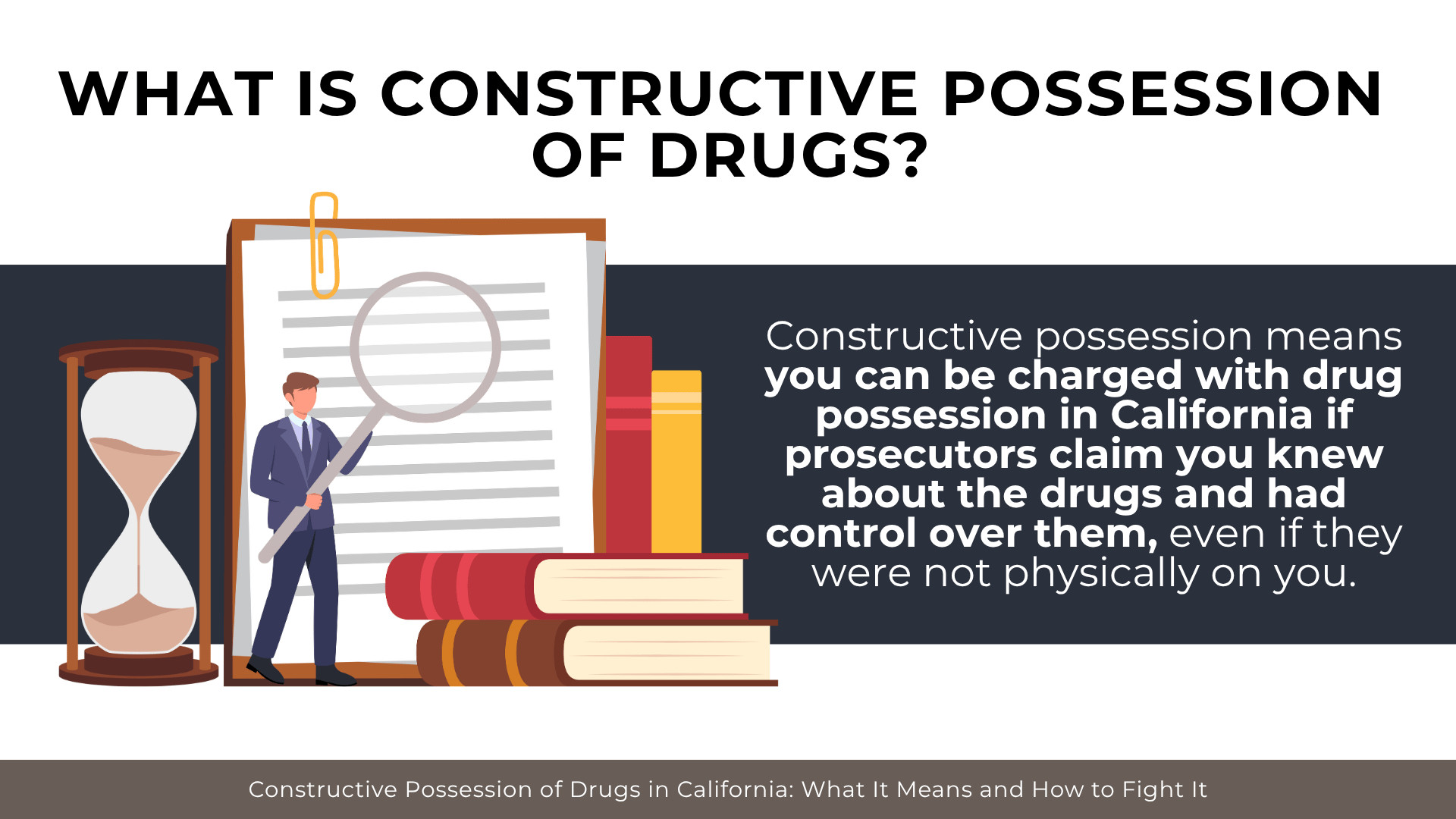
Constructive possession of drugs means you can face a drug possession charge in California even if the drugs were never physically on your body. Under California law, possession doesn’t require that someone be holding a substance or carrying it in a pocket. If prosecutors can establish that a person knew a controlled substance was present and had the ability to control it, that’s enough to support a possession charge. The drugs could have been in a car’s center console, a bedroom closet, or a shared storage space.
This is the distinction between actual possession and constructive possession. Actual possession is straightforward: the drugs are on you. Constructive possession reaches further. It applies when drugs are found in a location a person claimed had access to and authority over, even if someone else was physically closer to them.
California’s primary simple possession statutes are Health and Safety Code § 11350 for narcotics and Schedule III–V controlled substances, and Health and Safety Code § 11377 for non-narcotic controlled substances like methamphetamine. Both require the same basic elements: dominion and control over the substance, knowledge of its presence, and knowledge of its character as a controlled substance. Those elements apply the same way whether the possession is actual or constructive.
But here’s what makes constructive possession charges different in practice: because the drugs weren’t on the person, every one of those elements becomes harder for the prosecution to prove and easier for the defense to challenge. The gap between “drugs were found nearby” and “this specific person knowingly controlled those drugs” is where most constructive possession cases are won or lost.
How do prosecutors prove constructive possession in California?
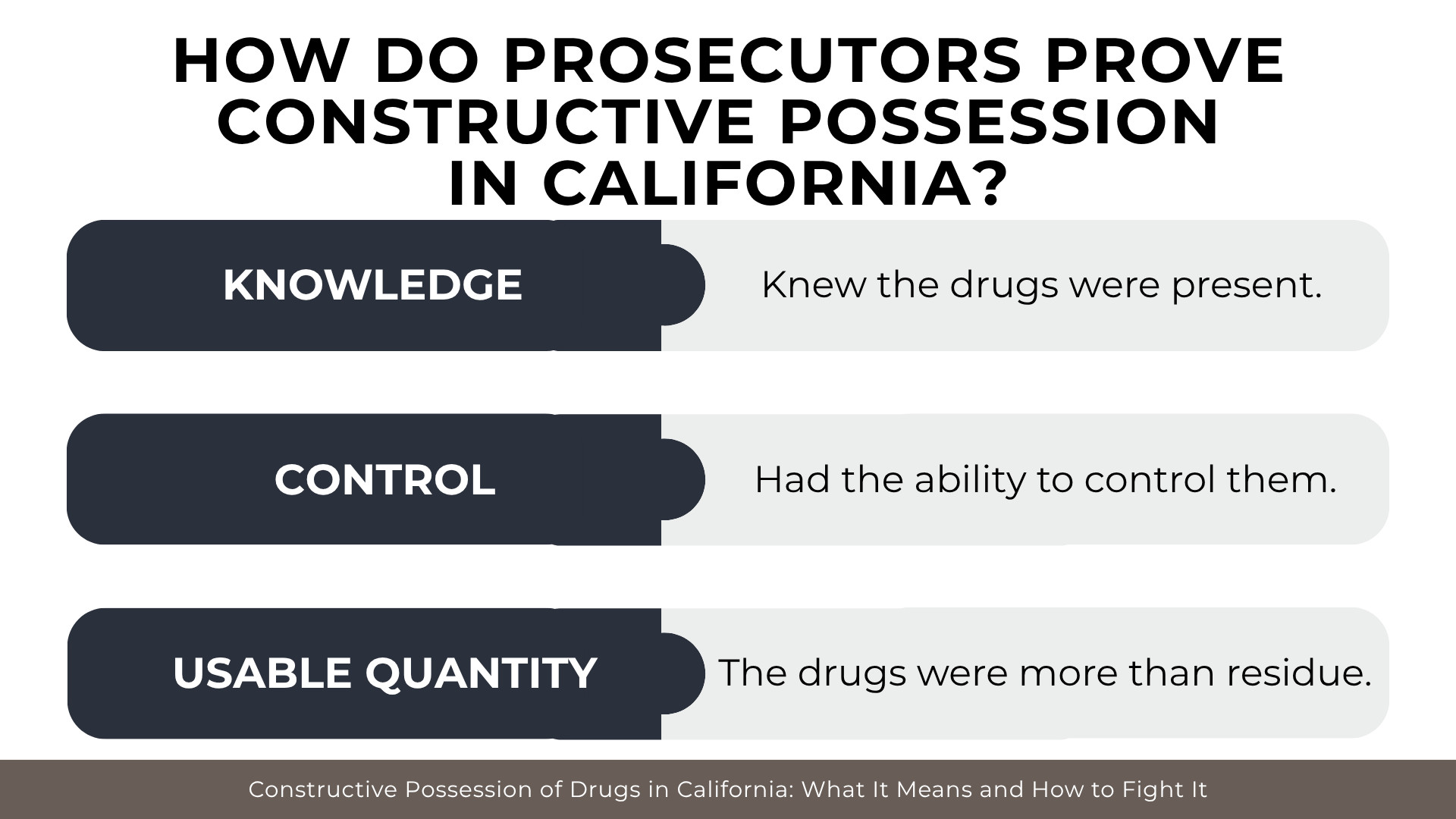
A constructive possession charge rests on two pillars, and the prosecution must prove both beyond a reasonable doubt.
The first is knowledge. The person must have known the controlled substance was there, and must have known what it was. Not suspicion, not proximity — actual awareness. The California Supreme Court addressed this directly in People v. Rubacalba (1993) 6 Cal.4th 62. The court held that the ultimate test for known possession of a narcotic is the awareness of the defendant of the presence of the narcotic. Being in the same room, same car, or same apartment as drugs does not, by itself, prove that a person knew those drugs existed.
The second is dominion and control. The person must have had the right or ability to control the substance — to move it, use it, or direct what happens to it. The California Supreme Court drew this line sharply in People v. Williams (1971) 5 Cal.3d 211. The court ruled that constructive possession requires knowledge of the drug’s presence and narcotic character. Mere presence in a vehicle the defendant occupied was not enough.
There’s a third requirement that often matters in constructive possession cases: the substance must be a “usable quantity.” Under People v. Leal (1966) 64 Cal.2d 504, possession of a minute crystalline residue of narcotic useless for either sale or consumption does not constitute sufficient evidence in itself to sustain a conviction. If what was recovered is a trace amount, a smear, or blackened residue in a pipe found in a shared space, the usable-quantity requirement creates an additional obstacle for the prosecution.
Together, these elements mean the prosecution can’t simply point to drugs found in someone’s area and call it possession. They need evidence connecting that specific person’s knowledge and control to that specific substance.
Where do constructive possession charges usually come from?
Constructive possession charges tend to arise in a handful of common situations. Recognizing them helps clarify what the prosecution actually has to work with.
The most common scenario is a vehicle search. Drugs are found in a glove compartment, under a seat, or in the trunk during a traffic stop — and there are two or more people in the car. The question immediately becomes: whose drugs are they? If you weren’t driving, weren’t sitting near the drugs, and didn’t own the vehicle, the prosecution faces a real burden in tying knowledge and control to you. Even for drivers, the fact that something was inside a car they were operating doesn’t automatically prove they knew it was there, particularly if the vehicle is shared or borrowed.
Shared living spaces create similar issues. Drugs might be found in a common area of an apartment with multiple residents, in a roommate’s bedroom, or in a storage unit with more than one keyholder. Each of these situations raises the question of which person — if any specific person — had the required knowledge and control.
A third scenario involves drugs found in someone else’s property that happens to be near the defendant: a friend’s backpack left in your car, a guest’s jacket in your home, a coworker’s bag in a shared workspace. These situations highlight the gap between physical proximity and legal control.
In each of these scenarios, the critical question is the same one the courts have identified: is there actual evidence that you specifically knew the drugs were present and had authority over them? Or is the prosecution relying on the fact that you were simply nearby?

What are the defenses to constructive possession?
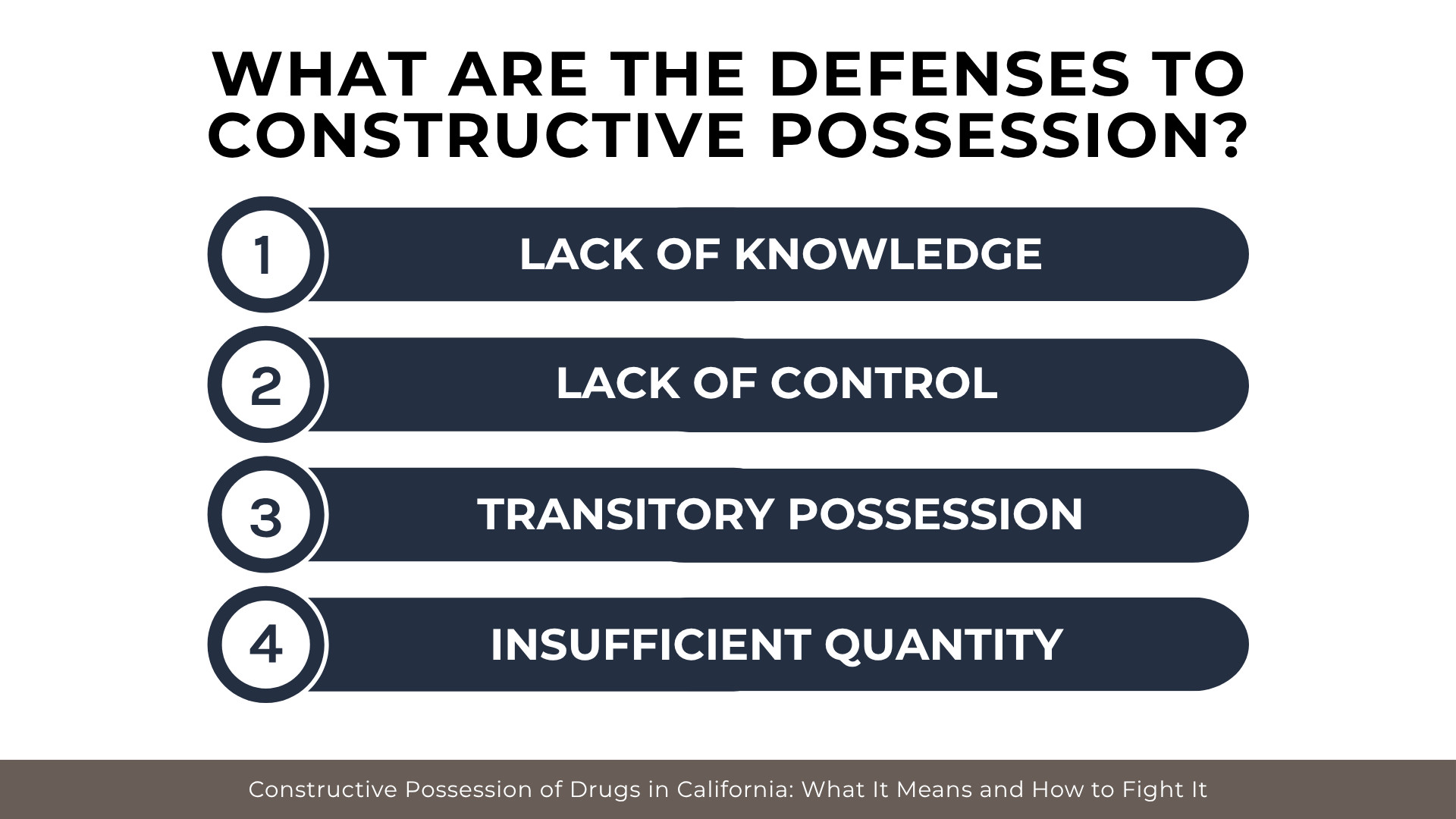
The elements the prosecution must prove are the same elements the defense can dismantle. Several established defenses apply directly to constructive possession cases in California.
Lack of knowledge. If you did not know the drugs were present, there is no constructive possession. This defense arises naturally in shared vehicle and shared residence cases. A passenger who had no idea the driver stashed drugs under the seat. A roommate who never entered the other person’s bedroom. A person who borrowed a car without knowing what was in the trunk. In each situation, the prosecution must produce actual evidence of awareness, not just evidence of proximity. Under Rubacalba, awareness is the “ultimate test,” and if the evidence doesn’t establish it, the charge fails.
Lack of control. Even if you knew drugs were present, constructive possession requires dominion and control — the ability to control the substance. A guest in someone else’s home may know the host keeps drugs in a drawer. But knowing about something and having the right or ability to control it are legally distinct. Williams makes clear that presence alone does not establish the control element.
Transitory possession. California recognizes a defense for momentary or transitory possession when the sole purpose was to dispose of the substance. Under People v. Mijares (1971) 6 Cal.3d 415, momentary, transitory possession solely to dispose of the drugs is a defense to possession. This defense is narrow — it requires that disposal was the only intent. But it directly addresses situations where someone discovers drugs in their space and tries to get rid of them.
Insufficient quantity. Under Leal, the substance must be a usable quantity. If what was recovered is residue, trace amounts, or a quantity that simply cannot be used, this element is not met. In constructive possession cases involving shared spaces where remnants or residue are found, this defense can be enough on its own to defeat the charge.
These defenses aren’t theoretical. The strength of available defenses shapes what happens long before a jury is ever seated. A constructive possession case with identifiable weaknesses in the knowledge or control evidence gives a defense attorney real leverage in negotiations — or a strong foundation if the case does go to trial.
Why do you need an experienced lawyer for a constructive possession charge?
Constructive possession cases are fundamentally evidence cases. The charge lives or dies on whether the prosecution can prove, with specific evidence, that a particular person knew about and controlled a particular substance. Every element — knowledge, control, usable quantity — is a potential point of failure for the prosecution and a potential avenue of defense.
That’s precisely why these cases demand an attorney who prepares every case as though it’s going to trial. When the prosecution knows the defense has identified weaknesses in the knowledge evidence or gaps in the control analysis, it changes the negotiation. It creates leverage that comes from thorough preparation.
At Angelo Reyes Law in Carlsbad, California, attorney Angelo Reyes works directly with clients on every case — not through a paralegal or associate. His practice across San Diego County criminal defense, including drug offenses, is built on a trial-first approach: preparing the strongest possible defense so that whether a case resolves through negotiation or goes to a jury, the client’s position is as strong as the facts allow.
If you or someone you know is facing a constructive possession charge in California, the specific facts of the case matter more than general assumptions about what the charge means. A consultation with a defense attorney who understands how to challenge the evidence underlying constructive possession is the most concrete next step available.
