When police respond to a domestic violence call in California, they can — and in most cases will — make an arrest based on probable cause alone. It does not matter whether the alleged victim asks them not to. California’s domestic violence statutes set a low threshold for charges. Domestic battery under Penal Code § 243(e)(1) requires no physical injury at all. Officers do not need the victim’s consent, cooperation, or even a visible injury to take someone into custody.
That reality drives everything that follows — from whether the district attorney files charges to the narrow window where early legal decisions carry the most weight.
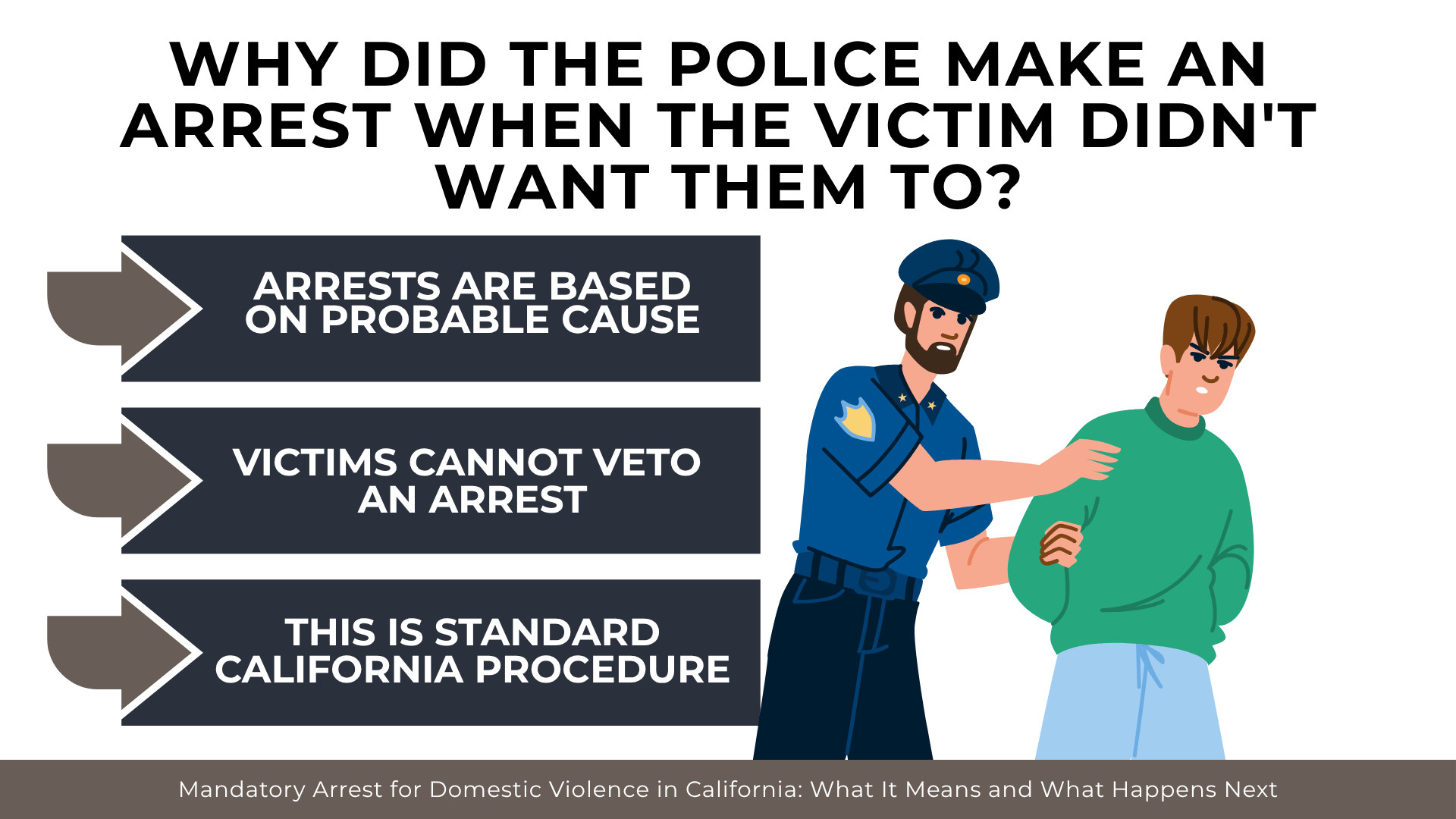
Why Did the Police Make an Arrest When the Victim Didn’t Want Them To?
When California law enforcement responds to a domestic violence call, the decision to arrest is driven by whether the officer finds probable cause to believe a DV offense occurred — not by whether the alleged victim wants an arrest to happen. The officer who responded was not weighing the victim’s wishes against the evidence. Once probable cause was established, the arrest followed.
This means the victim can tell officers it was a misunderstanding. The victim can say they don’t want anyone arrested. The victim can refuse to answer questions entirely. None of that overrides the officer’s probable cause determination.
This is not a rare procedural outcome. In 2024, California law enforcement responded to 163,024 domestic violence-related calls for assistance statewide. Every one of those calls triggered the same process — the same probable cause assessment, the same decision-making that takes the victim’s preference out of the equation.
What Does “Mandatory Arrest” Actually Mean Under California Law?
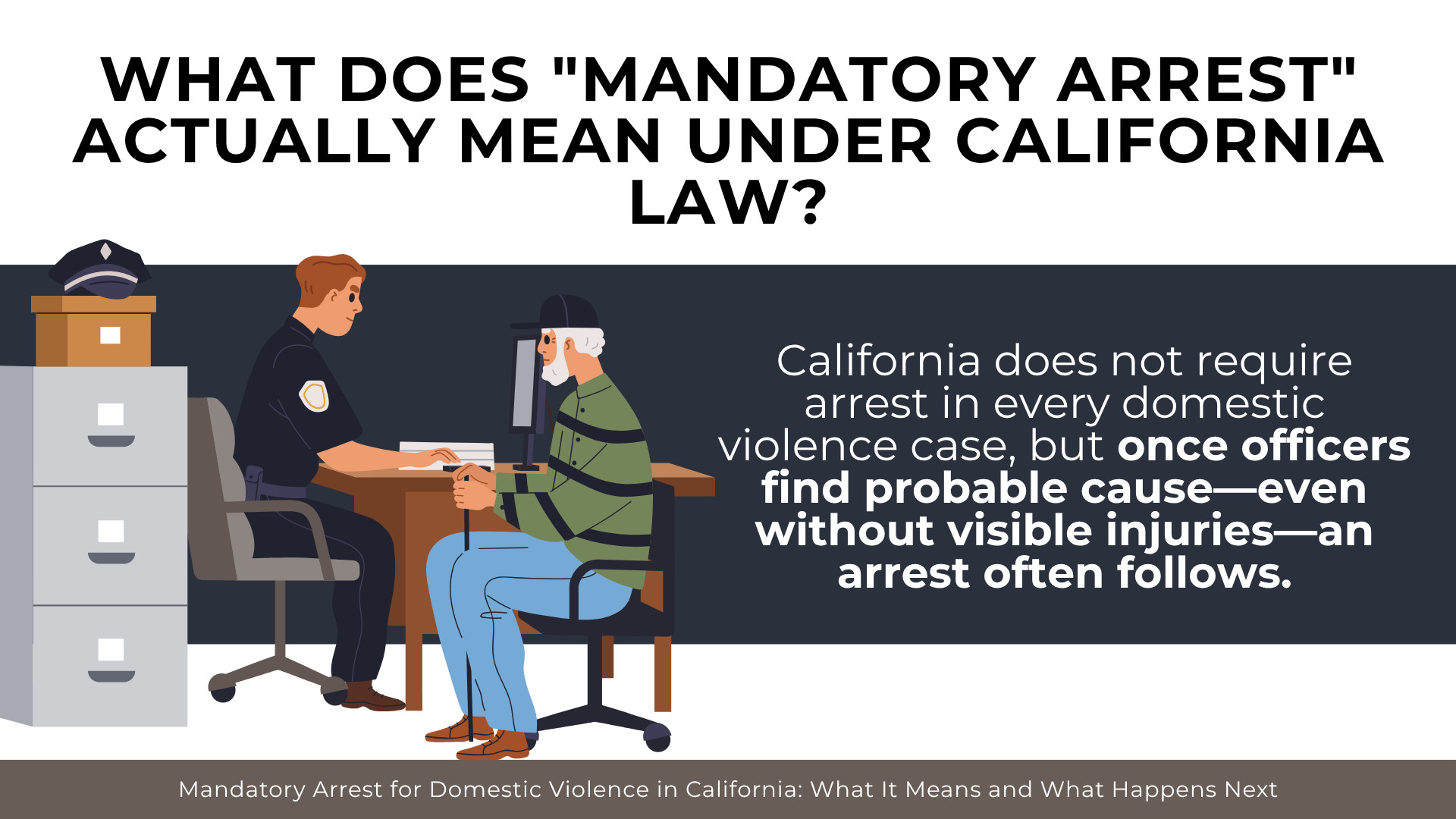
The term “mandatory arrest” gets used loosely, and the distinction matters. Some states have true mandatory arrest statutes — laws that require officers to arrest whenever they find probable cause for a DV offense, with zero discretion. California does not have a single statute that commands arrest in every domestic violence case. But the practical outcome is often the same — law enforcement agencies across the state widely treat DV calls as arrest-presumptive situations.
What triggers the arrest is probable cause that a domestic violence offense occurred. Under California law, that bar can be cleared without any visible injury at all. Domestic battery under Penal Code § 243(e)(1) requires only that the defendant committed a willful, unlawful touching in a rude or angry manner against a person in a qualifying relationship — a spouse, former spouse, cohabitant, fiancé, dating partner, or parent of the defendant’s child. No bruise. No mark. No medical attention. If an officer has reason to believe any offensive touching occurred between people who share one of those relationships, the probable cause threshold is met and the arrest follows.
This is why so many DV arrests feel disproportionate to the people involved. The legal standard that justifies the arrest is far lower than most people assume.
Can the Victim Drop the Charges After a DV Arrest?
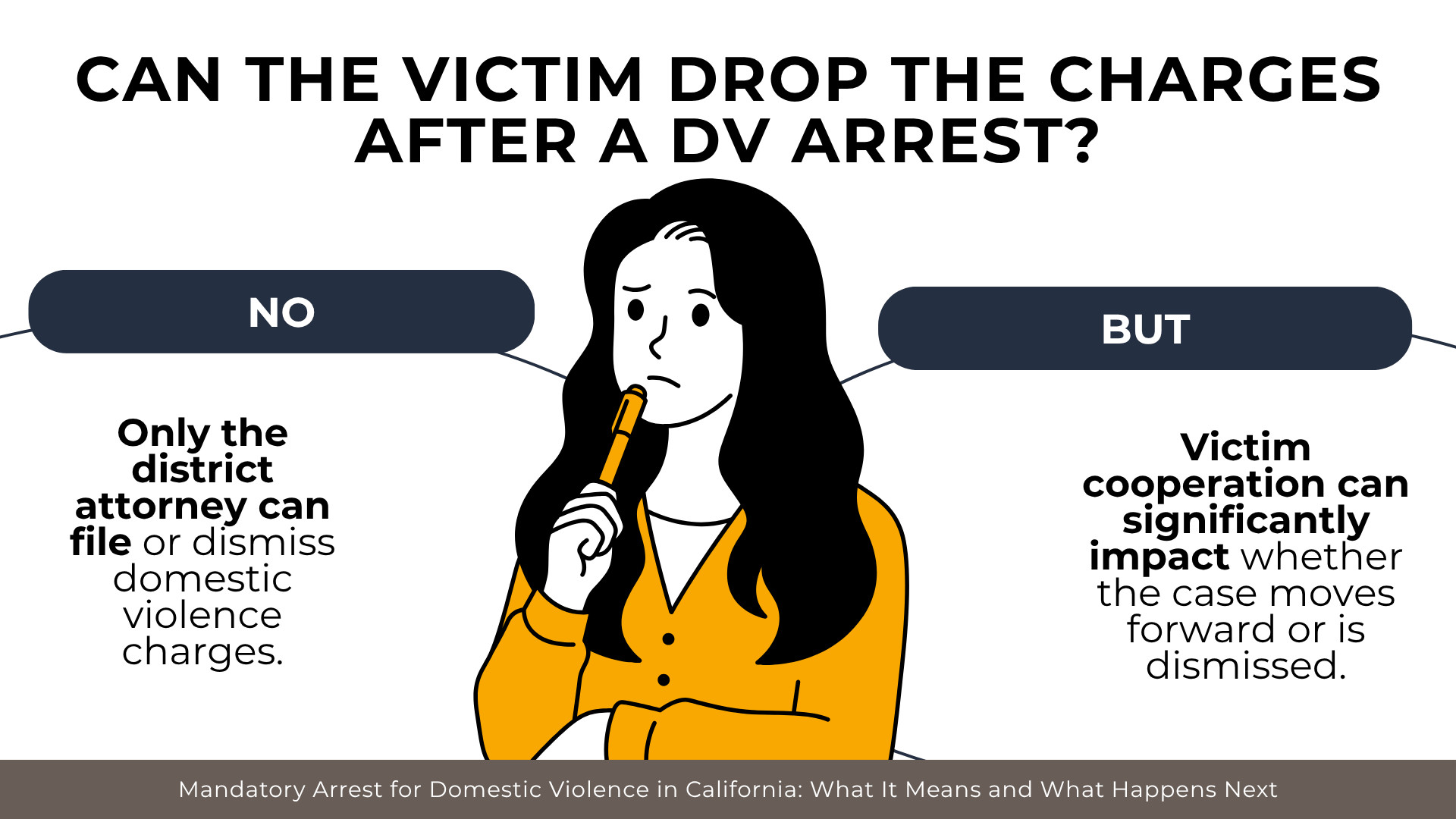
No. This is the most widespread and most damaging misunderstanding in domestic violence cases. Once an arrest is made, the decision to file criminal charges belongs only to the district attorney’s office. The alleged victim cannot “press charges” or “drop charges.” Those phrases describe a power that does not exist in California’s criminal justice system. The state is the prosecuting party, not the individual who was allegedly harmed.
That said, the victim’s willingness to participate matters a great deal to how the case actually plays out — just not in the way most people expect. When a first-responding officer conducts only a basic investigation, prosecutors decline to file criminal charges approximately 70% of the time. And among DV cases that are ultimately dismissed after filing, 78% are dismissed because the victim would not cooperate with the prosecution.
So while the victim holds no legal authority over the case, their cooperation is often the single most important practical factor in whether charges move forward. This creates a complicated reality. The district attorney may proceed without the victim’s testimony — using 911 recordings, officer observations, photographs, and other evidence gathered at the scene. But when a victim is unwilling to testify, the prosecution’s case becomes much more difficult to prove beyond a reasonable doubt.
What this means for you: do not assume the case will disappear because the alleged victim doesn’t want it to continue. Some cases do fall apart without victim cooperation. Many do not. A review of 135 studies found that roughly 60% of DV arrests result in charges being filed.
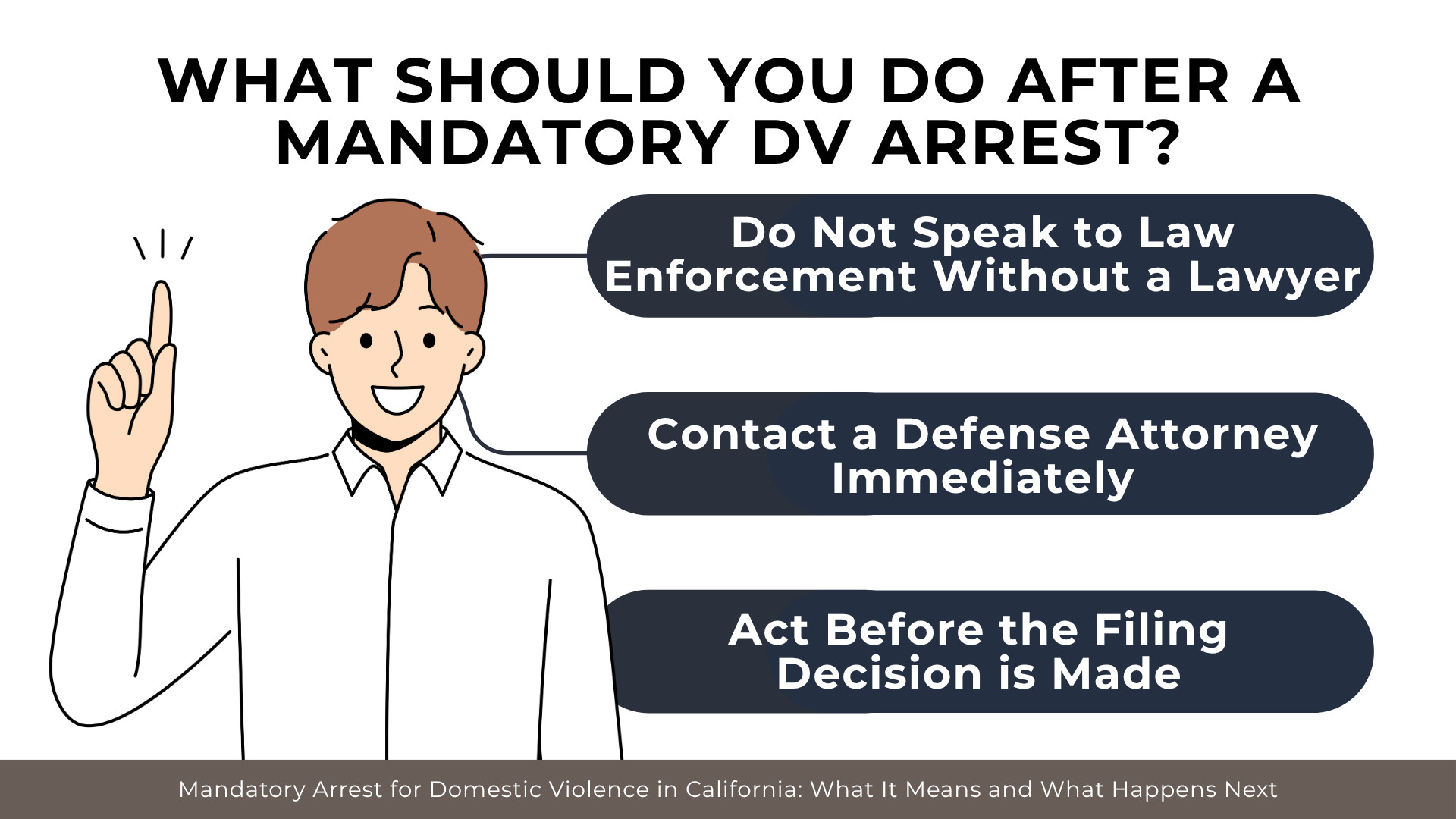
What Should You Do After a Mandatory DV Arrest?
The decisions you make before charges are formally filed carry disproportionate weight over everything that follows. The filing decision is the turning point — and it has not happened yet.
Do not make statements to law enforcement without counsel. Investigators may attempt follow-up interviews in the days after an arrest, and anything said in those conversations becomes evidence the prosecution can use. The right to remain silent exists for precisely this situation. Exercising it is not an admission of guilt. It is a legal right that experienced defense attorneys universally advise their clients to use.
The pre-filing window is the most valuable time in the case. Arrest alone increases prosecution likelihood by 92–96%. That means the earlier a defense attorney can engage with the facts, the more opportunity exists to influence the outcome. Presenting context, mitigating evidence, or witness statements to the DA’s office can shape whether charges are filed at all — and if so, at what level. When investigations remain basic, prosecutors decline to file roughly 70% of the time. That number reflects how much the quality and completeness of the evidence shapes outcomes — and a defense attorney can affect both sides of that equation.
At Angelo Reyes Law in Carlsbad, attorney Angelo J. Reyes defends clients facing criminal charges across San Diego County with a trial-first preparation approach — building every case as if it’s going to a jury, which creates leverage whether the matter resolves through negotiation or proceeds to trial. Clients work directly with Angelo throughout the case, not with a paralegal or associate. If you or a family member is facing a DV charge after a mandatory arrest, the most important decision available right now is getting a defense attorney involved before the filing decision is made.