
San Diego law enforcement runs DUI checkpoints year-round, and if you’re searching for information right now, you probably want to know what’s happening tonight or this weekend. This guide covers where checkpoints are most likely to appear, what happens when you drive through one, what you’re legally required to do (and what you’re not), and what comes next if things go sideways.
Where and When San Diego Sets Up DUI Checkpoints
San Diego County checkpoint locations aren’t random. Agencies choose them based on DUI crash data, prior arrest history, and traffic volume near alcohol-serving establishments. If you drive in San Diego regularly, you’ll notice checkpoints clustering in the same corridors.
Pacific Beach is the most heavily targeted area in the county. The stretch along Grand Avenue and Garnet Avenue sees repeated enforcement operations, with checkpoints at the 2400 block of Grand Avenue alone generating dozens of DUI arrests across multiple operations. The concentration of late-night bars, the direct connection to Mission Boulevard, and heavy foot-to-car traffic make this corridor a near-permanent fixture on enforcement schedules.
Downtown and the Gaslamp Quarter draw checkpoint activity on weekends and during major events — Padres home games, Comic-Con, San Diego Pride, and the Gaslamp Halloween celebration all trigger increased enforcement. Mission Bay and the area around West Mission Bay Drive see checkpoints tied to tourist traffic and beach activity. Further south, Chula Vista — particularly around East H Street near Southwestern College — gets targeted due to the mix of college traffic and suburban nightlife. In North County, Oceanside sees regular enforcement driven by beach crowds and Camp Pendleton military nightlife, and Escondido’s downtown corridor near I-15 draws both city and CHP operations.
The agencies running these checkpoints include the San Diego Police Department, the California Highway Patrol, and the San Diego County Sheriff’s Department. Operations funded through California Office of Traffic Safety grants are especially common during holiday weekends — St. Patrick’s Day, Fourth of July, Labor Day, and the entire summer season along coastal areas.
Most checkpoints run during nighttime and early morning hours, typically between 6:00 p.m. and 3:00 a.m. California law requires agencies to publicly announce checkpoints in advance, usually through press releases issued 24 to 72 hours before the operation. You can find announcements through local news outlets, the San Diego County Sheriff’s website, and checkpoint aggregator sites that compile alerts statewide.

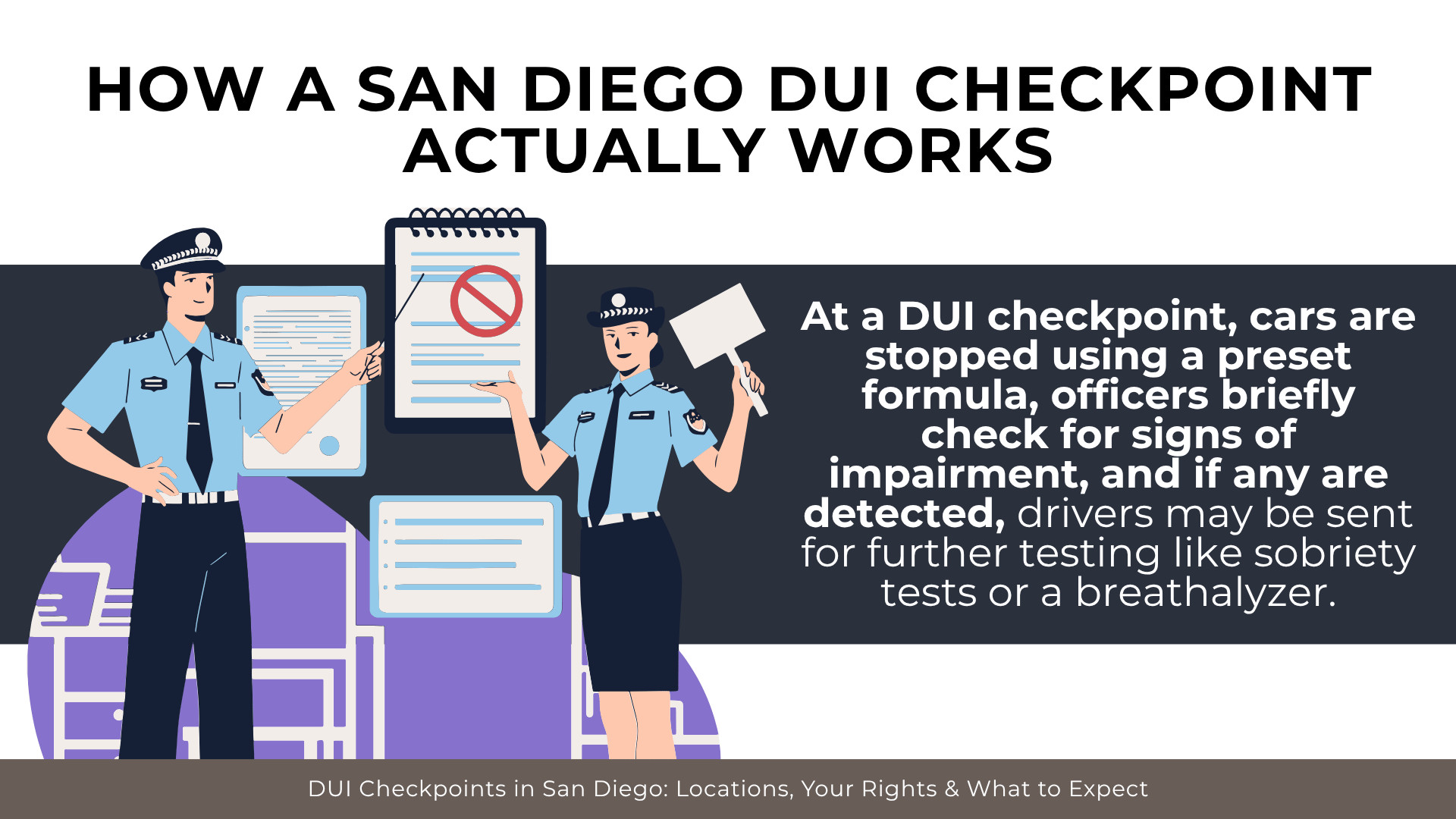
How a San Diego DUI Checkpoint Actually Works
Knowing what to expect takes the edge off. Here’s the sequence.
As you approach, you’ll see signs, cones, and usually flashing lights marking the checkpoint area. Officers use a predetermined, neutral vehicle selection formula — every third car, every fifth car, or a similar pattern. This isn’t discretionary. The formula is set by supervisory personnel before the checkpoint opens, and officers on the ground follow it. If your car is the one that gets waved over, it’s because of the formula, not because of how you look or what you’re driving.
When you stop, an officer will approach your window and ask for your license and registration. During this brief interaction — which should last no more than a few minutes if nothing raises concern — the officer is observing. They’re looking for the odor of alcohol, slurred speech, red or watery eyes, fumbling with documents, or any other visible sign of impairment.
If the officer sees no signs of impairment, you’ll be waved through. If something raises suspicion, the encounter escalates. You may be directed to a secondary screening area and asked to perform field sobriety tests — things like the walk-and-turn, one-leg stand, or horizontal gaze nystagmus test. You may also be asked to blow into a preliminary alcohol screening device, which is the handheld breathalyzer officers carry at the scene.
This is where most people don’t realize they have choices. The next section is the one that matters most.
Your Legal Rights at a San Diego DUI Checkpoint
There’s a hard line between what you must do at a checkpoint and what you can decline, and most drivers don’t know where that line falls.
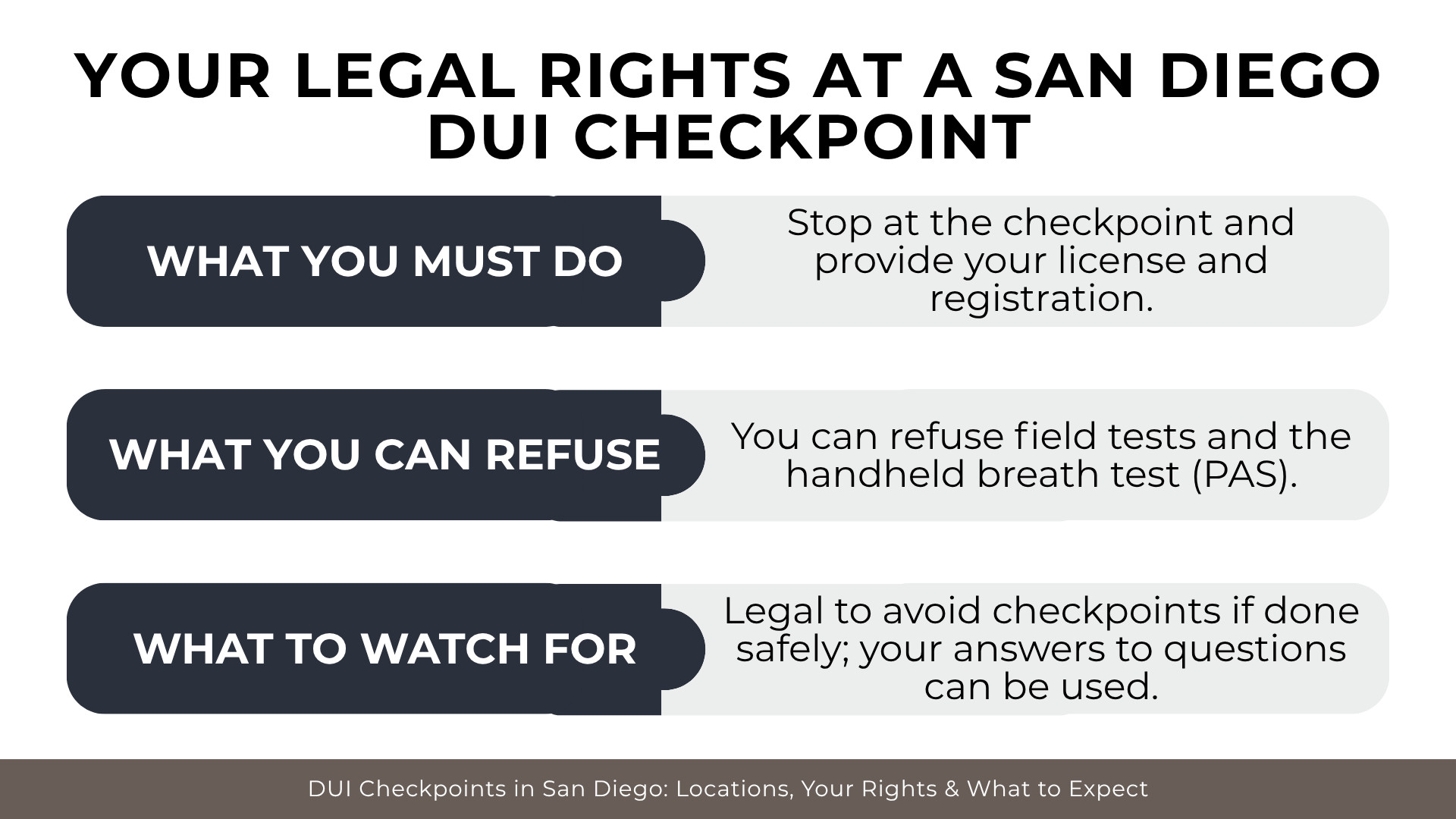
What you must do: Under California Vehicle Code § 2814.2, you are required to stop at a sobriety checkpoint. You must provide your driver’s license and registration when asked. These are non-negotiable.
What you can decline: Field sobriety tests — the walk-and-turn, the one-leg stand, all of them — are voluntary in California. There is no statutory penalty for refusing to perform them. The officer won’t necessarily tell you this. You should also know that your refusal can be mentioned in court as consciousness of guilt, but the tests themselves are not required.
The preliminary alcohol screening test — the handheld breathalyzer at the checkpoint — is also voluntary for drivers over 21 who are not currently on DUI probation. Under Vehicle Code § 23612(h)-(i), the officer is actually required to advise you that you have the right to refuse this test. Importantly, refusing the PAS test cannot be used against you in court the way refusing field sobriety tests can. The distinction matters: the PAS device is a screening tool, not the evidentiary chemical test that comes later.
Turning around: You can legally make a U-turn or turn off the road before reaching a DUI checkpoint, as long as you do so without committing a traffic violation. An officer cannot stop you solely for avoiding a checkpoint. However, if you make an illegal turn, cross a double yellow line, or drive erratically while turning around, that creates independent reasonable suspicion for a traffic stop — and now you’re in a worse position than if you’d just driven through.
Roadside questions and Miranda: If an officer asks you questions at the checkpoint — “Where are you coming from tonight?” or “Have you had anything to drink?” — you are not entitled to Miranda warnings. Under Berkemer v. McCarty, 468 U.S. 420 (1984), routine roadside questioning during a traffic stop does not constitute custodial interrogation. Miranda only attaches once the detention transforms into actual custody — meaning the officer’s conduct would cause a reasonable person to believe they are under arrest. Until that point, roadside questions are fair game, and your answers are admissible.
What Happens If You’re Arrested at a Checkpoint
If the officer determines there’s probable cause, you’ll be placed under arrest. At this point, the rules change significantly.
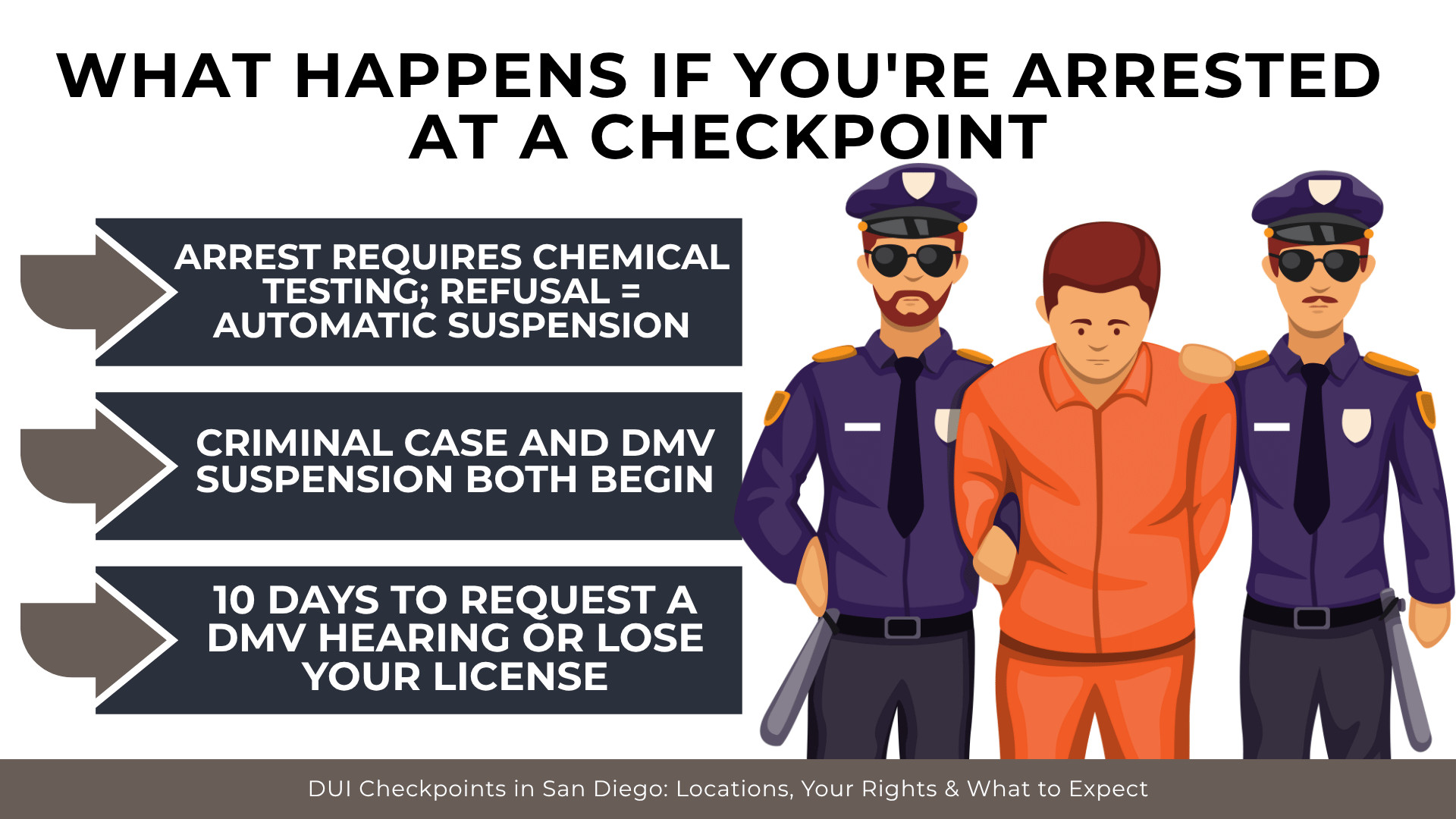
Once you’re under lawful arrest for DUI, California’s implied consent law kicks in. Under Vehicle Code § 23612(a)(1)(A), anyone who drives a motor vehicle in California is deemed to have already consented to chemical testing — blood or breath — upon lawful arrest. This is not the same as the preliminary screening device at the checkpoint. This is the evidentiary test, and refusing it carries serious consequences: under Vehicle Code § 13353, a first-offense refusal triggers an automatic one-year license suspension with no eligibility for a restricted license. A second-offense refusal means two years, and a third means three.
What catches most people off guard is that a DUI arrest triggers two entirely separate proceedings. The first is the criminal case, which moves through San Diego Superior Court. The second is a civil administrative action by the DMV called an Administrative Per Se (APS) hearing. Under Lake v. Reed, 16 Cal. 4th 448 (1997), the APS suspension is considered a civil remedial measure, not punishment — which means it proceeds on a lower burden of proof (preponderance of the evidence rather than beyond a reasonable doubt), and a criminal acquittal does not automatically vacate it.
Here’s the critical deadline most people miss: under Vehicle Code § 13558, you have ten days from receiving the suspension notice to request an APS hearing with the DMV. If you don’t request it within that window, you lose the right to contest the suspension, and it goes into effect automatically. The ten-day clock starts at arrest — not at your court date, not when you talk to a lawyer. At arrest.
For context on how common this is: California recorded 124,141 total DUI arrests in 2019. In 2020, the DMV took 91,300 Administrative Per Se license actions statewide — a process that moves forward whether you engage with it or not. Felony DUI typically requires a fourth offense within ten years, injury to another person, or a prior felony DUI conviction.
Can a DUI Checkpoint Arrest Be Challenged?
Yes, and more often than people realize.
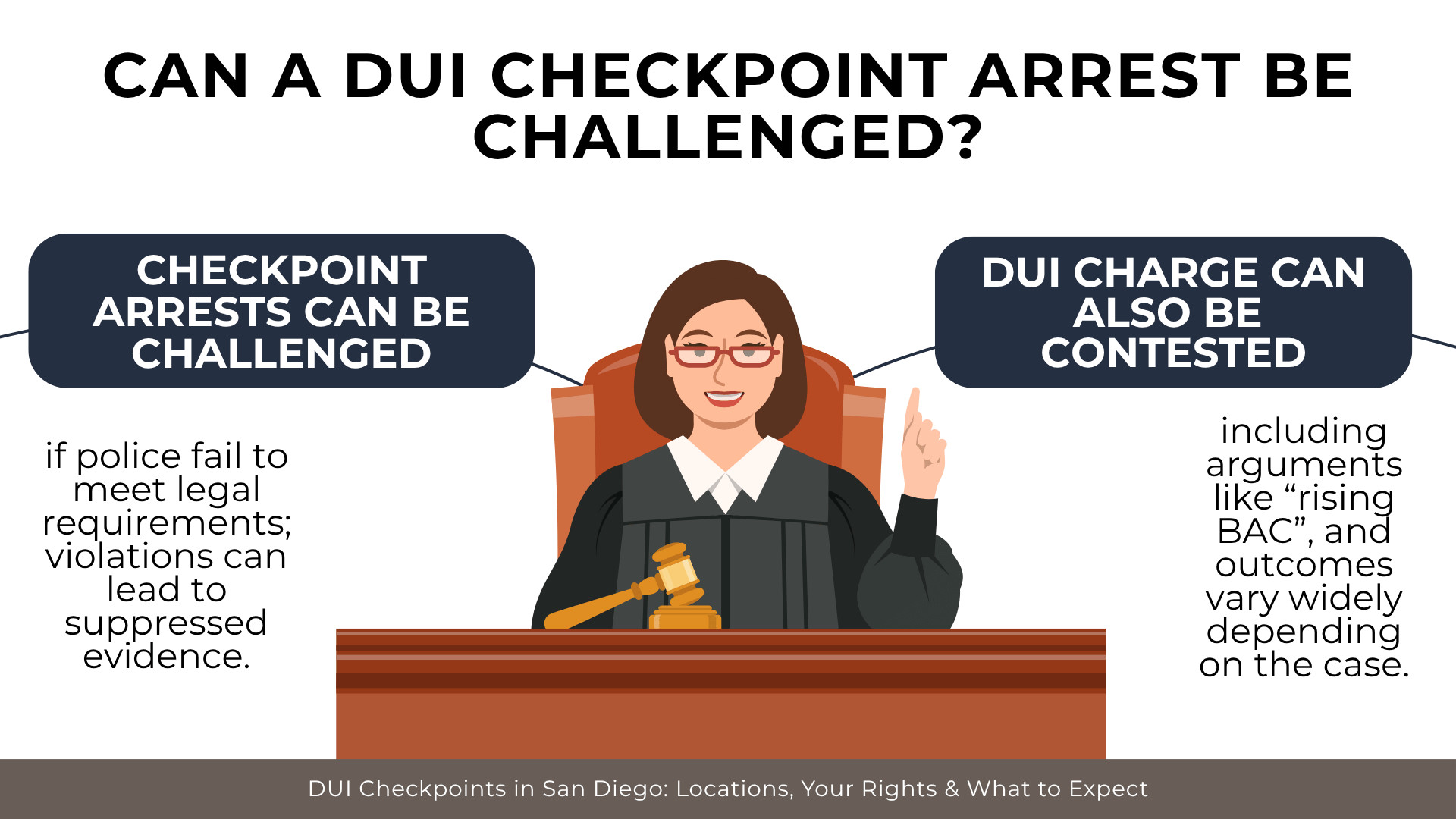
DUI checkpoints in California are constitutional, but only if they satisfy the eight-factor framework established in Ingersoll v. Palmer, 43 Cal. 3d 1321 (1987). These aren’t suggestions — they’re requirements. The checkpoint must be supervised by command-level personnel, use neutral and predetermined vehicle selection criteria, maintain adequate safety conditions, be set up at a reasonable location, provide advance publicity to the public, and impose only minimal detention on drivers. If the agency running the checkpoint failed to meet any of these factors, the stop itself may be challengeable, and any evidence gathered as a result could be subject to suppression.
Beyond checkpoint legality, the underlying science of the arrest can also be contested. Under People v. McNeal, 46 Cal. 4th 1183 (2009), a per se DUI charge under Vehicle Code § 23152(b) requires proof that your BAC was at or above 0.08% at the time of driving — not at the time of testing. Because blood alcohol concentration rises after your last drink before it falls, there’s a potential defense known as “rising blood alcohol,” arguing that your BAC was below the legal limit when you were actually behind the wheel and only reached 0.08% or higher by the time you were tested at the station.
The numbers suggest checkpoint arrests are far from automatic convictions. The overall DUI conviction rate for 2019 arrests was 68.9% — meaning roughly one in three DUI arrests did not end in a DUI conviction.
None of this guarantees a particular outcome in any individual case. But it does mean that a checkpoint arrest is the beginning of a legal process with room for scrutiny, challenge, and negotiation — not an automatic conviction.
Why Having a San Diego DUI Attorney Matters
A DUI checkpoint arrest involves technical legal requirements at every stage — the constitutionality of the checkpoint itself, the calibration and maintenance records of testing devices, the officer’s training and adherence to protocol, and the strict procedural deadlines on the administrative side. Missing the ten-day DMV hearing window alone can cost you your license before your criminal case even begins.
A local attorney who handles San Diego DUI cases knows which agencies are running checkpoints in which corridors, how those agencies document their operations, and where procedural gaps tend to appear. They represent you in both proceedings simultaneously — the criminal case in court and the administrative hearing at the DMV — which most people don’t realize require separate, coordinated defense strategies.
Angelo Reyes at Law Office of Angelo Reyes, APC in Carlsbad represents clients throughout San Diego County in DUI cases. A San Diego criminal defense attorney admitted to the State Bar of California and the U.S. District Court for the Southern District of California, Angelo has been recognized by the National Trial Lawyers as a Top 40 Under 40 attorney. He brings extensive trial experience to DUI defense and prepares every case for trial — which changes how the prosecution approaches your case from the start.
If you were arrested at a checkpoint or are facing a DUI charge in San Diego County, the ten-day DMV deadline is already running. Contact Law Office of Angelo Reyes, APC to discuss your case.
