
If you’re reading this, something happened — and now you’re trying to figure out what comes next. A DUI arrest in San Diego sets off a series of legal and administrative requirements that can feel overwhelming, especially when you’re seeing terms and timelines for the first time. DUI classes are one of those requirements, and understanding how they work is one of the most concrete things you can do right now to move forward.
This guide breaks down how California’s DUI education programs work, which one applies to your situation, what the experience looks like from the inside, and how all of it connects to getting your license back. Everything here is specific to California law and relevant to San Diego County.
What DUI Classes Actually Are — and Why the Court Requires Them
DUI classes are state-licensed alcohol and drug education programs that California courts order as a condition of DUI probation. They aren’t optional enrichment. They’re a legal obligation tied directly to your sentencing, your probation compliance, and your ability to reinstate your driver’s license.
Under California law, DUI probation runs between three and five years pursuant to Vehicle Code § 23600(b)(1), and enrollment in a DUI program is one of the standard conditions the court imposes during that period. Nearly 95.9% of convicted DUI offenders in California receive probation as a court sanction, which means almost everyone convicted of a DUI will face this requirement.
The programs are licensed and regulated by the California Department of Health Care Services. San Diego County has multiple approved providers, but every program follows the same state-mandated curriculum and reporting requirements. The court doesn’t care which licensed provider you choose — it cares that you enroll in the correct program level and complete it.

Which Program Level Applies to You
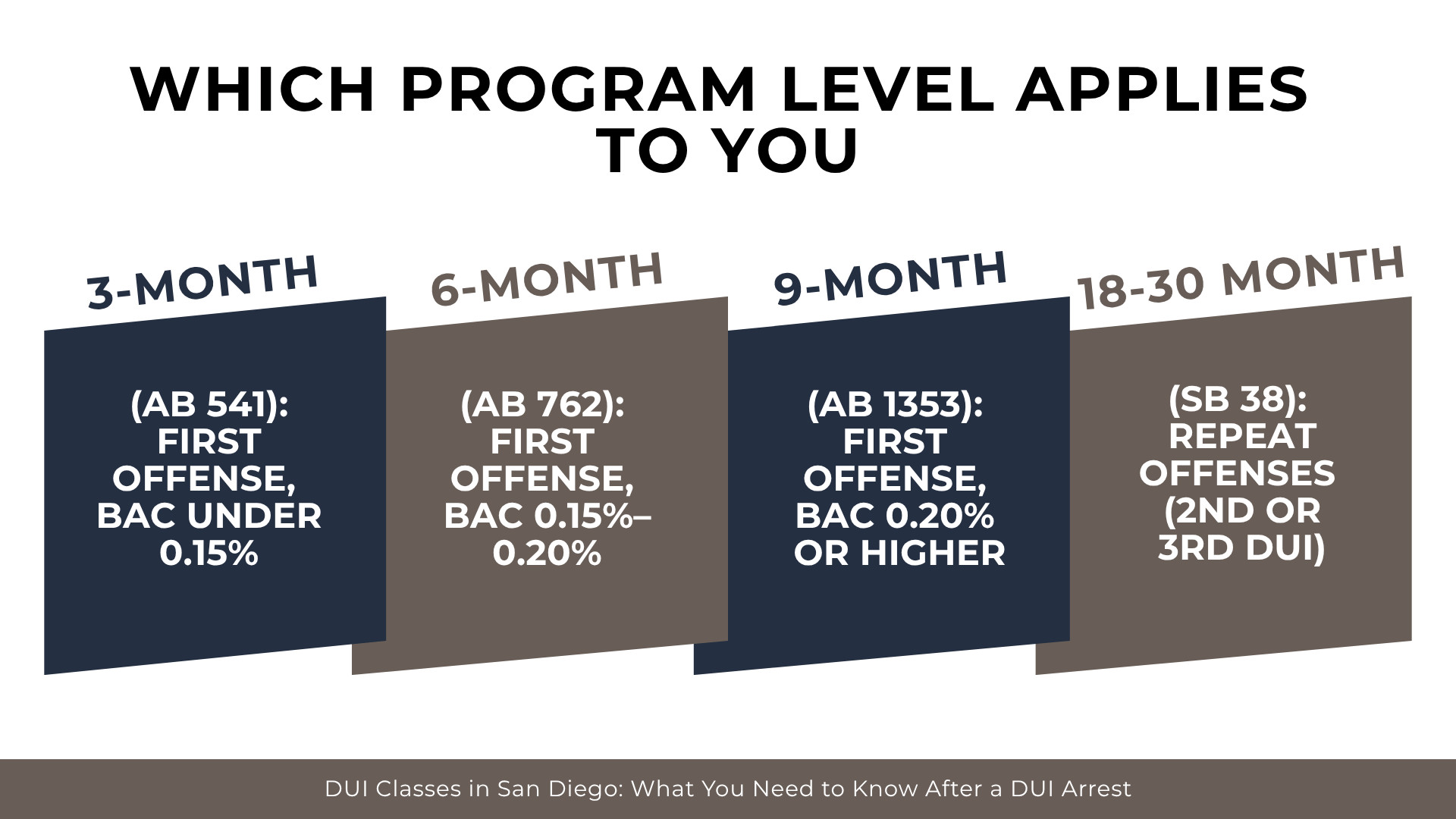
California doesn’t have a single DUI class. There are four distinct program levels, and the one you’re required to complete depends on the specifics of your case — primarily whether this is a first or repeat offense and what your blood alcohol concentration was at the time of arrest.
AB 541: The 3-Month First-Offense Program. This is the standard program for a first-time DUI conviction with no aggravating factors. It involves approximately 30 hours of education spread over three months. If you were convicted of a straightforward first DUI and your BAC was below 0.15%, this is most likely what the court ordered.
AB 1353: The 9-Month Program. Under Vehicle Code § 23538(b)(2), a BAC of 0.20% or higher triggers mandatory enrollment in the 9-month program. This isn’t discretionary. According to statewide data, a significant number of first offenders test well above the 0.08% threshold — so the 6- or 9-month programs are more common than many people expect.
SB 38: The 18-Month or 30-Month Program. Second and third DUI offenses within a ten-year lookback period require substantially longer programs. The 18-month program is standard for a second offense, while a 30-month program may be ordered for third offenses. These programs involve more intensive counseling and a greater number of total contact hours.
The critical point here is that the court determines your program level — you don’t get to choose a shorter one because it’s more convenient. Your sentencing paperwork will specify the program. If you’re unsure which level was ordered, that’s something a San Diego DUI attorney can clarify quickly by reviewing your court documents.
What Happens Inside These Programs
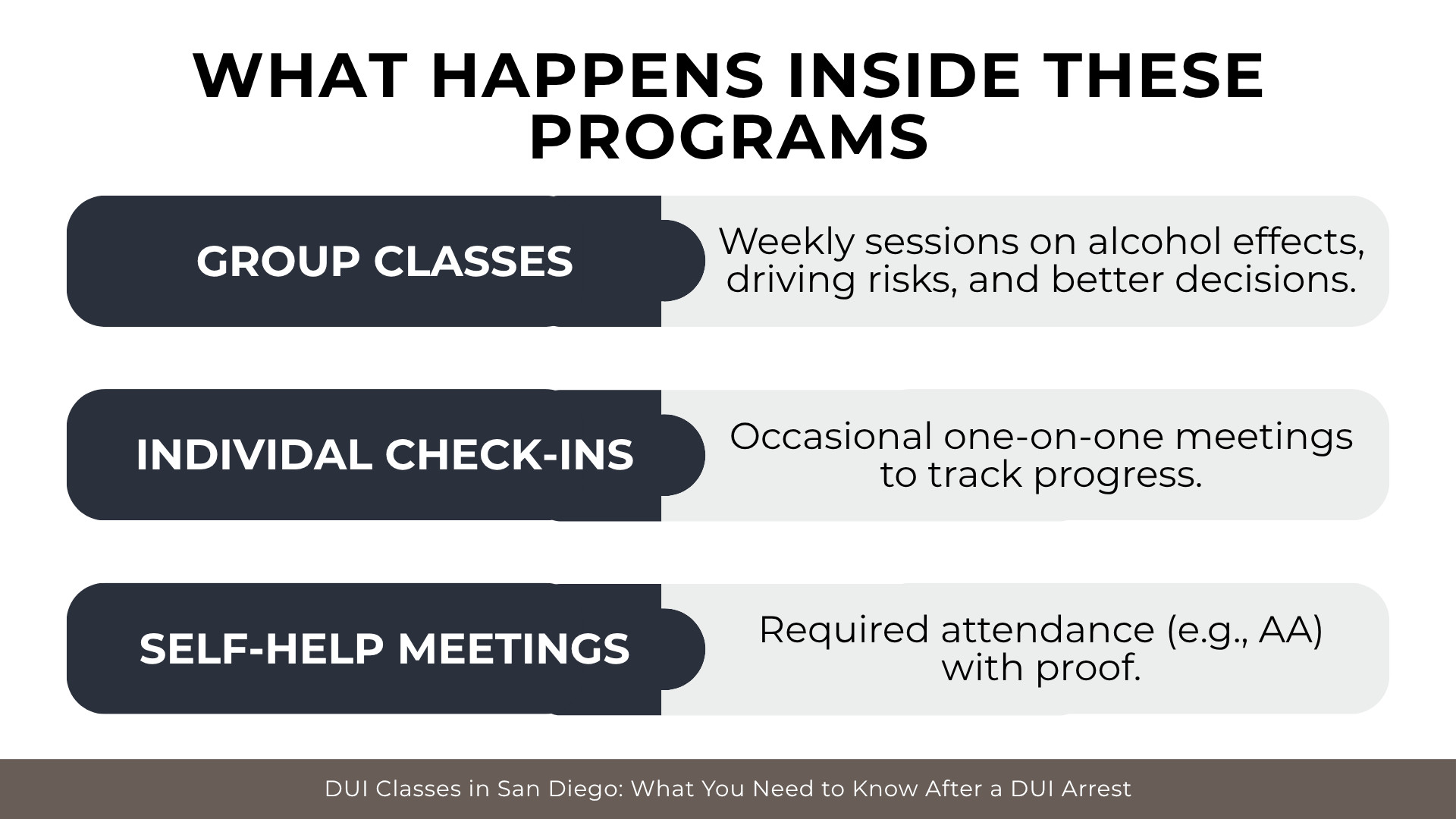
If you’ve never been through anything like this, it’s natural to wonder what you’re walking into. DUI programs in California follow a structured format that generally includes three components: group education sessions, individual interviews or counseling sessions, and self-help or community meeting attendance.
Group sessions are the core of the program. You’ll attend regularly scheduled classes — typically once or twice a week depending on your program level — covering topics like the physiological effects of alcohol, risk factors for impaired driving, and decision-making strategies. These are educational in tone, not confrontational. You’ll be in a room with other people going through the same process.
Individual sessions happen less frequently, often monthly, and involve one-on-one check-ins with a counselor. These are meant to assess your progress and address any personal circumstances relevant to your case.
Most program levels also require attendance at a specified number of self-help meetings, such as Alcoholics Anonymous or similar groups, with documentation that you attended.
What the programs are not is punitive group therapy. They’re structured, curriculum-based, and completion-oriented. You show up, participate, and meet milestones. The completion rate for first-time offenders who enroll is 83.9%, which means the large majority of people who start the program finish it.
Enrollment Deadlines and What the Court Expects
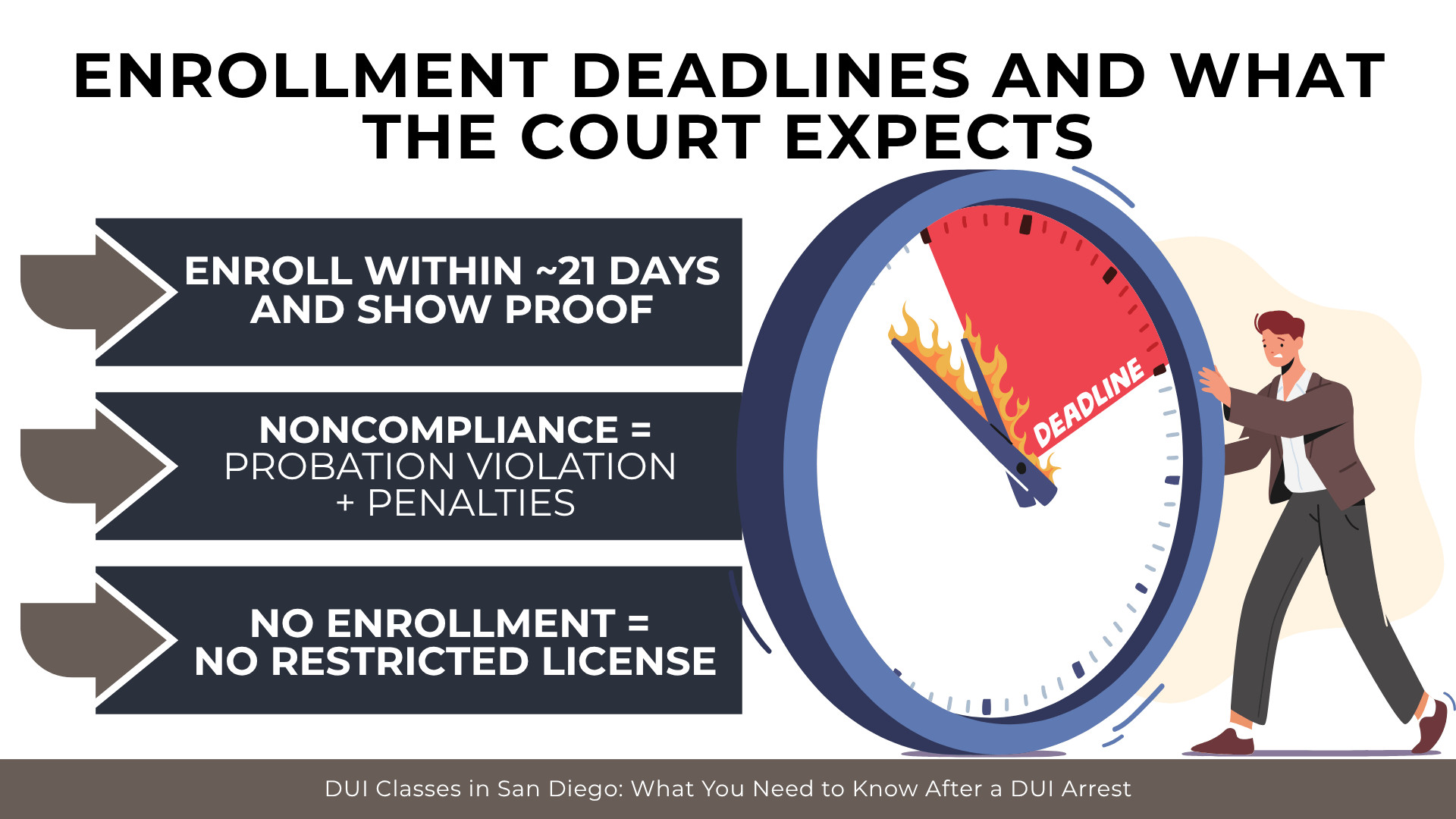
Timing matters. Courts in San Diego typically require that you enroll in your DUI program within 21 days of sentencing, though the exact deadline will be stated in your court order. Once enrolled, you’ll need to provide proof of enrollment to the court — usually a document from the program provider confirming your start date and program level.
This isn’t a formality the court forgets about. DUI probation conditions are actively monitored. If you fail to enroll by the deadline, fail to attend sessions, or drop out of the program, you’re in violation of your probation under the terms established at sentencing. The consequences of a probation violation can include a bench warrant for your arrest, additional jail time, and extension of your probation period.
This is also where the court process and the DMV process overlap. The DMV requires proof of DUI program enrollment as a precondition for issuing a restricted license — so delay in enrolling doesn’t just risk a probation violation, it delays your ability to legally drive.
How DUI Classes Connect to Getting Your License Back
One of the most immediate concerns after a DUI arrest in San Diego is driving. California runs two separate tracks after a DUI — the criminal case in court and the administrative license action through the DMV — and the DUI program sits at the intersection of both.
On the DMV side, the Administrative Per Se process under Vehicle Code § 13353.2 triggers an automatic license suspension if your BAC was 0.08% or higher, regardless of what happens in your criminal case. This suspension is a civil administrative action — the California Supreme Court has held that it functions as a remedial measure, not a punishment, meaning it proceeds on its own timeline independent of your court case.
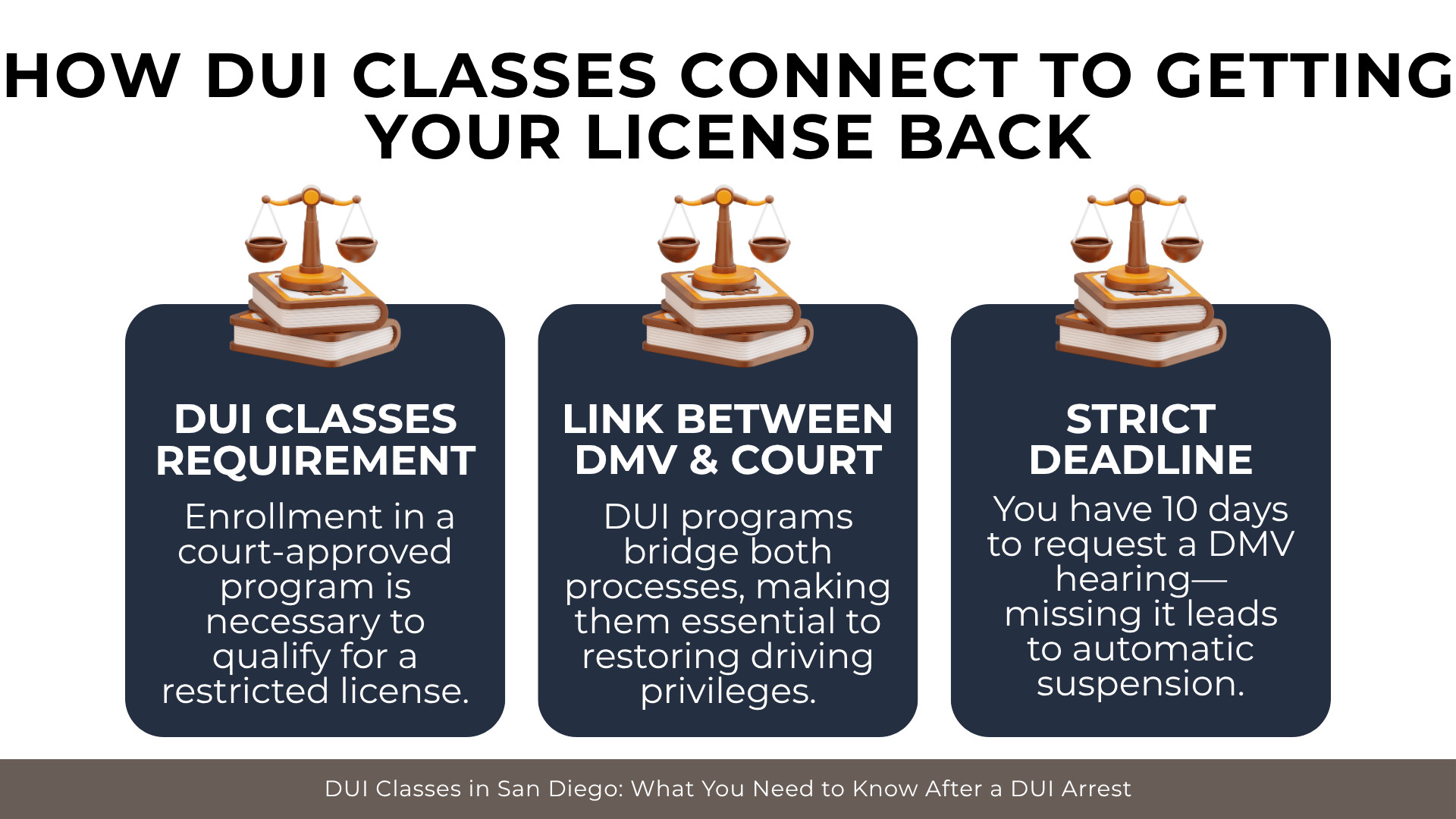
To get a restricted license that allows you to drive to work, school, or your DUI program, you generally need to satisfy three conditions: enroll in your court-ordered DUI program, file an SR-22 proof of financial responsibility with the DMV (which you’ll need to maintain for three years under Vehicle Code § 13352.4), and install an ignition interlock device if required under Vehicle Code § 23575.3.
The IID requirement has expanded significantly in recent years. Following the implementation of SB 1046, the rate of IID installation among convicted DUI offenders rose from 16.8% in 2018 to 23.7% following 2019 arrests. Under § 23575.3, IID duration varies by offense: 6 months for a first injury DUI, 12 months for a second offense, 24 months for a third, and 36 to 48 months for a fourth or subsequent offense.
There’s one critical deadline built into the DMV side: you have only ten days from your arrest to request an Administrative Per Se hearing under Vehicle Code § 13558. If you don’t request this hearing within that window, you lose the right to contest the administrative suspension entirely. This is one of the most time-sensitive steps in the entire DUI process, and it’s separate from anything your criminal defense attorney does in court.
Cost, Duration, and Practical Logistics in San Diego
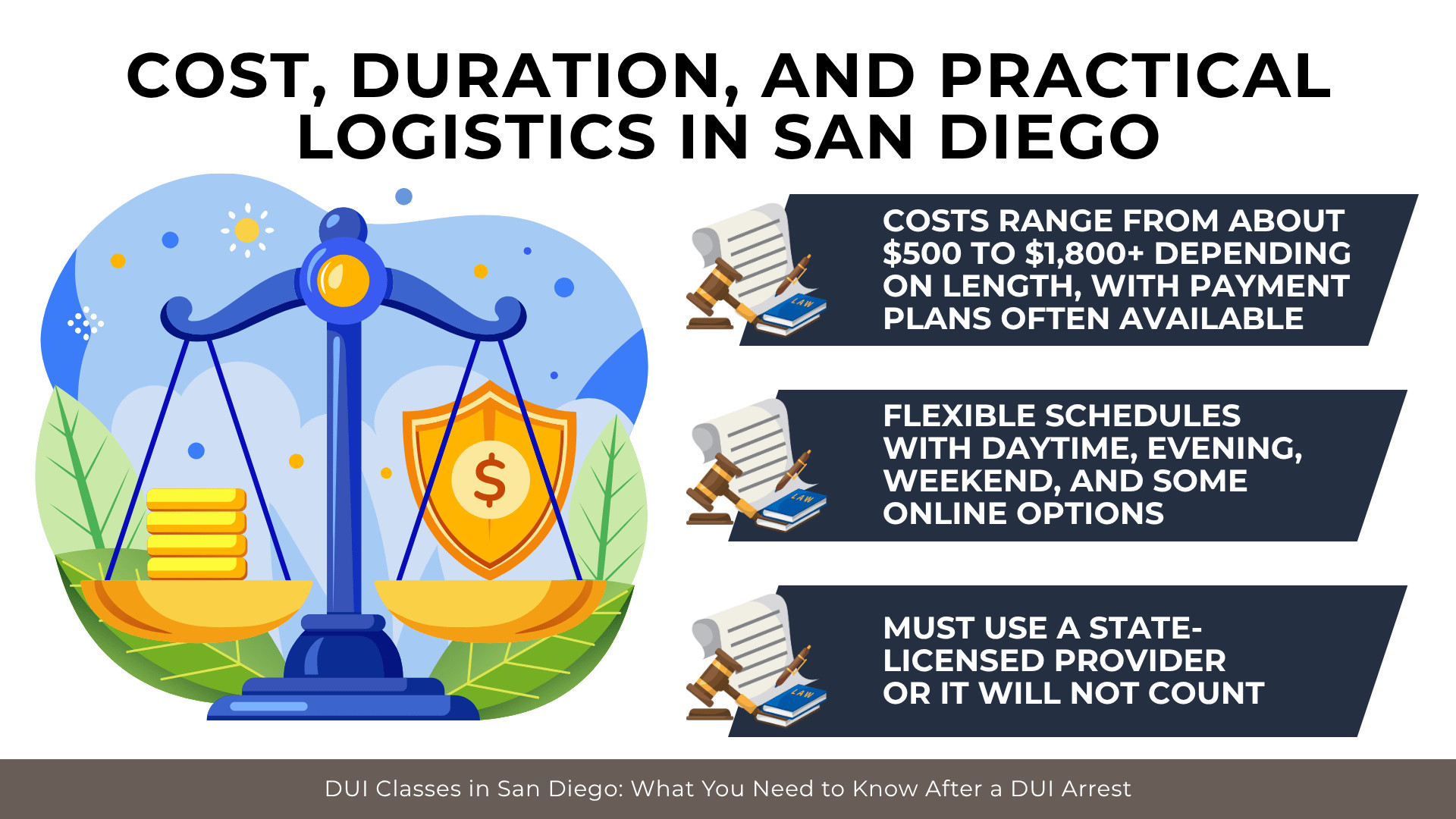
DUI program costs in San Diego vary by provider and program level, but they follow general ranges. The 3-month AB 541 program typically runs between $500 and $700. The 6-month and 9-month programs are proportionally higher, generally in the range of $800 to $1,200. The 18-month SB 38 program can cost $1,800 or more.
Most providers offer payment plans, and some offer sliding-scale fees based on income. Financial hardship should not prevent enrollment — it’s worth asking providers directly about reduced-cost options, because failing to enroll on time creates problems that cost far more than the program itself.
On scheduling, San Diego providers generally offer both daytime and evening sessions, and some offer weekend availability. Since the COVID-19 pandemic, some online or hybrid options have become available, though requirements vary by program and county. Confirm with both your provider and the court that any remote format satisfies your specific court order before relying on it.
Every provider you consider must be licensed by the California Department of Health Care Services. Completing a program through an unlicensed provider won’t satisfy your court or DMV requirements, and you’d have to start over.
What Happens If You Don’t Complete the Program
The data on this is straightforward. Among first-time offenders who enroll in DUI programs, 83.9% complete them successfully. But for second offenders — who face the longer 18-month programs — the completion rate drops to just 42.1%. The longer the program, the harder it is to stay on track, and the consequences of falling off don’t pause while you figure things out.
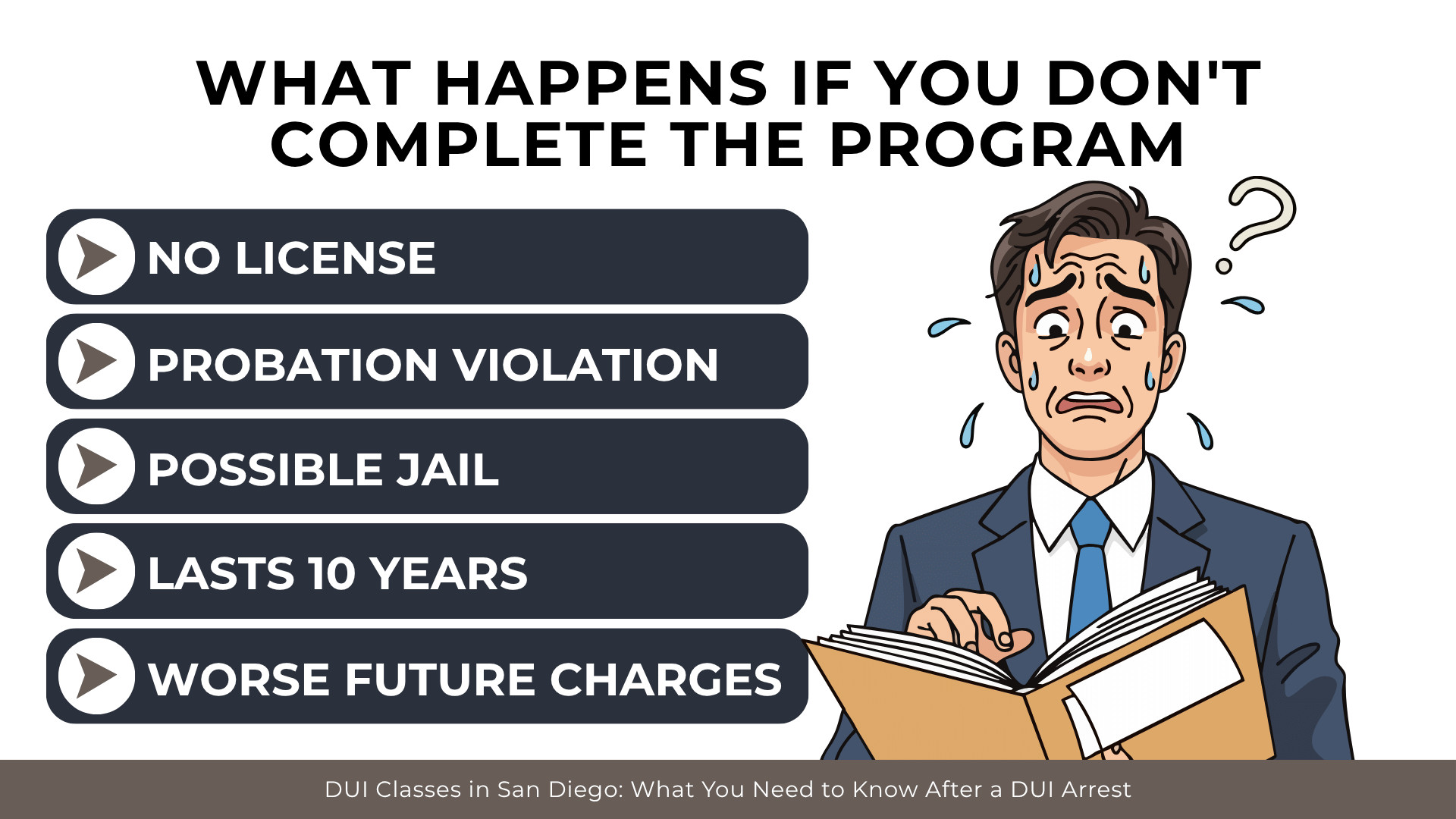
If you fail to complete your program, the DMV will not reinstate your full driving privileges. Your court-imposed probation remains in violation, which can trigger additional sentencing — including jail time that may have been suspended as part of the original plea. And because California uses a ten-year lookback period for DUI priors, an unresolved first offense complicates everything if there’s ever a second arrest.
None of this is meant to add to what you’re already dealing with. It’s meant to make the case that starting the program early — and finishing it — is genuinely the simplest path through a complicated situation.
How a San Diego DUI Attorney Can Help With DUI Classes and Beyond
DUI classes are just one piece of a larger legal process, and how the rest of that process unfolds can directly affect which program you’re required to complete and for how long.
For example, in some cases an attorney may be able to negotiate a plea to a “wet reckless” — an alcohol- or drug-related reckless driving conviction that carries different sentencing requirements than a standard DUI. The percentage of DUI convictions reduced to wet reckless was 7.9% statewide in 2019 — it’s not automatic, but it’s a recognized outcome that experienced DUI attorneys pursue when the facts support it. And the overall DUI conviction rate for 2019 arrests was 68.9%, meaning roughly one in three arrests did not end in a DUI conviction — which can materially change what a person is required to do after an arrest.
Beyond the criminal case, an attorney handles the DMV Administrative Per Se hearing and ensures every procedural requirement — from the 10-day hearing request deadline to enrolling in the correct program level — is met on time.
Law Office of Angelo Reyes, APC is a DUI defense firm based in Carlsbad, serving clients throughout San Diego County. Attorney Angelo J. Reyes, recognized by the National Trial Lawyers as a Top 40 Under 40 attorney, prepares every matter for trial — which shapes how he approaches negotiations, DMV hearings, and the full scope of what follows a DUI arrest. If you’re trying to figure out your next step, a consultation can help you understand exactly what you’re facing and what your options are.