
If you’re reading this, something just happened — a traffic stop, flashing lights, maybe a breath test you didn’t expect to fail — and now you’re trying to figure out how much trouble you’re in. Here’s the first thing worth knowing: being charged is not the same as being convicted. There is a path through this. But some of the deadlines are short, and California’s underage DUI laws work differently than most people assume. This guide walks through what you’re actually facing, what the law says, and what to do right now.
California’s Zero Tolerance Law: The 0.01% Standard
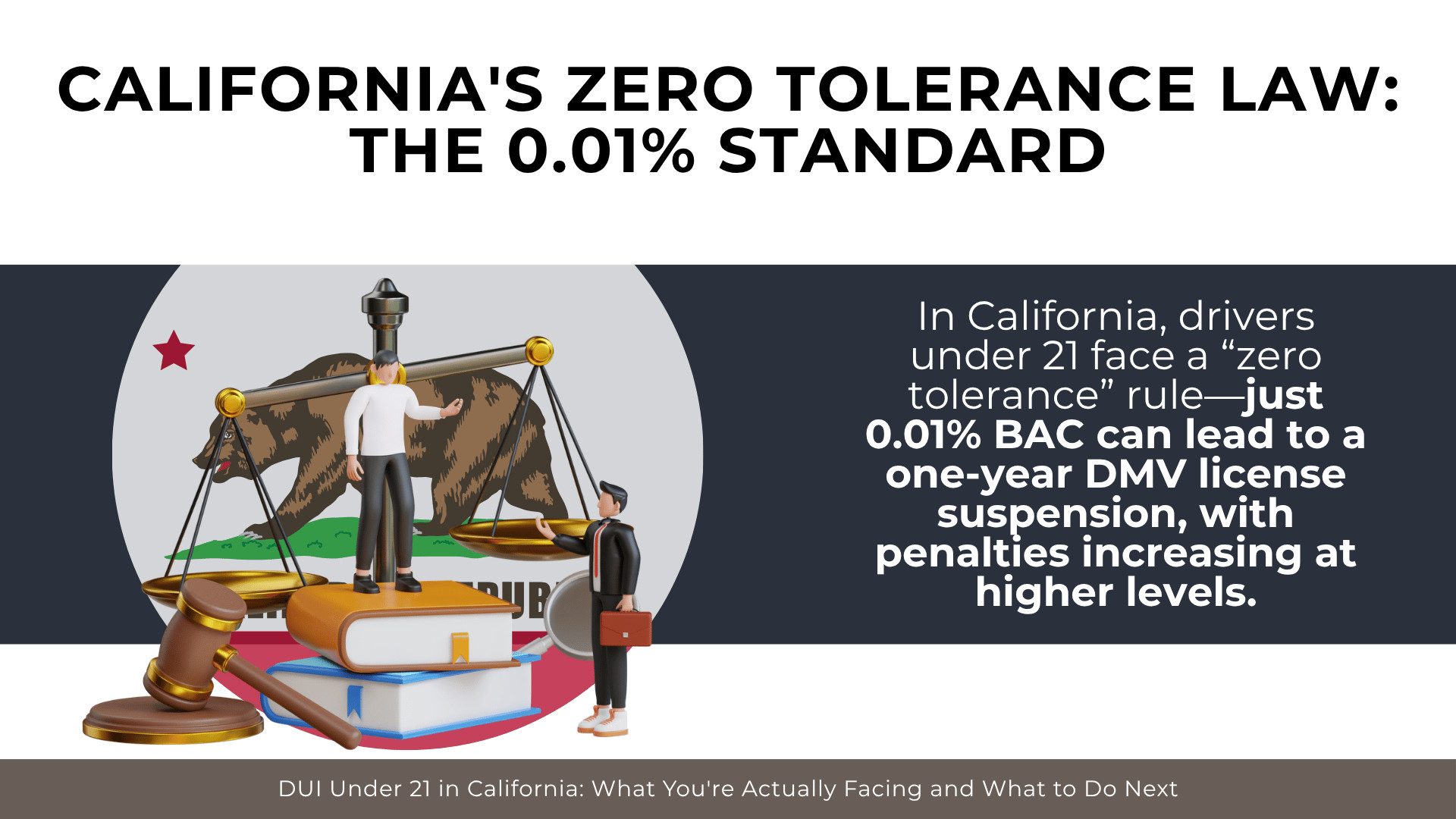
California does not give drivers under 21 the same 0.08% BAC threshold that applies to adults. Under Vehicle Code § 23136, it is unlawful for anyone under the age of 21 to drive with a blood alcohol concentration of 0.01% or higher. That is not a typo. One drink — sometimes less — can put you over the line.
This is California’s “zero tolerance” policy for underage drinking and driving. At this level, the violation is handled as a civil and administrative matter, not a criminal charge. The DMV — not a criminal court — imposes the penalty, which is a one-year license suspension.
But § 23136 is only the starting point. What happens to you depends almost entirely on how high your BAC was, and that’s where most of the confusion starts.
Three Separate Laws, Three Different Situations
Most people assume “underage DUI” is a single charge. It isn’t. California has three distinct statutes that can apply to a driver under 21 who has been drinking, and they layer on top of each other as BAC increases.
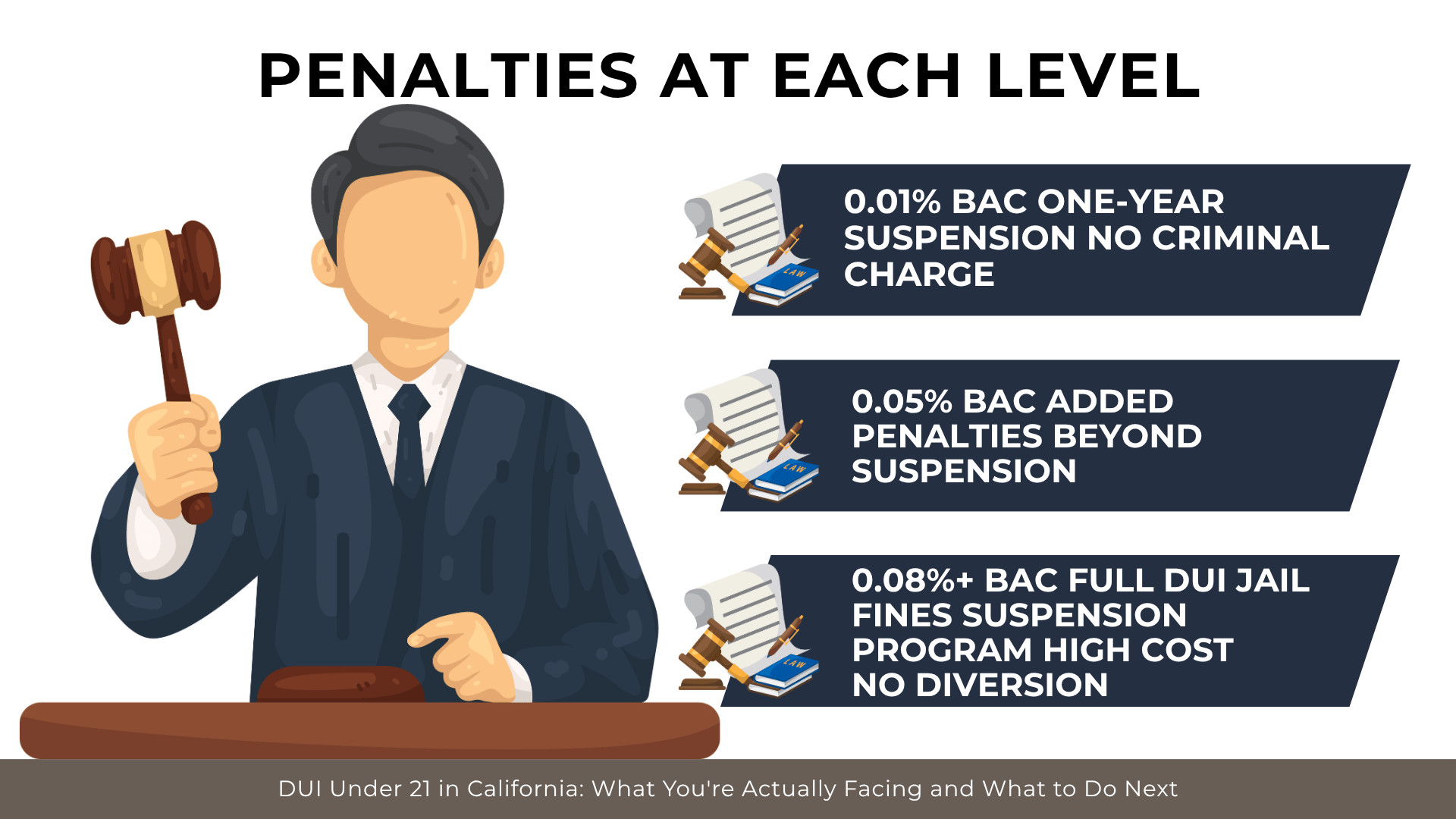
BAC of 0.01% or higher — Vehicle Code § 23136. This is the zero tolerance law. It’s a civil infraction, not a criminal offense. The consequence is a one-year suspension of your driver’s license through the DMV’s Administrative Per Se process. There is no jail time and no criminal record from this statute alone.
BAC of 0.05% or higher — Vehicle Code § 23140. This is an additional statute specific to underage drivers that carries its own penalties beyond the § 23136 suspension. Because § 23140 occupies a middle tier between zero tolerance and a full DUI, the specific consequences you face under it are something to discuss with an attorney based on your circumstances.
BAC of 0.08% or higher — Vehicle Code § 23152(a) and (b). This is the full DUI statute that applies to every driver in California regardless of age. If you are under 21 and your BAC hit 0.08% or above, you face the same criminal DUI charge as a 45-year-old — plus the underage consequences from § 23136 and potentially § 23140 stacked on top. This is a misdemeanor criminal offense. It goes on your criminal record. It carries potential jail time, heavy fines, mandatory DUI school, and a license suspension that can extend well beyond what the zero tolerance law imposes.
The distinction matters enormously. A 20-year-old who blows a 0.02% is in a very different legal position than a 20-year-old who blows a 0.10%. The first is dealing with a DMV administrative matter. The second is facing criminal prosecution.

Penalties at Each Level
Under § 23136 (0.01%+ BAC): One-year license suspension imposed by the DMV. No criminal charge, no jail, no criminal record from this violation alone.
Under § 23140 (0.05%+ BAC): Additional penalties beyond the § 23136 suspension apply at this tier. An attorney can walk you through what § 23140 means for your specific situation.
Under § 23152 (0.08%+ BAC) — First offense: This is where the consequences escalate sharply. Under Vehicle Code § 23536, a first-offense DUI carries 96 hours to six months in county jail, fines ranging from $390 to $1,000 (before penalty assessments, which multiply the base fine significantly), a six-month license suspension from the court under Vehicle Code § 13352, and mandatory enrollment in a DUI education program. If your BAC was 0.15% or higher, Vehicle Code § 23578 allows the court to impose additional enhanced penalties at its discretion. If it was 0.20% or higher, Vehicle Code § 23538(b)(2) mandates a nine-month DUI program rather than the standard three-month program.
The California Office of Traffic Safety estimates the total cost of a first-time DUI at approximately $13,500 when you combine fines, fees, insurance increases, attorney costs, DUI school, and lost wages.
DUI probation in California runs three to five years under Vehicle Code § 23600(b)(1), with a zero-tolerance alcohol condition — meaning any detectable BAC while on probation triggers a separate violation.
There is one more thing worth understanding about how seriously the system treats these cases: DUI offenses in California are categorically excluded from judicial diversion under Vehicle Code § 23640. The courts in Grassi v. Superior Court (2021) and Tan v. Superior Court (2022) confirmed this. Unlike many other misdemeanors, you cannot get a DUI diverted and dismissed through a standard diversion program.
The DMV Case vs. the Court Case: Two Separate Fights
This is the part that catches almost everyone off guard. When you are arrested for DUI in California, two entirely independent proceedings begin at the same time.
The DMV administrative action (APS). Under Vehicle Code § 13353.2, the DMV will move to suspend your license based solely on the arrest and chemical test results. This is a civil proceeding. The standard of proof is preponderance of the evidence — far lower than the “beyond a reasonable doubt” standard in criminal court. The California Supreme Court held in MacDonald v. Gutierrez (2004) that the DMV must prove the officer had reasonable cause to believe you were driving under the influence, but that’s a lighter burden than what prosecutors face.
The criminal case in court. If your BAC was 0.08% or above (or if there is evidence of impairment regardless of BAC under § 23152(a)), you also face criminal prosecution with its own timeline, hearings, and potential penalties.
These two tracks run in parallel. They do not depend on each other. The California Supreme Court made clear in Lake v. Reed (1997) that the APS suspension is a civil remedial measure, not criminal punishment, which means the Double Jeopardy Clause does not apply. You can be acquitted in criminal court and still lose your license through the DMV process.
The 10-day deadline. This is the single most time-sensitive piece of information in this article. Under Vehicle Code § 13558, you have 10 days from the date you receive the suspension notice to request an APS hearing with the DMV. If you miss this deadline, you lose the right to contest the administrative suspension and potentially to obtain a stay that keeps your license active during the hearing process. The officer who arrested you likely handed you a temporary license and a notice — that document is your clock.

What Happened During the Stop: Your Rights
If you’re replaying the traffic stop in your head and wondering what you were actually required to do, here’s how the law treats each stage.
The stop itself. Under People v. Bell (1996), a traffic stop requires reasonable suspicion — specific, articulable facts suggesting a traffic violation or criminal activity. An officer can’t pull you over on a hunch. If you were stopped at a DUI checkpoint rather than a traffic stop, different rules apply: under Ingersoll v. Palmer (1987), checkpoints are constitutional but must satisfy an eight-factor administrative framework involving supervisory oversight, neutral vehicle selection criteria, adequate safety measures, and other requirements. Vehicle Code § 2814.2 requires drivers to stop at these checkpoints.
Field sobriety tests. These are voluntary in California. There is no statutory penalty for refusing to perform them. However, as the court noted in People v. Jackson (2010), your refusal to take FSTs can be admitted as evidence of consciousness of guilt.
The preliminary alcohol screening (PAS) breath test. This is the handheld breath test administered before arrest. For drivers over 21 who are not on DUI probation, this test is voluntary under Vehicle Code § 23612(h)-(i), and the officer is required to tell you that. But for drivers under 21, § 23136 changes the calculus — the zero tolerance law applies to any detectable alcohol, and this preliminary test is the primary tool for enforcing it.
The post-arrest chemical test. Once you are lawfully arrested for DUI, California’s implied consent law under Vehicle Code § 23612(a)(1)(A) deems you to have already consented to a chemical test of your blood or breath. Refusing this test carries its own penalties under Vehicle Code § 13353: a one-year license suspension for a first refusal, two years for a second, and three years for a third. Critically, a refusal suspension carries no restricted license eligibility — meaning you cannot get a hardship license to drive to work or school during the suspension period.
On the constitutional side, the U.S. Supreme Court held in Birchfield v. North Dakota (2016) that warrantless breath tests incident to a DUI arrest are constitutional, while warrantless blood draws require either actual consent or exigent circumstances. The Court had earlier established in Missouri v. McNeely (2013) that the natural dissipation of alcohol in the bloodstream does not, by itself, constitute an exigency justifying a warrantless blood draw.
One more point worth understanding: roadside questioning during a DUI investigation typically does not trigger Miranda rights. The U.S. Supreme Court held in Berkemer v. McCarty (1984) that a routine traffic stop is not “custody” for Fifth Amendment purposes. Miranda warnings attach only when detention transforms into something a reasonable person would understand as a formal arrest, and questioning becomes interrogation.

Long-Term Consequences Beyond the Courtroom
The immediate penalties — fines, possible jail time, license suspension — are what people focus on first. But a DUI can create ripple effects that extend much further.
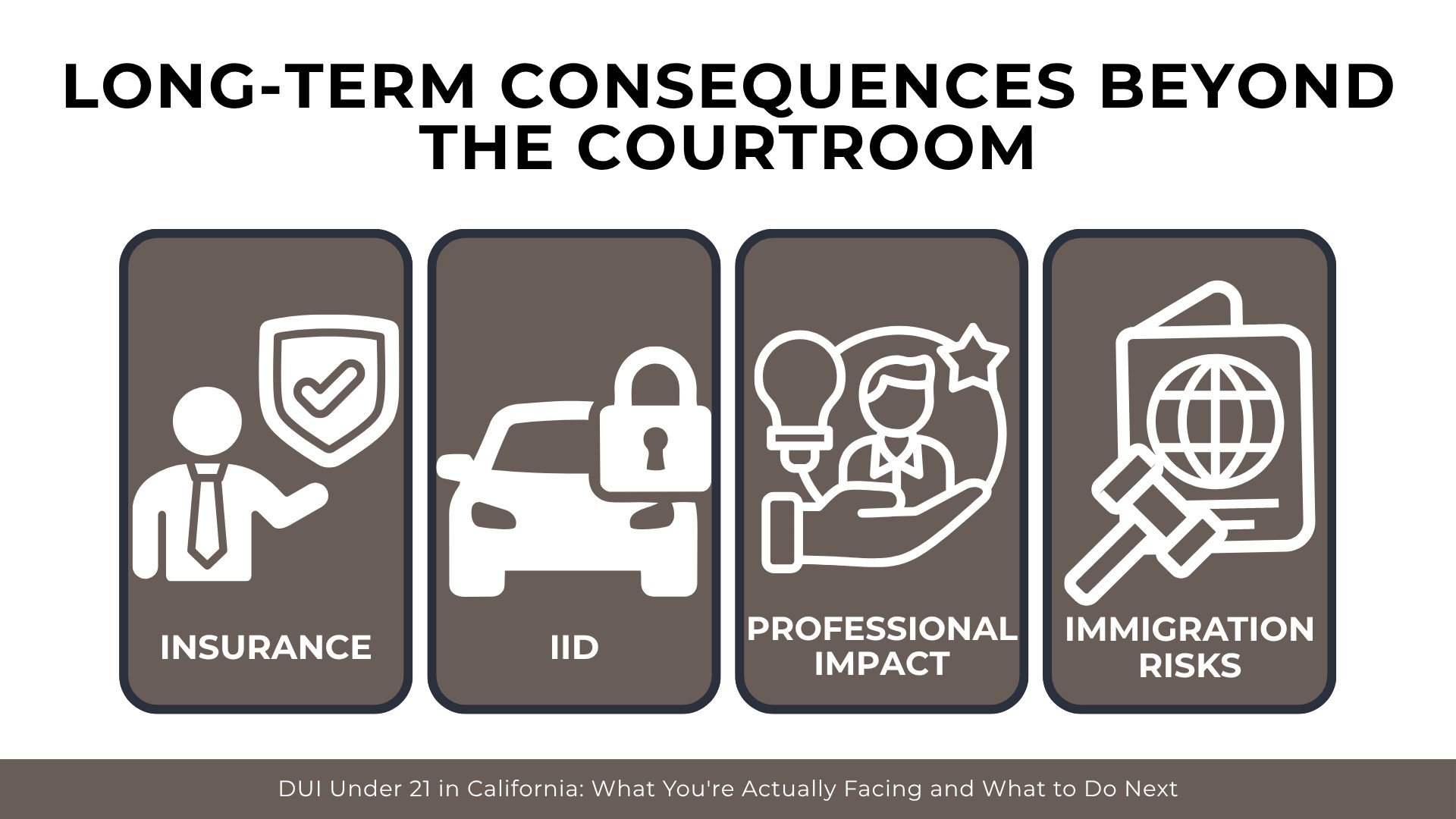
Insurance. A DUI conviction requires you to file an SR-22 certificate of financial responsibility for three years following license reinstatement. This typically results in substantially higher insurance premiums for the duration.
Ignition interlock device (IID). Under Vehicle Code § 23575.3 and following the implementation of SB 1046, IID installation is now part of the DUI penalty framework statewide. The required duration depends on the offense: six months for a first DUI involving injury, twelve months for a second offense, twenty-four months for a third, and thirty-six to forty-eight months for a fourth or subsequent offense. Note that drug-only DUI convictions under § 23152(f) are not eligible for IID-restricted licenses — alcohol involvement is required.
Professional and educational impact. Certain professional licenses require self-reporting of DUI convictions. Physicians must report within 30 days under Business and Professions Code § 802.1. Attorneys must report felony convictions under Business and Professions Code § 6068(o). If you’re still in school, a DUI may affect scholarships, financial aid, campus housing, or admission to graduate programs.
Immigration consequences. If you are not a U.S. citizen, the immigration implications depend on the specifics. The U.S. Supreme Court held in Leocal v. Ashcroft (2004) that DUI is not an aggravated felony “crime of violence” under federal law, and the Board of Immigration Appeals held in Matter of Torres-Varela (2001) that a simple DUI is not a crime involving moral turpitude. However, multiple DUI convictions can raise issues with the “good moral character” requirement for naturalization under INA § 101(f), and a single misdemeanor DUI can bar DACA eligibility as a “significant misdemeanor.”
Possible Defenses and Realistic Outcomes
A DUI charge is not a conviction, and the data bears that out. According to the California DMV’s DUI Management Information System report, the DUI conviction rate for 2019 arrests was 68.9%. That means roughly 20.5% of DUI arrest cases showed no corresponding conviction on DMV records — a figure that has been steadily increasing over time. Another 7.9% of convictions were reduced to a “wet reckless” — an alcohol-related reckless driving plea that carries lighter penalties than a full DUI, though it remains priorable if you are arrested for DUI again in the future.
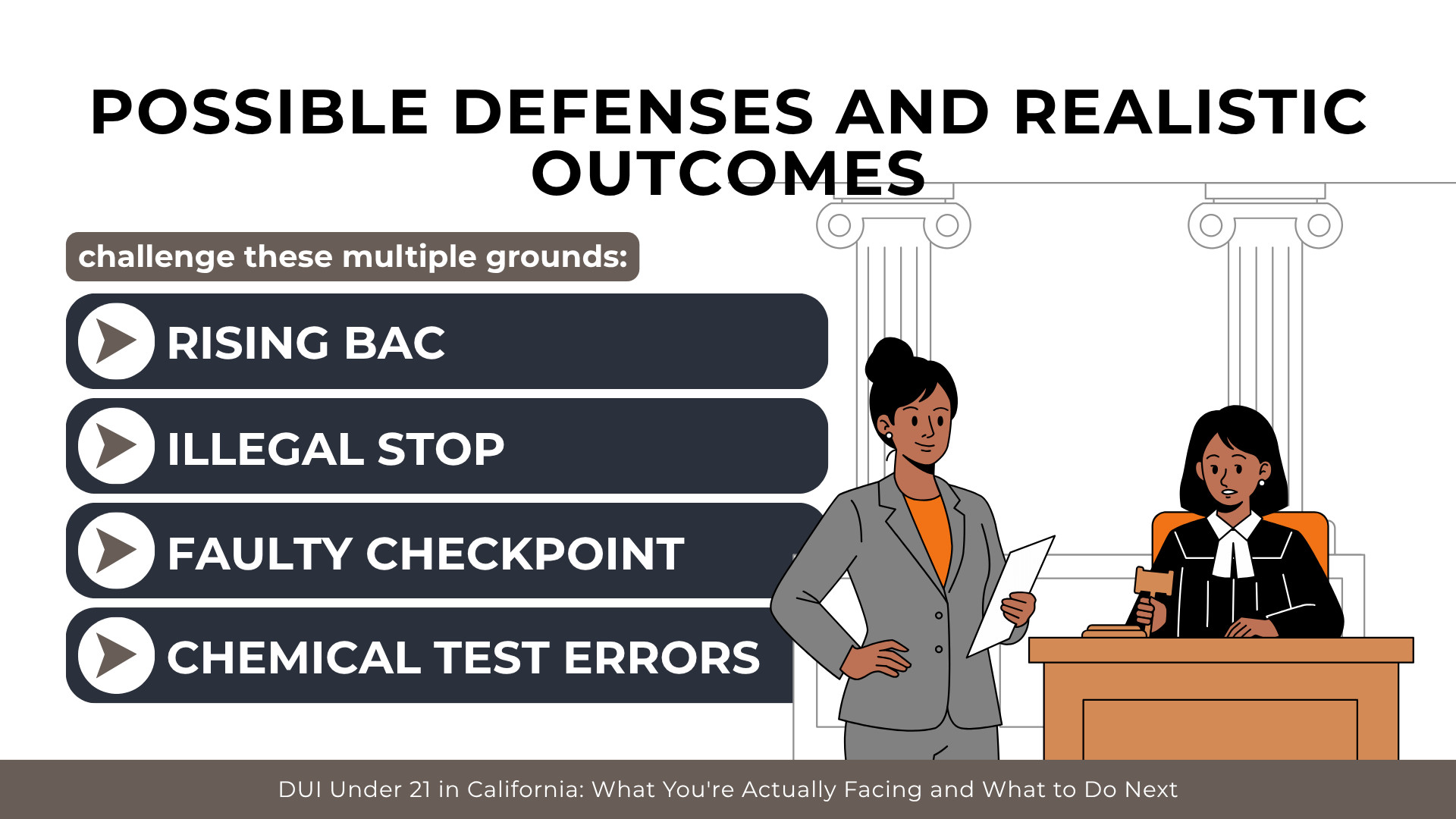
These numbers reflect the reality that DUI cases can be challenged on multiple grounds, depending on the facts.
Rising blood alcohol defense. The California Supreme Court held in People v. McNeal (2009) that per se DUI under § 23152(b) requires proof of BAC at the time of driving, not merely at the time of testing. Because blood alcohol continues to rise after your last drink, it is possible that your BAC was below the legal limit when you were actually behind the wheel but above it by the time you were tested. This is a factual defense that depends on timing, and it is particularly relevant for drivers near the 0.08% threshold.
Challenging the traffic stop. If the officer lacked reasonable suspicion to pull you over, everything that followed — the FSTs, the breath test, the arrest — may be subject to suppression. Under People v. Bell (1996), the stop must be based on specific, articulable facts, not a hunch.
Checkpoint compliance. If you were stopped at a DUI checkpoint, the eight-factor framework from Ingersoll v. Palmer (1987) must have been followed. Failures in supervisory oversight, selection criteria, or other requirements can form the basis of a challenge.
Chemical test issues. Breath testing instruments require proper calibration and maintenance. Blood samples must be drawn, stored, and analyzed according to established protocols. Deviations from these procedures can affect the reliability and admissibility of the results.
None of this guarantees a particular outcome, and conviction rates vary dramatically by county — from as low as 41.1% to as high as 91.9% depending on the jurisdiction. What it does mean is that the facts of your specific case matter, and a charge is the beginning of a process, not the end of one.
What to Do Right Now
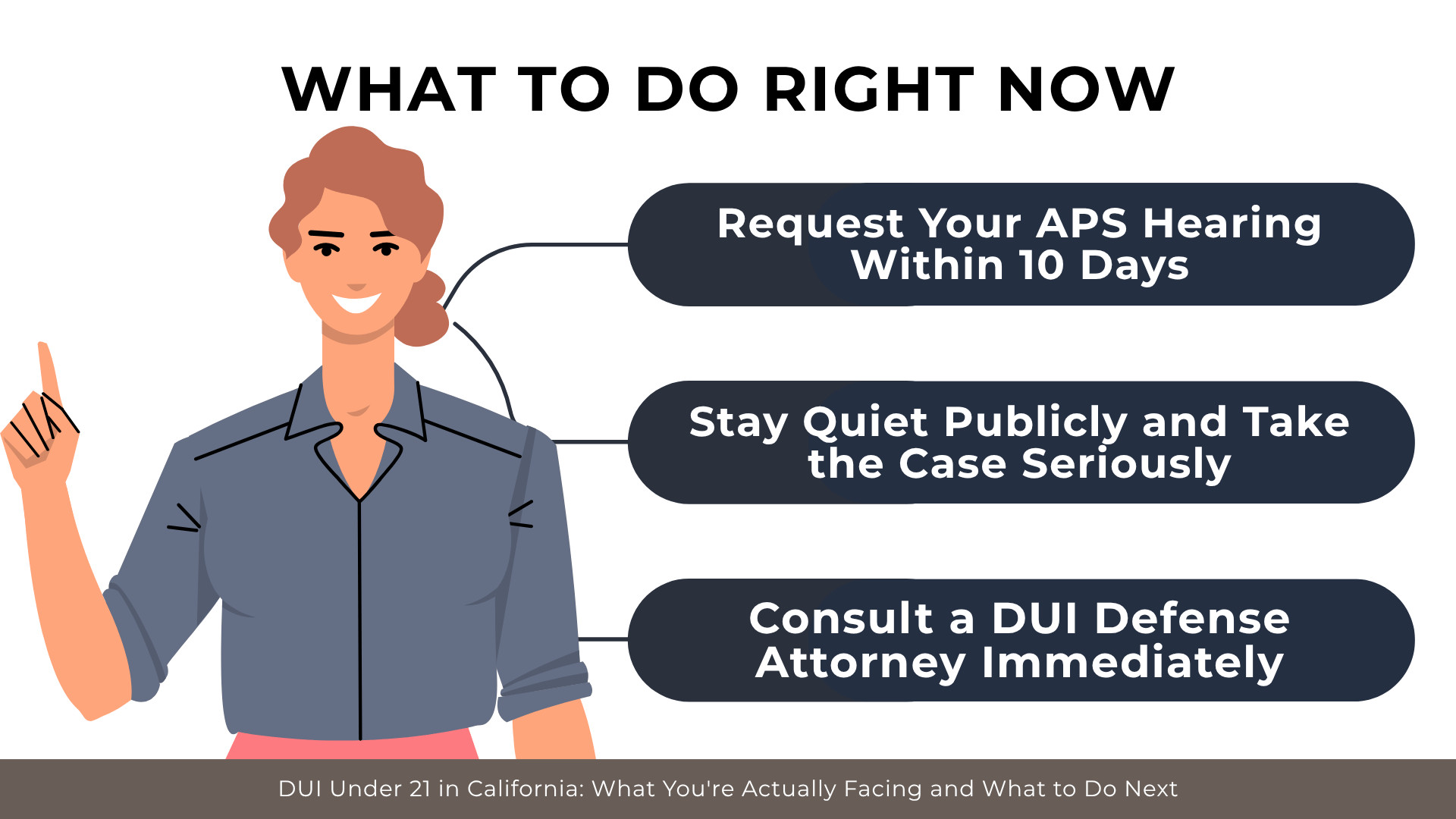
Request your APS hearing within 10 days. This is not optional if you want to contest your license suspension. Under Vehicle Code § 13558, the deadline runs from the date you received the notice — the pink temporary license the officer gave you. Mark the date. Don’t let it pass.
Do not post about your arrest on social media. Anything you write publicly can become evidence.
Do not ignore the DMV side. Even if you believe the criminal case is weak, the administrative suspension is a separate proceeding with a lower burden of proof. You need to address both.
Talk to a DUI defense attorney. The legal landscape for underage DUI in California involves overlapping statutes, two independent proceedings with different deadlines and standards, and potential consequences that extend into your insurance, education, career, and — depending on your circumstances — immigration status. An attorney who handles DUI cases in your jurisdiction can review the specific facts, identify which of the three statutory tiers applies to you, evaluate whether there are viable defenses, and make sure you don’t miss a deadline that forecloses an option.
Law Office of Angelo Reyes, APC , based in Carlsbad, California, represents clients facing DUI charges throughout San Diego County. Angelo J. Reyes is admitted to the State Bar of California and the U.S. District Court for the Southern District of California, has been recognized by the National Trial Lawyers as a Top 40 Under 40 attorney, and prepares every matter for trial. If you’re dealing with an underage DUI arrest in the San Diego area, you can reach out for a consultation to understand where your case stands and what your options look like going forward.