
If you’re reading this, chances are you were recently pulled over on a California road and asked to perform a series of physical tasks while an officer watched and took notes. Or maybe it happened to someone you care about. Either way, you’re trying to make sense of what just happened and what it means going forward.
Here’s a starting point that may help: field sobriety tests in California are not what most people think they are. They’re voluntary, they’re subjective, and the results can be challenged. Let’s walk through exactly how this works.
What Happens During a Field Sobriety Test in California
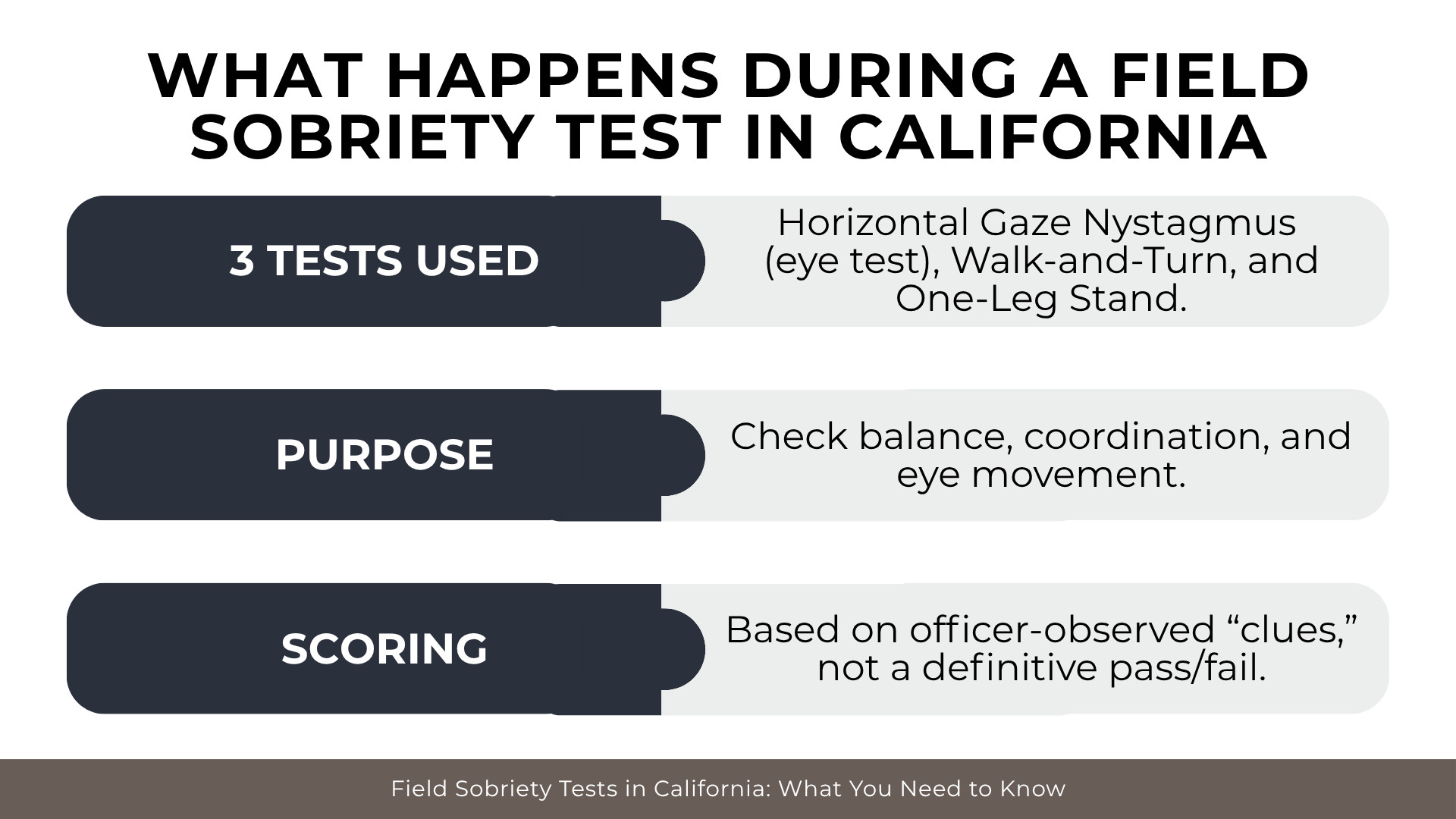
When an officer suspects a driver may be impaired, they’ll typically ask the driver to step out of the vehicle and perform a series of physical and cognitive exercises on the roadside. These are field sobriety tests, and law enforcement in California generally relies on three standardized tests developed by the National Highway Traffic Safety Administration (NHTSA).
The Horizontal Gaze Nystagmus (HGN) test involves the officer holding a stimulus — usually a pen or small flashlight — in front of your eyes and slowly moving it from side to side. They’re watching for involuntary jerking of the eye, which can be associated with alcohol consumption. But nystagmus can also be caused by medications, neurological conditions, fatigue, or even caffeine.
The Walk-and-Turn test asks you to take nine heel-to-toe steps along a straight line, turn in a prescribed manner, and take nine steps back. The officer is watching for eight specific “clues”: starting too soon, losing balance, stepping off the line, using your arms for balance, making an improper turn, taking the wrong number of steps, stopping while walking, or failing to touch heel to toe.
The One-Leg Stand test requires you to raise one foot approximately six inches off the ground and count aloud for 30 seconds. The officer looks for four clues: swaying, using arms for balance, hopping, or putting the foot down.
Each test is scored based on how many “clues” the officer observes. But here’s what matters: these aren’t pass-or-fail medical diagnostics. They’re judgment calls made by a single officer, on the side of a road, often at night, under stressful conditions — for both of you.
Field Sobriety Tests Are Voluntary in California
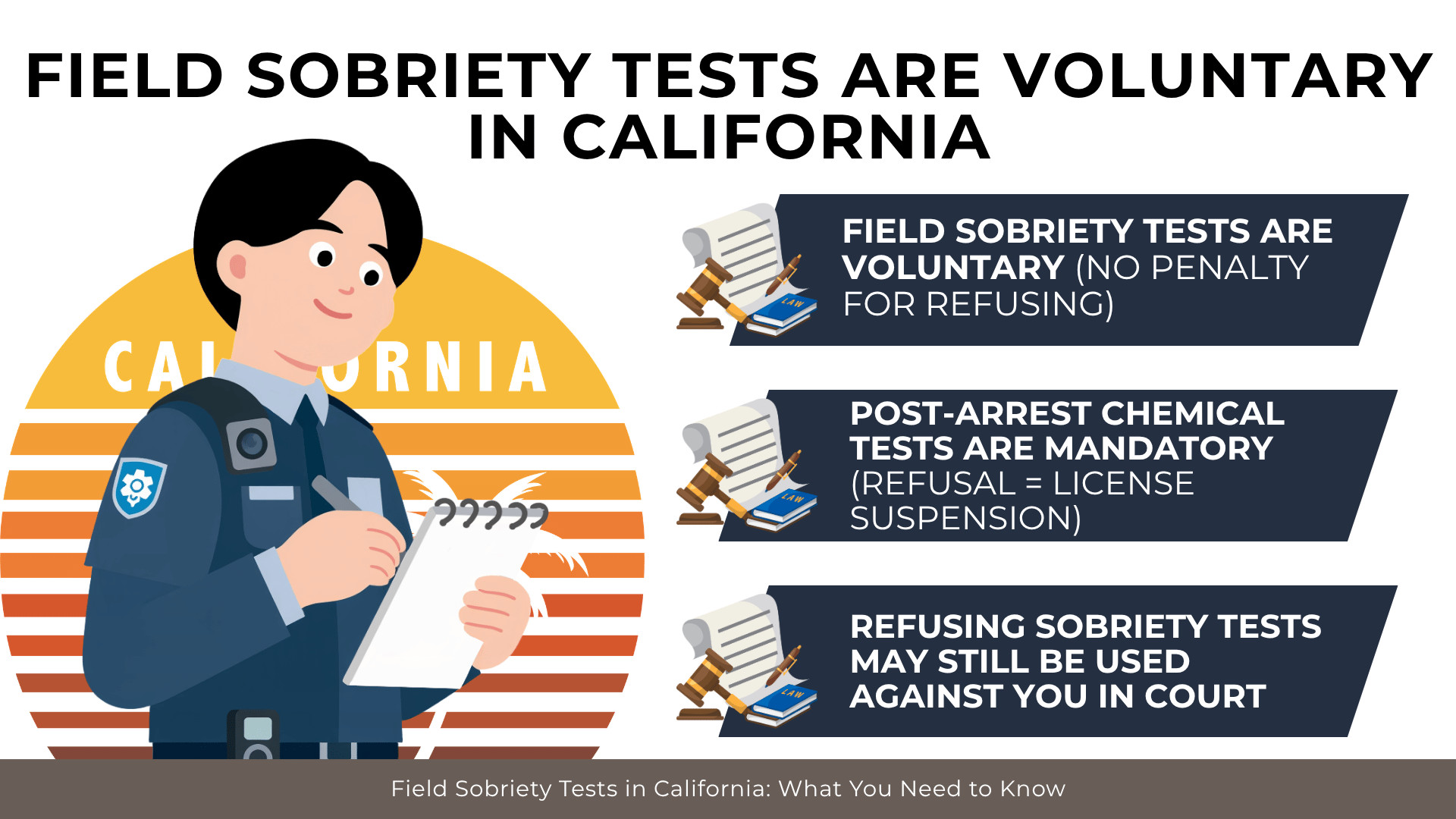
This is the single most important thing most people don’t know: field sobriety tests are voluntary in California. There is no statutory penalty for refusing to perform them.
This is a critical distinction from what happens after you’re arrested. California’s implied consent law under Vehicle Code § 23612(a)(1)(A) means that anyone who drives a motor vehicle in California is deemed to have consented to chemical testing — breath or blood — upon a lawful DUI arrest. Refusing a post-arrest chemical test triggers serious consequences: a one-year license suspension for a first refusal, two years for a second, and three years for a third under Vehicle Code § 13353.
But field sobriety tests are a different category entirely. They happen before an arrest, during the roadside investigation phase. The preliminary alcohol screening (PAS) test — the handheld breathalyzer some officers carry — is also voluntary for drivers over 21 who are not currently on DUI probation. Under Vehicle Code § 23612(h)-(i), the officer is actually supposed to advise you of your right to refuse the PAS test.
Now, here’s the nuance. In People v. Jackson, 189 Cal. App. 4th 1461 (2010), a California appellate court drew an important line: while refusing the PAS test cannot be used against you in court because you have a statutory right to refuse it, refusing field sobriety tests can be admitted as what the court called “consciousness of guilt.” In other words, a prosecutor may try to argue that you refused because you knew you’d fail.
That’s a factor worth understanding, but it doesn’t change the underlying reality — the tests themselves are voluntary, and there’s no automatic penalty for declining them.
Why Field Sobriety Test Results Are Unreliable
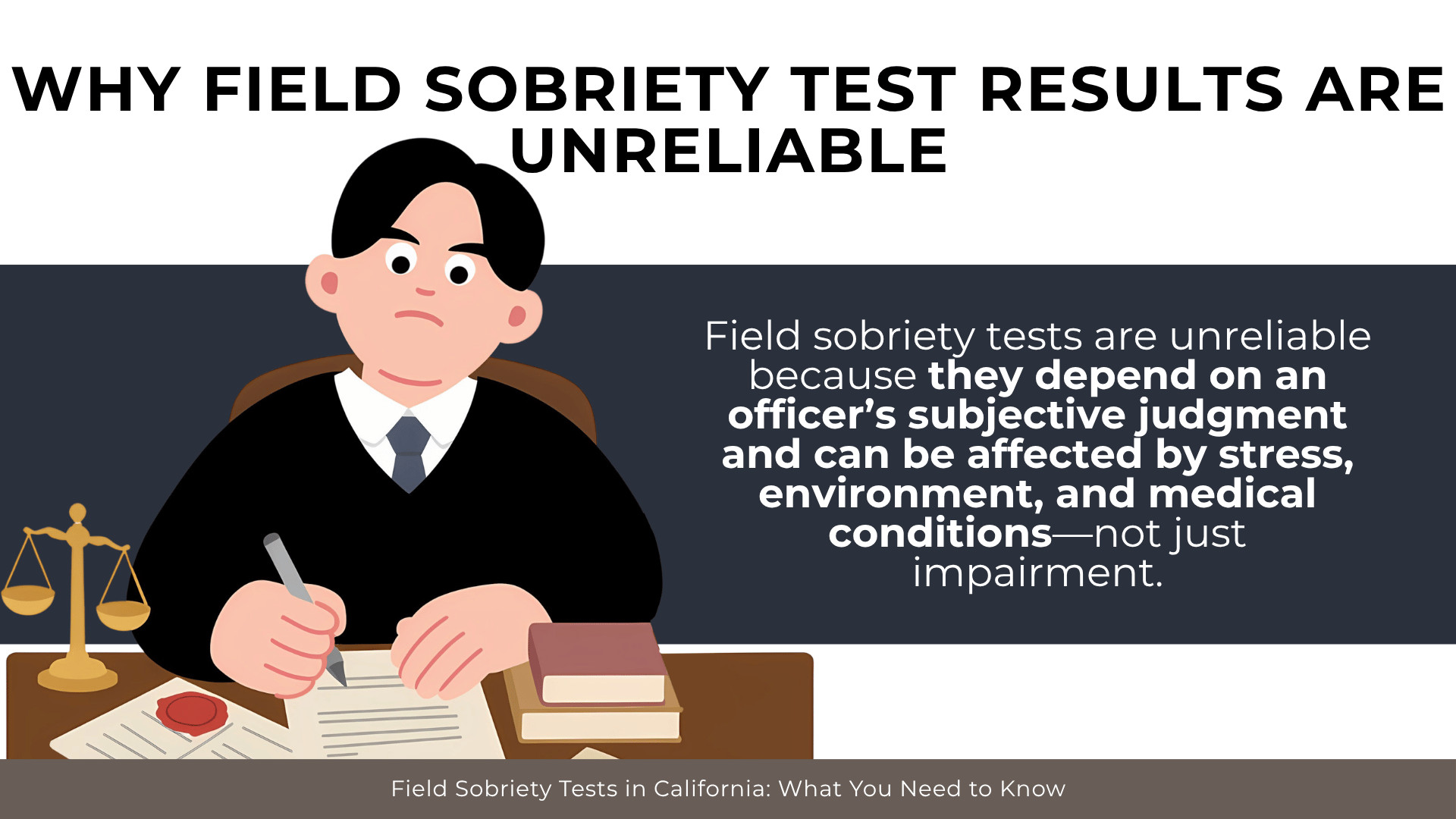
Field sobriety tests were designed to help officers establish probable cause for a DUI arrest. They were not designed to objectively or precisely measure impairment. That distinction matters enormously when you’re thinking about what FST results actually prove.
The tests are graded by the same officer who already suspected impairment — the same officer who pulled you over in the first place. There is no independent measurement, no machine readout, no second opinion. It’s one person’s assessment of your physical performance in a high-stress moment.
Consider the conditions under which most FSTs are administered. You may have been standing on a sloped or uneven road shoulder. It may have been dark. Passing traffic may have been creating wind, noise, and flashing headlights. You may have been wearing shoes that make balance difficult. You were almost certainly nervous — and nervousness affects balance, coordination, and the ability to follow multi-step instructions.
Beyond environmental factors, a wide range of medical conditions can produce the same “clues” officers are trained to watch for. Inner ear disorders affect balance. Back and knee injuries make heel-to-toe walking painful or impossible. Neurological conditions can cause nystagmus that has nothing to do with alcohol. Even age and weight can influence performance on tests that were standardized using a limited population.
None of this means FST results are automatically meaningless. But it does mean they’re far from the objective evidence many people assume them to be.
How FST Evidence Gets Used in a California DUI Case
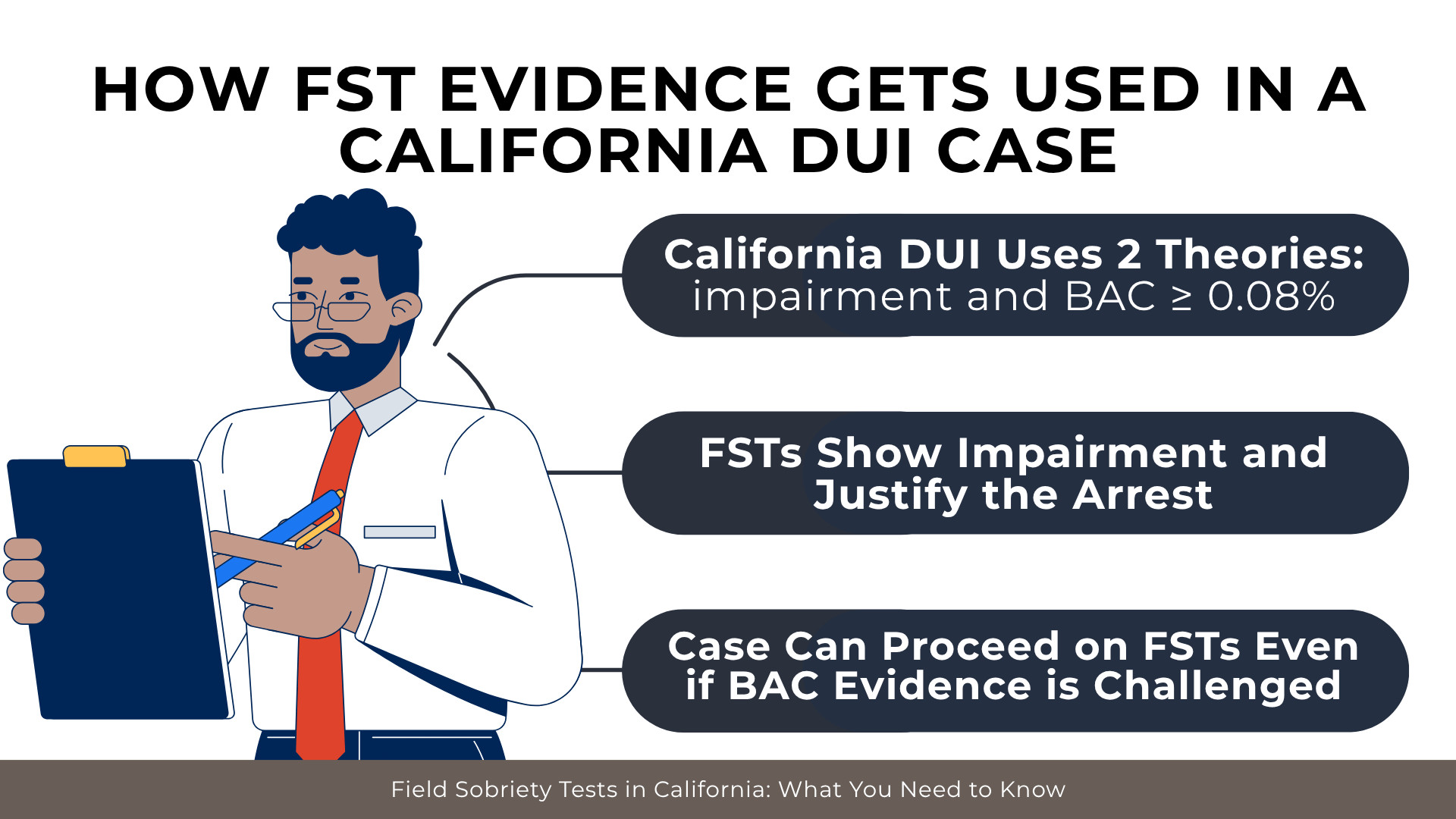
To understand what FST results mean for your case, you need to understand how California DUI prosecution works. The state typically charges DUI under two independent theories, and prosecutors routinely file both.
Under Vehicle Code § 23152(a) — the impairment theory — the prosecution must prove that alcohol or drugs impaired your ability to drive with the caution of a sober person exercising ordinary care. This is where FST results matter most. Your performance on roadside tests becomes the prosecution’s primary evidence that you were visibly, physically impaired.
Under Vehicle Code § 23152(b) — the per se theory — the prosecution only needs to prove that your blood alcohol concentration was at or above 0.08% at the time of driving. FST results are less central here, but they still play a supporting role.
The California Supreme Court confirmed in People v. McNeal, 46 Cal. 4th 1183 (2009), that per se DUI requires proof of BAC at the time of driving, not merely at the time of testing. This creates what’s commonly known as the “rising blood alcohol” defense — the possibility that your BAC was below the legal limit while you were actually behind the wheel but rose above it by the time testing occurred.
Here’s why this two-track structure matters for FST evidence: even if your chemical test result is contested or suppressed, the prosecution can still pursue the impairment theory based largely on the officer’s observations during field sobriety testing. FSTs also help establish the probable cause the officer needed to arrest you in the first place, which in turn triggered the implied consent obligation for chemical testing.
In practical terms, this means FST evidence can affect your case even if you think the breathalyzer or blood test is the only thing that matters.
Challenging Field Sobriety Test Results
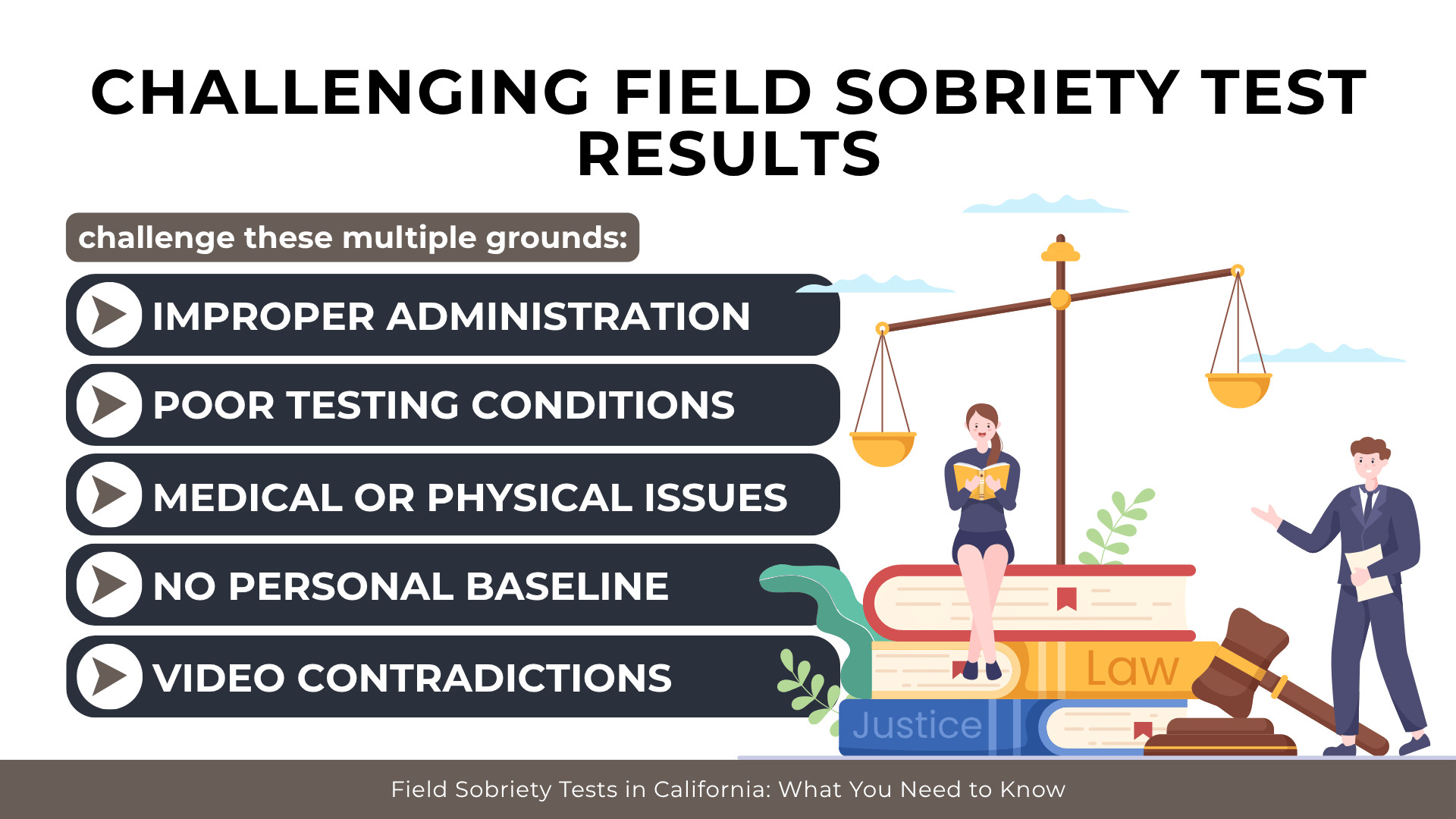
Because FSTs depend so heavily on the officer’s subjective observations and the conditions under which they were administered, there are several recognized grounds for challenging their reliability.
Improper administration is among the most common challenges. NHTSA’s own standardized testing protocols are specific — the instructions must be delivered in a particular way, the tests must be demonstrated correctly, and the scoring must follow established criteria. If an officer deviates from these protocols, the validity of the results is called into question.
Environmental conditions at the time of testing matter significantly. Defense attorneys routinely examine whether the road surface was level, whether lighting was adequate, whether weather conditions affected performance, and whether traffic created distracting or dangerous conditions. An officer’s report may describe a “failed” walk-and-turn test without noting that it was conducted on a gravel shoulder with a six-inch grade.
Medical conditions and physical limitations can produce false indicators of impairment. If you have an injury, a neurological condition, an inner ear disorder, or take medications that affect balance or eye movement, these factors can explain FST performance that has nothing to do with alcohol.
Lack of a baseline comparison is a structural weakness of FSTs that’s often overlooked. The officer has never seen you perform these tasks sober. They have no idea whether your balance, coordination, or gait are normal for you. They’re comparing your performance against a theoretical standard, not against your own abilities.
Dashcam and bodycam footage can be powerful tools when the officer’s written report doesn’t match what the video shows. An officer may note that you “swayed significantly” during the one-leg stand, while footage shows minor, momentary movement that most sober people would exhibit. When video is available, it introduces something FSTs otherwise lack — a second perspective.
The broader outcome data confirms that DUI charges are not automatic convictions. The strength of the evidence, including the reliability of FST results, plays a direct role in that gap.
The 10-Day Clock: What You Need to Do Right Now
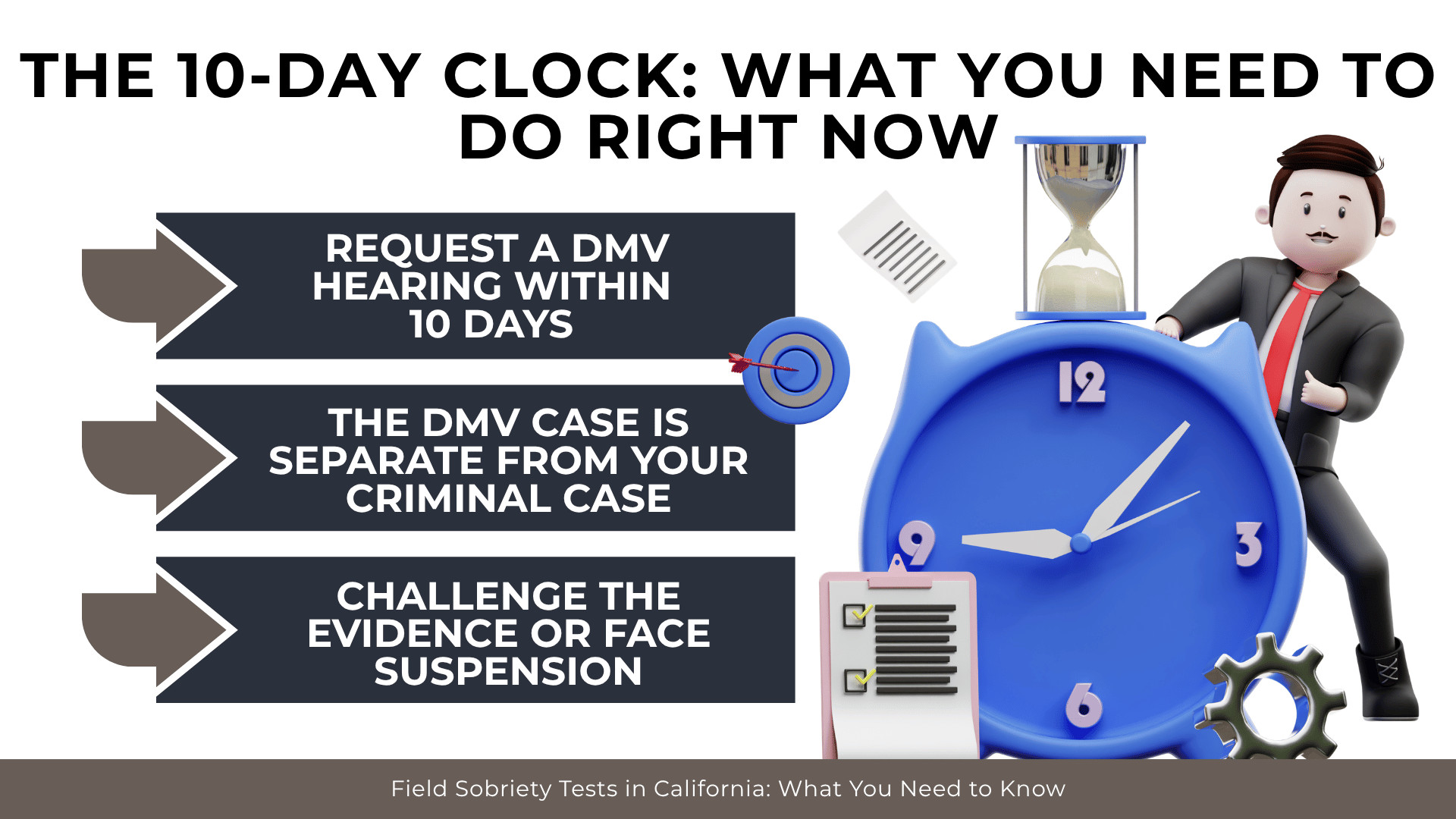
If you were arrested for DUI in California, there is a time-sensitive step you need to be aware of immediately. Under Vehicle Code § 13558, you have 10 days from your arrest to request an Administrative Per Se hearing with the DMV — a separate civil proceeding that can suspend your license regardless of what happens in criminal court. Miss this window and the suspension takes effect automatically. Your FST performance is directly relevant to both proceedings: at the DMV hearing, it goes to whether the officer had reasonable cause to believe you were DUI. You need to be present in both proceedings to challenge it.
When to Talk to a DUI Attorney
A DUI case in California is not a single legal problem — it’s at least two simultaneous proceedings with separate deadlines, different burdens of proof, and consequences that compound on each other. The question of whether you need an attorney depends on what’s at stake and how complex the facts are.
The complexity escalates quickly in certain situations. If you refused the post-arrest chemical test, you’re facing a mandatory one-year license suspension with no restricted license eligibility under Vehicle Code § 13353. If your BAC was at or above 0.15%, discretionary sentencing enhancements come into play under Vehicle Code § 23578. If this is a second or subsequent DUI within ten years, California’s lookback period means escalating mandatory minimum jail time, longer license suspensions, and extended DUI education programs.
Beyond criminal penalties, a DUI conviction triggers consequences including a three-year SR-22 insurance filing requirement, potential professional licensing issues, CDL disqualification under federal law, and immigration complications for non-citizens.
The estimated total cost of a first-time DUI in California is approximately $13,500 when you factor in fines, fees, insurance increases, DUI school, and related expenses. That figure doesn’t account for lost wages, professional consequences, or the long-term impact on your record.
Law Office of Angelo Reyes, APC, based in Carlsbad, California, represents clients facing DUI charges throughout San Diego County. Attorney Angelo J. Reyes — recognized by the National Trial Lawyers as a Top 40 Under 40 attorney and admitted to both the State Bar of California and the U.S. District Court for the Southern District of California — prepares every DUI case for trial, which means building the strongest possible challenge to the prosecution’s evidence, including field sobriety test results.
If you’re trying to figure out where you stand after a DUI arrest, the most important thing is to act within the timeline California gives you. The 10-day DMV deadline doesn’t wait, the criminal case will move forward on its own schedule, and the strength of your defense depends in part on how quickly the evidence — including any dashcam or bodycam footage of your FSTs — is preserved and reviewed..