

If you’re reading this, chances are you were recently arrested for a DUI in California — maybe last night, maybe a few days ago. You’re probably scared, embarrassed, and running through worst-case scenarios in your head. So let’s start with the most important distinction most people miss: an arrest is not a conviction.
That matters more than you think. According to the California DMV’s DUI Management Information System, roughly 68.9% of DUI arrests result in DUI convictions — which means nearly a third of cases end in dismissal, reduction, or some other outcome. Over 95% of DUI arrests are charged as misdemeanors, not felonies. None of this guarantees anything about your case, but it should tell you that what happens next depends on the specific facts and the decisions you make from here.
This guide walks you through what a first-offense DUI actually looks like in California — the penalties, the process, the costs nobody mentions upfront, and the concrete steps you should take starting today.
The Two Cases Against You: DMV and Criminal Court
Here’s something that catches almost everyone off guard: a DUI arrest in California triggers two completely separate proceedings. Most people only think about criminal court. But the California DMV runs its own civil process called an Administrative Per Se (APS) suspension, and it operates on a much shorter clock.
The moment you were arrested, the officer likely confiscated your license and handed you a temporary one. That temporary license is valid for 30 days — but here’s the critical part. Under California Vehicle Code § 13558, you have only 10 days from the date of your arrest to request an APS hearing with the DMV. If you don’t request that hearing within 10 days, your license suspension takes effect automatically on day 31. No exceptions, no extensions.
The APS hearing is a civil proceeding. The DMV only needs to prove by a preponderance of the evidence — a much lower bar than “beyond a reasonable doubt” — that the officer had reasonable cause to believe you were driving under the influence and that your BAC was 0.08% or higher. Importantly, what happens at the DMV has no binding effect on your criminal case, and what happens in criminal court doesn’t automatically resolve the DMV side either. The California Supreme Court confirmed in Lake v. Reed (1997) that the APS suspension is a civil remedial measure, not criminal punishment — meaning even a criminal acquittal doesn’t automatically restore your license.
Your criminal case runs on a separate track entirely, beginning with an arraignment where you’ll enter a plea. These two proceedings can produce different outcomes, and each one requires its own strategy. This is one of the main reasons people hire attorneys for DUI cases — managing both tracks simultaneously.

First-Offense DUI Penalties in California
California Vehicle Code § 23536 sets the penalty framework for a first-offense DUI. Here’s what the statute actually provides:
Jail time ranges from 96 hours (with a minimum of 48 continuous hours) up to 6 months in county jail. In practice, about 66.3% of first-time DUI offenders are sentenced to some jail time, though many of those sentences are suspended or converted to alternatives like community service or work programs. Nearly 96% of all convicted DUI offenders receive probation as their primary court sanction.
Fines are $390 to $1,000 in base fines — but don’t let those numbers fool you. California adds penalty assessments, court fees, and surcharges that typically multiply the base fine by four to five times. A $390 base fine can become $1,800 or more once everything is added.
License suspension is 6 months for a first offense under Vehicle Code § 13352. However, under California’s statewide ignition interlock device (IID) program established by SB 1046, you may be eligible for a restricted license that allows you to drive anywhere — not just to work and DUI school — if you install an IID. For a first offense involving injury, the IID requirement is 6 months under Vehicle Code § 23575.3.
DUI school is mandatory. A standard first offense requires a 3-month program. But if your BAC was 0.20% or higher, Vehicle Code § 23538(b)(2) mandates a 9-month program instead. The good news is that 83.9% of first-time offenders who enroll in DUI school complete it successfully.
Probation runs 3 to 5 years under Vehicle Code § 23600(b)(1). During probation, you’re subject to a zero-tolerance alcohol condition — any measurable BAC while driving triggers a violation. You must also agree to submit to chemical testing if stopped for suspected DUI during your probation period.
A few factors can make penalties steeper. A BAC at or above 0.15% gives the judge discretion to impose enhanced penalties under Vehicle Code § 23578. If there was a child under 14 in the vehicle, Vehicle Code § 23572 adds mandatory consecutive jail time — 48 hours for a first offense. And if you refused the post-arrest chemical test, Vehicle Code § 13353 imposes a 1-year license suspension with no restricted license eligibility.

The Hidden Costs Nobody Warns You About
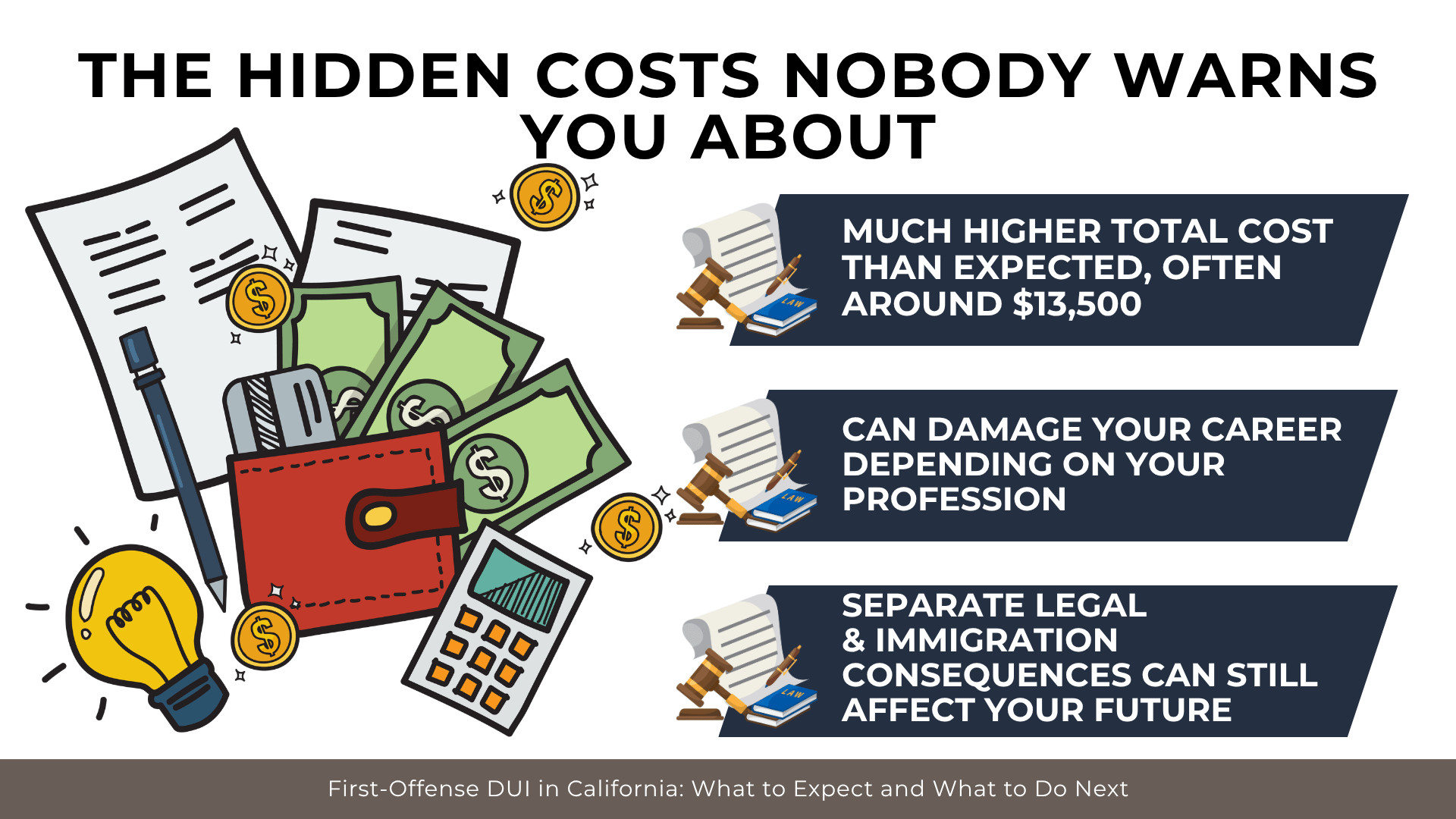
The fines and court fees are just the beginning. The California Office of Traffic Safety estimates the total cost of a first-time DUI in California at approximately $13,500 when you account for everything.
That figure includes fines, fees, insurance increases, attorney costs, DUI school, lost wages, and related expenses. One of the longer-lasting financial hits is the SR-22 requirement — under Vehicle Code § 13352.4, you’ll need to carry this high-risk insurance certificate for 3 years after your license is reinstated.
Beyond the financial impact, a DUI conviction creates professional consequences that depend on your occupation. Physicians must report a conviction to their licensing board within 30 days under Business and Professions Code § 802.1. Attorneys with a felony conviction face mandatory self-reporting under Business and Professions Code § 6068(o). If you hold a commercial driver’s license, federal law under 49 C.F.R. § 383.51 imposes a 1-year CDL disqualification for a first offense — and a lifetime disqualification for a second.
For non-citizens, the stakes are different but important to understand clearly. A simple DUI is generally not considered a crime involving moral turpitude under federal immigration law — the Board of Immigration Appeals held as much in Matter of Torres-Varela (2001), and the Supreme Court in Leocal v. Ashcroft (2004) confirmed that DUI is not an aggravated felony. However, DACA eligibility is barred by a single misdemeanor DUI as a “significant misdemeanor.” If immigration status is a concern, this is a conversation to have with an attorney who understands both DUI defense and immigration consequences.
How a First-Offense DUI Case Moves Through Court
The criminal process typically unfolds in stages, and understanding what each one involves can make the experience significantly less disorienting.
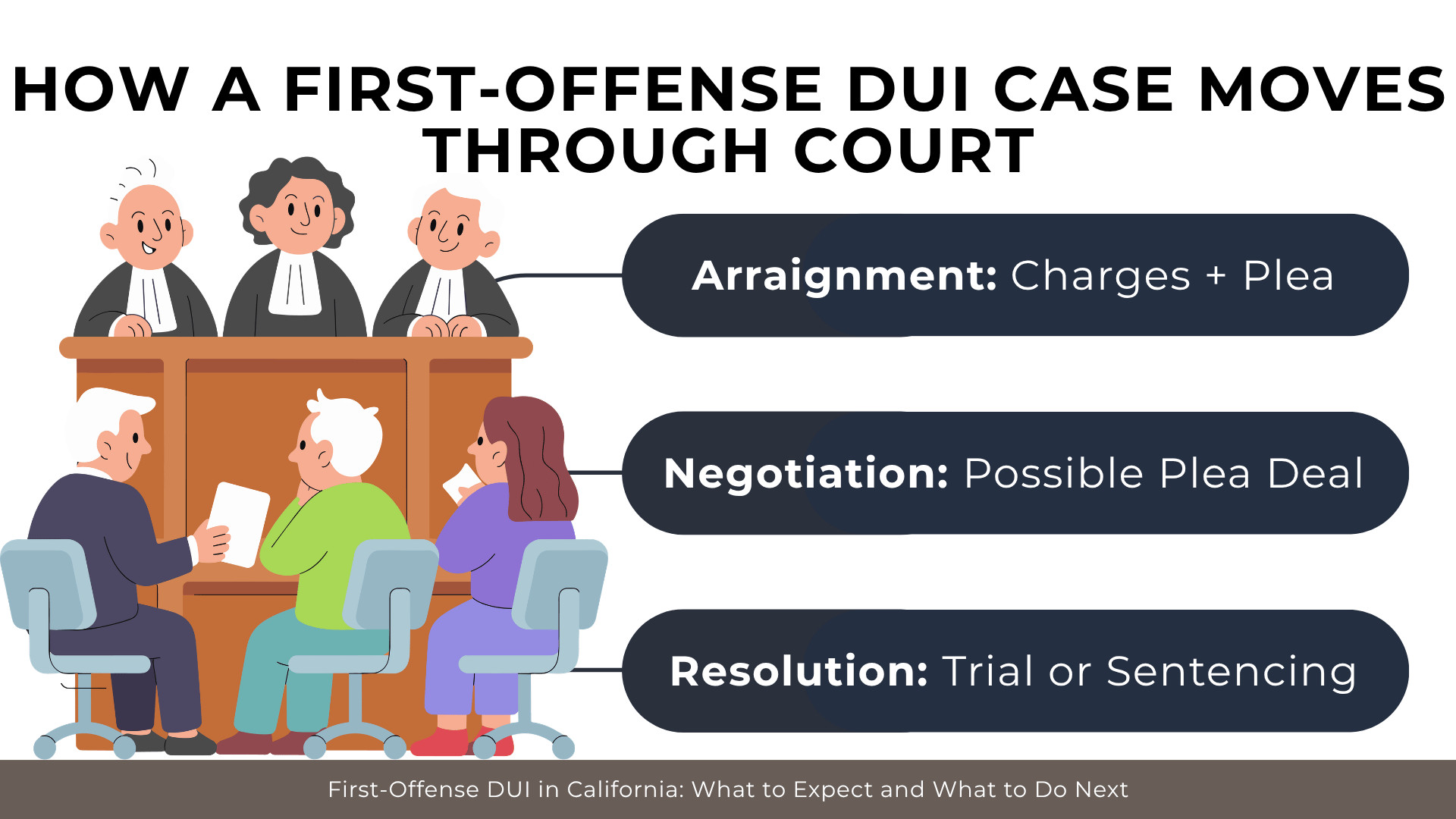
Arraignment is your first court appearance. You’ll hear the charges against you — typically both Vehicle Code § 23152(a) (impairment-based DUI, meaning the prosecution argues alcohol or drugs impaired your ability to drive with ordinary care) and § 23152(b) (per se DUI, meaning your BAC was at or above 0.08%). Prosecutors routinely charge both counts, though a conviction on both still counts as a single DUI for sentencing. You’ll enter a plea, and if you have an attorney, they may be able to appear on your behalf for some hearings.
Pretrial negotiations follow. This is where the specific facts of your case — your BAC level, the circumstances of the stop, the strength of the evidence — determine what options exist. In some cases, the prosecution may offer a plea to a reduced charge. The most common reduction is a “wet reckless” — an alcohol- or drug-related reckless driving conviction that carries lighter penalties than a full DUI. About 7.9% of DUI convictions in 2019 were reduced to wet reckless. A wet reckless is still priorable for future DUI offenses, meaning it can count against you if you’re arrested again — though you should discuss the specific implications with an attorney.
One important thing to know: DUI cases in California are not eligible for judicial diversion. Vehicle Code § 23640 expressly prohibits it, and California appellate courts have upheld that prohibition twice in recent years — in Grassi v. Superior Court (2021) and Tan v. Superior Court (2022). The only exception is military diversion under Penal Code § 1001.80 for qualifying veterans and active-duty service members.
Trial or resolution is the final stage. If no agreement is reached, the case goes to trial. If you accept a plea, sentencing follows. About 72.8% of convicted DUI offenders are first-time offenders, so courts handle these cases routinely — which means the process, while stressful, is at least predictable.
Defenses That Actually Exist
A DUI arrest can feel like the outcome is already decided, but California DUI law contains several substantive defenses rooted in constitutional protections and statutory requirements. Whether any of them apply depends entirely on the facts of your case.
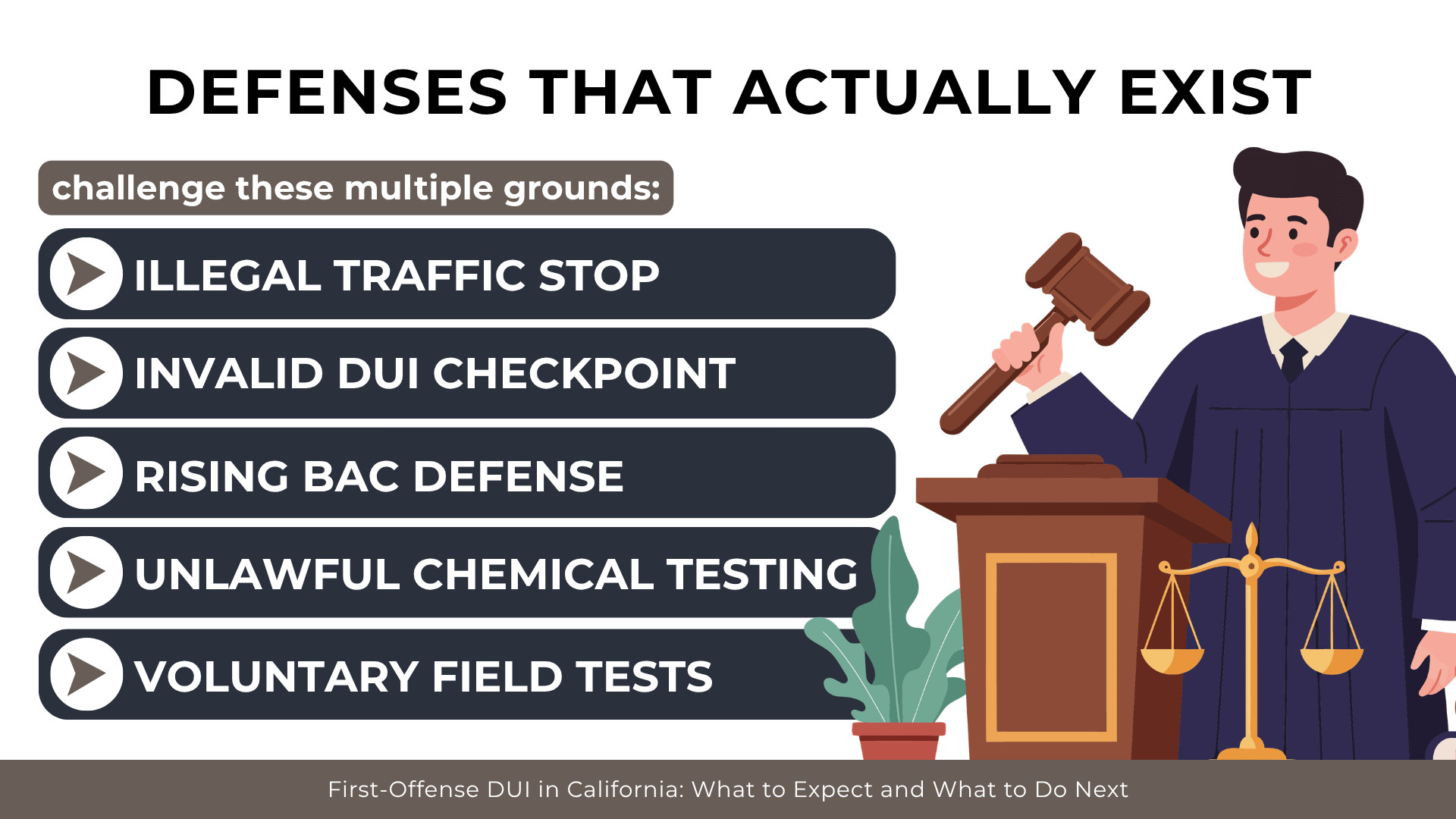
Challenging the traffic stop. Under the Fourth Amendment and California case law, an officer needs reasonable suspicion based on specific, articulable facts to pull you over. A hunch isn’t enough — the California Court of Appeal held in People v. Bell (1996) that traffic stops require articulable facts suggesting a traffic violation or criminal activity. If the stop itself was unlawful, everything that followed — the field sobriety tests, the BAC results — may be suppressed.
Challenging DUI checkpoint procedures. Checkpoints must satisfy the eight-factor administrative framework from Ingersoll v. Palmer (1987), and a failure to meet those requirements can form the basis of a challenge to the evidence.
Rising blood alcohol defense. The California Supreme Court held in People v. McNeal (2009) that per se DUI under § 23152(b) requires proof that your BAC was at or above 0.08% at the time of driving — not at the time of testing. Because alcohol takes time to absorb, your BAC may have still been rising between when you were driving and when you were tested, meaning your BAC at the time of driving could have been lower than the test result.
Chemical testing issues. The U.S. Supreme Court’s decisions in Missouri v. McNeely (2013) and Birchfield v. North Dakota (2016) impose constitutional limits on how chemical tests can be obtained — particularly warrantless blood draws, which require either actual consent or case-specific exigent circumstances.
Field sobriety tests and the pre-arrest preliminary alcohol screening (PAS) test are both voluntary under Vehicle Code § 23612(h)-(i), though the Court of Appeal held in People v. Jackson (2010) that FST refusal may be admitted as consciousness of guilt while PAS refusal cannot.
These defenses don’t exist in the abstract. They require someone who knows how to identify them in the facts of your case and raise them effectively.
What to Do Right Now
You have a narrow window to take the steps that matter most. Here’s where to focus your energy.
Request your DMV hearing within 10 days. This is the single most time-sensitive action. Call the DMV Driver Safety Office to request an APS hearing. Doing so preserves your right to contest the administrative license suspension and can temporarily stay the suspension while the hearing is pending. Miss this deadline and the suspension becomes automatic.
Gather your documents. Locate your temporary license, any paperwork the officer gave you, your citation, and your booking paperwork. If you remember specific details about the stop — where you were, what the officer said, how the field sobriety tests were conducted — write them down now while they’re fresh.
Consult a DUI defense attorney. The dual-track nature of California DUI cases — managing both the DMV hearing and the criminal proceeding, identifying applicable defenses, negotiating with prosecutors — is where experienced representation makes a measurable difference. Law Office of Angelo Reyes, APC in Carlsbad handles DUI defense throughout San Diego County, with a courtroom advocacy approach that prepares every matter for trial. Attorney Angelo J. Reyes is recognized by the National Trial Lawyers as a Top 40 Under 40 attorney and is admitted to both the State Bar of California and the U.S. District Court for the Southern District of California. A consultation can help you understand the specific strengths and vulnerabilities of your case before you make any decisions.
A first-offense DUI in California is serious — but it is a legal problem with a legal process, and that process has rules, defenses, and outcomes that vary based on the facts and the choices you make. The worst thing you can do right now is nothing. The 10-day clock is already running.
