A first-time violation of a restraining order is a criminal offense in California. Under California Penal Code § 273.6, a first offense can result in up to one year in county jail, a fine of up to $1,000, or both. If the violation involved physical injury, the penalties are steeper and include mandatory jail time.
This page covers what the law considers a violation, how penalties work depending on what happened, what to do immediately after a violation occurs, and how an attorney can help enforce the order and pursue stronger protections going forward.
What Are the Penalties for a First-Time Restraining Order Violation in California?
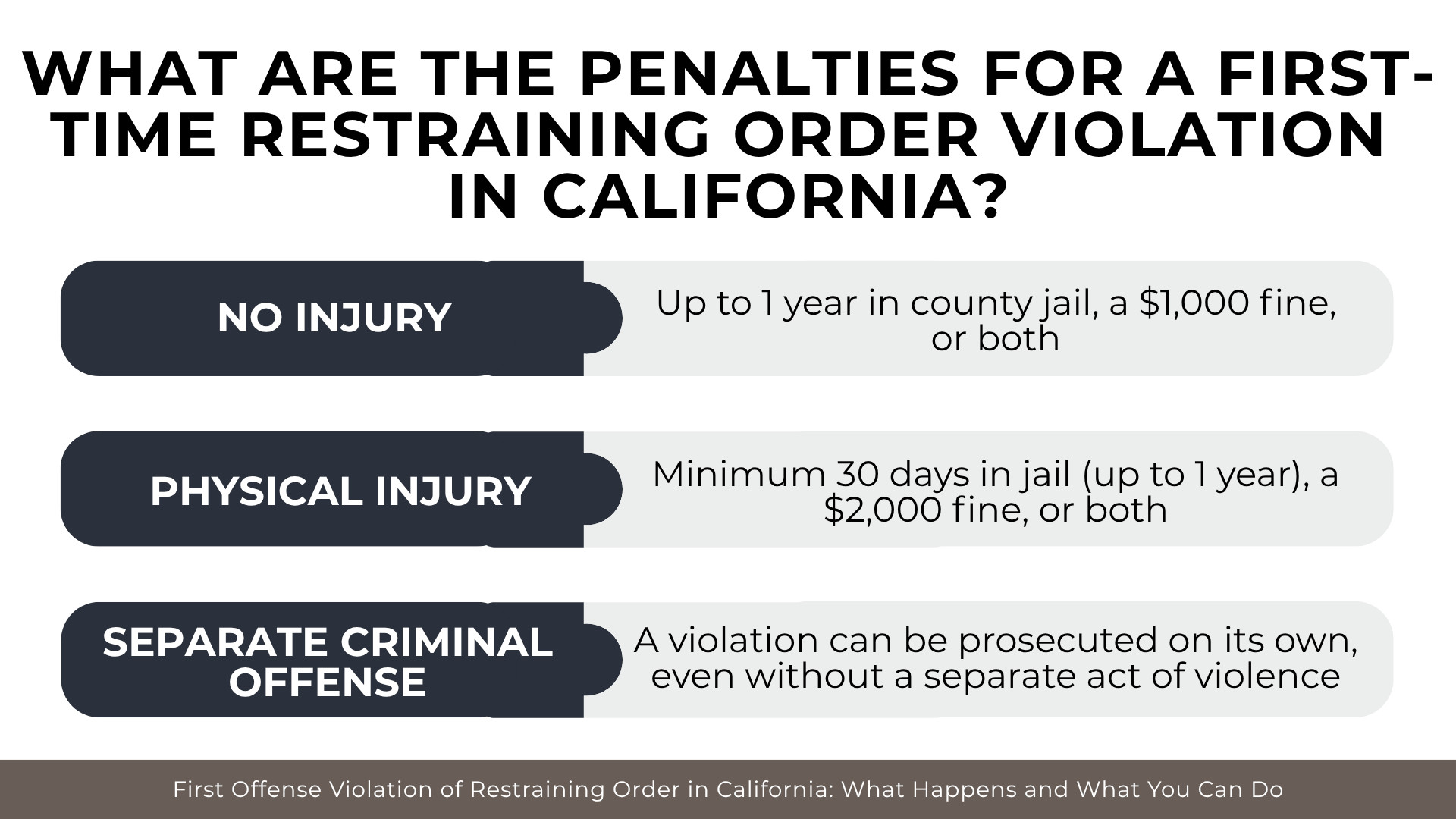
California Penal Code § 273.6 makes it a misdemeanor to violate a protective order issued under the state’s domestic violence laws. For a first offense with no physical injury, the court may impose up to one year in county jail, a fine of up to $1,000, or both.
When the violation involves physical injury, the consequences change substantially. Under § 273.6(b), the court must impose a mandatory minimum of 30 days in county jail, with a maximum of one year, along with a fine of up to $2,000, or both. That 30-day minimum is not optional — if the violation caused physical injury, the court is required to impose it.
A second or subsequent violation involving a credible threat of violence within seven years can result in imprisonment in county jail for up to one year under Penal Code § 273.6(d). So while a first offense carries serious penalties on its own, it also sets the starting point for harsher consequences if the behavior continues.
It is important to understand what these penalties represent. The legal system treats a restraining order violation as a standalone crime. The person who violated the order does not need to have committed a separate act of violence for criminal charges to apply. The violation itself is the offense.
These penalties apply specifically to violations of civil protective orders, including Domestic Violence Restraining Orders, Temporary Restraining Orders, and Emergency Protective Orders. Violations of Criminal Protective Orders — issued by criminal courts under Penal Code § 136.2 — are typically prosecuted under a different statute, Penal Code § 166(c)(1), which carries its own set of penalties.
What Counts as Violating a Restraining Order?
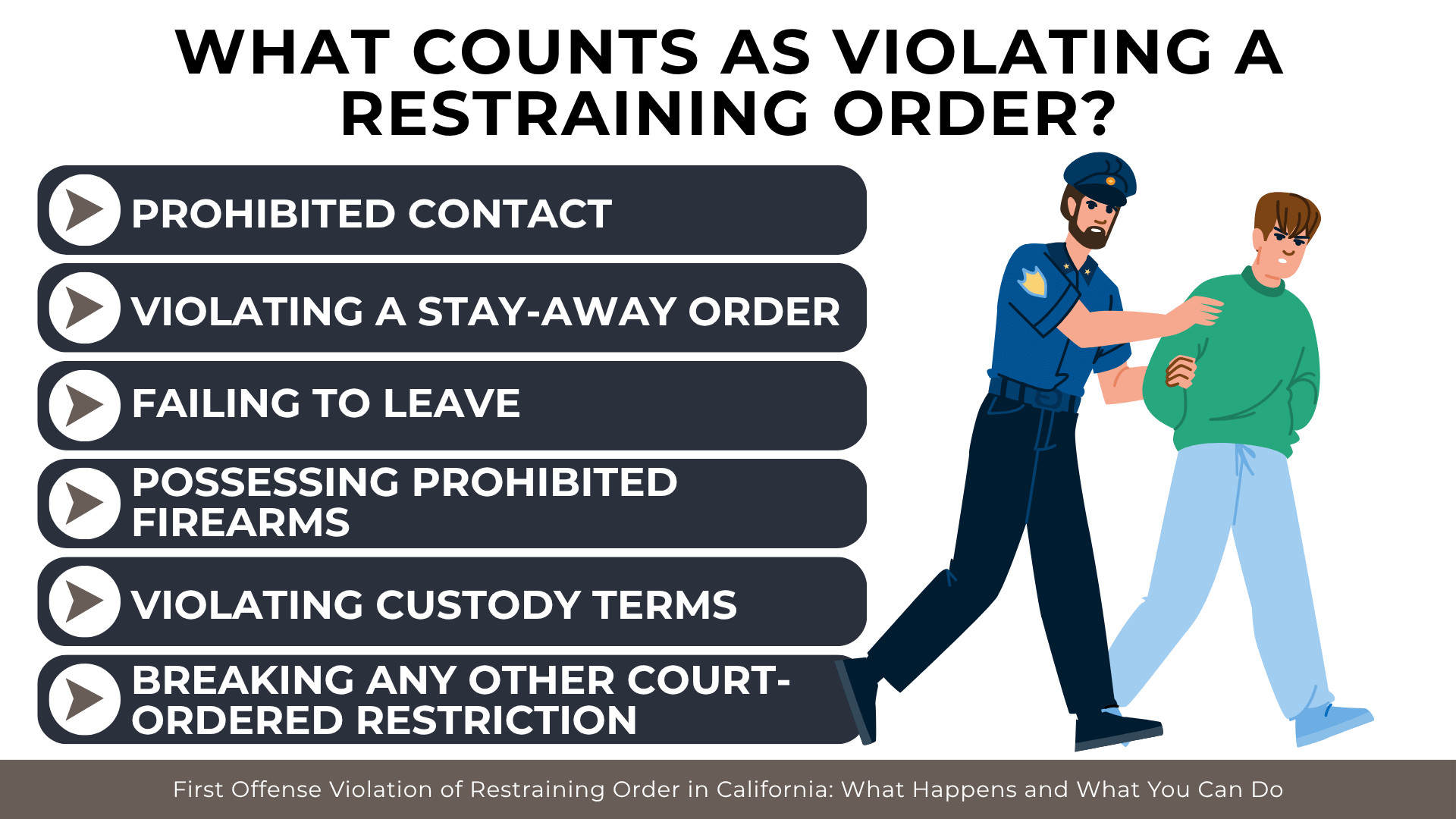
A violation occurs any time the restrained person does something the order specifically prohibits. The exact terms vary depending on what the court ordered, and DVROs issued under Family Code § 6300 can include a broad range of terms.
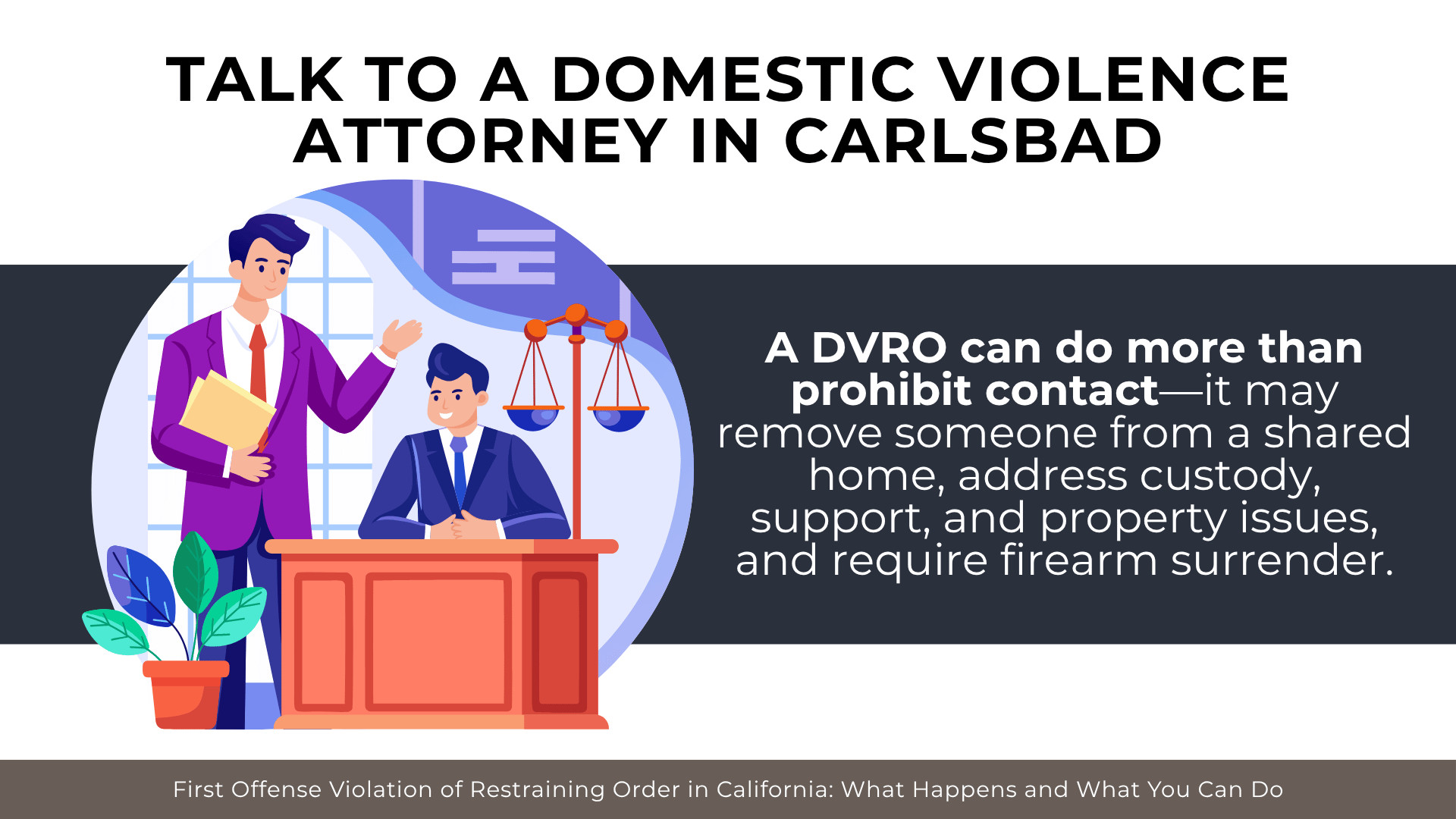
Under Family Code § 6320, the court may issue stay-away orders. Under Family Code § 6321, the court can order residence exclusion — requiring the restrained person to move out of a shared home. DVROs may also include firearms prohibitions under Family Code § 6389, temporary child custody terms under Family Code § 6323, and property control orders under Family Code § 6324. The specific conduct that counts as a violation depends on which terms the court included in the order.
Because the terms of each order define what is prohibited, any conduct that breaks those terms can be charged as a violation under § 273.6. The conduct does not need to be threatening or violent on its own. If the order prohibits it, doing it is a potential criminal offense.
This matters because violations are sometimes dismissed — by the violator, by bystanders, sometimes even by the person protected by the order — as too minor to count. Under § 273.6, the legal question is not whether the contact seemed harmful in the moment. It is whether the conduct was prohibited by the terms of the order.
What Should I Do Right After a Restraining Order Violation?
The steps taken immediately after a violation can determine whether the legal system is able to act on it effectively.
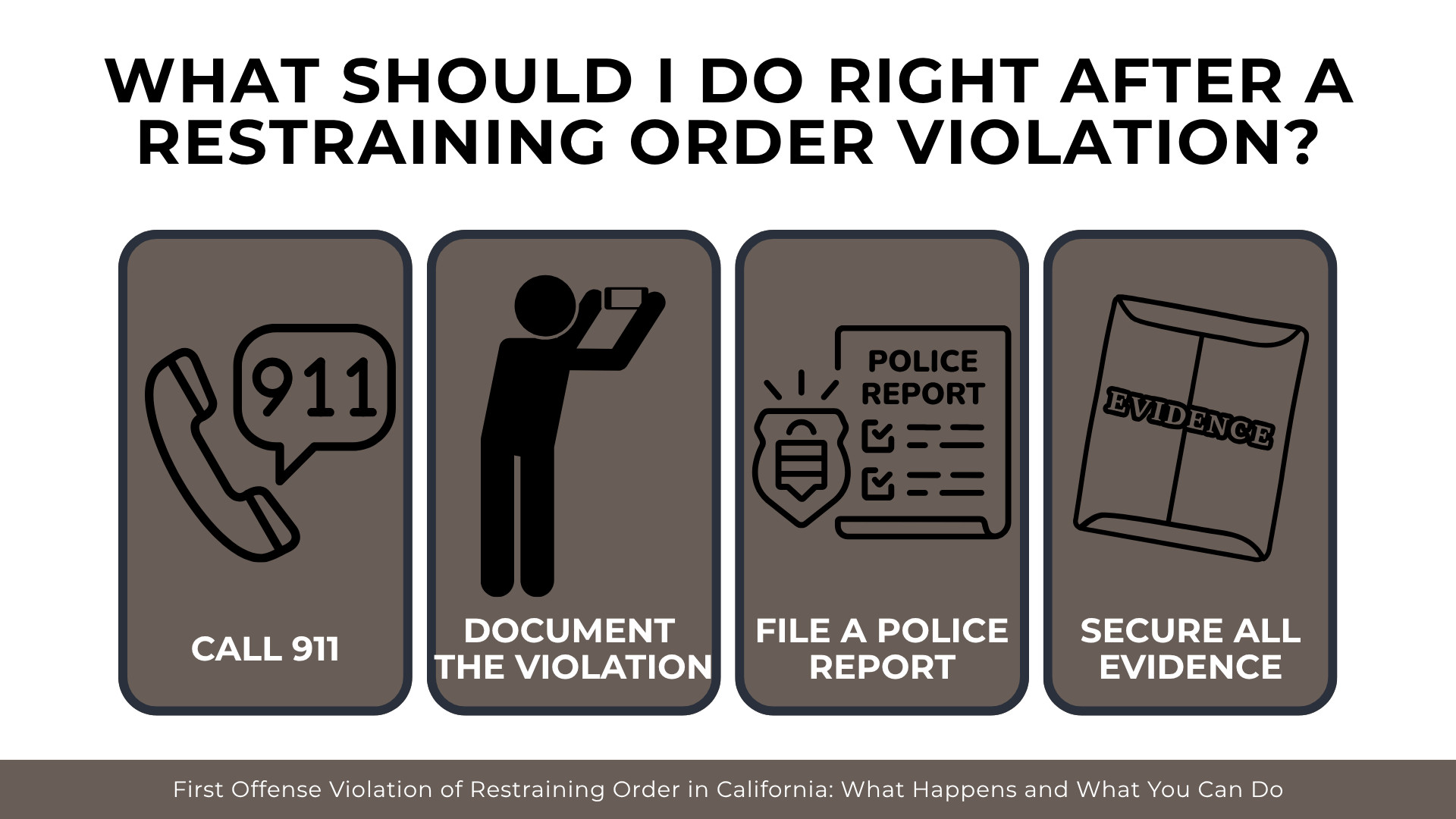
If there is any immediate danger, call 911. Law enforcement can respond to a restraining order violation in real time. Officers have the authority to make an arrest based on the violation itself.
Document everything as close to the event as possible. Save any evidence of the prohibited conduct — screenshots, photographs, written accounts with dates and times, and the names of anyone who witnessed what happened. Write down what occurred in detail while it is fresh. If the violation involved the restrained person appearing at a location covered by the order, note whether security cameras or similar recordings may have captured it.
File a police report even if the violation did not involve physical contact or an immediate threat. A report creates an official record, and that record serves two purposes. It supports a potential criminal prosecution under Penal Code § 273.6. It also builds the documented history that strengthens any future request to modify, extend, or permanently renew the existing protective order.
Store copies of all evidence in a location the restrained person cannot access. Forward materials to a trusted person or keep them in a separate, secure account.
Prosecution likelihood drops by roughly 50% when police reports take more than 30 days to reach the prosecutor. Timing matters. The sooner a violation is reported and documented, the stronger the foundation for every legal step that follows.
Can a First Violation Lead to Stronger Protections?
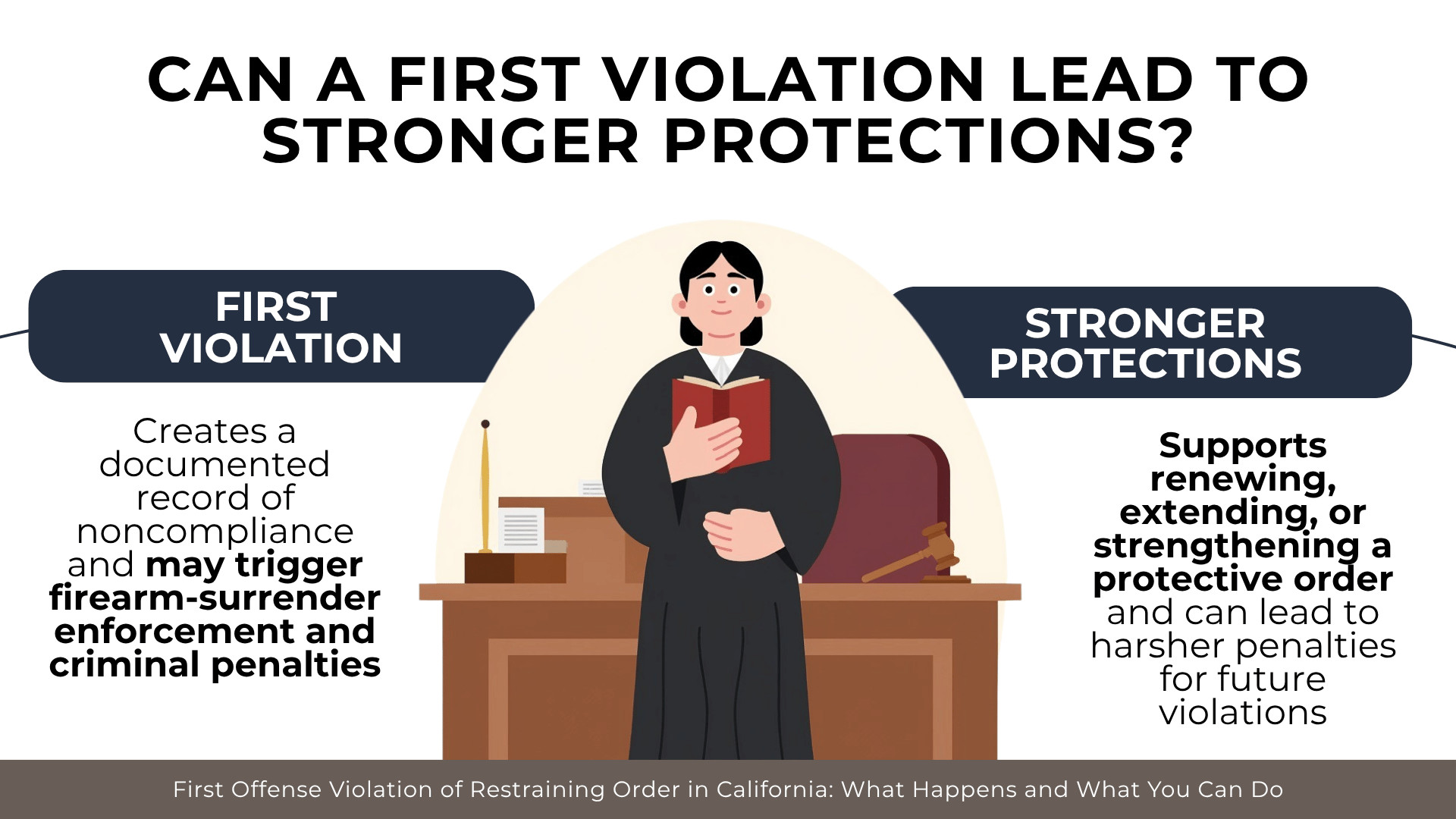
A documented violation does more than expose the violator to criminal penalties. It can trigger additional legal consequences and open the door to protections that were not in place before.
On the firearms side, California Penal Code § 29825 makes it a wobbler offense to possess a firearm while subject to a qualifying protective order, including DVROs and CPOs. A wobbler can be charged as either a misdemeanor or a felony. A misdemeanor conviction carries up to one year in county jail and fines up to $1,000. A felony conviction carries 16 months, two years, or three years in state prison and fines up to $1,000. California’s prohibition is broader than the federal standard in a critical respect: it covers ex parte and temporary orders, not only post-hearing orders.
When a protective order is in effect, California law requires the restrained person to surrender all firearms and ammunition within 24 hours under Penal Code § 136.2(d) and Family Code § 6389. The restrained person must also file proof of compliance within 48 hours. A violation of the restraining order can prompt the court and law enforcement to verify whether that surrender actually took place. Over half of all individuals disarmed through California’s Armed and Prohibited Persons System are prohibited at least in part due to a restraining order — a figure that reflects how seriously the state treats the connection between protective orders and firearms access.
On the protective order itself, a documented violation strengthens the case for renewal or strengthening. Under the standard established in Ritchie v. Konrad, 115 Cal.App.4th 1275 (2004), a court should renew a DVRO if the protected party demonstrates a reasonable apprehension of future abuse by a preponderance of the evidence. You do not need to prove that new acts of abuse occurred since the original order was issued. A documented restraining order violation is strong evidence supporting that apprehension. It can be the basis for extending an order that might otherwise expire — or for making it permanent under Family Code § 6345(a).
A first violation also resets the escalation path. Under Penal Code § 273.6(d), any subsequent violation involving a credible threat of violence within seven years faces harsher penalties. The documented record of a first violation means that if the behavior continues, the legal system’s response can escalate with it.
What If They Claim the Violation Was an Accident?
A common concern after a restraining order violation is that the restrained person will deny it, minimize what happened, or claim the contact was unintentional. It helps to understand how these situations typically play out so expectations are realistic.
A person charged under Penal Code § 273.6 may argue they did not know the order existed, that the encounter was coincidental, or that the protected person initiated the contact. These arguments do not automatically prevent prosecution, but they can complicate it — particularly when there is limited evidence to counter them.
This is where documentation becomes decisive. Tangible evidence with timestamps and preserved records is harder to explain away than a verbal account alone. The stronger the evidence on record, the less room there is for the violation to be reframed as a misunderstanding. An attorney experienced in domestic violence protective order enforcement can help organize the available evidence and anticipate the arguments likely to be raised. They can also work with prosecutors to present the violation in its full context — not as an isolated or unclear event, but as a breach of a court order that was issued for a specific reason.

Do I Need a Lawyer to Enforce a Restraining Order?
A restraining order is issued by a court, and law enforcement has independent authority to arrest someone who violates it. In that sense, enforcement options exist with or without a private attorney. But having an attorney can make a real difference in the outcome. A lawyer can affect whether the violation is prosecuted, whether the existing order is strengthened, and what protections are in place going forward.
An attorney can work with the district attorney’s office to advocate for criminal prosecution of the violation. Prosecutors manage heavy caseloads. A case that arrives with organized evidence, a clear timeline, and legal context is more likely to receive the attention it needs.
Beyond the criminal case, an attorney can file for contempt of court based on the violation. They can seek modification of the existing order to add or strengthen its terms. They can request an extension or permanent renewal of a DVRO under Family Code § 6345(a). And they can pursue civil remedies where the violation caused harm.
If you are dealing with a restraining order violation, your goal is not only to respond to what already happened. It is to make sure the full range of legal protections is in place going forward — and that the record supports those protections if they are ever needed again.

Talk to a Domestic Violence Attorney in Carlsbad
Angelo Reyes Law is based in Carlsbad, California and serves clients throughout San Diego County. If a restraining order has been violated, attorney Angelo Reyes can help you understand your options, build the evidentiary record, and take the legal steps necessary to enforce the protections you were granted. Contact the Law Office of Angelo J. Reyes, APC to discuss your situation.