
If you’re reading this, there’s probably a number stuck in your head. Maybe it showed up on a screen during a traffic stop, or maybe it appeared on a police report you’re now holding. Either way, you’re wondering whether that number is telling the truth.
It’s a fair question, and the answer is more complicated than most people realize. Breathalyzer technology has real, documented limitations — some rooted in biology, some in physics, and some in how the machines are maintained and operated. Understanding those limitations doesn’t make a DUI charge disappear, but it does give you the specific knowledge you need to evaluate what happened during your stop and what options you actually have.
The Number on the Screen Isn’t What You Think It Is
Here’s the first thing most people don’t know: a breathalyzer doesn’t measure your blood alcohol concentration. It measures alcohol in your breath and then converts that measurement into an estimated BAC using a mathematical ratio.
That ratio — called the partition ratio — is fixed at 2100:1. It assumes that for every 2,100 parts of alcohol in your breath, there is exactly 1 part in your blood. The problem is that this ratio varies from person to person and even within the same person at different times. Your body temperature, your breathing pattern, your physiology — all of these influence the actual ratio at any given moment.
So when a breathalyzer displays “0.09%,” it’s not reporting a direct measurement of your blood. It’s reporting a calculation built on an assumption that may or may not reflect your actual biology at that moment. That distinction matters enormously when the legal threshold sits at exactly 0.08%.

The Two Types of Breathalyzers (and Why It Matters Which One You Blew Into)
Not all breathalyzers carry the same weight, legally or scientifically.
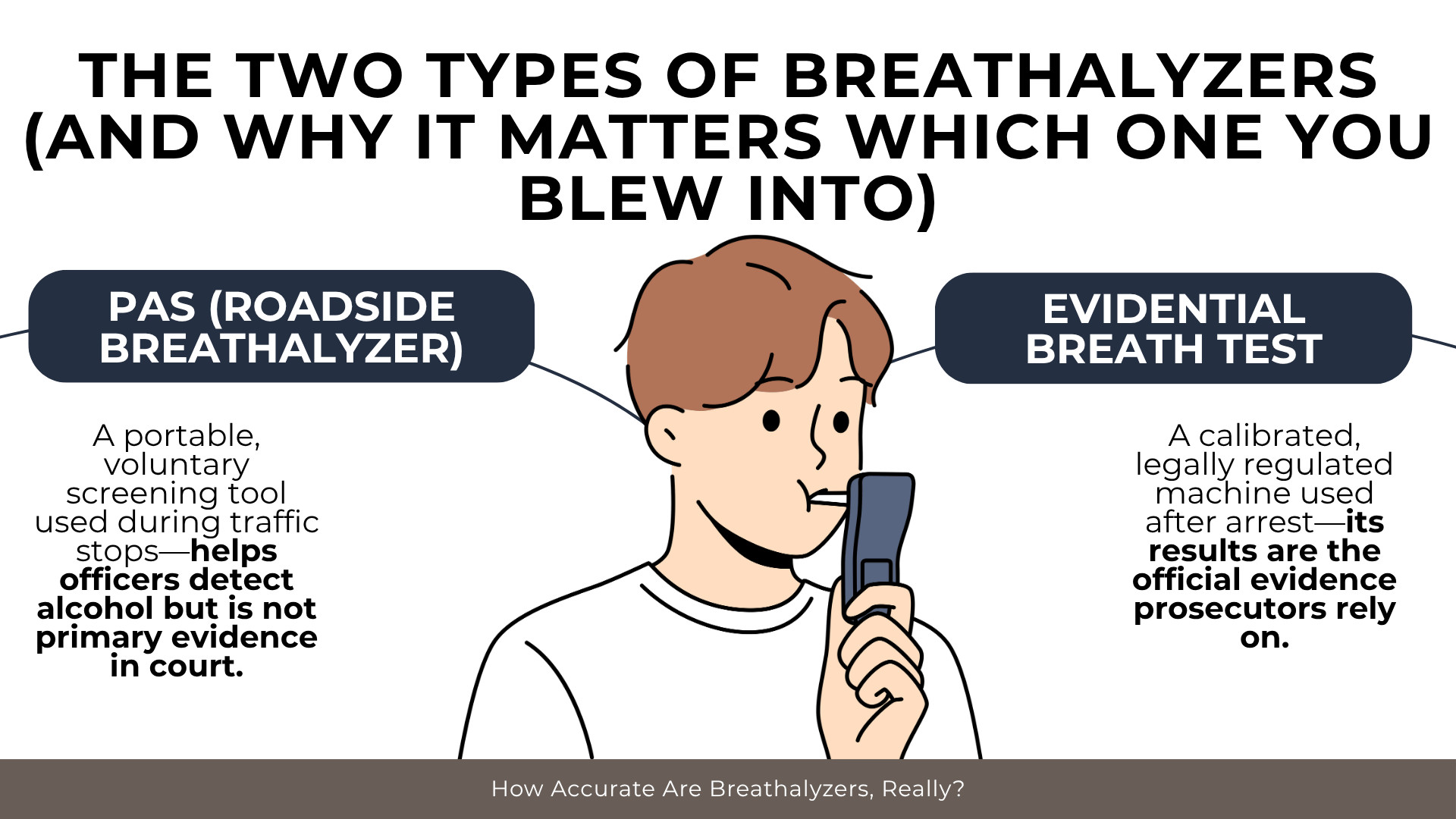
The device used during a traffic stop is typically a portable unit called a Preliminary Alcohol Screening device, or PAS. It’s a handheld tool designed to give officers a quick indication of whether alcohol is present. Under California Vehicle Code § 23612(h)-(i), the PAS test is voluntary for drivers over 21 who are not on DUI probation, and officers are required to tell you that you have the right to refuse it. A PAS result is a screening tool, not the primary evidence in your case.
The second type is the evidential breath testing instrument — a larger, stationary device typically located at the police station. These instruments are subject to stricter calibration and operational requirements under Title 17 of the California Code of Regulations. This is the test that produces the result prosecutors rely on.
If you were arrested for DUI, identifying which device generated which number is one of the first things that matters. A reading from a roadside PAS device and a reading from an evidential instrument at the station carry very different scientific and legal significance.
Known Error Sources: What the Science Says Goes Wrong
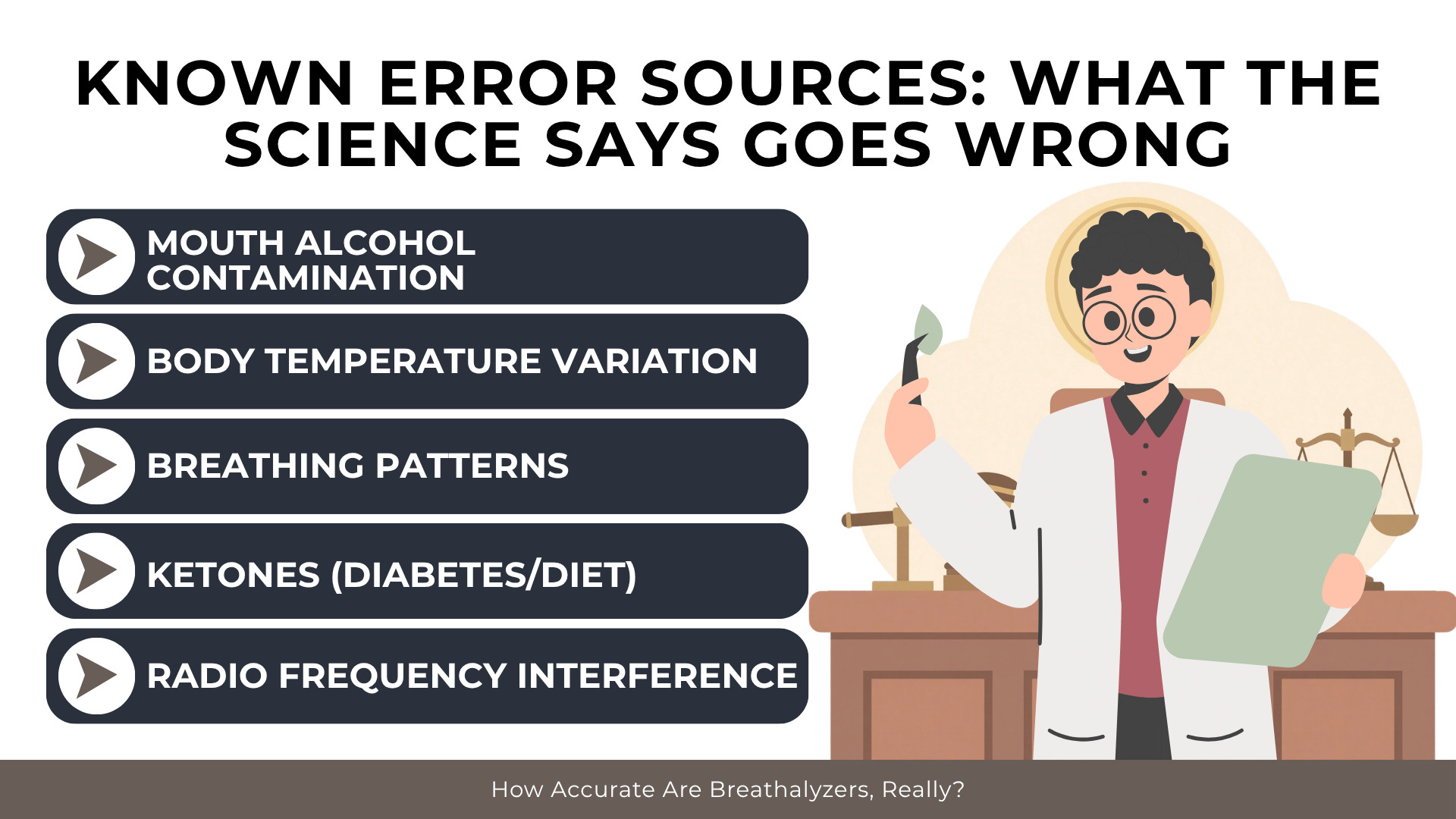
Breathalyzer inaccuracy isn’t a conspiracy theory. It’s a well-documented set of scientific variables. Here are the most significant ones.
Mouth alcohol contamination. A breathalyzer is designed to measure deep lung air — the air that has exchanged gases with your blood. But if residual alcohol is present in your mouth or throat, the device can’t distinguish it from lung air. Gastroesophageal reflux disease (GERD), acid reflux, recent vomiting, or even a recent belch can push alcohol vapors from your stomach into your oral cavity, artificially inflating the reading. This is why California’s Title 17 regulations require a continuous observation period before an evidential breath test, during which the subject must not eat, drink, smoke, or regurgitate.
Body temperature. The 2100:1 partition ratio assumes a normal body temperature of 98.6°F. But if your body temperature is elevated — from illness, physical exertion, sitting in a hot patrol car, or simple biological variation — the concentration of alcohol in your breath increases. Research has suggested that elevated body temperature can meaningfully inflate breath alcohol readings, though the exact magnitude depends on the individual and the circumstances. A fever or even being overheated after a long wait may produce a reading that overstates your actual BAC.
Breathing patterns. How you breathe into the device affects the result. Hyperventilating before the test can lower the reading; holding your breath can raise it. A deep, prolonged exhalation — which officers often instruct subjects to provide — delivers air from deeper in the lungs where alcohol concentration is higher, potentially inflating the number.
Diabetic ketones and dietary factors. People with diabetes, those on ketogenic diets, or individuals in a fasting state can produce acetone through ketosis. Some breathalyzer technologies may mistake acetone for ethyl alcohol, potentially generating a positive or inflated reading in someone who has consumed little or no alcohol.
Radio frequency interference. Electronic devices, police radios, and cell phones can produce electromagnetic interference that may affect breathalyzer readings. While modern instruments typically include RFI detectors, the effectiveness of these safeguards can vary.
Each of these factors is independent. When two or more overlap — say, a person with GERD who was sitting in a warm patrol car and was asked to blow hard — the cumulative effect on accuracy can be substantial.
Calibration, Maintenance, and Operator Error
Even if your biology cooperated perfectly, the machine itself has to be functioning correctly. And that depends entirely on the people responsible for maintaining it.
California’s Title 17 regulations impose specific requirements on how evidential breath testing instruments must be calibrated, maintained, and operated. The instruments must be checked against a known alcohol reference solution at regular intervals. That solution has a defined expiration date. The operator must hold current certification. The device must complete an internal accuracy check before producing a reportable result.
When these requirements aren’t followed — when calibration logs show gaps, when reference solutions are expired, when an operator’s certification has lapsed, when the required observation period was cut short or not conducted at all — the reliability of the result becomes a legitimate question. Not a theoretical one. A practical, evidentiary one that can be examined through maintenance records, calibration logs, and operator training files.
These aren’t exotic scenarios. Breath testing programs are administered by law enforcement agencies across California’s 58 counties, each with its own protocols, staffing, and compliance track record. The variation in how carefully these programs are run is a real factor in how reliable any individual result turns out to be.

What a Margin of Error Means at 0.08%
All of this becomes concrete when you understand where the legal line sits.
In California, the per se DUI threshold under Vehicle Code § 23152(b) is a BAC of 0.08%. You don’t have to be visibly impaired. You don’t have to be swerving. If a chemical test shows 0.08% or above, that alone satisfies the per se statute.
Now consider accuracy margins. If a breathalyzer carries a margin of error in the range of ±0.01% — and some devices acknowledge margins in that vicinity — a reading of 0.09% could mean a true BAC anywhere from 0.08% to 0.10%. A reading of 0.08% could mean a true BAC of 0.07%. For someone whose reading is near the legal threshold, the margin of error isn’t an abstraction. It’s the difference between a DUI conviction and a dismissal.
For context, this matters most for the cases that are genuinely close. Drivers at 0.08% BAC are approximately 4 times more likely to crash than sober drivers, and at 0.15% that risk rises to at least 12 times. Many DUI cases involve readings well above the threshold where instrument precision is less consequential. But not all. And if your reading was near the line, the accuracy of that specific instrument on that specific night becomes the central question in your case.
The broader data supports the conclusion that evidence quality matters. The overall DUI conviction rate for 2019 arrests was 68.9% — meaning nearly one in three DUI arrests did not result in a DUI conviction. While breathalyzer inaccuracy isn’t the sole explanation, cases where the BAC result is close to 0.08% are precisely the cases where instrument reliability becomes the central factual question — and where challenging that reliability is most consequential.

How Breathalyzer Results Get Challenged in California Courts
California DUI law gives defendants specific avenues to challenge breath test evidence, and understanding the legal structure helps explain why.
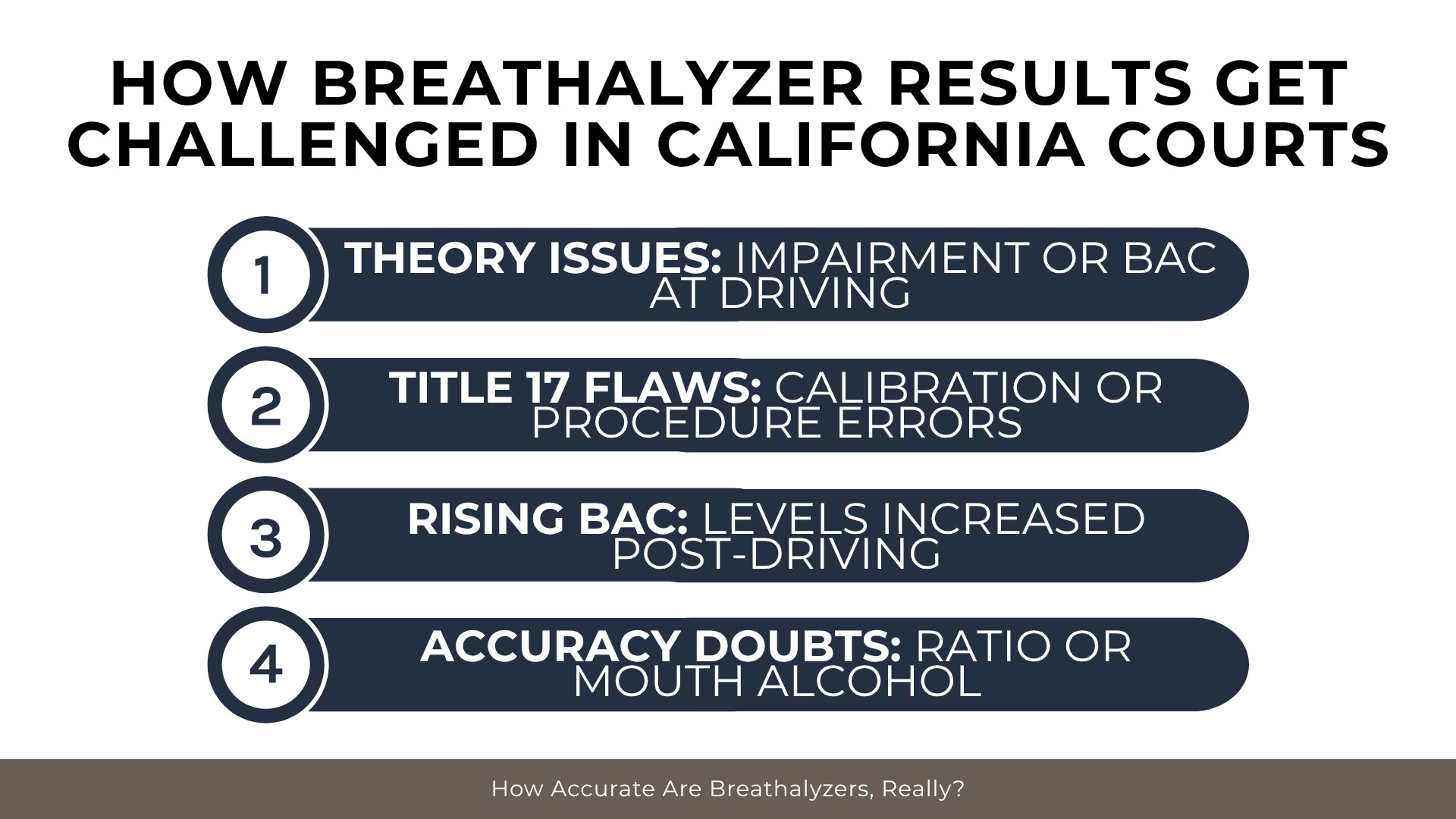
The state prosecutes DUI under two independent theories. Vehicle Code § 23152(a) is the impairment theory — the prosecution must prove that alcohol or drugs rendered you incapable of driving with ordinary care. Vehicle Code § 23152(b) is the per se theory — the prosecution only needs to prove your BAC was at or above 0.08%. Prosecutors routinely charge both, though a conviction on both counts constitutes a single DUI offense for sentencing.
This dual structure creates distinct defense strategies around breathalyzer accuracy.
Title 17 compliance challenges. If the testing instrument wasn’t properly calibrated, if the observation period wasn’t completed, if the operator wasn’t currently certified, or if any other regulatory requirement wasn’t met, the breath test result can be challenged as unreliable. This requires obtaining and reviewing the specific maintenance records, calibration logs, and operator credentials associated with the device that tested you.
Rising blood alcohol defense. Under People v. McNeal (2009), the per se statute requires proof that your BAC was at or above 0.08% at the time of driving — not at the time of testing. Because alcohol takes time to absorb, your BAC may have been lower while you were actually behind the wheel and risen by the time you were tested at the station. If there was a significant gap between the stop and the test, this defense has real scientific grounding.
Partition ratio challenges. Since the breathalyzer assumes a 2100:1 breath-to-blood ratio, defense experts can present evidence that a defendant’s individual ratio differs from the assumed standard, meaning the device may have overestimated their true BAC.
Mouth alcohol and contamination arguments. Evidence that GERD, recent dental work, or other conditions could have introduced mouth alcohol goes directly to the reliability of the breath sample, particularly if the observation period was inadequate.
None of these are magic bullets, and none of them work as generic arguments. They require case-specific investigation — pulling the actual calibration records for the actual device, reviewing the actual timeline of your stop, and understanding the actual science as it applies to your circumstances.
What to Do If You Think Your Breathalyzer Result Was Wrong
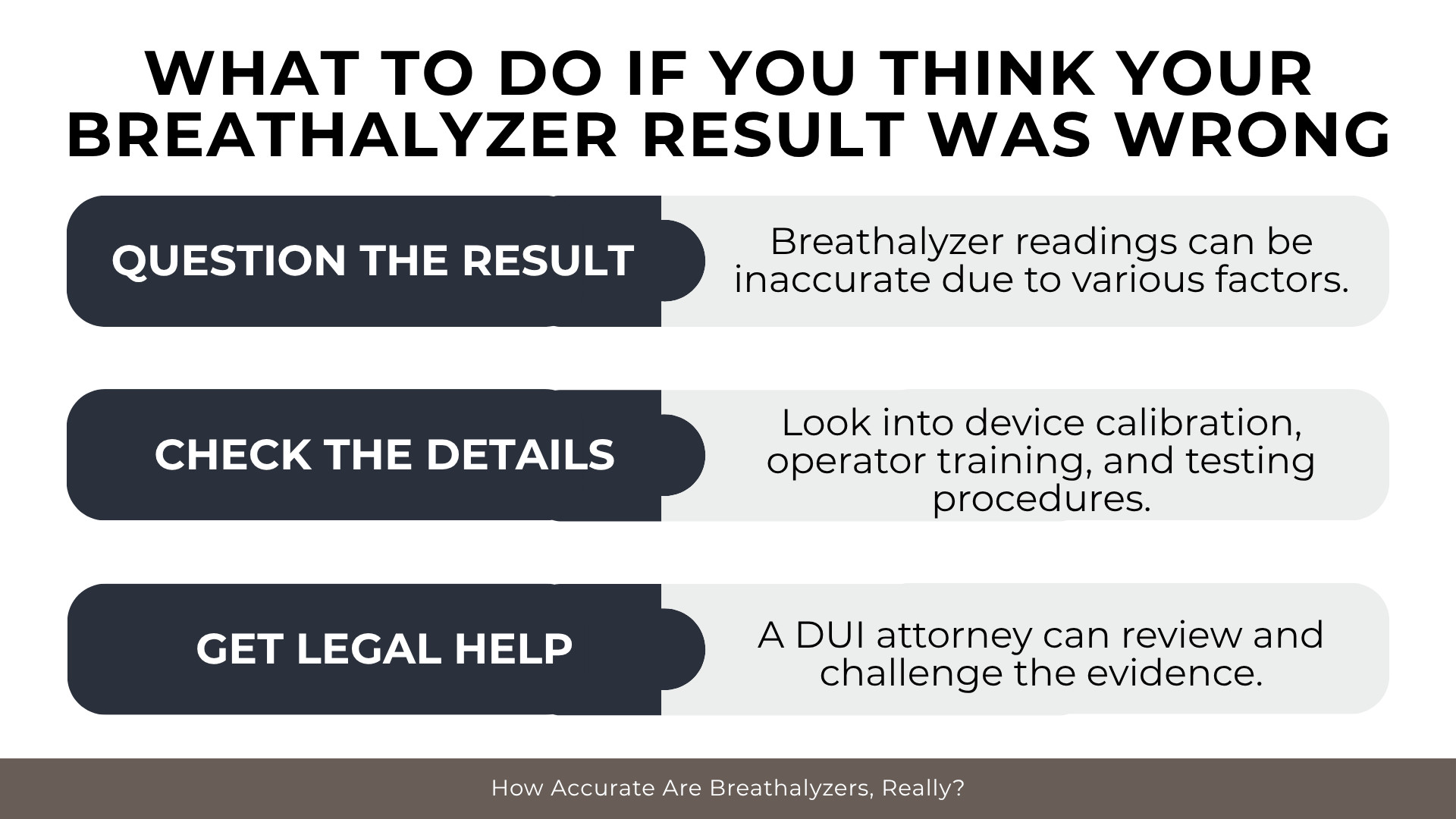
You now know more about breathalyzer accuracy than most people will ever learn. You understand that the reading is an estimate, not a measurement. You know that biology, machine maintenance, and operator conduct all introduce variables. You understand that California law provides specific frameworks for challenging this evidence, and that the strength of the prosecution’s case depends on details that can be investigated.
The question is what to do with that knowledge.
If you’re facing a DUI charge in San Diego County, the most important next step is having someone examine the specific evidence in your case — not breathalyzer accuracy in general, but the calibration history of the device that tested you, the certification status of the operator who ran it, the timeline between your stop and your test, and whether Title 17 requirements were followed at every step.
At Law Office of Angelo Reyes, APC in Carlsbad, that’s exactly how DUI cases are handled. Angelo J. Reyes is a San Diego criminal defense attorney with extensive trial experience who prepares every matter for trial — which means actually obtaining and scrutinizing the maintenance logs, the operator records, and the procedural details that determine whether a breath test result can withstand cross-examination. Recognized by the National Trial Lawyers as a Top 40 Under 40 attorney, Angelo represents clients throughout San Diego County.
A breathalyzer number started this. But a number is only as reliable as the science, the machine, and the process behind it. Understanding that is the first step. Having someone investigate it is the next one.