

If you’re searching this, you probably need a number — not a lecture. So here it is: a first-time DUI in California typically costs somewhere between $10,000 and $20,000 when you add up everything. The California Highway Patrol and the Office of Traffic Safety put the figure at approximately $13,500.
That range surprises most people because the “fine” everyone talks about is only $390 to $1,000. That base fine is real, but it’s roughly 5% of what you’ll actually pay. The rest comes from penalty assessments the court stacks on top, mandatory programs you pay for out of pocket, insurance increases that follow you for years, and a collection of fees from the DMV, your probation department, and the tow yard that impounded your car.
Below is a full accounting of where the money goes, what changes if this isn’t your first offense, and what you can realistically do to bring these costs down.
The Line-by-Line Cost Breakdown
Each of these costs is separate. They come from different agencies, hit at different times, and none of them are optional.
Court fines and penalty assessments: $1,800–$3,600. The base fine under California Vehicle Code § 23536 is $390 to $1,000. But California law adds multiple penalty assessments and court fees on top of that base number. By the time the court is done, most first-time offenders owe between $1,800 and $3,600 depending on the county. The base fine is the only part most people know about. The penalty assessments are the part that actually hurts.
DUI school: $500–$1,800. California requires completion of a state-approved DUI education program as a condition of probation and license reinstatement. A first offense with a BAC under 0.20% typically means a 3-month program (30 hours of classes) at around $500. If your BAC was 0.20% or higher, Vehicle Code § 23538(b)(2) mandates a longer 9-month program, and the cost climbs accordingly. Repeat offenders face 18- or 30-month programs at the higher end of that range. About 83.9% of first offenders who enroll complete the program — it’s manageable, but it’s not free.
Ignition interlock device (IID): $800–$2,500. Under SB 1046, IID installation is now part of the DUI framework for all alcohol-related offenses in California. First offenders typically face a 6-month requirement. You pay for installation, a monthly rental fee, and regular calibration. Those costs add up to roughly $800 to $2,500 over the required period. The rate of IID installation jumped 71% after SB 1046 took effect in January 2019, and about 23.7% of convicted offenders now install one.
License reinstatement and DMV fees: $125+. After your suspension period ends, the DMV charges a $125 Administrative Per Se (APS) reinstatement fee plus any additional reissue or restriction fees. This is separate from anything the court charges. You’ll also need to file an SR-22 form — more on that below.
Towing and impound: $200–$500. If your car was towed at the time of arrest, you’re responsible for the tow fee, daily storage charges, and the release fee. The longer your car sits, the more this costs.
Attorney fees: $2,500–$10,000+. DUI defense attorneys in California typically charge $2,500 to $4,000 as a flat fee for a straightforward first offense. More complex cases, cases with aggravating factors, or cases that go to trial can run $10,000 or more. Whether this expense is worth it depends on the specifics of your case — a question worth exploring during a consultation.
Insurance premium increases: $1,000–$3,000 per year for 3+ years. This is the cost most people underestimate. After a DUI conviction, California requires you to carry an SR-22 certificate of financial responsibility for 3 years following license reinstatement under Vehicle Code § 13352.4. Insurance companies treat a DUI as a major risk factor, and premiums commonly increase by 50% to 100%. Over three years, that can mean an additional $3,000 to $9,000 or more — often the single largest cost of a DUI.
Probation fees: $50–$100 per month. Most first-offense DUI convictions result in 3 to 5 years of probation. 95.9% of convicted DUI offenders receive probation. Some counties charge a monthly supervision fee in the range of $50 to $100, which over a 3-year term adds $1,800 to $3,600 to your total.
Lost wages and miscellaneous costs. Court appearances, DUI school sessions, DMV hearings, and meetings with your attorney all require time away from work. If you’re held in custody or sentenced to jail time — 66.3% of first-time DUI offenders receive a jail sentence, though many are suspended or converted to alternatives — the lost income can be significant. Add bail ($2,500–$10,000 for a first offense, depending on the county), alternative transportation during any license suspension, and you can see how the total reaches $10,000 to $20,000 even in a best-case scenario.

How Costs Escalate: Second, Third, and Felony DUI
California uses a 10-year lookback period measured from arrest date to arrest date. If you have a prior DUI within that window, every cost category above increases — and new ones appear.
A second or third DUI conviction can push total costs to $25,000–$50,000 or more. Mandatory jail sentences increase substantially: 95.2% of repeat offenders receive jail time, compared to 66.3% of first offenders. DUI school requirements extend to 18 or 30 months. License revocation periods lengthen to 2 years for a second offense and 3 years for a third under Vehicle Code § 13352. Completion rates for longer DUI programs drop sharply — only 42.1% of second offenders who enroll finish the program, partly because the time commitment is so much greater.
A DUI becomes a felony under California law when it’s a fourth offense within 10 years (Vehicle Code § 23550) or when it causes bodily injury to another person (Vehicle Code § 23153). Felony DUI with injury carries a potential state prison sentence of 16 months, 2 years, or 3 years, and if the prosecution proves great bodily injury under Penal Code § 12022.7, that adds 3 to 6 years consecutive. Fines can reach $5,000 plus penalty assessments. In the most serious cases — DUI causing death where the prosecution can show implied malice — the charge can be second-degree murder under the standard established in People v. Watson, 30 Cal.3d 290 (1981).
Certain aggravating factors increase penalties at any offense level. A BAC of 0.15% or higher triggers a discretionary enhancement under Vehicle Code § 23578. A BAC of 0.20% or higher mandates the extended 9-month DUI school. Having a child under 14 in the vehicle adds mandatory consecutive jail time under Vehicle Code § 23572 — 48 hours for a first offense, 10 days for a second, 30 days for a third. The median BAC among convicted California DUI offenders is 0.16% — double the legal limit — which means enhancements are in play for a large share of cases.

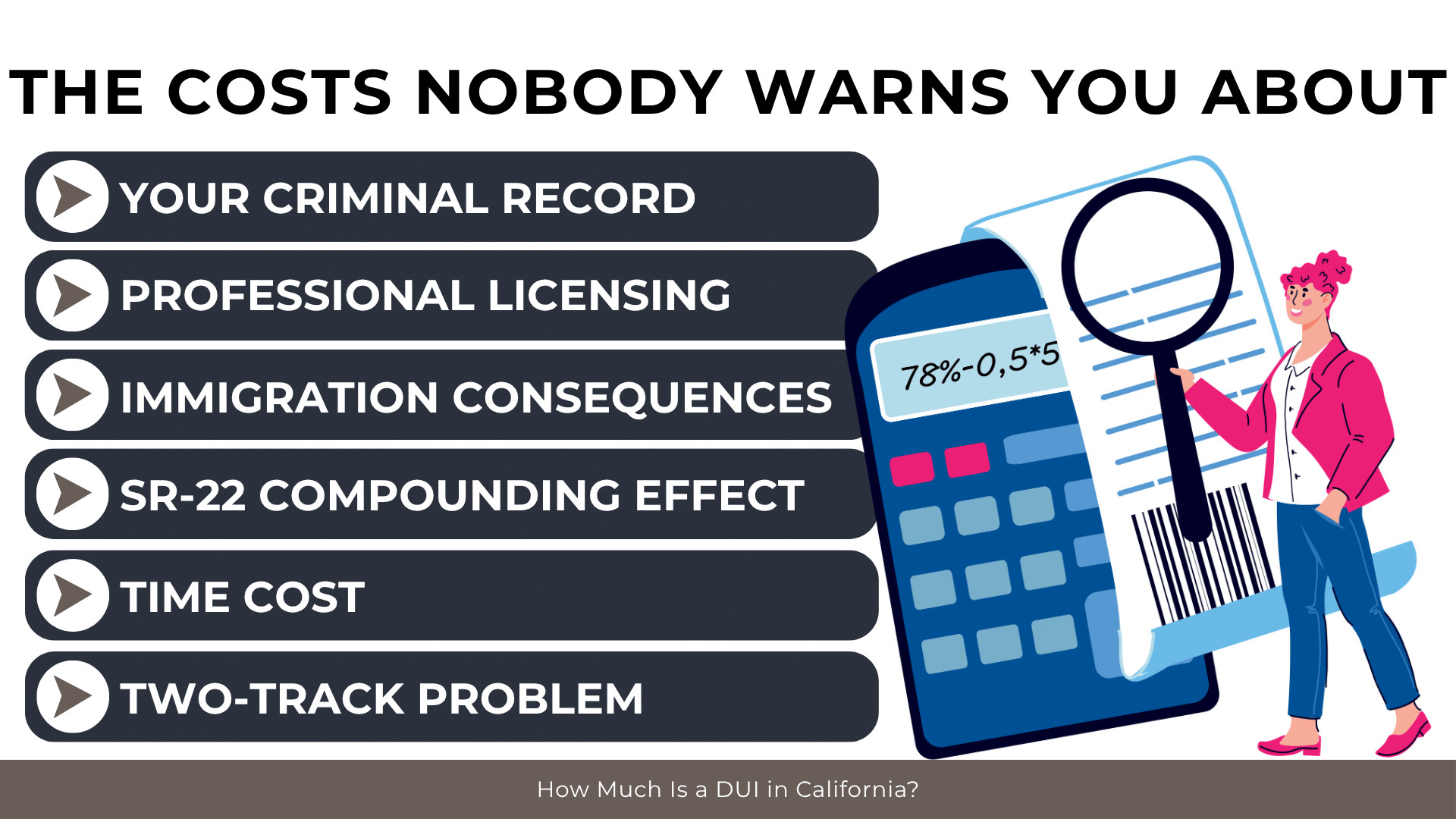
The Costs Nobody Warns You About
The dollar figures above are the direct, measurable costs. But a DUI conviction creates financial pressure in ways that don’t show up on any court invoice.
Your criminal record. A DUI conviction stays on your criminal record and can surface on background checks. Certain employers — particularly in healthcare, education, law, and any role requiring a commercial driver’s license — may take disciplinary action or decline to hire. Under California law, a DUI conviction can be expunged after you successfully complete probation, but the process takes time and typically requires attorney assistance.
Professional licensing. If you hold a professional license, a DUI conviction may trigger a mandatory reporting obligation and potential disciplinary proceedings from your licensing board. This applies across a range of professions.
Immigration consequences. For non-citizens, a DUI conviction can create immigration complications, particularly if drugs or a child passenger were involved. The specifics depend on immigration status and the details of the case, but the stakes can be severe.
The SR-22 compounding effect. The 3-year SR-22 requirement doesn’t just raise your premiums — it locks you into a high-risk insurance category that limits your options. If your SR-22 policy lapses for any reason, the DMV is notified and your license can be suspended again, restarting the cycle.
The time cost. Between court appearances, DUI school sessions (30 hours minimum), DMV hearings, attorney consultations, probation check-ins, and IID maintenance appointments, a DUI conviction consumes dozens of hours over months or years. For someone paid hourly or self-employed, this translates directly into lost income. For everyone, it’s a sustained disruption to normal life.
The two-track problem. Something that catches many people off guard is that a DUI triggers two separate proceedings — a criminal case in court and a civil administrative action by the DMV. These run on different timelines with different standards of proof. Winning one doesn’t guarantee winning the other. The California Supreme Court confirmed in Lake v. Reed, 16 Cal.4th 448 (1997), that the DMV’s Administrative Per Se suspension is a civil remedial measure, not punishment — meaning it stands independently of what happens in criminal court. A criminal acquittal does not automatically vacate a DMV suspension.
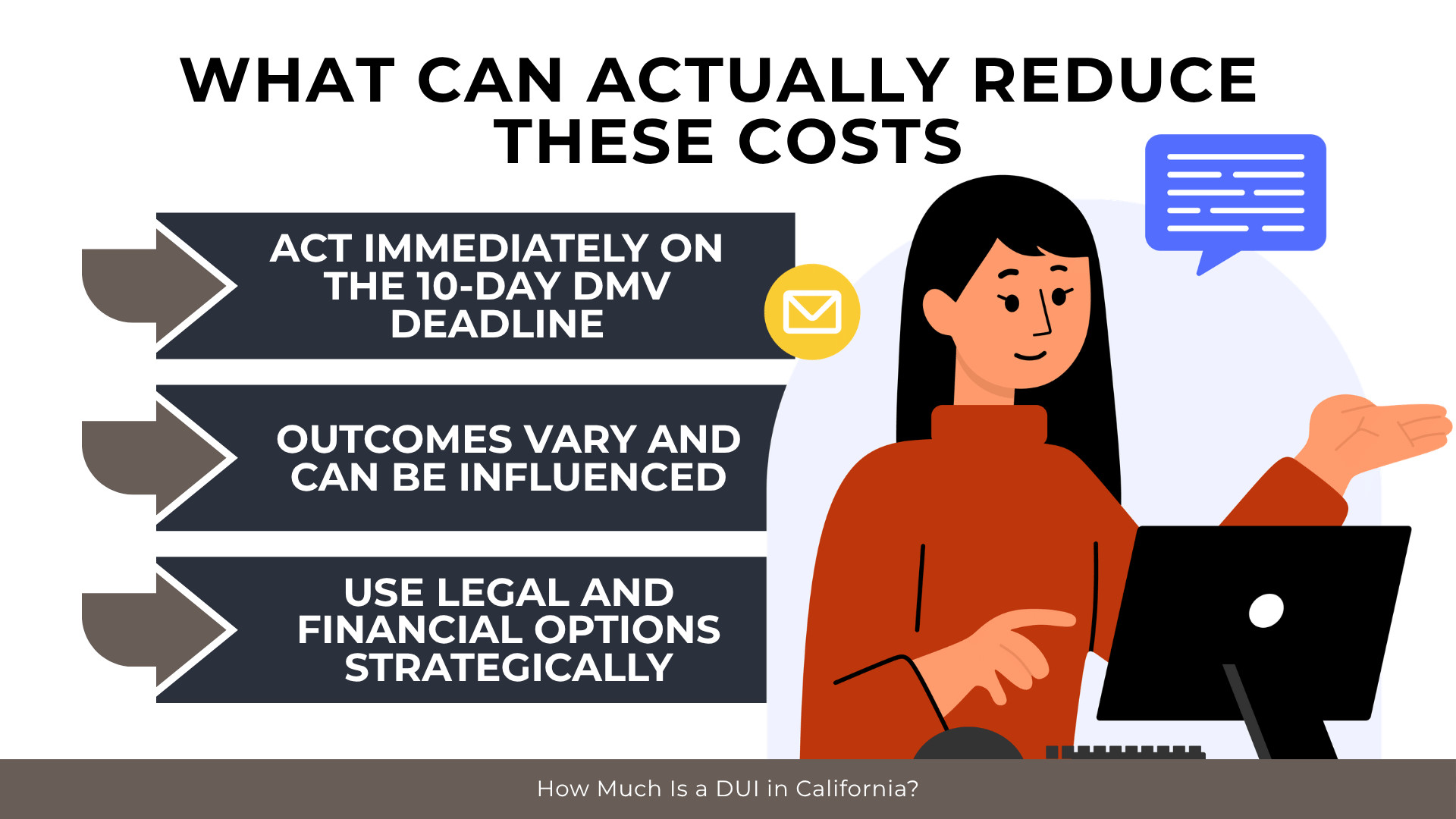
What Can Actually Reduce These Costs
None of this is inevitable. The data shows that outcomes vary significantly, and several factors are within your control.
The 10-day DMV hearing deadline. This is the most time-sensitive action item. Under Vehicle Code § 13558, you have 10 calendar days from the date of your arrest to request an APS hearing with the DMV. If you miss this deadline, your license suspension goes into effect automatically with no opportunity to contest it. Requesting the hearing can also stay the suspension while the hearing is pending. This deadline applies regardless of what happens in your criminal case.
Case outcomes are not predetermined. According to DMV data, 68.9% of DUI arrests in 2019 resulted in DUI convictions. That also means roughly 31% did not. About 20.5% of DUI arrest cases showed no corresponding conviction on DMV records, a figure that has been steadily rising over the past decade. Conviction rates vary dramatically by county, ranging from 41.1% to 91.9% across California. Where your case is filed matters.
Plea reduction to a wet reckless. In 2019, 7.9% of DUI convictions were reduced to alcohol- or drug-related reckless driving — commonly called a “wet reckless.” This is not an acquittal. A wet reckless still counts as a prior offense if you’re arrested for DUI again. But it typically carries lower fines, a shorter DUI program, better insurance implications, and may not require an IID in some circumstances.
Defense strategies that affect outcomes. California DUI law offers several avenues that an experienced attorney can evaluate. Per se DUI under Vehicle Code § 23152(b) requires proof that your BAC was at or above 0.08% at the time of driving — not at the time of testing. The California Supreme Court recognized in People v. McNeal, 46 Cal.4th 1183 (2009), that this distinction creates a potential “rising blood alcohol” defense. Separately, California does not recognize “actual physical control” as DUI — under Mercer v. DMV, 53 Cal.3d 753 (1991), the term “drive” requires volitional movement of the vehicle. Field sobriety tests are voluntary with no statutory penalty for refusal. And DUI checkpoint stops must satisfy the eight-factor framework from Ingersoll v. Palmer, 43 Cal.3d 1321 (1987), or the evidence may be challenged.
Financial assistance options. Most counties offer installment payment plans for court fines. If you qualify financially, a public defender can handle your criminal case at no cost. Some DUI programs offer reduced fees in limited cases.
Why Acting Fast Matters
A DUI in California is expensive — that’s unavoidable. But the difference between a $20,000 outcome and a significantly better one often comes down to what happens in the first 10 days after an arrest.
You have the DMV hearing deadline running. You have a criminal case that needs attention. You have two separate proceedings that require coordination. And you have decisions to make about your defense that become harder to reverse the longer you wait. About 72.8% of convicted DUI offenders are first-time offenders — most people going through this have never dealt with the criminal justice system before. That’s normal, and it’s exactly why early legal guidance matters.
Law Office of Angelo Reyes, APC, based in Carlsbad, represents clients facing DUI charges throughout San Diego County. Attorney Angelo J. Reyes is a trial attorney recognized by the National Trial Lawyers as a Top 40 Under 40, admitted to the State Bar of California and the U.S. District Court for the Southern District of California. If you’re trying to figure out what a DUI is going to cost you, a consultation can give you a clearer picture based on the specific facts of your case — your BAC, your county, your record, and your options.
The question you searched — how much is a DUI in California — has a real answer. It’s $10,000 to $20,000 or more for a first offense. But the more important question is how much of that you can control. The answer to that one depends on what you do next.
