

Simple possession charges in California can be beaten — and they are, more often than most people realize. Statewide data show that 22.4% of felony arrests are dropped before prosecutors ever file a case. Of those that are filed, 17.5% end in dismissal or acquittal. Simple possession cases — which carry a lower burden and more legal vulnerabilities than almost any other drug charge — fall apart at even higher rates when the defense knows where to push.
That doesn’t mean the charge is trivial. It means the outcome depends almost entirely on whether the right defenses are raised at the right time. This page walks through the specific legal strategies that defeat simple possession charges in California. You’ll learn what the prosecution has to prove and where those elements break down. You’ll see how an illegal search can eliminate the evidence entirely. You’ll understand what happens when the drugs weren’t yours or the amount was too small to prosecute. And you’ll learn which diversion programs result in full dismissal.
Can a simple possession charge actually be beaten?
Yes — and the numbers back that up. California’s criminal justice system resolves the overwhelming majority of cases through plea negotiations, not trials. Roughly 94.8% of felony convictions result from plea bargains. That statistic reveals something important about how defense actually works. Most cases are won or lost based on the strength of the defense’s position before trial, not at trial itself. When a defense attorney identifies a constitutional violation, a missing element, or a viable diversion path, prosecutors know their case has a problem. That problem creates leverage to negotiate a reduction, a dismissal, or an outright drop.
Since Proposition 47 took effect in November 2014, most simple possession offenses under California Health & Safety Code §§ 11350 and 11377 are classified as misdemeanors. The maximum penalty is up to six months in county jail and/or a fine of up to $1,000.
At Angelo Reyes Law in Carlsbad, every case is prepared as if it’s going to a jury. That trial-first approach creates real leverage whether the matter resolves through negotiation or at trial.

What does the prosecution actually have to prove?
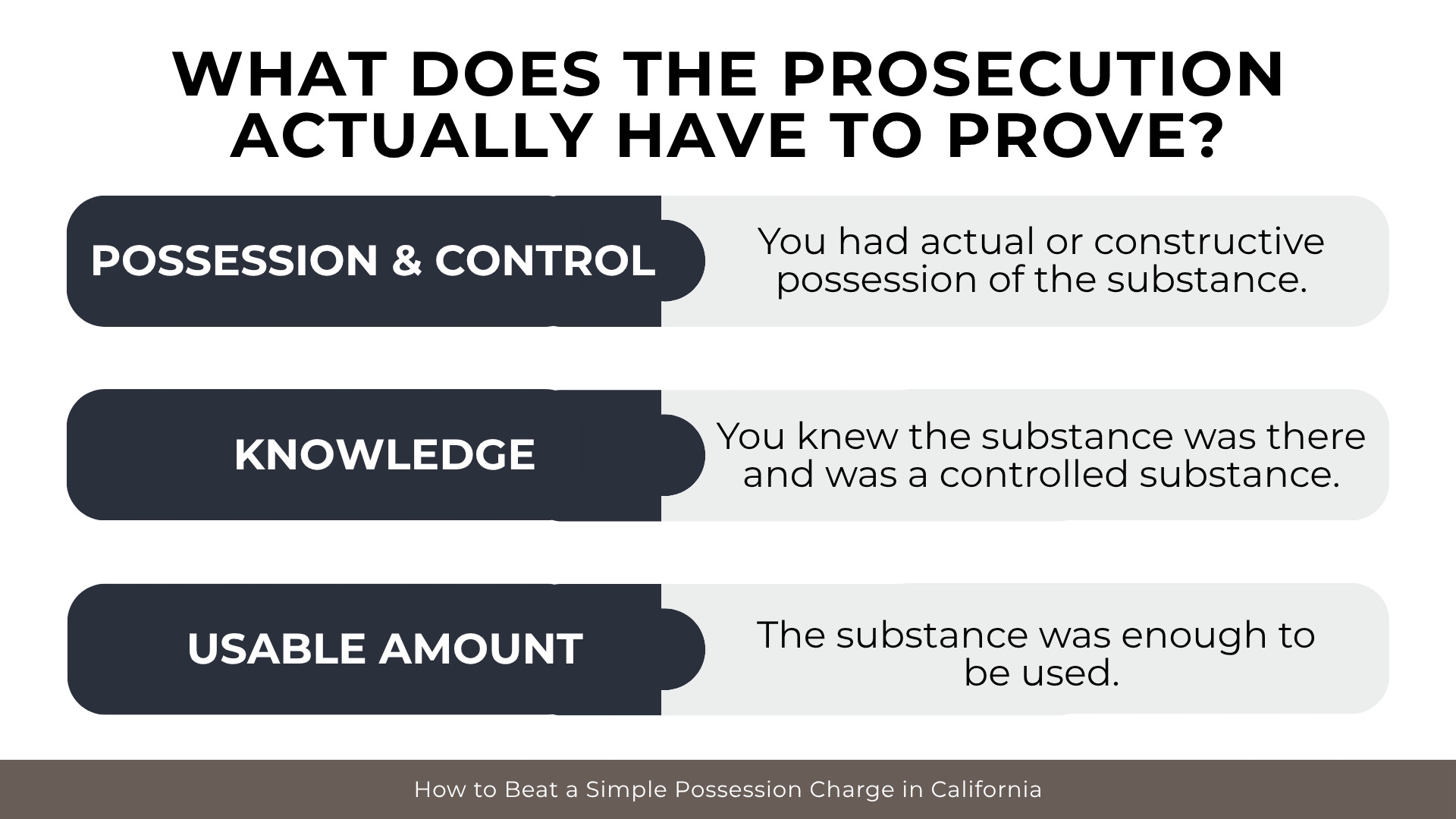
Before you can evaluate your defenses, you need to understand what the prosecution is required to establish. A simple possession conviction in California demands proof of three separate elements. The failure of any one of them means the charge cannot stand.
Dominion and control. The prosecution must prove actual or constructive possession. Under People v. Williams (1971) 5 Cal.3d 211, merely being present where drugs are found is not enough — the prosecution must connect you to the substance through evidence of knowledge and control.
Knowledge. The prosecution must prove awareness that the substance was present and was a controlled substance. If drugs were hidden, left by someone else, or otherwise outside your awareness, the knowledge element fails.
Usable quantity. The substance must be enough to actually use. Under People v. Leal (1966) 64 Cal.2d 504, trace residue or amounts useless for consumption or sale cannot sustain a conviction.
Each of these elements is an independent pressure point. A defense that creates reasonable doubt about any one of them defeats the charge. How these elements play out in real cases — particularly in shared vehicles, shared homes, and other multi-person scenarios — is covered in depth on our pages about simple possession defenses and constructive possession.
What if the police found the drugs during an illegal search?
This is the defense that collapses possession cases frequently. If the evidence was obtained through a search that violated the Fourth Amendment or Article I, Section 13 of the California Constitution, the defense can file a motion to suppress under California Penal Code § 1538.5. If that motion succeeds, the drugs — the prosecution’s entire case — can’t be used in court. Without the physical evidence, there is no possession charge.
Police need either a warrant or a recognized exception to conduct a search. The most common exceptions in drug cases are vehicle searches based on probable cause, searches incident to arrest, consent searches, plain-view seizures, and brief investigative detentions. Each exception has strict boundaries, and law enforcement frequently exceeds them.
Vehicle searches are a common flashpoint. Under California v. Acevedo (1991) 500 U.S. 565, police may search a closed container inside a vehicle without a warrant — but only when they have probable cause to believe it contains contraband. Probable cause is a specific legal standard, not a hunch or a general suspicion. If an officer searched your vehicle or a container inside it without specific probable cause, the evidence may be thrown out.
Traffic stops carry their own restrictions. In Rodriguez v. United States (2015) 575 U.S. 348, the U.S. Supreme Court held that police cannot extend a traffic stop beyond the time needed to complete its original purpose — writing the ticket, checking registration. To conduct a drug investigation or a dog sniff, they need independent reasonable suspicion of criminal activity. A dog sniff of a vehicle’s exterior during a lawful stop is not itself a search under Illinois v. Caballes (2005) 543 U.S. 405. But the moment the stop is prolonged to make that sniff happen, the legal ground shifts.
Cell phones receive stronger protection. In Riley v. California (2014) 573 U.S. 373, the Supreme Court held that police generally need a warrant before searching the digital contents of a phone seized during an arrest. Text messages, photos, location data, and call logs obtained without a warrant may all be thrown out. In drug cases, those digital records are often what prosecutors rely on to establish knowledge or intent.
A suppression motion requires identifying the specific constitutional violation and presenting it to the court with precision. This is where experienced defense counsel matters most. Angelo Reyes prepares every case with the possibility of a suppression hearing in mind, because when the evidence falls, the case falls with it.

What if the drugs weren’t mine?
If the drugs were found in a shared car, a roommate’s apartment, or a common area, the prosecution faces a significantly harder burden. Under People v. Williams (1971) 5 Cal.3d 211, merely being present in a vehicle where drugs are found does not prove possession. The prosecution must connect you specifically to the substance through evidence of knowledge and control — not just proximity. California also recognizes transitory possession as a defense under People v. Mijares (1971) 6 Cal.3d 415, where momentary possession solely to dispose of a substance does not constitute criminal possession. For a full breakdown of how constructive possession works and the defenses that apply, see our page on constructive possession of drugs in California.

Can the charge be dismissed if the amount was too small?
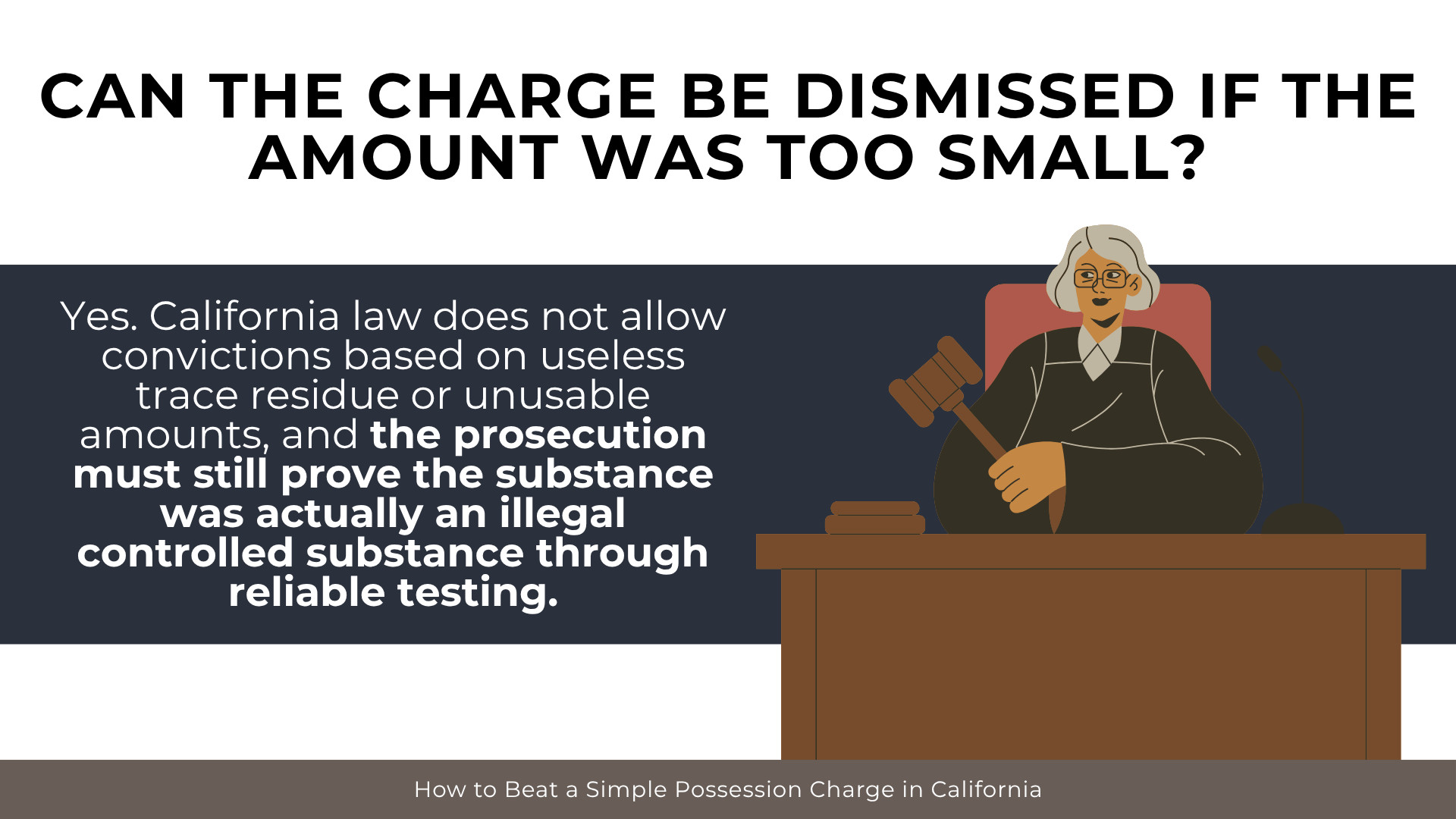
Yes. Under People v. Leal (1966) 64 Cal.2d 504, a minute crystalline residue useless for either sale or consumption cannot sustain a conviction. If the amount recovered is residue scraped from a pipe, an empty baggie with trace powder, or a pill fragment, the defense has strong ground to argue it falls below the usable-quantity threshold.
There is an additional layer. The prosecution must also prove the substance is actually a controlled substance. Under People v. Davis (2013) 57 Cal.4th 353, the People must present competent evidence or a stipulation about the substance’s chemical structure or effects. Lab errors, broken chain-of-custody procedures, and testing failures all create openings for the defense.
Are there programs that get the charge dismissed entirely?
For many people facing a simple possession charge, diversion is the most direct path to a full dismissal — and California offers several options.
California offers three diversion tracks — PC 1000 pretrial diversion, Proposition 36 treatment probation under Penal Code §§ 1210 and 1210.1, and PC 1000.5 drug court — each of which results in dismissal of the charge upon successful completion. Eligibility depends on the specific charge and your criminal history; possession for sale, transportation, manufacturing, and armed-possession charges are automatically excluded. For a first-time or low-level simple possession defendant, diversion is frequently the strongest play, and identifying eligibility early is critical because these programs have time windows that close as a case progresses. Our page on California drug diversion programs covers each track, its requirements, and its eligibility rules in detail.

What should I do right now?
The defenses described on this page — suppression motions, element challenges, usable-quantity arguments, diversion eligibility — all share one thing in common: they are strongest when raised early. Evidence preservation matters. Witness memories fade. Filing deadlines for suppression motions are set by law. Diversion programs have eligibility windows that narrow as a case progresses.
Angelo Reyes Law represents clients facing drug possession charges throughout San Diego County from its Carlsbad office. Angelo works directly with every client — not a paralegal, not an associate — and prepares every case as if it’s going to a jury, creating real leverage whether the matter resolves through negotiation or at trial.
If you’re facing a simple possession charge and want to understand your options, call Angelo Reyes Law for a consultation.
