You searched this because something happened — probably recently — and you need answers. Maybe you saw the flashing lights in your mirror, went through a checkpoint, or woke up to the reality of a charge you never expected. Whatever brought you here, you’re likely dealing with a mix of fear, embarrassment, and uncertainty about what comes next.
Here’s what you should know before anything else: a DUI arrest is not a DUI conviction. According to the California DMV’s own data, 20.5% of DUI arrest cases in 2019 showed no corresponding conviction on DMV records — and that number has been climbing steadily over the past decade. That doesn’t mean dismissals are easy or guaranteed. It means the system has gaps, officers make mistakes, and the law has standards the prosecution has to meet. When they don’t meet them, cases fall apart.
This article walks you through exactly how that happens in California — the specific legal grounds, the timeline, and the realistic factors that affect your chances.
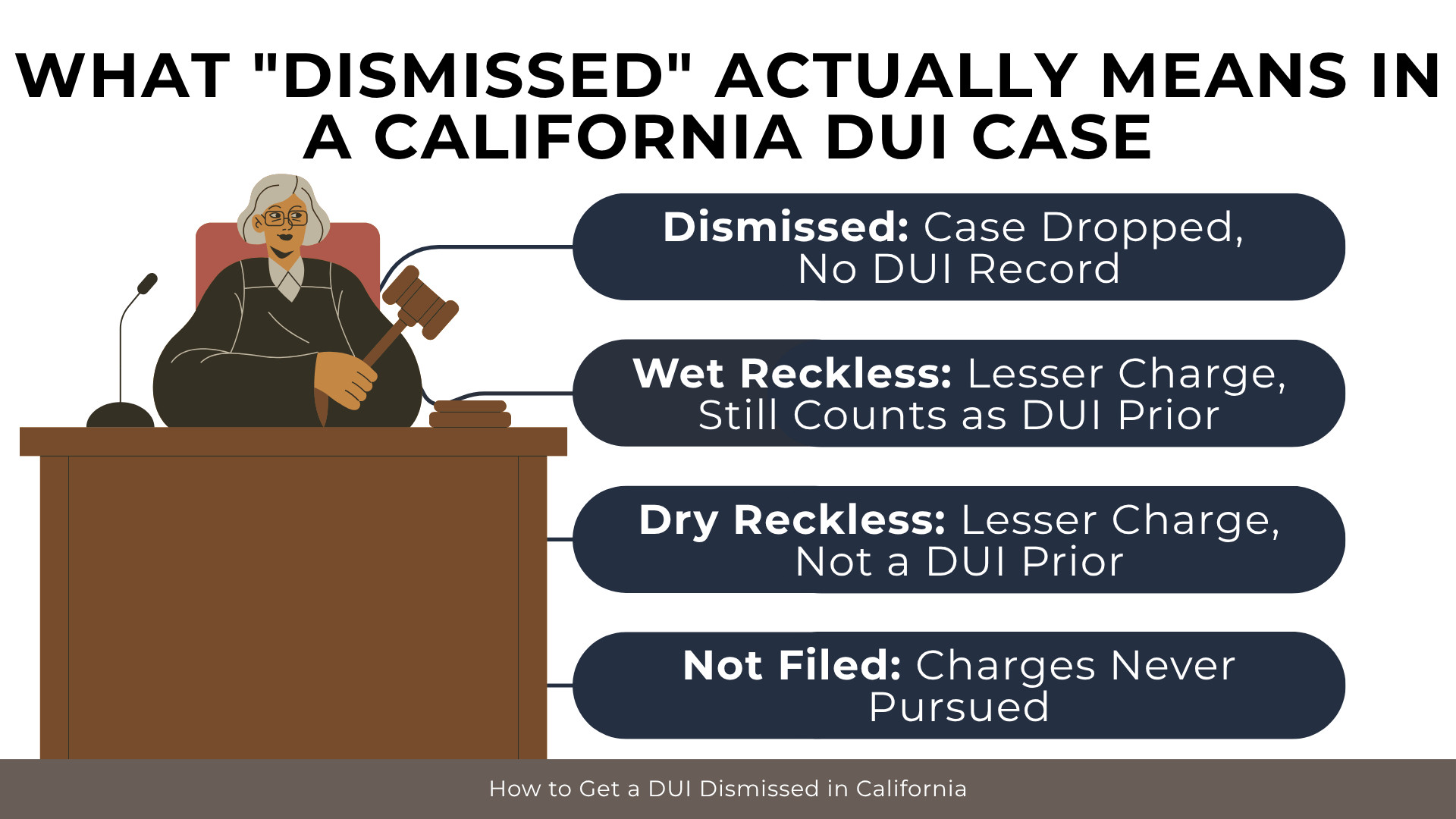
What “Dismissed” Actually Means in a California DUI Case
Most people searching for how to get a DUI dismissed are picturing one thing: a judge says “case dismissed,” and life goes back to normal. That does happen. But it’s one outcome on a spectrum, and understanding the full range matters because a “win” in a DUI case doesn’t always look the way you’d expect.
Full dismissal means the charges are dropped entirely. This can happen before trial (if a judge grants a motion to suppress key evidence) or when the prosecution decides they can’t prove their case. You walk away with no conviction and no DUI on your record.
Reduction to a “wet reckless” — an alcohol- or drug-related reckless driving plea — is far more common. 7.9% of DUI convictions in 2019 were reduced to this category. It’s not a dismissal in the technical sense, but it carries lighter penalties — shorter probation, lower fines, no mandatory license suspension from the court. The tradeoff: it still counts as a prior DUI offense if you’re ever arrested again within ten years.
Reduction to a “dry reckless” — standard reckless driving with no alcohol or drug component — is the best plea outcome short of full dismissal. It’s not priorable as a DUI, which means it won’t count against you in a future DUI case.
Charges dropped before filing happens more often than people realize. The district attorney reviews every arrest and decides whether to file formal charges. If the evidence is weak, they may decline to prosecute altogether.
The point is this: when a DUI attorney evaluates your case, they’re looking at all of these exits, not just one. The strategy that leads to the best outcome depends entirely on the facts of your arrest.
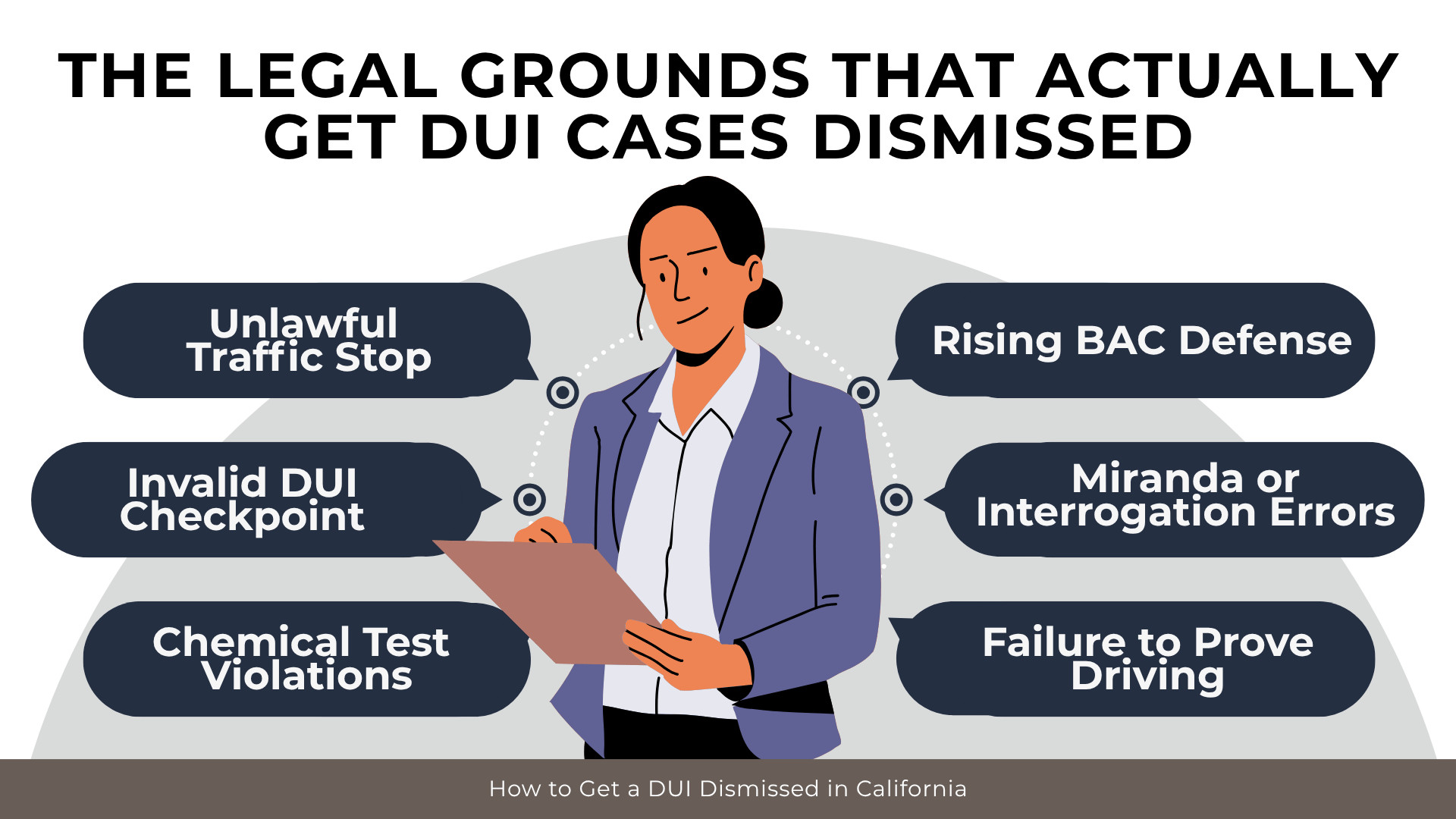
The Legal Grounds That Actually Get DUI Cases Dismissed
DUI dismissals aren’t random. They come from identifiable errors — constitutional violations, procedural failures, and evidentiary problems that the law takes seriously. Here are the grounds California courts recognize.
The Traffic Stop Was Unlawful
Every DUI case begins with a traffic stop or a checkpoint. If the stop itself was illegal, everything that followed — the field sobriety tests, the breath test, the arrest — can be challenged.
Under the Fourth Amendment, an officer needs reasonable suspicion based on specific, articulable facts to pull you over. In People v. Bell (43 Cal.App.4th 754, 1996), the California Court of Appeal held that a traffic stop requires reasonable suspicion of illegality based on articulable facts — hunches aren’t enough. If an officer can’t explain exactly what they observed — weaving, running a light, equipment violation — the stop may not hold up.
This also applies to how the stop was conducted. Under Terry v. Ohio (392 U.S. 1, 1968), any investigative detention must be reasonably related in scope to the circumstances that justified the initial interference. If an officer pulls you over for a broken taillight and turns it into a 45-minute DUI investigation without observing any signs of impairment, that expansion of scope is legally vulnerable.
One important nuance: if you turned away from a DUI checkpoint, that alone is not grounds for a stop. Officers cannot pull you over solely for avoiding a checkpoint unless they observe an independent traffic violation or visible signs of impairment.
The DUI Checkpoint Didn’t Follow the Rules
DUI checkpoints are legal in California, but only when they meet strict requirements. In Ingersoll v. Palmer (43 Cal.3d 1321, 1987), the California Supreme Court established an eight-factor test that every checkpoint must satisfy: supervisory oversight by command-level personnel, neutral criteria for selecting which vehicles to stop, adequate safety conditions, a reasonable location, reasonable duration of the stop, clear indicia of the checkpoint’s official nature, advance publicity, and a formula for selecting vehicles that limits officer discretion.
If a checkpoint failed to meet any of these factors — no supervisory oversight, arbitrary vehicle selection, no advance notice — the evidence gathered there can be challenged and potentially suppressed.
Chemical Testing Violations
The chemical test — breath or blood — is usually the prosecution’s strongest piece of evidence. It’s also where some of the most consequential errors happen.
California’s implied consent law under Vehicle Code § 23612 means that by driving on California roads, you’ve consented to chemical testing after a lawful arrest for DUI. But there’s a critical word in that sentence: lawful. If the underlying arrest was improper, the implied consent framework doesn’t apply the way the prosecution needs it to.
For blood draws specifically, the U.S. Supreme Court set a hard line in Missouri v. McNeely (569 U.S. 141, 2013): the natural dissipation of alcohol in the bloodstream does not automatically create an emergency justifying a warrantless blood draw. The court requires a totality-of-circumstances analysis. And in Birchfield v. North Dakota (579 U.S. 438, 2016), the court held that while warrantless breath tests incident to a DUI arrest are constitutional, warrantless blood tests are not — the government needs either actual consent or a warrant.
An important distinction: refusal to submit to the pre-arrest preliminary alcohol screening (PAS) test carries no penalty for drivers over 21 who are not on DUI probation, per Vehicle Code § 23612(h)-(i). But refusing the post-arrest chemical test is a different matter entirely. And when drug-only DUI is suspected, blood testing is required — breath tests detect only alcohol.
The Rising Blood Alcohol Defense
This is one of the most misunderstood but legally significant defenses in California DUI law. Under Vehicle Code § 23152(b), the prosecution must prove your BAC was at or above 0.08% at the time you were driving — not at the time you were tested, which is often 30 minutes to two hours later.
Alcohol takes time to absorb. If you had drinks shortly before driving, your BAC may have still been rising when you were behind the wheel and only crossed 0.08% after you were already stopped. In People v. McNeal (46 Cal.4th 1183, 2009), the California Supreme Court confirmed that per se DUI requires proof of BAC at the time of driving, creating a potential basis for this defense.
This doesn’t apply to every case. But if your test result was close to 0.08% and there was a significant gap between when you were driving and when you were tested, this is a real issue the prosecution has to address.
Miranda and Interrogation Violations
Here’s where most people’s understanding diverges from the law. Officers do not have to read you Miranda rights during a routine traffic stop. The U.S. Supreme Court held in Berkemer v. McCarty (468 U.S. 420, 1984) that roadside questioning during a traffic stop is not custodial interrogation, so Miranda doesn’t apply.
But Miranda does attach the moment a detention transforms into custody — once an officer’s conduct would cause a reasonable person to believe they’re under arrest. If you were handcuffed, placed in a patrol car, and then questioned about how much you’d had to drink without being read your rights, those statements may be suppressible.
A related point from People v. Jackson (189 Cal.App.4th 1461, 2010): refusing a field sobriety test can be used against you in court as consciousness of guilt, but refusing the preliminary alcohol screening (PAS) test cannot, because you have a statutory right to refuse it under Vehicle Code § 23612(h). If the prosecution tried to use your PAS refusal against you, that’s an error.
The “Driving” Element
California has a narrower definition of “driving” than many people assume. In Mercer v. Department of Motor Vehicles (53 Cal.3d 753, 1991), the California Supreme Court held that “driving” requires volitional movement of the vehicle. Sitting in a parked car with the engine running — even intoxicated — does not constitute driving under California law. Unlike many other states, California does not recognize an “actual physical control” standard. If the prosecution can’t prove you actually moved the vehicle, they can’t prove DUI.
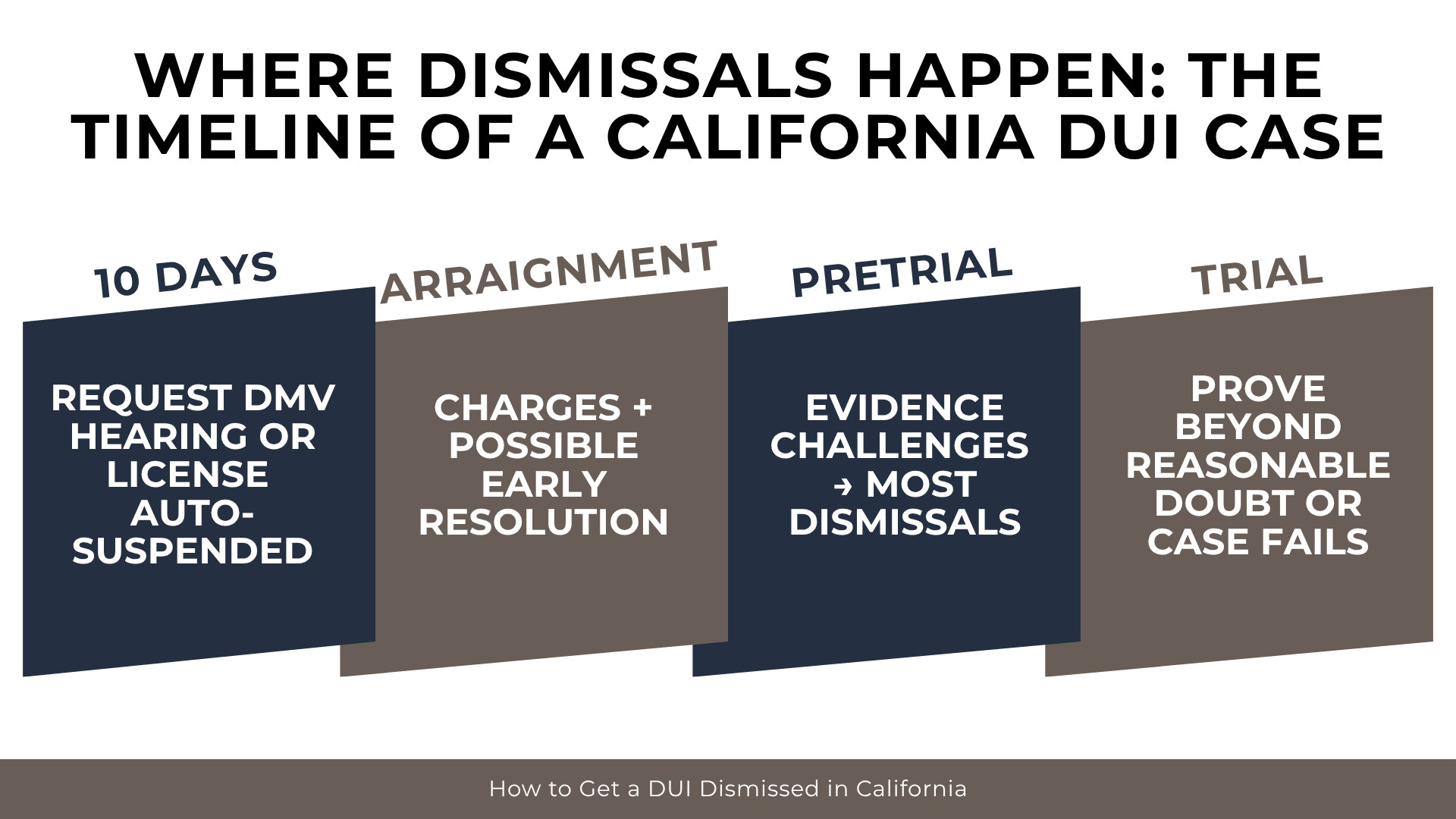
Where Dismissals Happen: The Timeline of a California DUI Case
Understanding when these challenges get raised matters, because some deadlines are unforgiving.
The 10-day window (DMV APS hearing). The moment you’re arrested for DUI in California, a separate administrative process begins. The DMV will automatically suspend your license through its Administrative Per Se program under Vehicle Code § 13353.2 — and you have exactly ten days from your arrest to request a hearing to challenge it under Vehicle Code § 13558. Miss this deadline and the suspension goes into effect automatically. This administrative proceeding is entirely separate from your criminal case — as the California Supreme Court held in Lake v. Reed (16 Cal.4th 448, 1997), the APS suspension is a civil remedial measure, not punishment, and the Double Jeopardy Clause does not apply. At the APS hearing, the DMV must prove by a preponderance of evidence that the officer had reasonable cause to believe you were DUI, per MacDonald v. Gutierrez (32 Cal.4th 150, 2004). Winning this hearing doesn’t dismiss your criminal case, but it can preserve your driving privileges and sometimes reveals weaknesses in the prosecution’s evidence.
Arraignment. Your first court appearance, where formal charges are read and you enter a plea. An attorney can begin negotiating with the prosecution here, and sometimes weak cases are resolved early.
Pretrial motions. This is where most dismissal-winning arguments are made. A motion to suppress evidence asks the judge to exclude evidence obtained through constitutional violations — an unlawful stop, an improper blood draw, a defective checkpoint. If the judge grants it and the prosecution loses their key evidence, they often have no choice but to dismiss or significantly reduce the charges.
Trial. If the case goes to trial, the prosecution must prove every element beyond a reasonable doubt. The overall DUI conviction rate for 2019 arrests was 68.9% — meaning roughly 31% of DUI arrests did not end in a DUI conviction. Some were reduced, some were dismissed, and some were acquitted at trial.
What Strengthens and Weakens Your Chances
Not every DUI case has the same odds. Here are the factors that matter most.
Your BAC level. Drivers at 0.08% BAC are approximately 4 times more likely to crash than sober drivers; at 0.15%, that risk multiplies to at least 12 times. If your result was close to 0.08%, there’s more room for a rising blood alcohol defense, calibration challenges, and margin-of-error arguments. If it was well above that threshold, the defense typically shifts toward procedural and constitutional issues rather than disputing impairment.
Whether there was an accident. 8.3% of 2019 DUI arrests were associated with crashes involving injuries or fatalities. Cases involving injuries can be charged as felonies under Vehicle Code § 23153, which is a wobbler offense — meaning prosecutors have discretion to file it as either a felony or a misdemeanor depending on the circumstances. Cases without an accident — a routine traffic stop — tend to have more room for negotiation and dismissal arguments.
First offense vs. repeat offense. 72.8% of convicted DUI offenders were first-time offenders. First offenses generally carry more options for reduction and more prosecutorial willingness to negotiate, particularly when the evidence has weaknesses. A fourth offense within ten years becomes a felony under Vehicle Code § 23550.
Your county. This matters more than most people realize. A California DMV study found that DUI conviction rates across counties ranged from 41.1% to 91.9%, with counties that had higher arrest rates tending to have lower conviction rates. While this data reflects an earlier period, the underlying dynamic — that local prosecution culture, court caseloads, and how aggressively individual DA offices pursue DUI cases all vary significantly — remains relevant. An attorney who practices in your specific county understands these dynamics.
Whether you refused testing. Refusing the post-arrest chemical test triggers an automatic one-year license suspension for a first offense under Vehicle Code § 13353, with no restricted license eligibility. It also gives the prosecution a different kind of evidence — the refusal itself can be used against you in court. But the flip side is that without a BAC number, the prosecution has to prove impairment through officer observations alone, which can be a harder case to make.

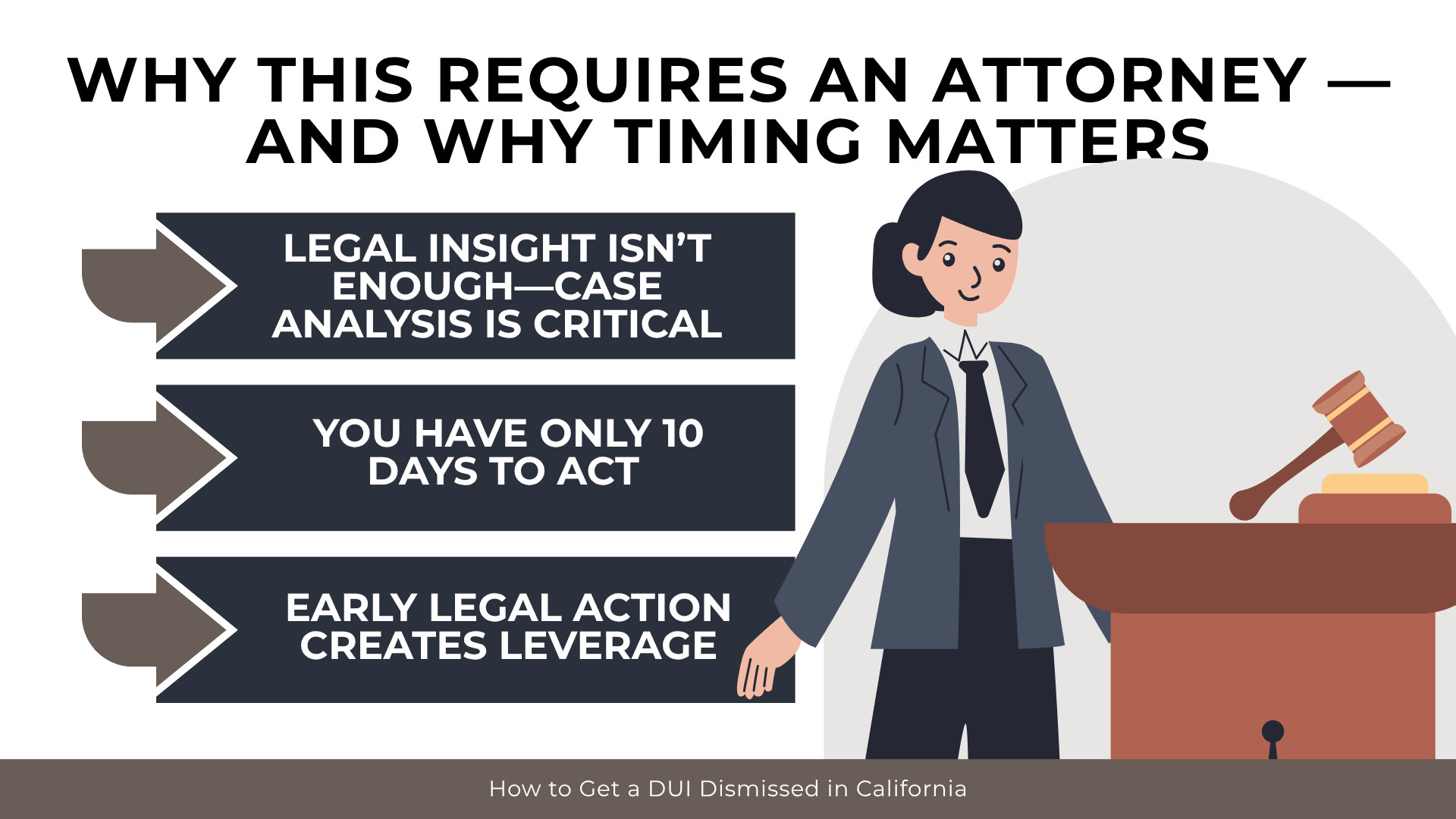
Why This Requires an Attorney — and Why Timing Matters
You now understand the legal grounds that lead to DUI dismissals in California. But understanding the grounds and identifying them in your specific case are two very different things. Every viable dismissal path begins with someone reviewing the actual evidence: the arrest report, dashcam or bodycam footage, the chemical test records, and checkpoint documentation.
This isn’t something you can do yourself, and it’s not something that can wait. The 10-day DMV hearing deadline starts the clock the moment you’re arrested. Missing it means losing your first opportunity to challenge the evidence and preserve your license.
Law Office of Angelo Reyes, APC in Carlsbad represents clients facing DUI charges throughout San Diego County. Attorney Angelo J. Reyes, recognized by the National Trial Lawyers as a Top 40 Under 40, is a courtroom advocate with extensive trial experience who prepares every matter for trial — because the willingness to go to trial is what creates leverage for dismissals, reductions, and favorable outcomes at every stage before one. If you’re facing a DUI charge in the San Diego area, the most important thing you can do right now is have your case evaluated before that window closes.