To get a domestic violence restraining order in California, you file a petition with your local superior court. The petition asks a judge to order another person to stay away from you, stop contacting you, and comply with other protective conditions. In many cases, a judge can grant temporary protection the same day you file — before the other person is even notified.
The process has specific eligibility requirements, deadlines, and procedural steps. This page walks through who qualifies, the types of orders available, how to file, what happens at the court hearing, what the order can cover, and when it makes sense to involve an attorney.
Do I Qualify for a Restraining Order in California?
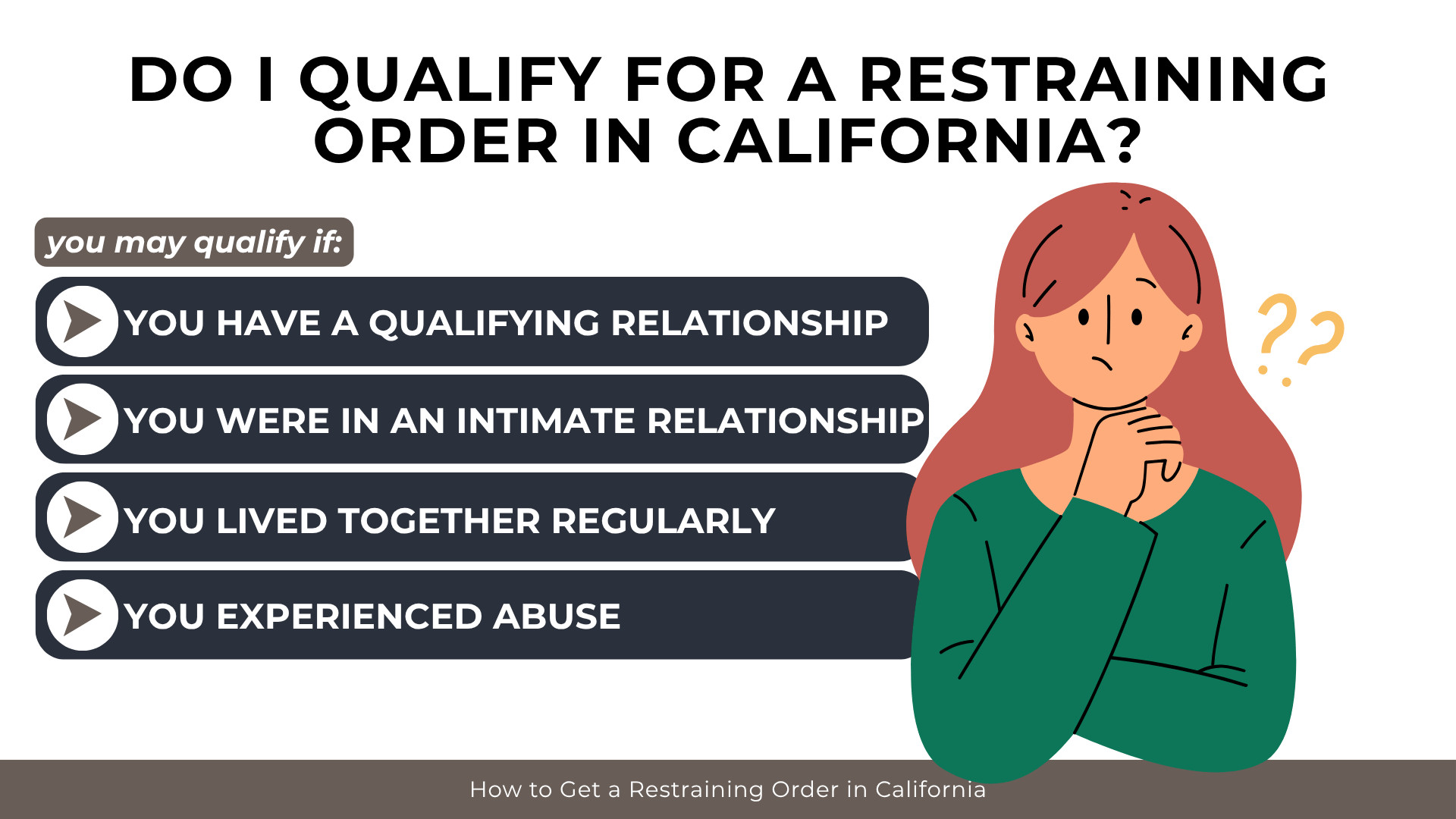
California’s Domestic Violence Prevention Act provides restraining orders specifically for you if you have a qualifying relationship with the person you need protection from. Under California Family Code § 6211, that includes a spouse or former spouse, a current or former cohabitant, someone you have or previously had a dating or engagement relationship with, a co-parent, or children of a party or a child who is the subject of a Uniform Parentage Act action. It also includes any person related to you by blood or marriage within the second degree — parents, siblings, grandparents, in-laws, aunts, uncles, nieces, and nephews.
A “dating relationship” under Family Code § 6210 means frequent, intimate associations mainly defined by the expectation of affection or sexual involvement, independent of financial considerations. A “cohabitant” under Family Code § 6209 means a person who regularly resides in the household — a broader standard than what applies in criminal cases.
If the person you need protection from doesn’t fall into one of these categories — a neighbor, a stranger, a coworker with no intimate or family connection — you may still qualify for a civil harassment restraining order. However, the DVPA process covered here would not apply.
One point worth understanding early: “abuse” under this law is not limited to physical violence. Family Code § 6203 defines abuse to include intentionally or recklessly causing or attempting to cause bodily injury, sexual assault, placing a person in reasonable apprehension of imminent serious bodily injury to that person or to another, or engaging in behavior that could be prohibited under Family Code § 6320. A California appellate court confirmed in Rodriguez v. Menjivar (2015) that controlling and coercive behavior — including isolation, monitoring, and emotional abuse — counts as abuse under the DVPA and can serve as the basis for a restraining order.
What Types of Restraining Orders Are Available in California?
California has four different types of protective orders in domestic violence situations. They differ in who can request them, how quickly they take effect, and how long they last.
An Emergency Protective Order is started by law enforcement, not by you directly. When an officer responds to a scene and believes there is an immediate and present danger of domestic violence, the officer can contact a judge and request an EPO on the spot. Under Family Code § 6241, a judge must be available at all times for this purpose, whether or not court is in session. An EPO expires at the close of business on the fifth court day after it is issued or on the seventh calendar day, whichever comes first. It is designed to bridge the gap until you can file for longer-term protection. When it meets certain specific requirements, it takes the highest enforcement priority over all other protective orders.
A Temporary Restraining Order is what you file for yourself. Under Family Code § 6300, a court can issue a TRO based on reasonable proof of a past act or acts of abuse. It can do so without notifying the other person first. The statute is explicit: a TRO “shall not be denied solely because the other party was not provided with notice.” A TRO stays in effect until the court hearing, typically scheduled 20 to 25 calendar days after filing.
A Domestic Violence Restraining Order is what the court issues after a full hearing where both sides have the opportunity to present evidence. If granted, a DVRO can last up to five years and includes broader protections than a TRO, including custody, support, and property provisions.
A Criminal Protective Order is issued by a criminal court, not a family court. If the person you need protection from has been arrested or charged with a crime against you, the prosecutor or judge can issue a CPO. Post-conviction criminal protective orders can last up to 10 years, or up to 15 years for corporal injury convictions under Penal Code § 273.5. During a pending criminal case, the CPO takes priority over any civil court orders except EPOs.
You don’t necessarily have to choose between these. You can hold both a CPO and a DVRO at the same time. The DVRO provides protections — custody, support, property control — that a CPO does not, while the CPO carries criminal enforcement weight.

How Fast Can I Get Protection?
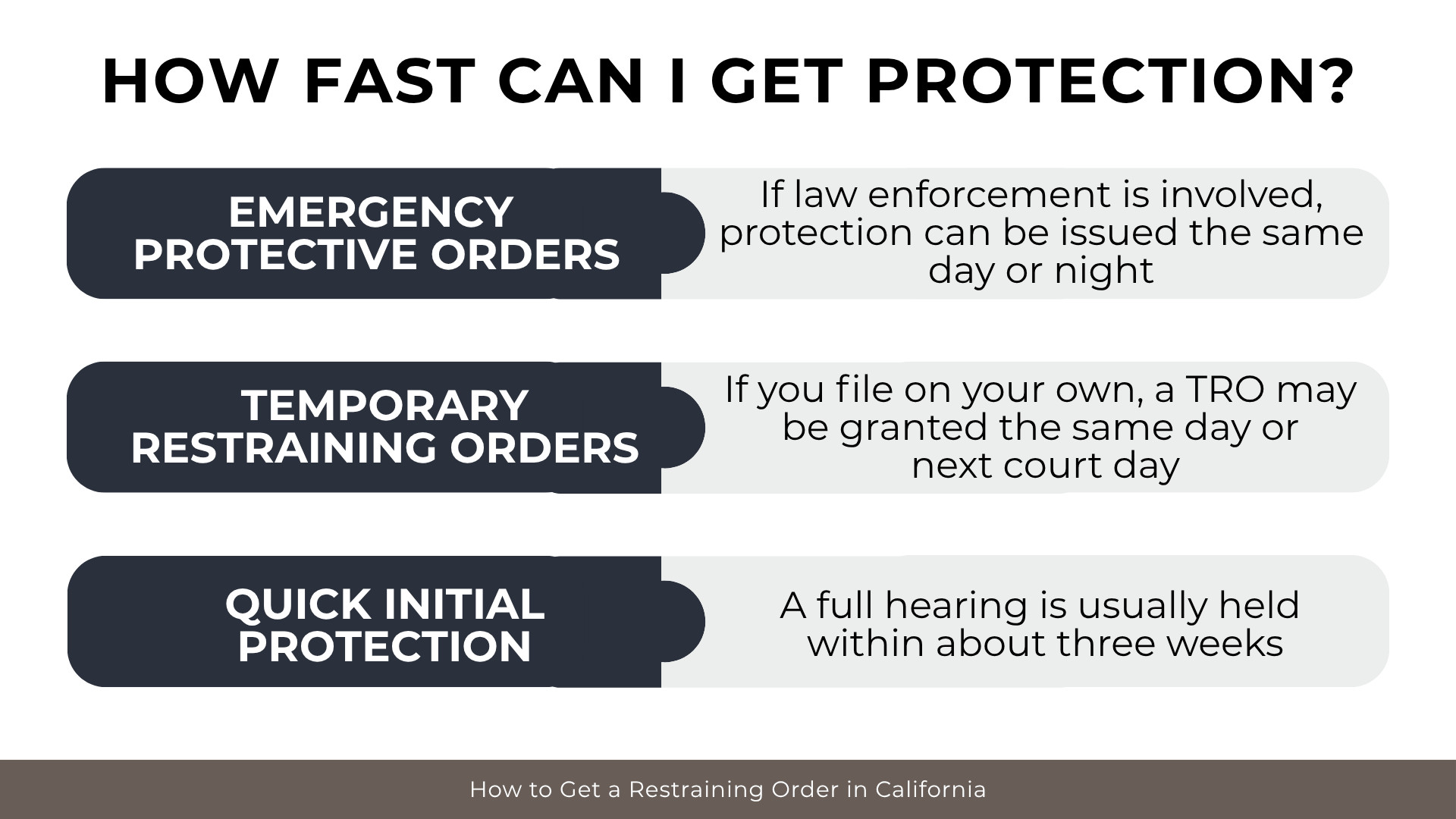
If law enforcement is involved, an EPO can be issued the same day — or the same night. Judges are required to be reasonably available at all times for EPO requests.
If you’re filing on your own, a TRO can often be granted the day you submit your petition or the next court day. Because TROs can be issued ex parte — meaning without the other party present or notified — the court can act on your filing as soon as a judge reviews it. If the court denies a TRO request, Family Code § 6320.5 requires it to state its reasons. And under the appellate court’s holding in Nakamura v. Parker (2007), a court cannot deny a DVPA application that is supported by facially adequate allegations of abuse without providing a hearing or explanation.
The practical takeaway: you do not need to wait weeks or months while feeling unsafe. The system is designed to provide initial protection quickly, then schedule a full hearing within roughly three weeks.
What Are the Steps to File for a Restraining Order?
The process follows a predictable sequence.
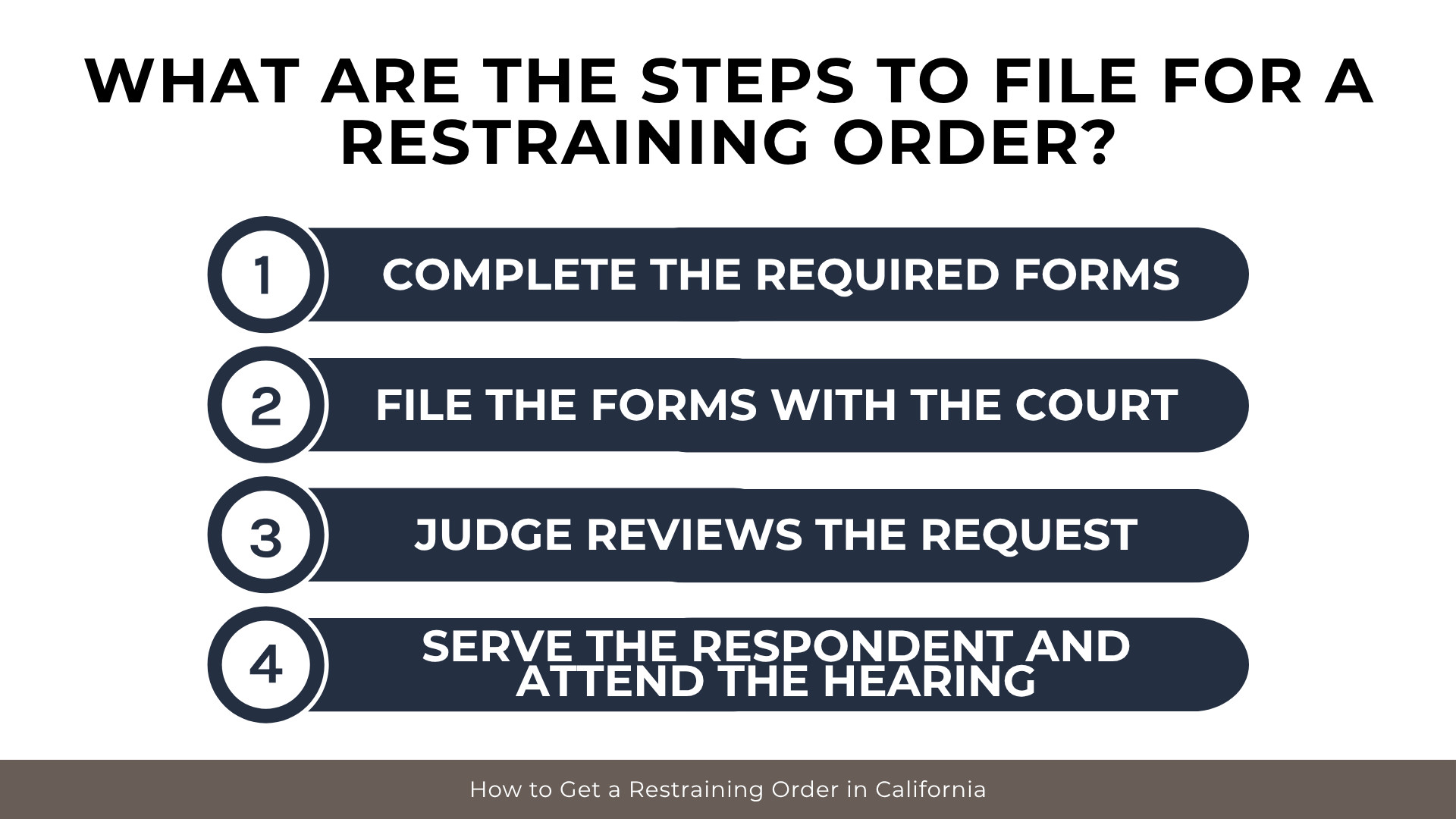
You begin by completing the required Judicial Council forms. These forms ask you to describe the abuse, identify the person you need protection from, and specify what orders you are requesting — stay-away distance, no-contact provisions, custody arrangements, residence exclusion, and other protections.
You file the forms with the clerk at your local superior court.
A judge reviews your petition. The legal standard at this stage is “reasonable proof of a past act or acts of abuse” under Family Code § 6300. If the judge finds that standard is met, the court issues a TRO, which is effective immediately.
The respondent must then be served with copies of the TRO and the notice of the hearing date. The hearing is typically scheduled 20 to 25 calendar days after the TRO is issued. Both sides can attend, present evidence, and testify.
What Happens at the Restraining Order Hearing?
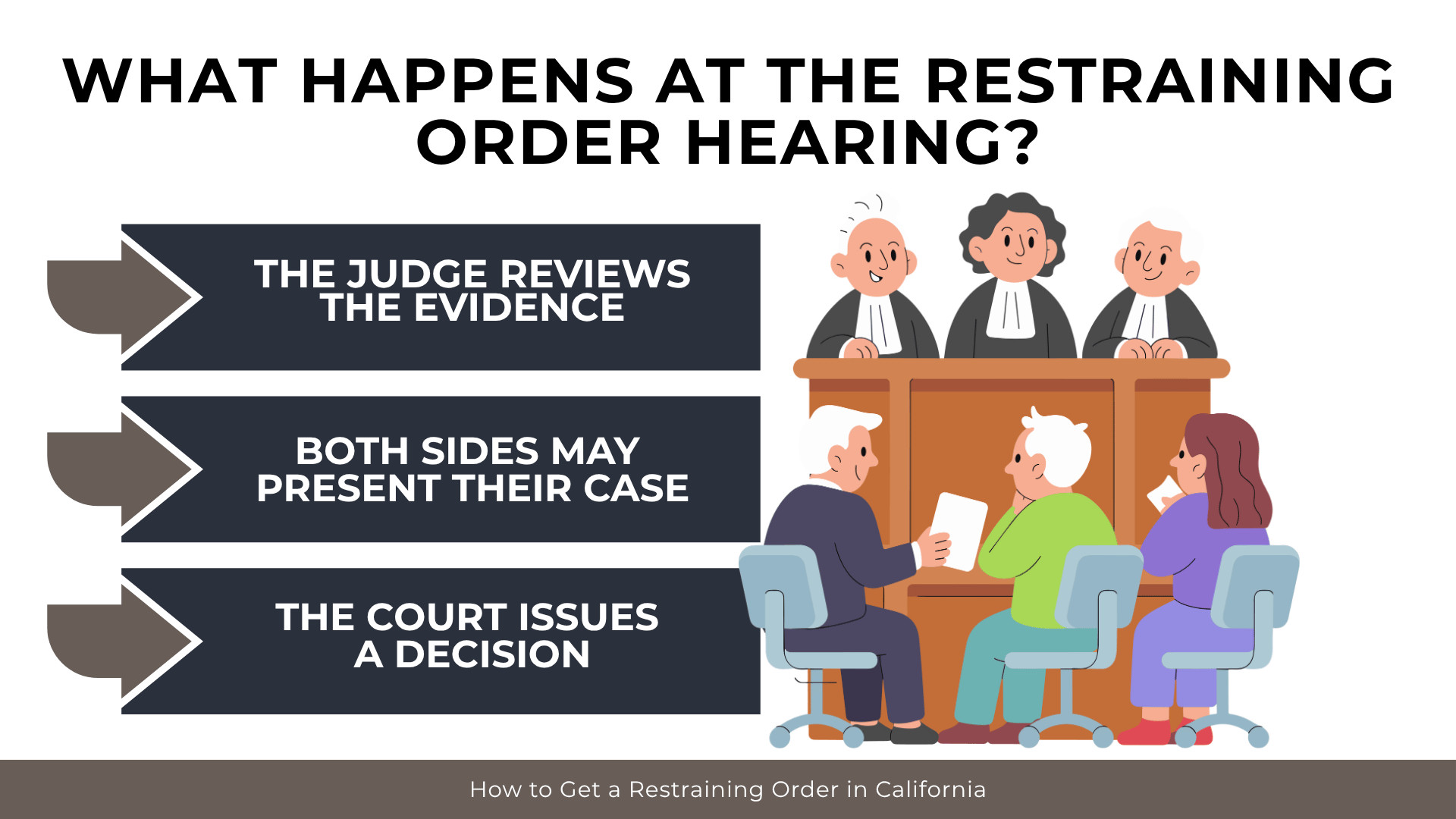
At the hearing, the court decides whether to grant a longer-term DVRO. The standard of proof is preponderance of the evidence — meaning you need to show it is more likely than not that abuse occurred. This is a lower bar than the “beyond a reasonable doubt” standard in criminal cases.
Both parties can present testimony, declarations, photographs, medical records, text messages, police reports, and other evidence. The respondent has the right to attend and contest the order.
If the court grants the DVRO, it can last up to five years under Family Code § 6345(a). If the court denies the request, it must provide its reasoning.
One protection worth noting: California restricts mutual restraining orders. Under Family Code § 6305(a), a court cannot issue an order against both parties unless three conditions are met. Each party must personally appear and file their own written application with evidence of abuse on the required Judicial Council form. The court must also make detailed findings that both parties acted primarily as aggressors and neither acted primarily in self-defense.
What Can a California Restraining Order Actually Do?
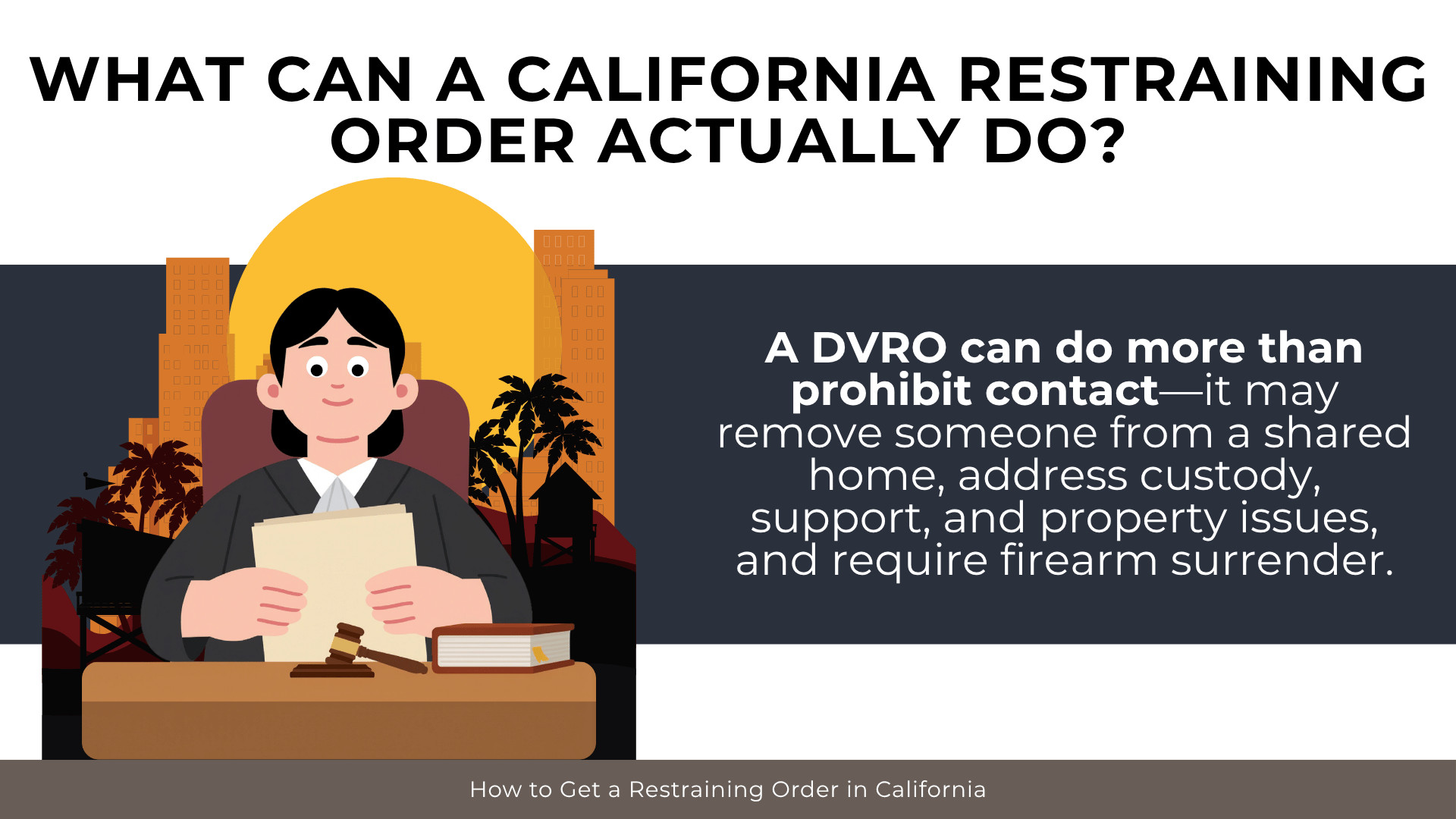
A DVRO is not just a stay-away order. Its reach under the DVPA is broad. A court can order the restrained person to stay a specified distance away and cease all contact (Family Code § 6320). It can exclude the restrained person from a shared residence (Family Code § 6321). The court can also issue temporary child custody and visitation orders (Family Code § 6323), order child support or spousal support (Family Code § 4325), grant you temporary control of shared property like vehicles or bank accounts (Family Code § 6324), and require mandatory firearms and ammunition surrender (Family Code § 6389).
The firearms provision carries real weight. Under Family Code § 6389 and Penal Code § 136.2(d), a person subject to a DVRO or CPO must surrender all firearms and ammunition within 24 hours — either to law enforcement or to a licensed dealer. They must also file proof of compliance with the court within 48 hours. Possessing a firearm while subject to a qualifying protective order is a separate criminal offense under Penal Code § 29825, charged as either a misdemeanor or a felony. California’s prohibition is broader than federal law in this respect: it applies to ex parte and temporary orders, not just orders issued after a full hearing. California has invested $40 million in a court-based firearm surrender program specifically for people prohibited from having firearms due to domestic violence. People prohibited due to restraining orders account for over half of those disarmed through the state’s Armed and Prohibited Persons System.
Do I Need a Lawyer to Get a Restraining Order?
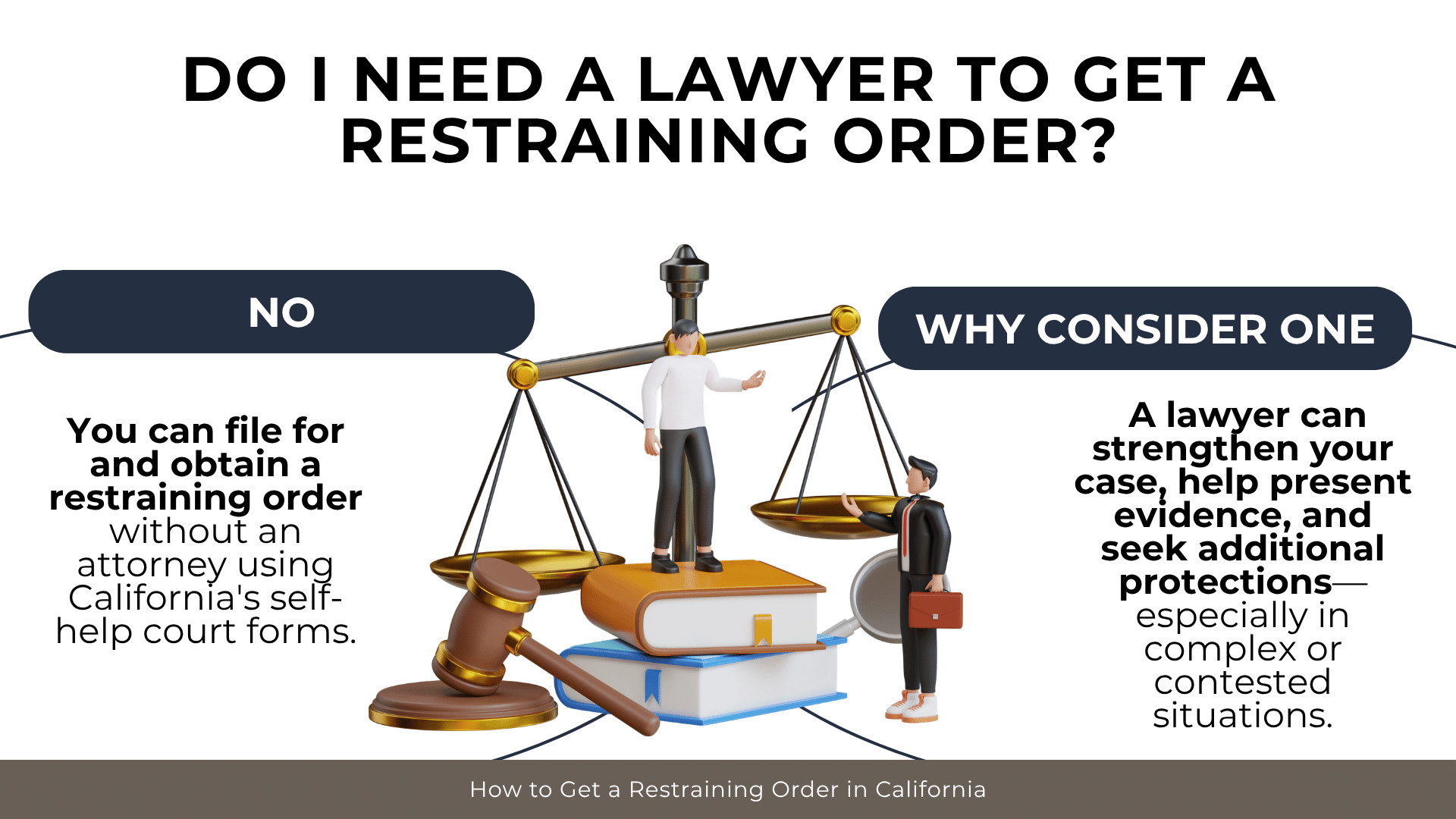
You are not required to have an attorney. The Judicial Council forms are designed for people representing themselves, and many people file for and obtain restraining orders on their own.
That said, the process has procedural requirements — evidence presentation, hearing preparation, and coordination with other legal cases — where mistakes can lead to delays or a weaker order. An attorney can strengthen the petition by framing the factual allegations to meet the legal standard clearly. They can prepare you for what to expect at the hearing and how to present testimony effectively. An attorney can also pursue the full range of available protections — including custody, support, property control, and firearms surrender — that you might not know to request. And if a related criminal case exists, an attorney can coordinate the restraining order with that case.
This is especially true when the situation involves serious threats, children, shared property, or a respondent who is likely to contest the order aggressively.
At Angelo Reyes Law in Carlsbad, California, attorney Angelo J. Reyes works directly with every client — not through a paralegal or associate — and prepares every case as if it’s going to jury, creating leverage whether the matter resolves through negotiation or at trial. That approach matters in restraining order proceedings, where the strength of your evidence and how it is presented at the hearing often determines whether the court grants a five-year order or something less. Angelo J. Reyes is licensed in California and Washington and is admitted to the U.S. District Court for the Southern District of California.
Talk to a Criminal Defense Attorney About Your Situation
If your situation involves serious threats, a history of violence, criminal charges, or custody concerns, a conversation with an attorney can help you understand what level of protection is available and how to secure it effectively. Contact Angelo Reyes Law to discuss your case directly with an experienced trial attorney.
