

If you’re reading this, something happened — and now you need to know how serious it is. Here’s the direct answer: most DUIs in California are misdemeanors. According to the California DMV, 95.6% of all DUI arrests in 2020 were misdemeanor charges. Only 4.4% were charged as felonies.
But California law draws clear lines where a DUI crosses from misdemeanor into felony territory. Whether your situation lands on one side or the other depends on a few specific facts — not on how scared you feel right now. This article walks through what those facts are.
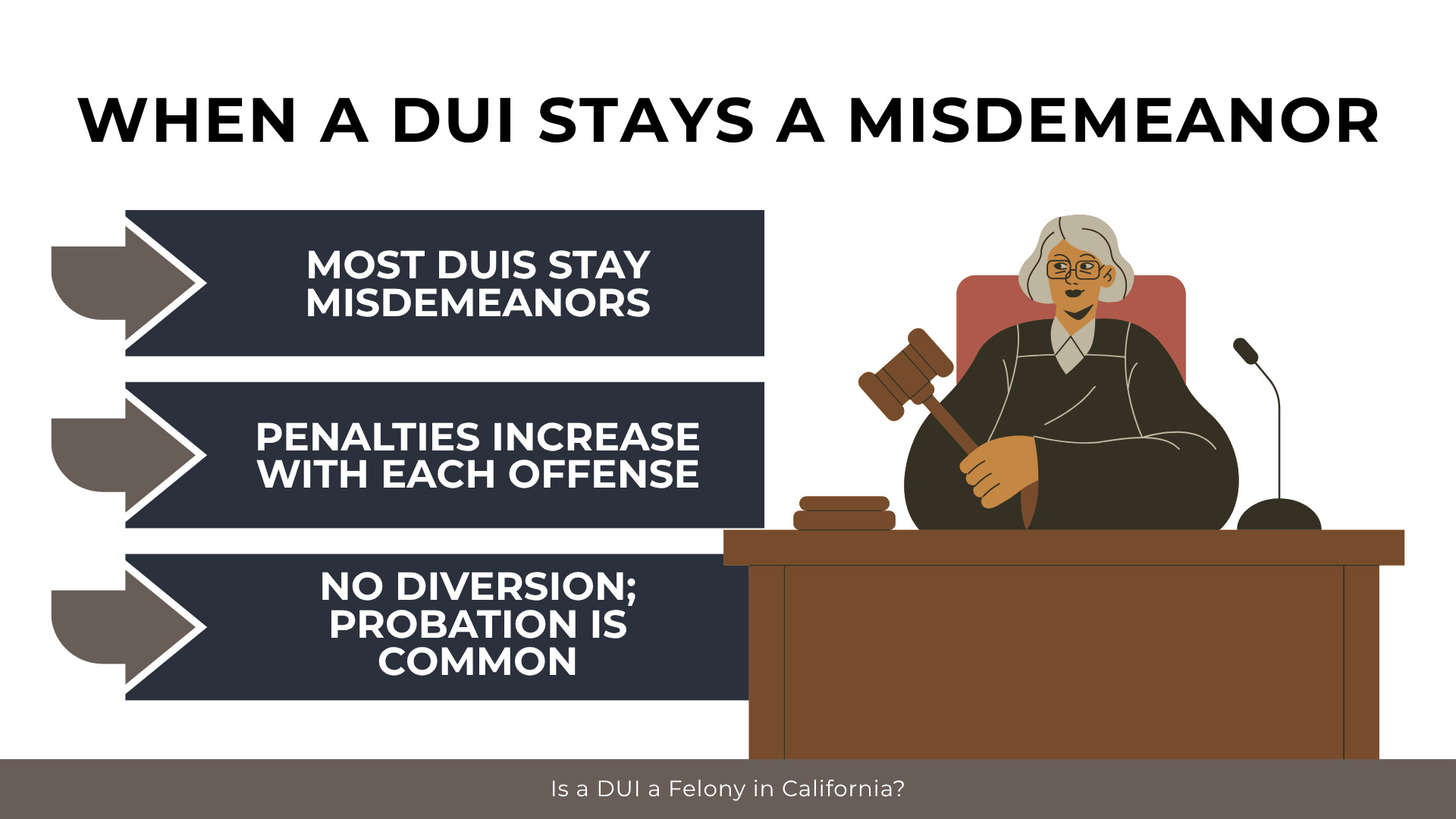
When a DUI Stays a Misdemeanor
A first, second, or even third DUI in California is typically charged as a misdemeanor. That doesn’t mean the consequences are minor — it means you’re facing county jail, not state prison.
Here’s what misdemeanor DUI penalties look like as they escalate under California law:
A first DUI under Vehicle Code § 23536 carries a minimum of 96 hours in county jail (with at least 48 hours served continuously) up to 6 months, fines between $390 and $1,000 (plus penalty assessments that multiply the base fine several times over), a six-month license suspension, and a three-month DUI education program. A second DUI within ten years under VC § 23540 increases the jail range to 90 days to one year, with a two-year license suspension and an 18-to-30-month DUI program. A third DUI within ten years under VC § 23546 carries 120 days to one year in county jail, a three-year license revocation, and a 30-month DUI program.
At every level, roughly 96% of convicted DUI offenders receive probation, which typically runs three to five years under VC § 23600(b)(1) and includes a zero-tolerance condition for any alcohol while driving. And one detail worth knowing now: under VC § 23640, DUI offenses are categorically excluded from California’s judicial diversion programs. The courts in Grassi v. Superior Court (2021) and Tan v. Superior Court (2022) both confirmed this. A DUI cannot be diverted — it has to be resolved on the merits.
None of this is trivial. But it’s a fundamentally different situation than what follows.
The Four Scenarios That Make a DUI a Felony
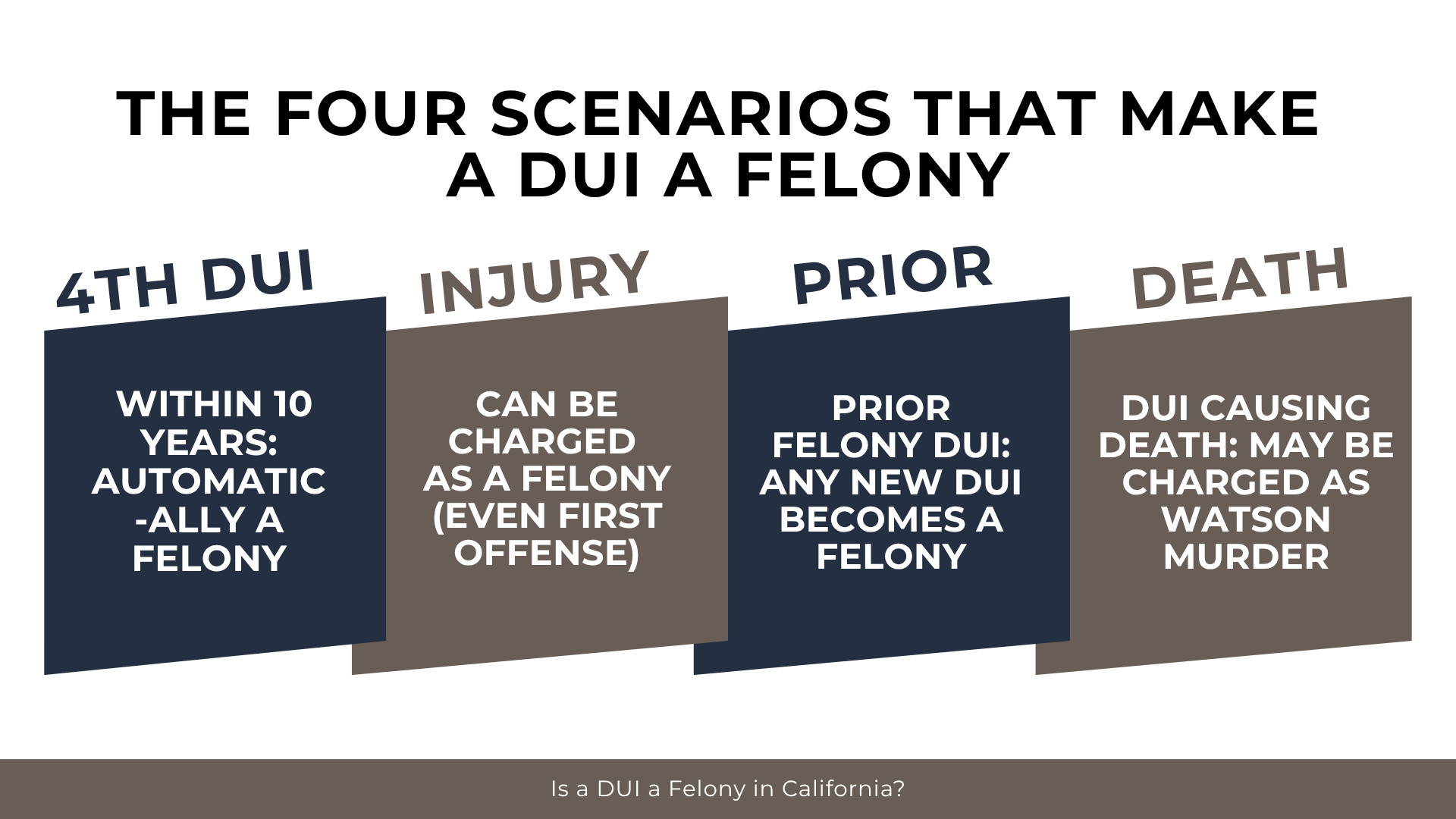
California law elevates a DUI to a felony under four specific circumstances. If none of these apply to your situation, you’re most likely facing a misdemeanor — regardless of how high your BAC was or how the arrest felt.
Fourth DUI Within Ten Years
Under Vehicle Code § 23550, a fourth DUI within a ten-year window is automatically charged as a felony. California measures that window from arrest date to arrest date, not conviction dates, and it counts any prior DUI or wet reckless conviction within the lookback period.
The penalties shift dramatically. Instead of county jail with a maximum of one year, a fourth-offense felony DUI carries 16 months, two years, or three years in state prison. Fines remain in the $390 to $1,000 base range, but the license revocation extends to four years under VC § 13352, and the court will require an 18-to-30-month DUI program.
One thing people often don’t realize: the ten-year lookback period is longer than it used to be. California extended it from seven years, meaning offenses you might assume have “aged out” could still count.
DUI Causing Injury
This is the scenario that catches people off guard — because it can apply to a first offense. Under Vehicle Code § 23153, a DUI that causes bodily injury to another person is what California law calls a “wobbler.” Prosecutors can charge it as either a misdemeanor or a felony, and the decision often hinges on the severity of the injuries.
When charged as a felony, DUI causing injury carries 16 months, two years, or three years in state prison. But the real exposure comes from sentence enhancements. If the victim suffered great bodily injury, Penal Code § 12022.7 adds three to six years of consecutive prison time on top of the base sentence. That means a first-time DUI driver involved in a serious collision could face upward of nine years.
Of all DUI arrests in California in 2019, 8.3% involved crashes with injuries or fatalities. Every one of those arrests carried potential felony exposure.
Prior Felony DUI on Your Record
If you have any prior DUI conviction that was charged and resolved as a felony, any new DUI — even one that would otherwise be a straightforward misdemeanor — will be filed as a felony. This applies regardless of how many years have passed or whether the new offense involved injury. The prior felony DUI permanently changes how every future DUI is charged.
Watson Murder — DUI Causing Death With Implied Malice
The most serious category isn’t a DUI charge at all. Under the doctrine established in People v. Watson, 30 Cal.3d 290 (1981), a person who drives under the influence and kills someone can be prosecuted for second-degree murder. The California Supreme Court held that drunk driving with conscious disregard for human life constitutes implied malice sufficient to support a murder charge.
In 2023, 1,355 people were killed in alcohol-impaired traffic crashes in California alone. Not every one of those cases results in a Watson murder charge — but the doctrine means the possibility exists whenever a DUI results in a death.
Felony vs. Misdemeanor DUI — What Actually Changes
The word “felony” isn’t just a label. It changes nearly everything about what happens next and what follows you afterward.
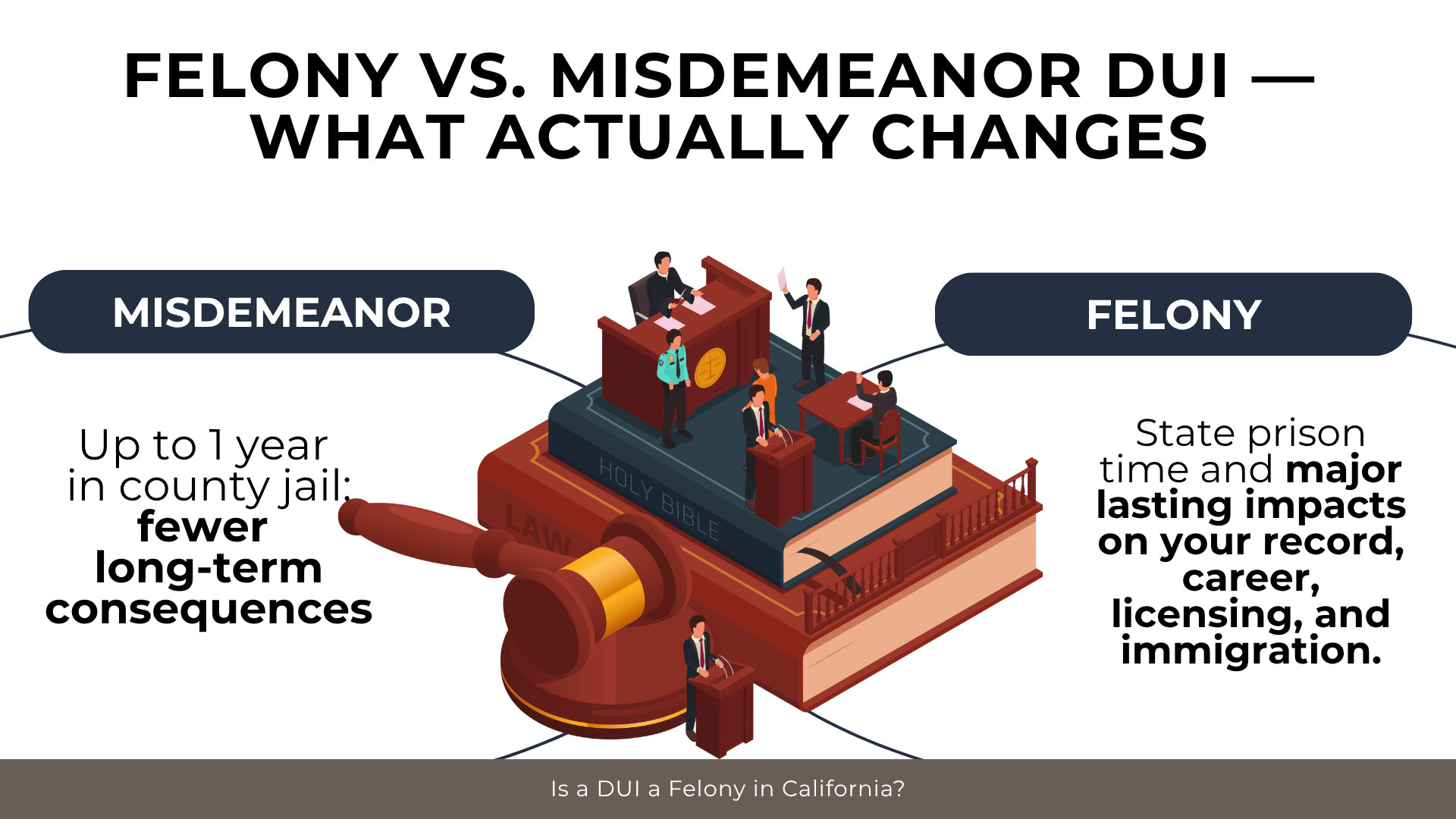
Where you serve time. Misdemeanor DUI means county jail with a one-year maximum. Felony DUI means state prison, with sentences of 16 months, two years, or three years as the base — and potentially far longer with enhancements.
Your criminal record. A misdemeanor DUI is serious, but a felony conviction carries consequences that extend into almost every corner of your life. Under federal regulations at 49 C.F.R. § 383.51, a first felony DUI triggers a one-year commercial driver’s license disqualification. A second offense means lifetime CDL disqualification. Professionals in licensed fields face mandatory reporting requirements — physicians must report a conviction within 30 days under Business & Professions Code § 802.1, and attorneys must self-report felony charges under § 6068(o).
Immigration consequences. While the courts have held that a simple DUI is not a crime involving moral turpitude (Matter of Torres-Varela, 2001) and not an aggravated felony (Leocal v. Ashcroft, 2004), multiple DUIs can bar naturalization under INA § 101(f)’s “habitual drunkard” provision. And critically, a single misdemeanor DUI conviction is classified as a “significant misdemeanor” that bars DACA eligibility.
License suspension. Under VC § 13352, the court-ordered license suspension escalates with each offense: six months for a first DUI, two years for a second, three years for a third, and four years for a fourth or subsequent felony DUI. Refusing a chemical test adds its own separate suspension under VC § 13353 — one year for a first refusal, two for a second, three for a third — with no restricted license eligibility.
Ignition interlock device requirements. Under VC § 23575.3, IID installation scales with the offense: six months for a first injury DUI, 12 months for a second, 24 months for a third, and 36 to 48 months for a fourth or subsequent offense.
The financial weight is substantial at every level. The California Office of Traffic Safety estimates the total cost of a first-time DUI at approximately $13,500 when you factor in fines, fees, insurance increases, DUI school, attorney costs, and lost wages. Felony DUI costs climb significantly higher.
The “Wobbler” — How Prosecutors Decide
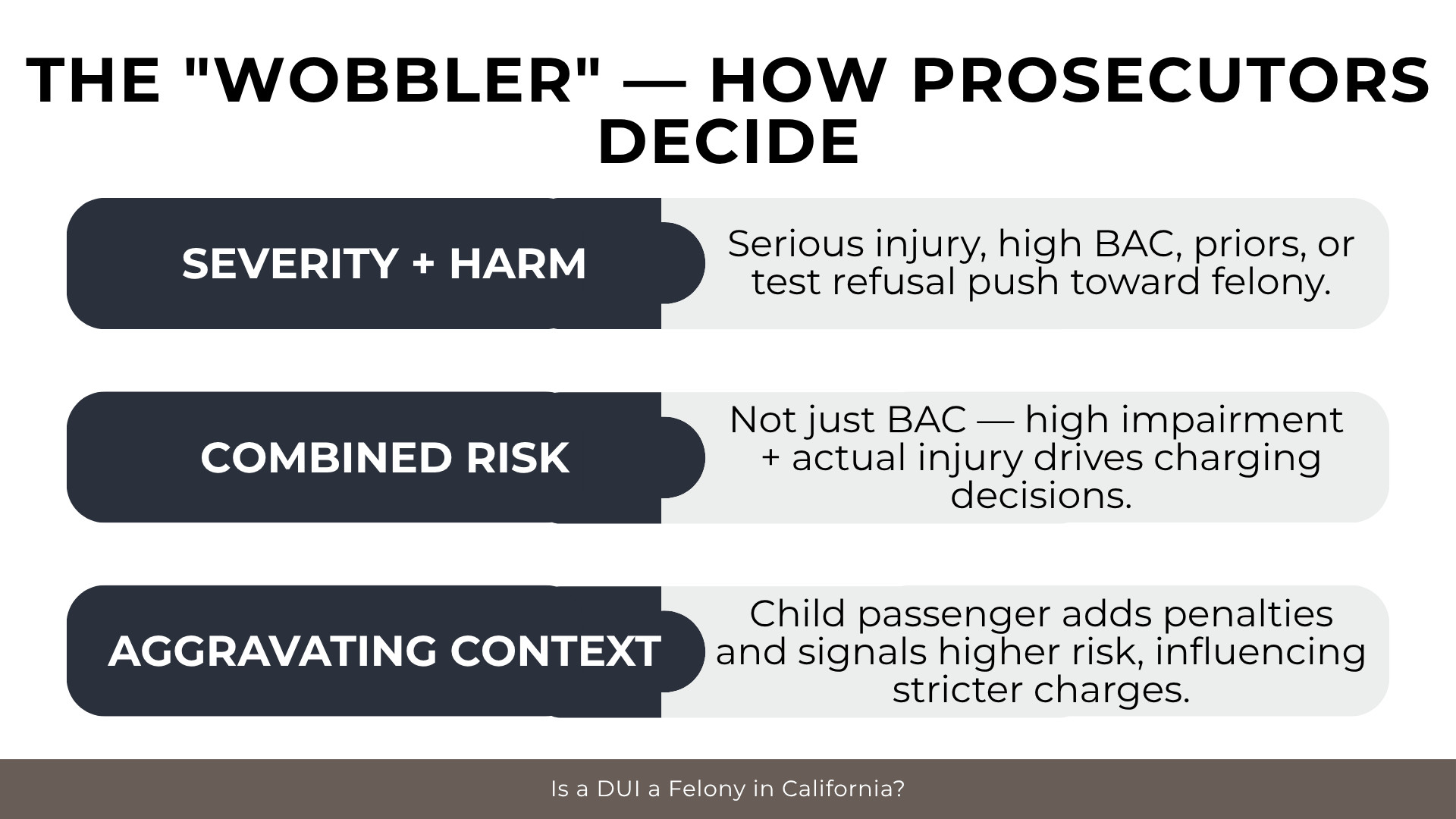
If your situation involves a DUI with injury under VC § 23153, you’re in wobbler territory — and the charging decision hasn’t been made by a formula. It’s made by a prosecutor weighing the facts of your case.
The factors that typically push a wobbler toward felony filing include the severity of injuries to the other person, whether the BAC was at or above the 0.15% high-BAC threshold (which triggers discretionary enhancement under VC § 23578), prior DUI history, and whether the driver refused chemical testing. A BAC at or above 0.20% carries its own mandatory consequence — a nine-month DUI school requirement under VC § 23538(b)(2) — and signals to prosecutors a level of intoxication that cuts against leniency.
Context matters here: the median BAC among convicted DUI offenders in California is 0.16%, which is already double the legal limit. Prosecutors see these numbers regularly. What moves the needle toward a felony charge is the combination of high impairment with actual harm to another person.
If a child under 14 was in your vehicle at the time of the DUI, VC § 23572 adds mandatory consecutive jail time — 48 hours for a first offense, 10 days for a second, 30 days for a third, and 90 days for a fourth. This enhancement applies to misdemeanor DUI only and does not apply to wet reckless pleas or felony DUI, but the presence of a minor passenger often influences a prosecutor’s overall charging posture.
What Happens After a Felony DUI Charge
If you’re facing a felony DUI, two separate tracks are now running at the same time — and they don’t wait for each other.
The DMV administrative track starts immediately. Under VC § 13353.2, the DMV initiates an Administrative Per Se suspension the moment your arrest is reported with a BAC at or above 0.08% (or 0.04% for a commercial vehicle, or 0.01% if you’re under 21). You have exactly ten days from receiving the suspension notice to request an APS hearing under VC § 13558. Miss that deadline and the suspension takes effect automatically. This is a civil proceeding with a preponderance-of-evidence standard — completely separate from your criminal case. Even if the criminal charges are eventually reduced or dismissed, the administrative suspension stands on its own. The California Supreme Court confirmed in Lake v. Reed (1997) that APS suspension is a civil remedial measure, not criminal punishment, and double jeopardy protections don’t apply.
The criminal track moves on its own timeline. A felony DUI case will involve arraignment, preliminary hearing, and potentially trial. What it won’t involve is diversion — as noted above, VC § 23640 categorically bars DUI offenses from diversion programs, and California courts have upheld that exclusion. The only exception is military diversion under Penal Code § 1001.80, which remains available for qualifying veterans and active-duty service members.
The DUI conviction rate for 2019 arrests in California was 68.9%. That number means roughly one in three DUI arrests didn’t result in a DUI conviction — some were dismissed, others were reduced to lesser charges. What it tells you is that outcomes are not predetermined, and the facts of your specific case matter more than the general statistics.

Talk to a DUI Defense Attorney in San Diego County
If you’re trying to figure out whether your DUI could be charged as a felony, the specifics of your case are what matter — not the worst-case scenarios running through your head right now. An experienced DUI defense attorney can evaluate the actual facts, identify where the prosecution’s case is strong or vulnerable, and give you a realistic picture of what you’re facing.
Law Office of Angelo Reyes, APC is a criminal defense firm based in Carlsbad, California, serving clients throughout San Diego County. Attorney Angelo J. Reyes is a trial-focused DUI defense lawyer recognized by the National Trial Lawyers as a Top 40 Under 40 attorney, admitted to the State Bar of California and the U.S. District Court for the Southern District of California. Every case is prepared for trial — because that preparation is what drives better outcomes at every stage.
If you need to understand where your case stands, contact Law Office of Angelo Reyes, APC Law for a consultation.