Yes and no — and that two-word non-answer is exactly why this question sends so many people to Google. Under California state law, marijuana is legal for personal use by adults 21 and older within specific quantity limits. Under federal law, marijuana is still a Schedule I controlled substance, the most restrictive category that exists, right alongside heroin and LSD. Both of those things are true at the same time, in the same state. The difference between which one applies to you depends on what you did, how much you had, and who is prosecuting the case.
What follows breaks down what Proposition 64 actually permits, where federal law still overrides it, and why the answer to this question is not as simple as either “yes” or “no.”
What Does California Law Actually Say About Marijuana?
California voters passed Proposition 64 — the Adult Use of Marijuana Act — on November 8, 2016, with 57 percent of the vote. The law took effect the following day. But Prop 64 did not remove marijuana from California’s controlled substance schedules entirely. What it did was carve out a specific zone of legal conduct for adults.
Under California Health and Safety Code § 11362.1, adults 21 and older may possess, process, transport, purchase, obtain, or give away to other adults up to 28.5 grams of cannabis (not in concentrated form) and up to 8 grams of concentrated cannabis, including cannabis contained in cannabis products. If your conduct falls within those boundaries, you are not committing a crime under state law.
That distinction matters more than most people realize. Prop 64 is not blanket legalization. It is a narrow exemption built into a controlled substance system that otherwise remains fully intact. California Health and Safety Code §§ 11054 through 11058 still establish the state’s five-schedule classification system, closely following the federal Controlled Substances Act. Marijuana was not deleted from that system. It was given a conditional pass for personal adult use, and every condition has a hard edge.

Why Is Marijuana Still a Federal Controlled Substance?
Because federal law does not answer to state ballot initiatives. Marijuana remains a Schedule I controlled substance under the federal Controlled Substances Act. That means the federal government classifies it as having a high potential for abuse and no currently accepted medical use. That classification has not changed despite legalization in California and dozens of other states.
The U.S. Supreme Court addressed this conflict directly in Gonzales v. Raich, 545 U.S. 1 (2005). The Court held that Congress’s power under the Commerce Clause extends to prohibiting even the purely in-state cultivation and possession of marijuana, regardless of whether a state has authorized it. In practical terms, this means federal agents and federal prosecutors retain full authority to enforce marijuana laws in California. The fact that they generally choose not to pursue small personal-use cases is a matter of prosecutorial discretion, not legal protection. That discretion can shift with any change in administration or enforcement priorities.
For most Californians using marijuana within Prop 64’s limits, the federal conflict is a background reality that rarely surfaces. But if your situation involves quantities above the personal-use threshold, any kind of commercial activity without proper licensing, proximity to federal property, or a connection to immigration law, the federal classification moves from background to foreground very quickly.

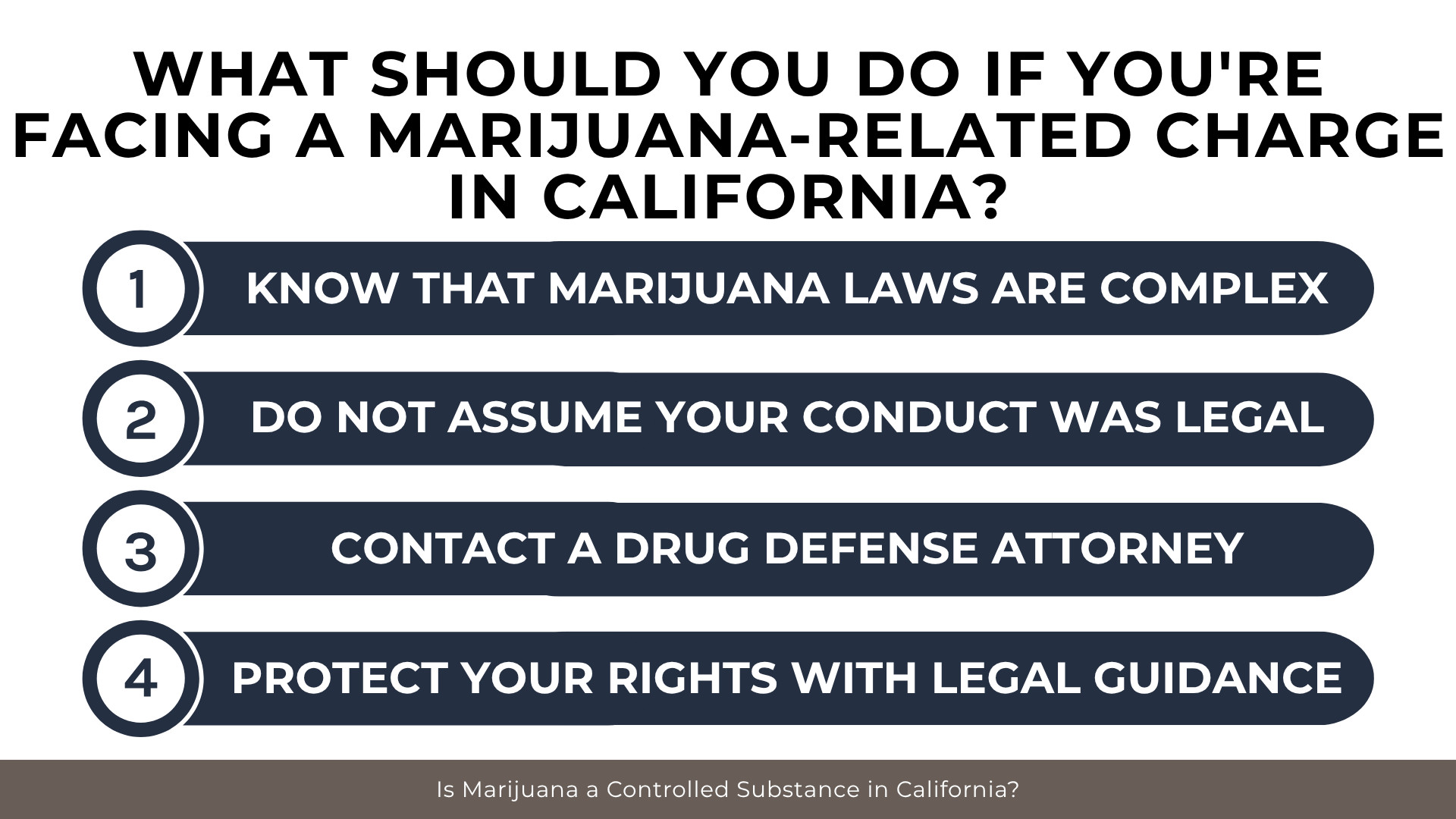
What Should You Do If You’re Facing a Marijuana-Related Charge in California?
Marijuana is legal under state law within strict boundaries but still a Schedule I controlled substance under federal law. That creates a legal situation where the line between permitted conduct and criminal risk is not always obvious. Quantity, conduct, licensing status, and which government is paying attention all matter, and they interact in ways that are not intuitive.
That is the kind of analysis that requires a criminal defense attorney who handles drug cases and understands how state and federal law overlap in this area. At Angelo Reyes Law in Carlsbad, California, attorney Angelo J. Reyes works directly with clients on drug offense cases throughout San Diego County. His approach is to prepare every case as though it is going to trial, which is designed to create leverage whether the case ultimately resolves through negotiation or goes before a jury. If you are trying to figure out where your situation falls in the legal landscape this article describes, a consultation is a direct way to get a clear answer.