
If you’re looking this up, you probably need a straight answer — so here it is. California law makes it illegal to have any opened alcoholic beverage in the passenger area of a motor vehicle. That applies to drivers and passengers equally, and it doesn’t matter whether anyone is actively drinking.
The rules are spread across several sections of the California Vehicle Code but they work together as a single framework. Understanding how they interact is what separates a minor inconvenience from a serious legal problem.
What Counts as an “Open Container”
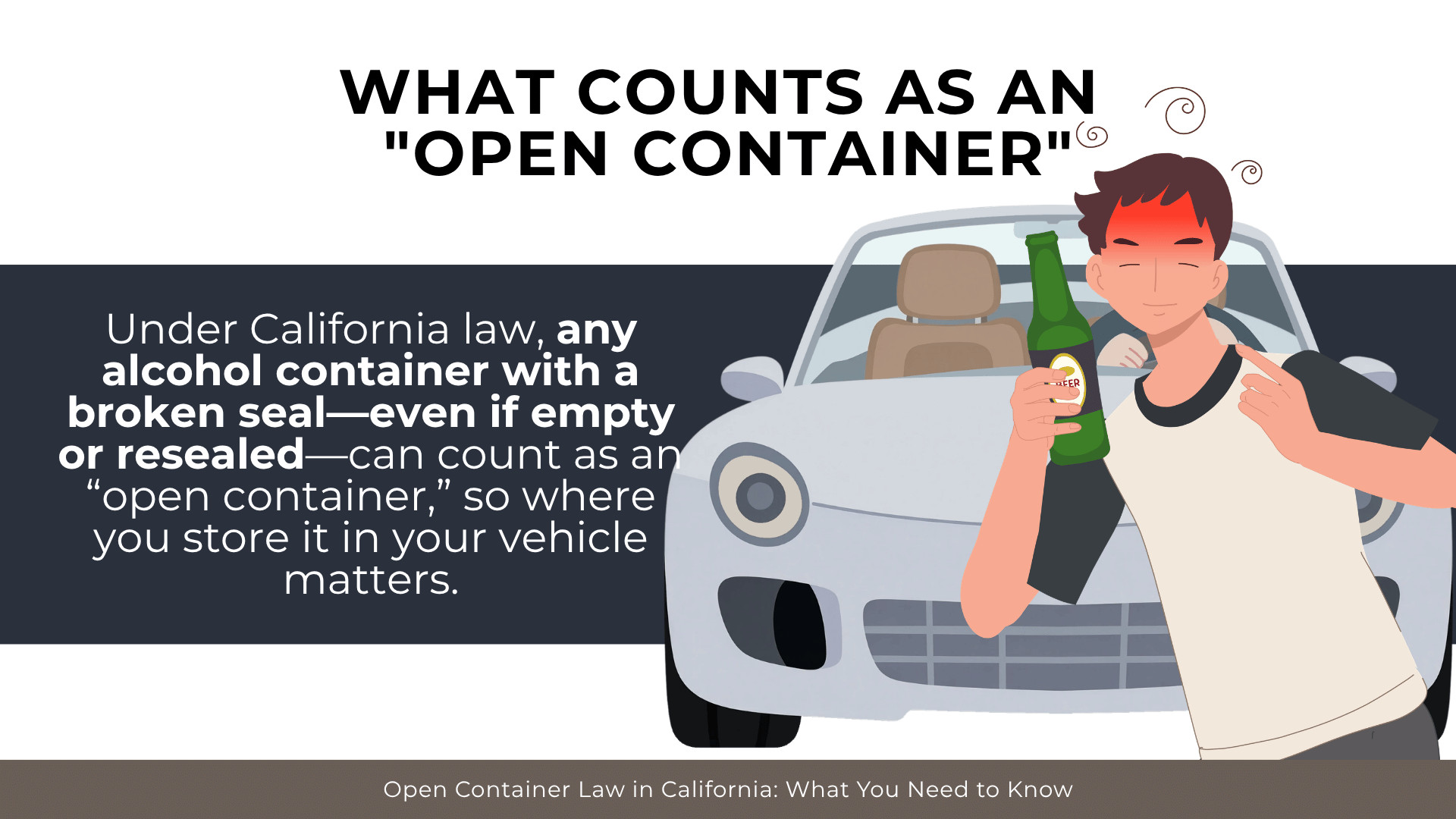
This is where most people get tripped up. Under California law, an “open container” generally means any bottle, can, or other receptacle containing an alcoholic beverage that has been opened, has a broken seal, or has had any of its contents removed.
That means “open” doesn’t require the lid to be off. A recorked bottle of wine from dinner last night can qualify. A flask you haven’t touched in weeks can qualify. An empty beer can under the seat can qualify. If the original seal has been broken at any point, California may treat it as an open container — regardless of whether there’s anything left inside or whether anyone in the vehicle has been drinking.
The practical takeaway: if you’re transporting any alcoholic beverage that has ever been opened, where you put it in the vehicle matters enormously.
Where the Law Applies — and Where It Doesn’t
California’s open container laws generally apply on public highways and on public land open to motor vehicle traffic. That’s a broad scope — it covers freeways, city streets, parking lots open to the public, and similar spaces.
However, there are two important boundaries.
Private property may be outside the law’s reach. If you’re parked on private land that isn’t open to general motor vehicle traffic, these Vehicle Code sections may not apply.
The trunk is generally your safe zone. Open containers may typically be stored in the trunk of a vehicle. If your vehicle doesn’t have a separate trunk — an SUV, hatchback, or pickup truck, for instance — the container generally must be placed in an area not normally occupied by the driver or passengers. A locked toolbox in a truck bed may work. The area behind the rear seats of an SUV can work, depending on the circumstances.
One area that generally does not qualify is the glove compartment. California law treats the glove compartment as part of the passenger area, even if it locks.
So if you’re driving home from a dinner party with a half-finished bottle of wine, the trunk is your safest option. If you don’t have a trunk, put it as far from the passenger cabin as your vehicle allows. Keeping it in the center console, under a seat, or in the glove box risks creating a violation — even if nobody has had a sip during the drive.

Exceptions to the Rule
California does carve out specific exceptions, and they matter if you’re planning an event that involves transportation and alcohol.
Passengers in for-hire vehicles may be exempt. Passengers riding in a taxi, limousine, Uber, Lyft, party bus, or other vehicle hired specifically to transport passengers may typically possess and consume open containers of alcohol. The driver, however, is never exempt — the no-drinking, no-open-container rules always apply to whoever is behind the wheel.
Certain RVs and campers may qualify. If the vehicle has a living-quarters area that is separate from the driving compartment, passengers in the living area may have open containers. This doesn’t apply to every RV configuration, and the driver remains fully subject to the law regardless.
Vehicles transporting minors may face additional restrictions. California law generally limits alcohol access in for-hire vehicles when passengers under 21 are on board.

Penalties: Adults vs. Under 21
The consequences of an open container violation depend almost entirely on age, and the gap between adult and underage penalties is steep.
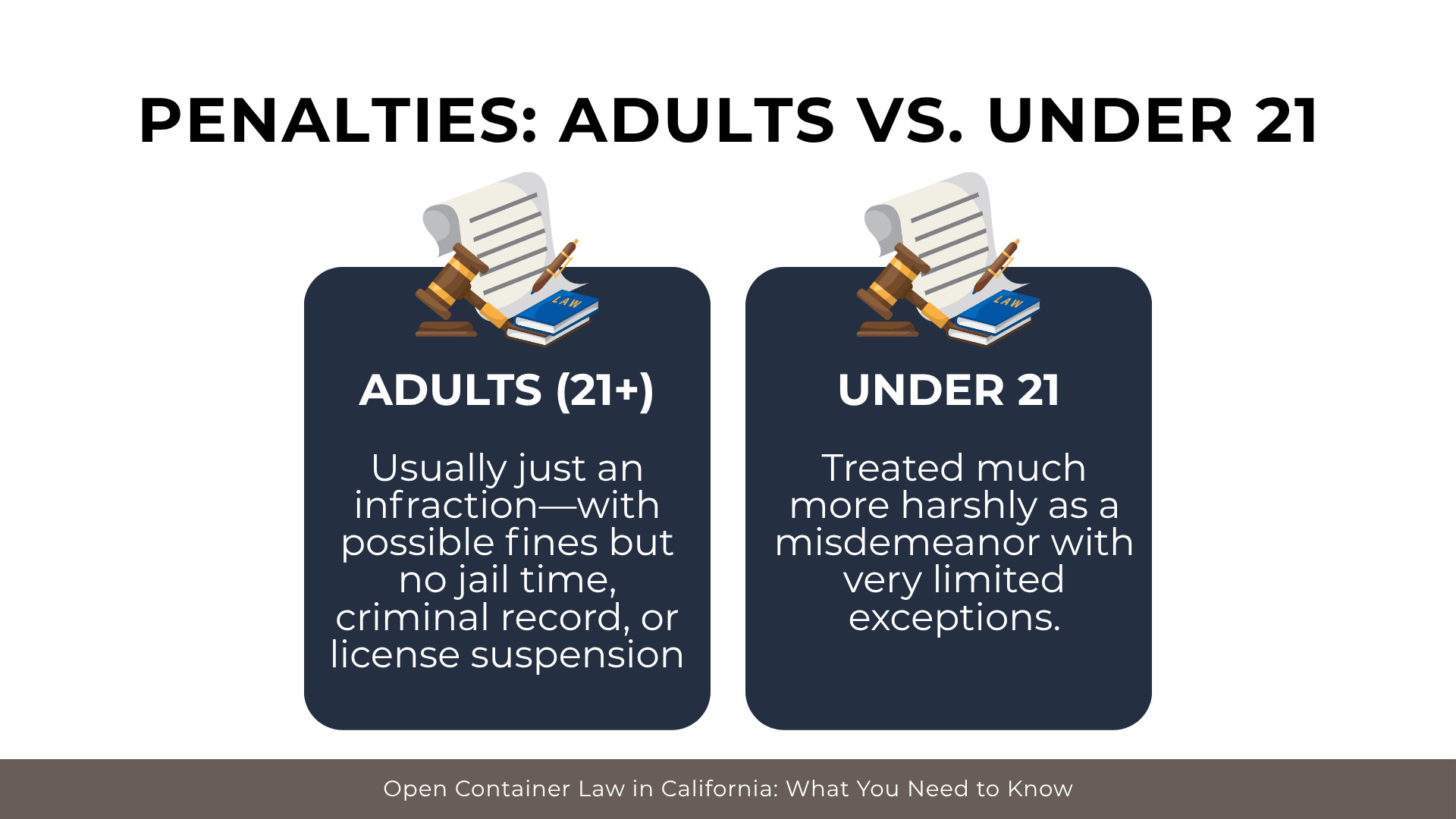
If you’re 21 or older, an open container violation is typically an infraction — not a misdemeanor, not a criminal offense. Fines may apply but there is generally no jail time, no criminal record, and no license suspension. It’s roughly equivalent to a traffic ticket in terms of legal severity.
If you’re under 21, the situation is fundamentally different. California law treats underage possession of alcohol in a vehicle — open or sealed, consumed or untouched — as a misdemeanor. Limited exceptions may exist, such as when the minor is under the supervision of a parent or legal guardian, or is transporting alcohol as part of their employment. Potential consequences for an underage violation can be significantly more serious than the adult infraction, potentially including jail time, higher fines, license suspension, and vehicle impoundment.
This is one area where the law leaves very little room for leniency, reflecting California’s zero-tolerance approach to underage alcohol possession.
Open Container vs. DUI: How One Can Lead to the Other
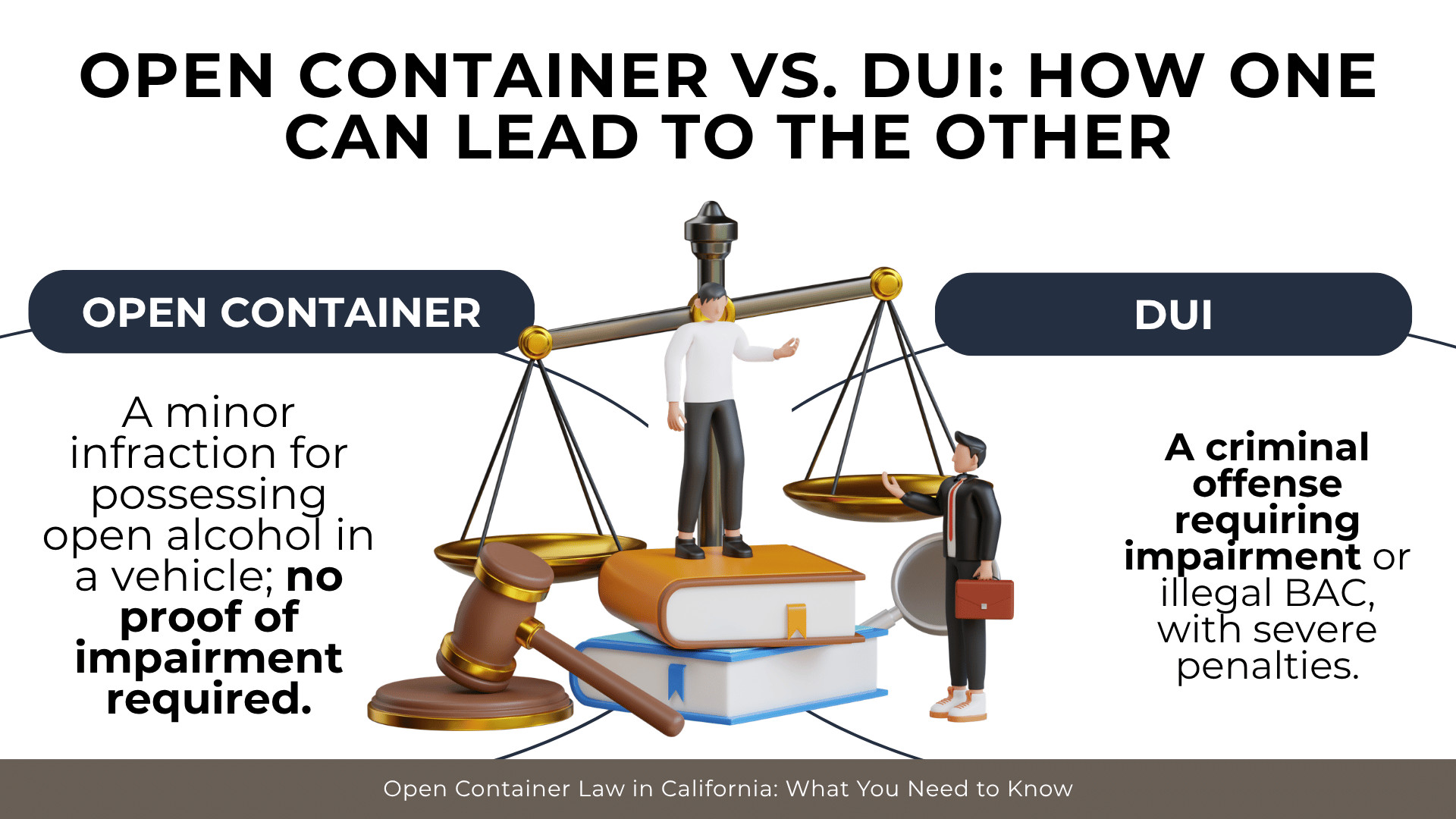
An open container violation is not a DUI. The two charges operate under completely different sections of the Vehicle Code, carry different penalties, and require different elements of proof. But in practice, one frequently leads to the other.
When a law enforcement officer spots an open container during a traffic stop, it creates reasonable grounds to investigate further for impairment. That investigation typically involves field sobriety tests — which are voluntary in California, though refusal can be admitted as consciousness of guilt under case law established in People v. Jackson (189 Cal. App. 4th 1461). It may also involve a preliminary alcohol screening (PAS) breath test, which drivers over 21 who are not on DUI probation have the right to refuse without penalty under VC 23612(h)-(i).
If that investigation leads to a lawful arrest for DUI, California’s implied consent law under VC 23612 kicks in — meaning you are deemed to have consented to a chemical test (blood or breath) upon lawful arrest. Refusing the post-arrest chemical test triggers a separate one-year license suspension for a first refusal under VC 13353, independent of whatever happens with the DUI charge itself.
The point is this: what begins as a minor infraction can escalate into a DUI investigation within minutes. In California, a first-offense DUI conviction carries penalties of 96 hours to six months in jail and fines of $390 to $1,000 under VC 23536, along with license suspension, mandatory DUI school, and potential ignition interlock device requirements. The median BAC among convicted DUI offenders in California is 0.16% — double the legal limit — which suggests that many people who end up with DUI convictions were well past the point where they would have also had open containers present. And with roughly 124,000 DUI arrests statewide in 2019, these aren’t rare events.
The DMV also operates a parallel administrative track. An Administrative Per Se (APS) suspension is a civil proceeding entirely separate from criminal prosecution, and it can take effect within 30 days of a DUI arrest — before your criminal case even reaches a courtroom. Under VC 13558, you have only ten days from the date of arrest to request a hearing to contest that suspension. Missing that window means the suspension proceeds automatically.
None of this is inevitable from an open container citation alone. But understanding the pathway from one to the other helps explain why the seemingly minor open container laws carry weight beyond their face-value penalties.
How to Fight an Open Container Ticket
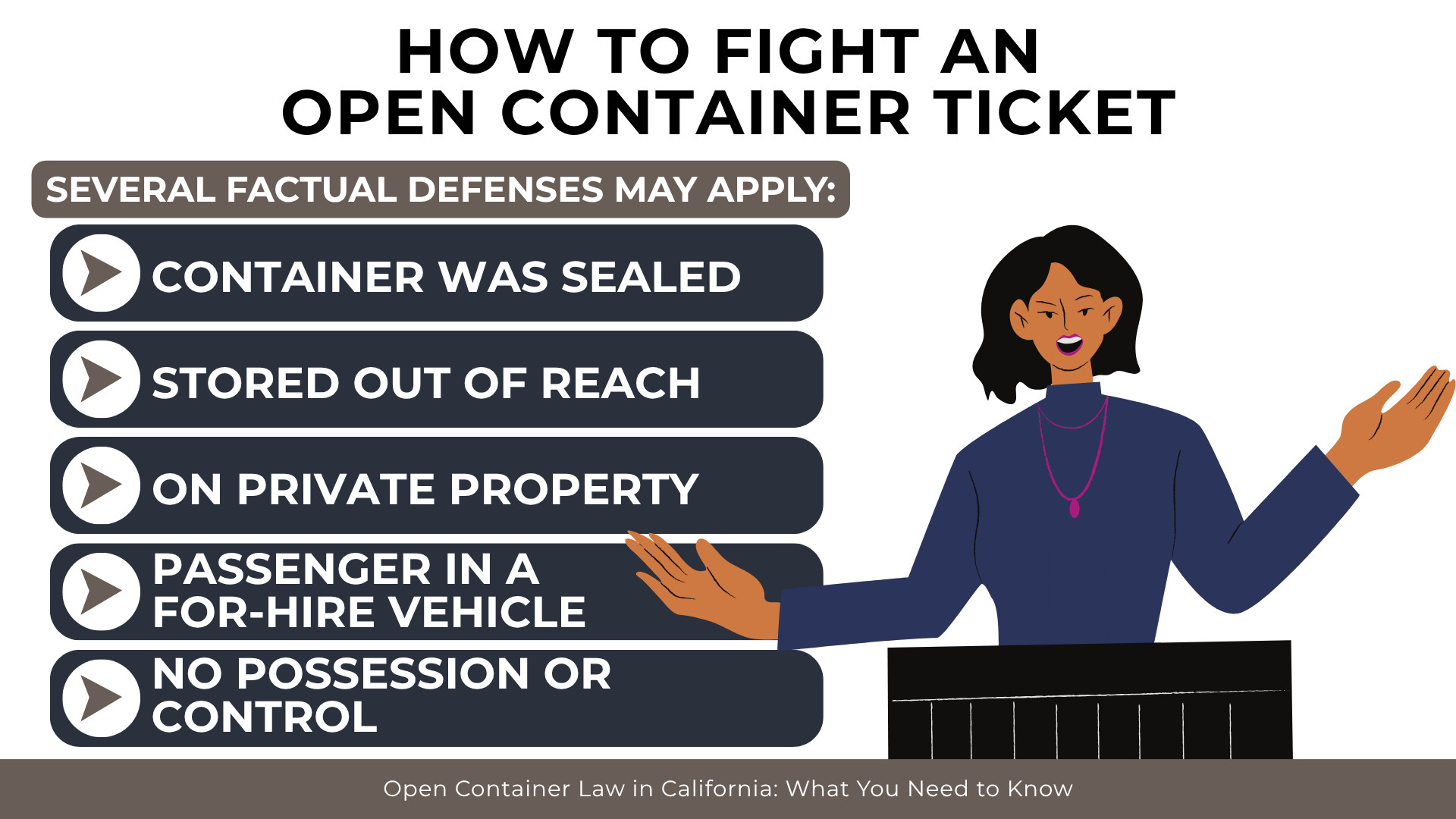
If you’ve already received a citation, there are several factual defenses that may apply depending on the circumstances.
The container was sealed. If the prosecution cannot establish that the container had been opened, had a broken seal, or had contents removed, the charge may fail on its basic elements. An unopened bottle of wine rolling around the back seat generally isn’t a violation.
The container was in the trunk or an equivalent area. If the open container was stored in the trunk, or in a part of the vehicle not normally accessible to the driver or passengers, that storage may constitute a defense.
You were on private property. California’s open container laws generally apply to highways and public lands open to motor vehicle traffic. A citation issued while you were on genuinely private property may not hold up.
You were a passenger in a for-hire vehicle. If you were riding in a taxi, limousine, rideshare, or party bus — and you weren’t the driver — the for-hire vehicle exception may apply.
The container wasn’t in your possession or control. The open container generally must be in the cited person’s possession. If another occupant of the vehicle was holding or controlling the container, that may undermine the charge against you.
For a standard adult infraction, many people handle the citation on their own and the process is similar to contesting a traffic ticket.
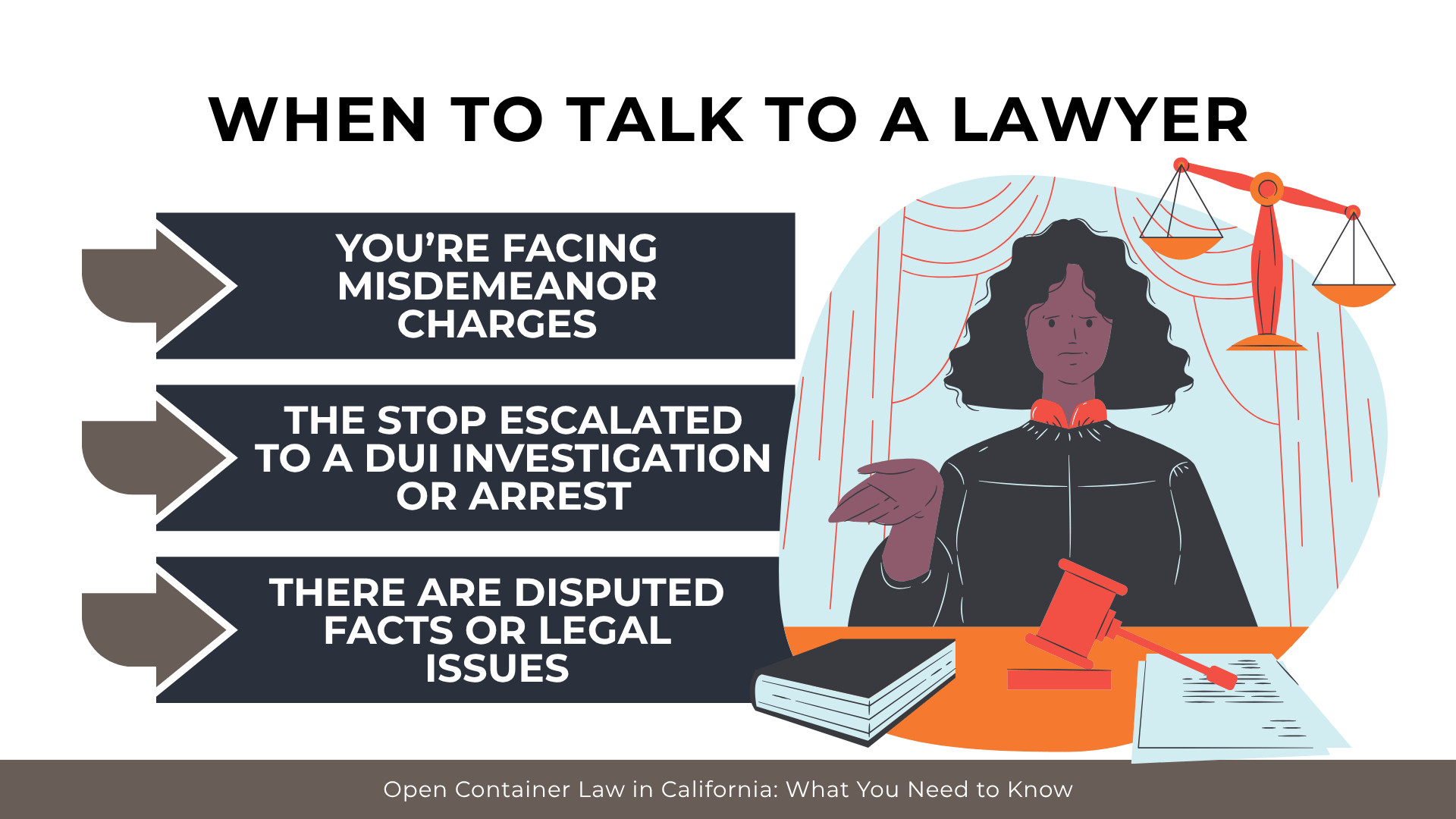
When to Talk to a Lawyer
Not every open container situation calls for legal representation, but several do.
If you’re under 21 and facing misdemeanor charges, the classification alone warrants legal counsel. A conviction affects your criminal record, your license, and potentially your future in ways that a simple infraction does not.
If an open container stop escalated into a DUI investigation or arrest, the stakes rise sharply. California DUI cases involve both a criminal prosecution and a separate DMV administrative proceeding, each with its own deadlines, procedures, and consequences. The ten-day window under VC 13558 to request an APS hearing is one that cannot be recovered once missed.
And if the facts of your stop are in dispute — whether the container was truly open, whether it was in the passenger area, or whether the traffic stop itself was supported by reasonable suspicion — those are legal questions that benefit from professional evaluation.
Law Office of Angelo Reyes, APC, based in Carlsbad, represents clients throughout San Diego County on DUI matters. Attorney Angelo J. Reyes brings extensive trial experience to criminal defense cases and is a courtroom advocate who prepares every matter for trial. If your situation involves anything beyond a straightforward infraction, a consultation can help you understand where you stand and what your options actually are.