

Possession of drug paraphernalia in California is a misdemeanor under Health and Safety Code 11364. If you were cited or arrested for this charge, you are not facing a felony, and you are not looking at state prison. In many cases, the charge can be dismissed entirely through a diversion program without ever entering a guilty plea. That said, even a misdemeanor paraphernalia conviction carries consequences that extend well beyond the courtroom — particularly for immigration status, employment, and professional licensing. That is why understanding the full picture matters before deciding how to handle the charge.
This page covers what California law defines as drug paraphernalia, the penalties you face, the defenses that apply, and what a conviction can cost you even after the case is closed.
What counts as “drug paraphernalia” under California law?
Health and Safety Code 11364 makes it illegal to possess a device used for unlawfully smoking, injecting, or otherwise consuming a controlled substance. The statute generally targets instruments of personal drug use — glass pipes, methamphetamine pipes, hypodermic needles (outside of certain legal exceptions), and similar items — rather than every object that could be associated with drugs.
This is an important distinction. California law also addresses items used in the cultivation, manufacture, packaging, and sale of controlled substances — scales, baggies, growing equipment, and similar items tied to distribution. But 11364 — the charge most people are searching about — deals specifically with the use end of the equation.
The challenge with paraphernalia charges is that many of the objects that could fall under 11364 have perfectly legal uses. A glass pipe sold at a smoke shop is legal to purchase and legal to own. Whether an item counts as drug paraphernalia under 11364 typically depends on circumstantial evidence connecting it to illegal drug use — residue on the item, proximity to a controlled substance, statements made during the encounter, or the context of the arrest. The object alone, without evidence connecting it to illegal drug use, may not be enough to establish the charge.

Is this a misdemeanor or a felony?
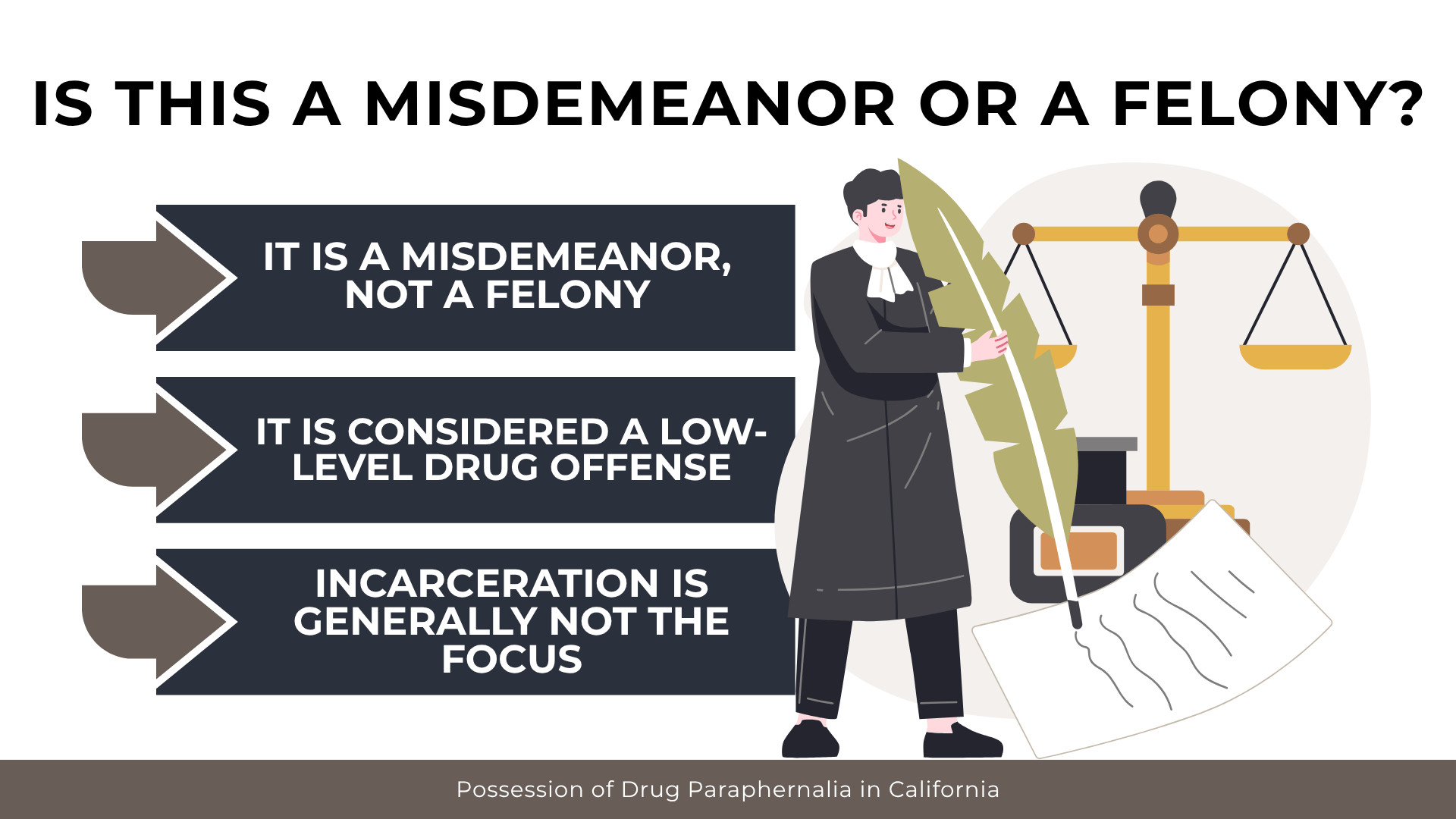
It is a misdemeanor. Possession of drug paraphernalia under Health and Safety Code 11364 is not a felony in California.
To put that in perspective, paraphernalia possession was already a misdemeanor before Proposition 47 reclassified most simple drug possession offenses in 2014. The broader trend in California drug enforcement has moved sharply toward treating personal-use offenses as misdemeanors. Today, drug offenses are the single largest category of misdemeanor arrest in California, accounting for 25.7 percent of roughly 548,500 misdemeanor arrests statewide in 2024.
What this means practically is that a paraphernalia charge, while serious enough to take seriously, sits at the lower end of California’s drug-offense spectrum. The system is not focused on incarceration for this offense.
What defenses actually work against a paraphernalia charge?
Several, and they depend almost entirely on the facts of how the item was found.
The first line of defense is that the item is not drug paraphernalia. As discussed above, the object must be connected to unlawful drug use through evidence beyond its mere existence. A clean glass pipe, a sealed syringe, or an item with no residue and no drugs found nearby raises a genuine question about whether the prosecution can establish the item’s illegal purpose. The burden is on the state to prove that connection, not on you to disprove it.
The second defense is lack of knowledge. You may not have known the item was in your vehicle, your bag, or your living space — particularly if other people had access. California drug law requires proof that you knew both that the item was present and that it was connected to a controlled substance.
The third — and frequently the most powerful — is a challenge to the search itself. Most paraphernalia is discovered during traffic stops, vehicle searches, or searches incident to arrest. Each of these encounters is governed by the Fourth Amendment and Article I, Section 13 of the California Constitution. Each has boundaries that law enforcement regularly approaches or exceeds.
In paraphernalia cases, the search that produced the item is frequently where the case is won or lost. Officers need probable cause before searching a vehicle or its containers. A cell phone search requires a warrant, even incident to arrest, under Riley v. California (2014) 573 U.S. 373. And a traffic stop cannot be extended beyond its original purpose to conduct a drug investigation unless officers have independent reasonable suspicion under Rodriguez v. United States (2015) 575 U.S. 348. If the stop that should have taken five minutes stretched to twenty while officers waited for a K-9 unit, the paraphernalia found during that extended detention can be challenged through a motion under Penal Code 1538.5. Since Proposition 8 (1982), California suppression standards generally track federal Fourth Amendment law — meaning these federal protections apply directly in California courts.

Will this show up on my record — and what else can it cost me?
If the case is dismissed through diversion, it will not result in a conviction on your record. But if the case is not dismissed — if diversion is unavailable, uncompleted, or not pursued — a paraphernalia conviction, even as a misdemeanor, creates consequences that many people do not expect.
The most significant for non-citizens is immigration risk. Federal immigration law under 8 U.S.C. § 1227(a)(2)(B)(i) makes a person deportable for a conviction “relating to a controlled substance.” For years, there was an open question about whether a state paraphernalia conviction — which does not require proof of possessing an actual controlled substance — triggered that provision.
The U.S. Supreme Court addressed this in Mellouli v. Lynch, 575 U.S. 798 (2015), holding that a state paraphernalia conviction for concealing unidentified pills did not trigger deportability under 8 U.S.C. § 1227(a)(2)(B)(i) because the conviction did not require proof that the paraphernalia related to a federally scheduled substance. That ruling is favorable, but it is not a blanket shield. A paraphernalia plea that references a specific federally scheduled substance — or is paired with a possession plea that does — can still carry immigration consequences. Under Padilla v. Kentucky, 559 U.S. 356 (2010), defense counsel has a constitutional obligation to correctly advise clients about deportation consequences. If you are not a U.S. citizen, this is not a charge to handle without understanding exactly how your plea will be read by immigration authorities.
Beyond immigration, a paraphernalia conviction can affect professional licensing, employment background checks, housing applications, and eligibility for certain public benefits under federal housing regulations (24 C.F.R. § 982.553). Expungement under Penal Code 1203.4 can help reduce some of these consequences, but it does not eliminate a conviction for federal immigration purposes.

Why should I talk to a lawyer before deciding anything?
A paraphernalia charge is manageable — but “manageable” does not mean “handle it alone.” The difference between a dismissal and a conviction that follows you into immigration proceedings, job applications, and housing screenings often comes down to how the case is handled in its first weeks. Was a suppression motion filed? Could the search that produced the evidence be challenged? Was a plea structured to minimize lasting consequences?
At Angelo Reyes Law in Carlsbad, California, attorney Angelo J. Reyes works directly with clients on criminal cases throughout San Diego County — not through a paralegal or associate. Every case is prepared as if it is going to jury, creating leverage whether the matter resolves through negotiation or at trial. If you are facing a paraphernalia charge, a conversation about your specific facts is the first step toward knowing where you actually stand.
