
Selling methamphetamine in California is a straight felony that can carry years in state prison. California law defines “selling” more broadly than most people expect.
You do not have to complete a hand-to-hand transaction to be charged. Possessing meth with the intent to sell it is enough for prosecutors to file felony charges. Those charges carry serious prison time, disqualify you from most diversion programs, and trigger collateral consequences that can follow you for life.
This page breaks down exactly what the prosecution has to prove, what penalties are on the table, how these cases are defended, and when a state charge can become a federal one.
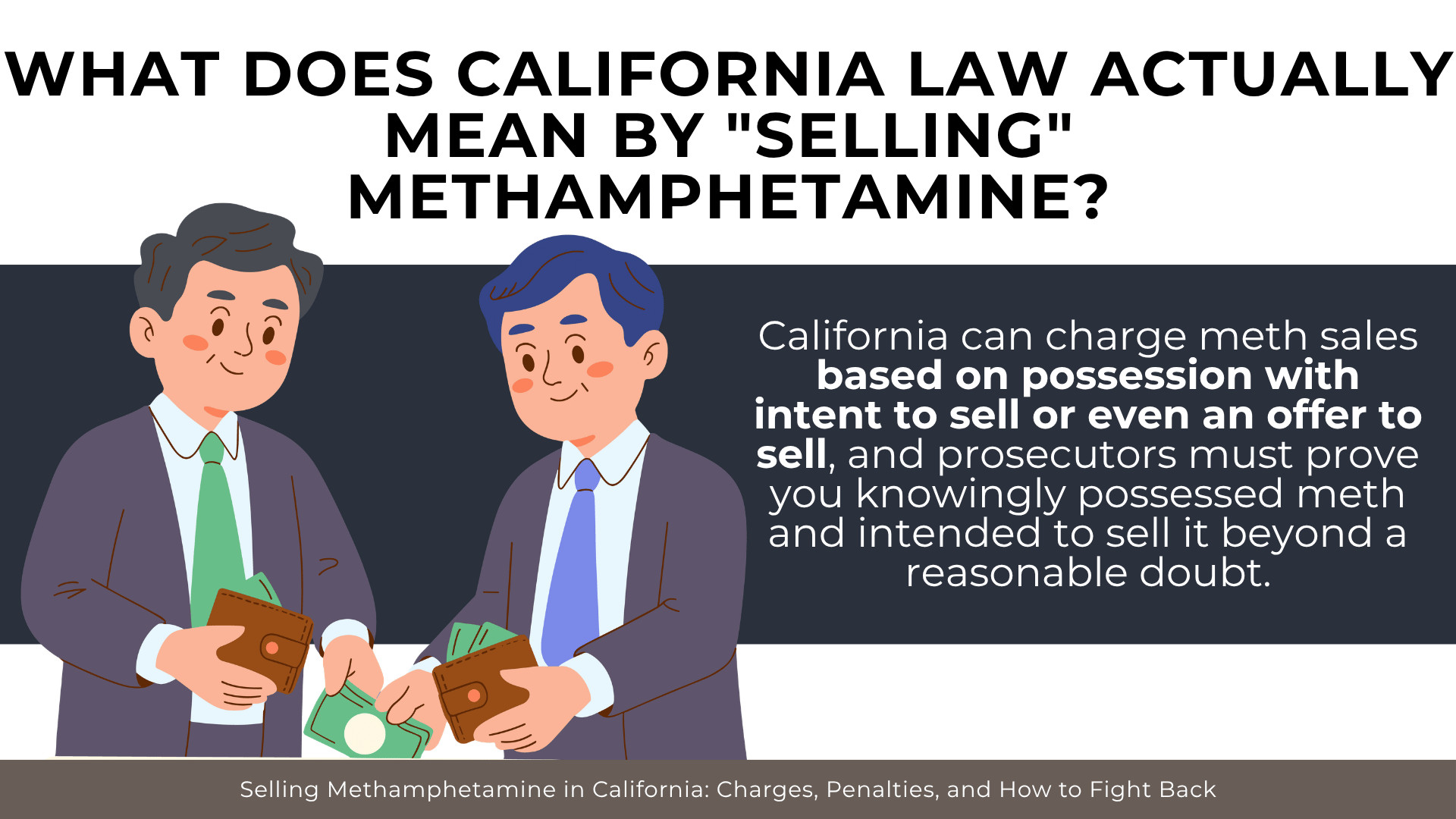
What Does California Law Actually Mean by “Selling” Methamphetamine?
California prosecutes meth sales under two separate statutes, and the distinction matters.
Health and Safety Code §11378 covers possession of methamphetamine for sale. Health and Safety Code §11379 covers the actual sale, transportation, furnishing, administering, or giving away of methamphetamine — as well as the offer to do any of those things, or the attempt to transport or import it. That second statute means a completed sale is not required. An offer alone can support a felony charge.
Under either statute, the prosecution must prove a set of specific elements drawn from decades of California case law. First, you had physical or constructive possession of a substance containing methamphetamine. Second, you knew the substance was present and knew it was a controlled substance. The California Supreme Court established in People v. Newman (1971) 5 Cal.3d 48 that possession for sale requires physical or constructive possession along with knowledge of the presence and narcotic character of the drug. Third — and this is where most of the courtroom battle happens — you had the specific intent to sell.
There is no statutory weight threshold in California that automatically converts a possession charge into a possession-for-sale charge. The prosecution must prove specific intent to sell beyond a reasonable doubt, and that proof almost always depends on circumstantial evidence.
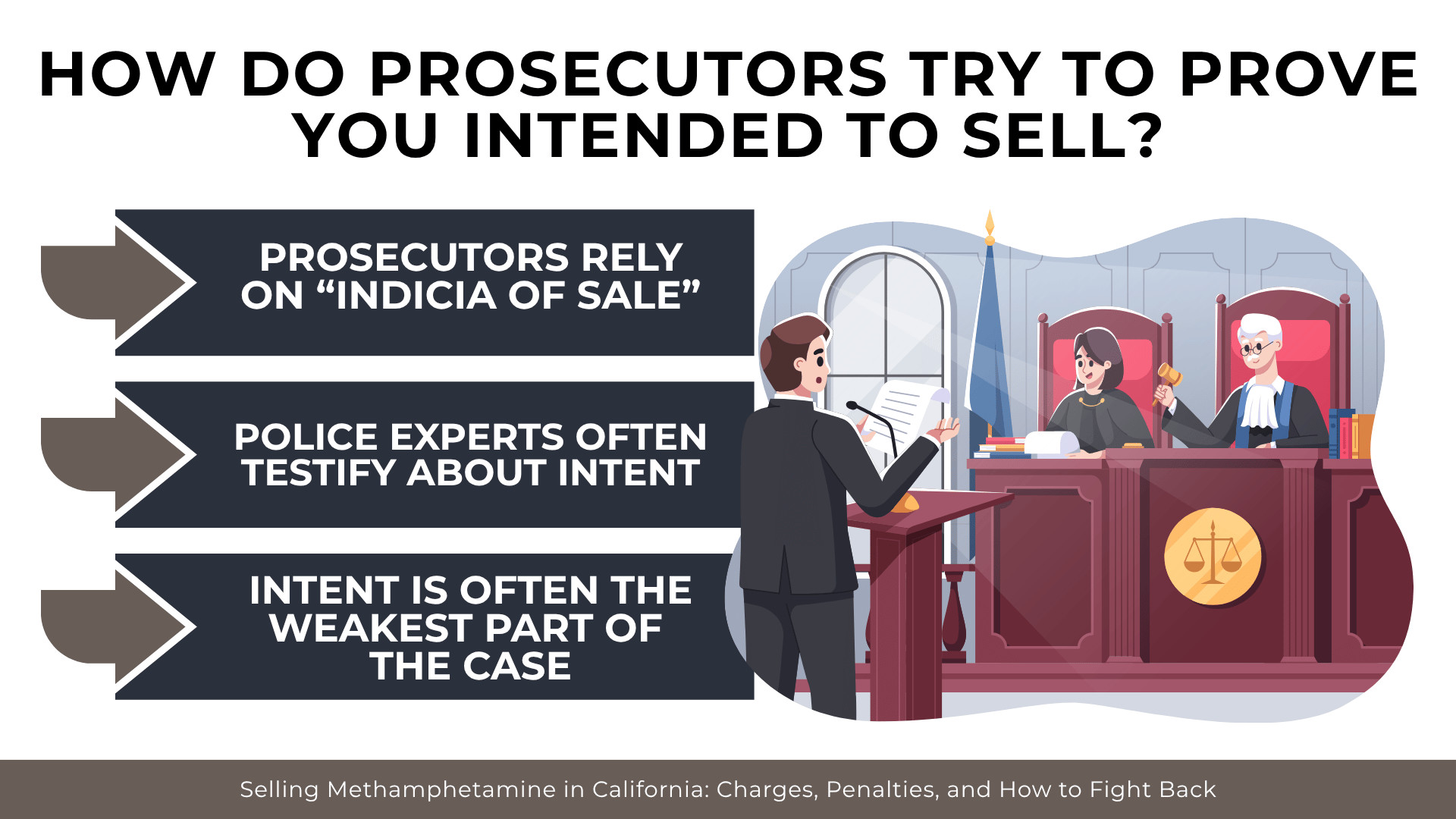
How Do Prosecutors Try to Prove You Intended to Sell?
Because intent lives inside someone’s head, prosecutors build their case through circumstantial “indicia of sale.” Under People v. Parra (1999) 70 Cal.App.4th 222, experienced officers may opine — based on quantity, packaging, and surrounding circumstances — that methamphetamine was possessed for sale. But in meth cases specifically, the defense opportunities in the intent element are substantial.
Methamphetamine users commonly purchase in larger quantities to avoid repeated transactions, which means a quantity that looks large to a narcotics officer may reflect personal-use buying patterns rather than distribution. Cash from legitimate employment, the absence of scales or packaging material, and the presence of a personal-use pipe all undermine the prosecution’s theory. Because California has no fixed weight threshold and the case rests on the totality of circumstances, a defense attorney who hires an expert to offer an alternative interpretation of the same evidence can create genuine reasonable doubt about intent.
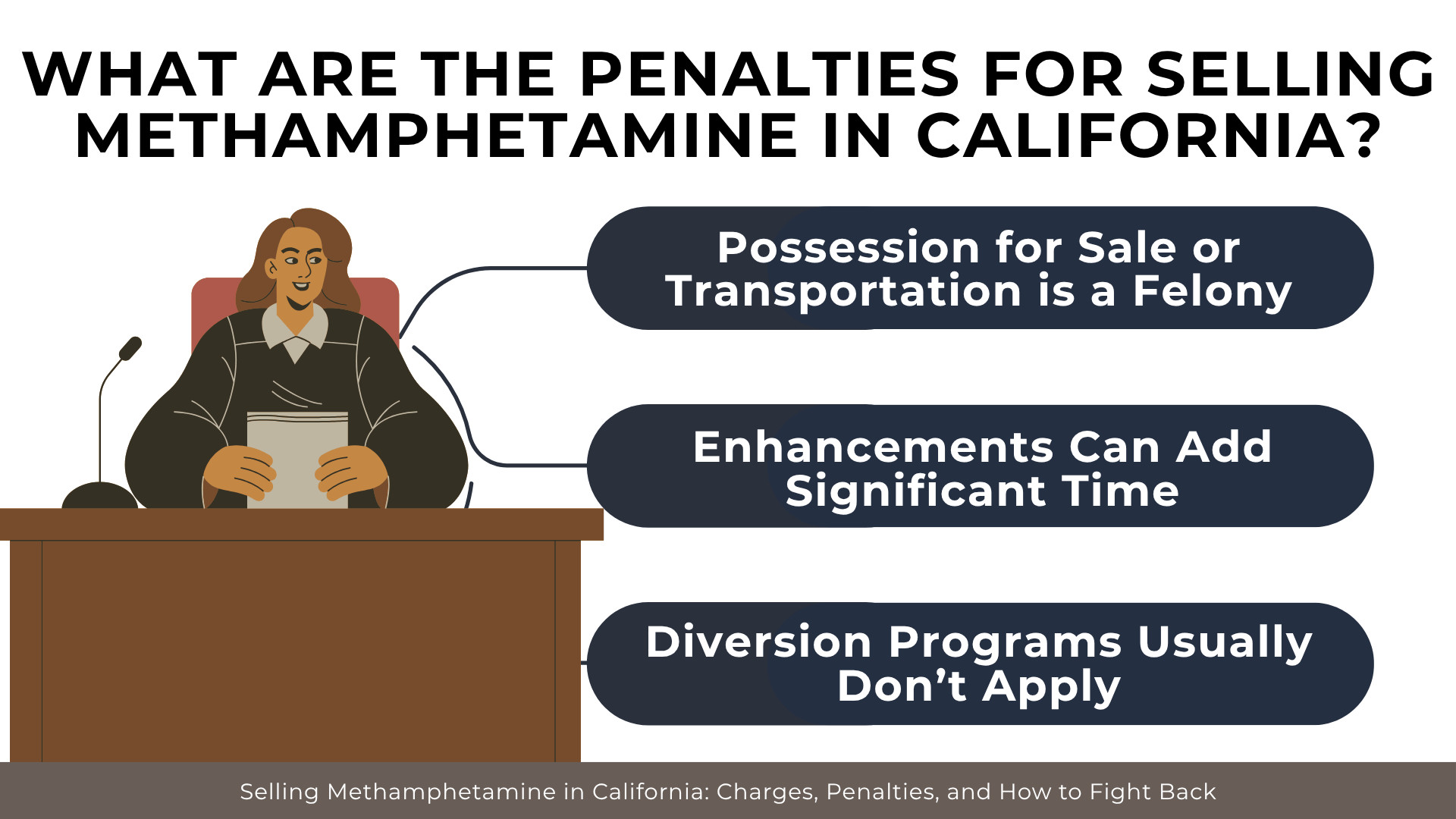
What Are the Penalties for Selling Methamphetamine in California?
The penalties depend on which statute you are charged under and whether enhancements apply.
Possession for sale under H&S §11378 is a straight felony punishable under Penal Code §1170(h). That means the sentence is served in county jail rather than state prison under California’s realignment law. Sale or transportation under H&S §11379 is also a straight felony punishable under §1170(h). For narcotics offenses charged under the related statute H&S §11352, transportation across two or more non-contiguous counties increases exposure to 3, 6, or 9 years.
Sentence enhancements can add years on top of those base terms. H&S §11370.2 imposes a 3-year enhancement for a prior felony drug conviction. H&S §11370.4 imposes weight-based enhancements ranging from 3 to 25 additional years for trafficking-level quantities — for example, cases involving a kilogram or more.
Two things you should know about what is not available to you: Proposition 47’s misdemeanor reclassification does not apply to sales charges. And diversion programs — PC 1000, Prop 36 treatment, and drug court — are categorically unavailable for possession for sale, transportation, or manufacturing.
That said, the statutory maximum is not the typical outcome. The statewide felony conviction rate is 60.0% — meaning four in ten felony arrests do not result in a conviction at all. Of those that do result in conviction, probation with jail is the most common sentence for adult felony cases in California. Understanding the realistic range of outcomes — not just the worst-case scenario — is important context for making informed decisions about your defense.
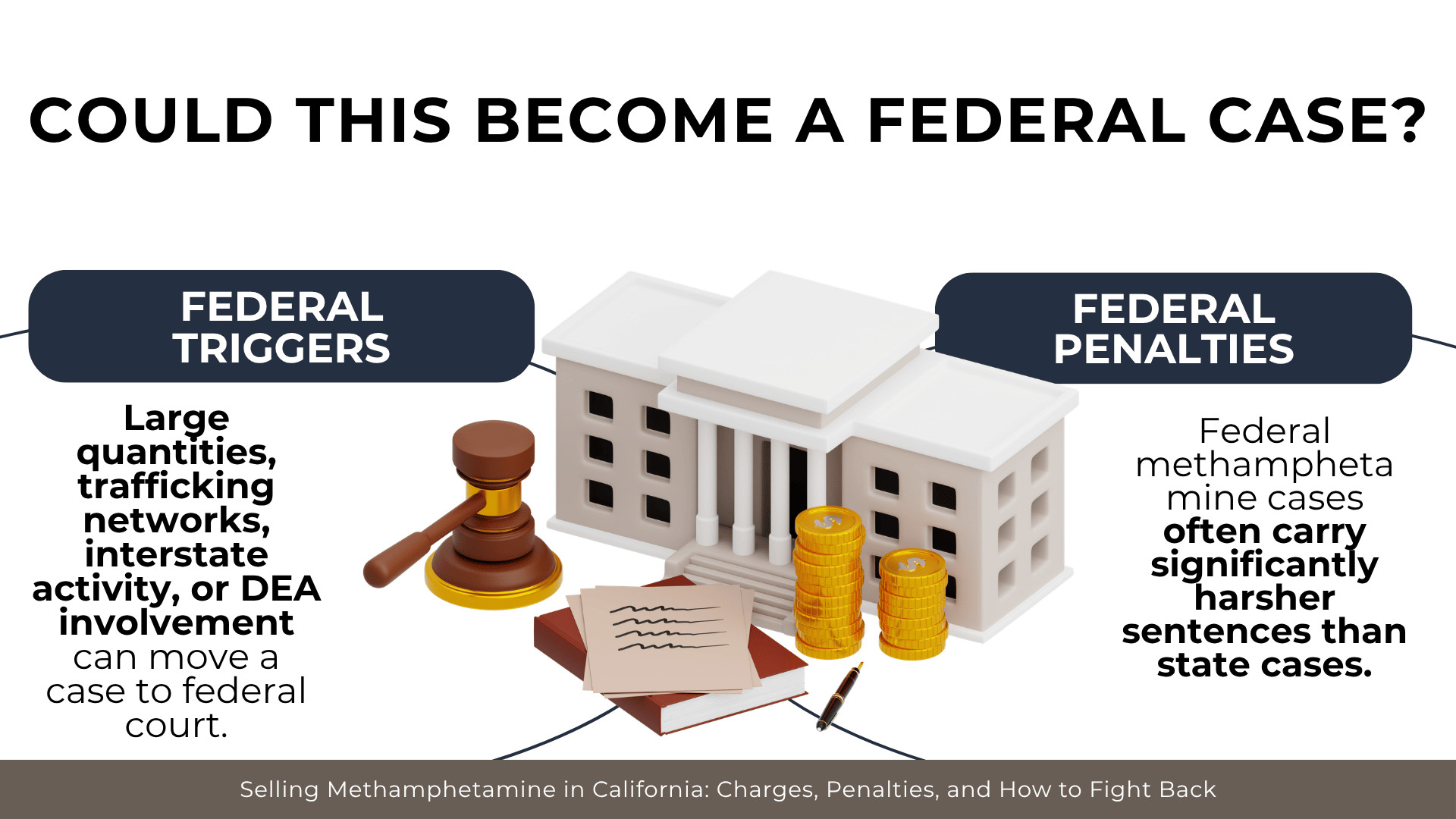
Could This Become a Federal Case?
Most methamphetamine sales cases in California are prosecuted in state court. But certain factors can push a case into the federal system: large quantities, involvement in a distribution network, activity that crosses state or international borders, or cases developed by federal agencies like the DEA.
The difference in sentencing exposure is significant. Nationally, the average federal sentence for methamphetamine trafficking is 105 months — the highest of any drug type. Methamphetamine accounts for nearly half of all federal drug-trafficking cases. 56% of federal drug-trafficking defendants are convicted of an offense carrying a mandatory minimum sentence.
Geography matters too. The Southern District of California, which includes San Diego County, handles one of the largest federal drug caseloads in the country. The average drug-trafficking sentence there is 35 months — well below the national average — largely because many defendants are couriers or lower-level participants who qualify for mitigating-role adjustments and early disposition departures.
Whether a case stays in state court or goes federal is not always predictable, but it is one of the first questions an experienced defense attorney will assess.
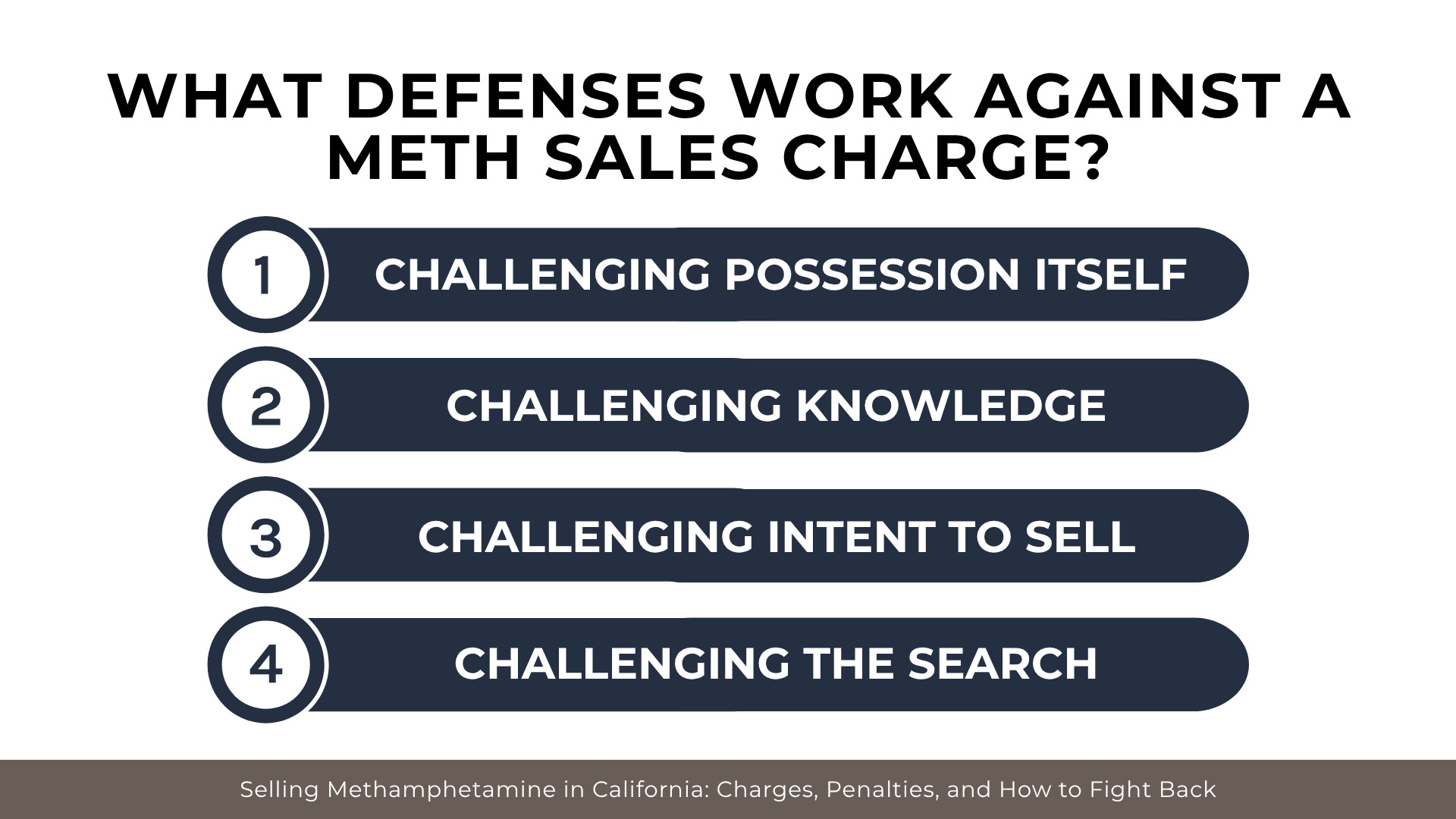
What Defenses Work Against a Meth Sales Charge?
Because the prosecution has to prove every element beyond a reasonable doubt, a defense strategy targets whichever element is weakest in the specific case. Several well-established defenses apply to meth sales charges in California.
Challenging possession and knowledge. The prosecution must prove you had dominion and control over the methamphetamine and knew it was there. Under People v. Williams (1971) 5 Cal.3d 211, mere presence in a vehicle where drugs are found is not enough. In cases involving shared cars, apartments, or common spaces, the prosecution’s ability to tie knowledge and control specifically to you is often the weakest part of its case.
Challenging intent to sell. As discussed above, intent is circumstantial. A defense attorney can hire an expert to offer an alternative interpretation of the same evidence — arguing that the quantity, packaging, or surrounding circumstances are equally consistent with personal use. Because there is no weight-based presumption of intent in California, the prosecution’s expert opinion is not the final word.
Challenging the search. Methamphetamine cases frequently originate from traffic stops and vehicle searches — encounters governed by strict constitutional boundaries under the Fourth Amendment and Article I, Section 13 of the California Constitution. If law enforcement exceeded those boundaries, the evidence obtained can be suppressed through a motion under Penal Code §1538.5. In meth sales cases specifically, prosecutors often rely on text messages and call logs to establish sales activity. Under Riley v. California (2014) 573 U.S. 373, police generally need a warrant before searching the digital contents of a phone seized during arrest — meaning that digital evidence collected without a warrant may be excluded entirely. When the evidence that supports the sales charge falls, the charge falls with it.
Talk to a Meth Sales Defense Attorney Now
A methamphetamine sales charge under H&S §11378 or §11379 is a straight felony with no diversion safety net. But the prosecution’s case depends on proving intent through circumstantial evidence. And every element — possession, knowledge, intent, the legality of the search — is a potential point of challenge. The earlier a defense attorney can evaluate the evidence and identify suppression issues, the more options remain available.
Angelo Reyes Law in Carlsbad, California handles meth sales defense cases across San Diego County. Angelo J. Reyes is a trial attorney licensed in California and Washington, admitted to the U.S. District Court for the Southern District of California, and recognized by the National Trial Lawyers Top 40 Under 40. Clients work directly with Angelo — not a paralegal, not an associate — from the first conversation through resolution. If you are facing a methamphetamine sales charge, contact Angelo Reyes Law today.