
If you’re reading this, there’s a good chance you or someone close to you was recently arrested for DUI in California — and somewhere between the panic and the Googling, you came across the term “wet reckless.” Maybe a friend mentioned it. Maybe you saw it on a forum. Either way, you’re trying to figure out what it is, whether it applies to your situation, and whether it’s worth pursuing.
Here’s what you need to know.
What a Wet Reckless Actually Is
A wet reckless is not a charge you can be arrested for. You will never see a police officer write “wet reckless” on a citation. It exists only as a plea bargain — a reduced charge that a prosecutor offers to resolve a DUI case. The formal charge is alcohol- or drug-related reckless driving. The “wet” label distinguishes it from ordinary reckless driving (sometimes called a “dry reckless”) because the court record specifically notes that alcohol or drugs were involved.
This distinction matters for one critical reason: you can only get a wet reckless if the prosecution agrees to offer it. Your attorney can negotiate for it, but no defendant has a right to it. The prosecutor evaluates the facts of your case and decides whether reducing the charge is appropriate. That decision depends on factors we’ll get to shortly.

Wet Reckless vs. DUI: The Concrete Differences
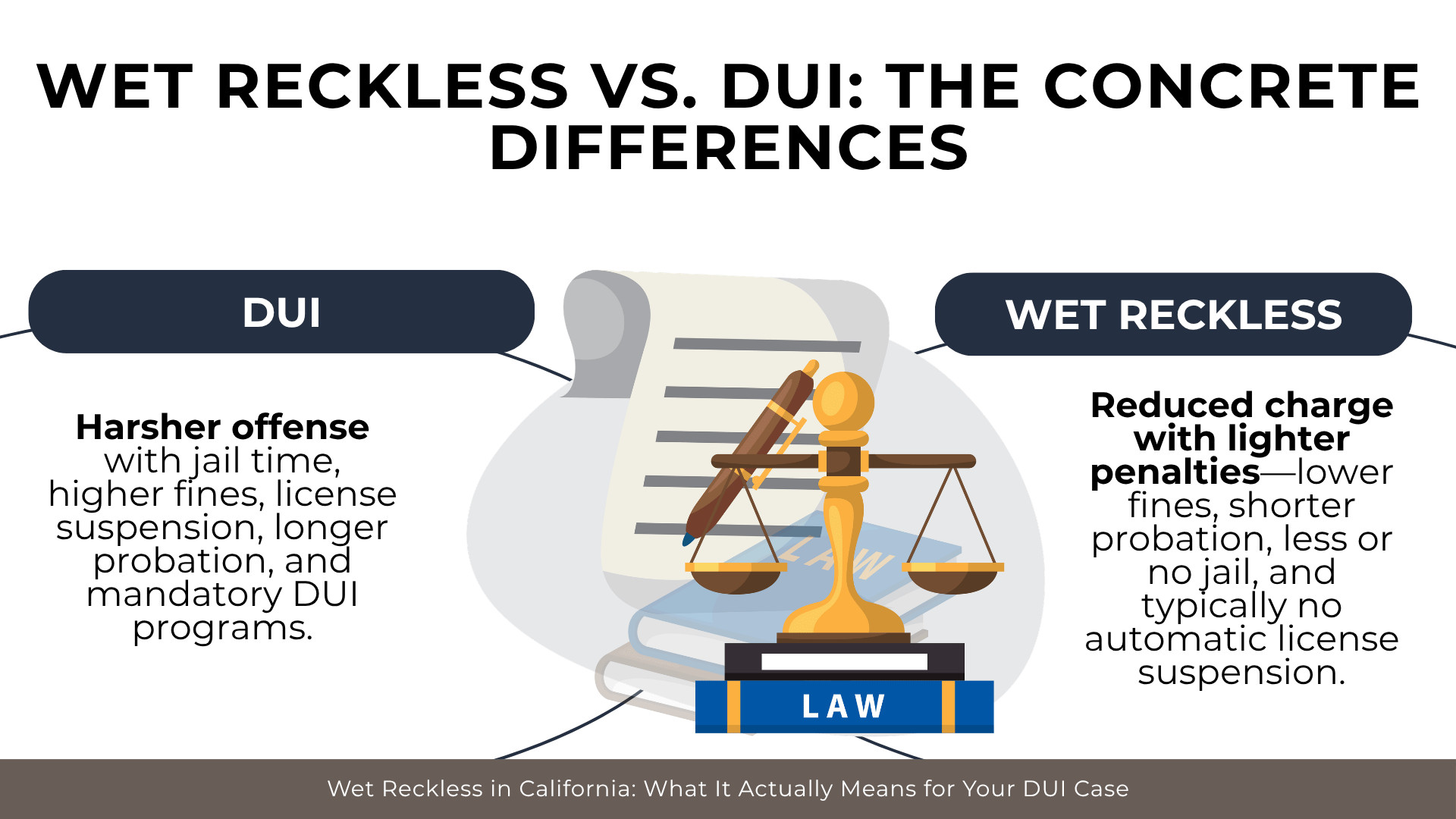
Understanding why people pursue a wet reckless requires comparing it directly to what a DUI conviction carries. Under California Vehicle Code § 23536, a first-time DUI conviction comes with 96 hours to six months in county jail, fines ranging from $390 to $1,000 (plus penalty assessments that multiply the base fine significantly), a six-month court-triggered license suspension under Vehicle Code § 13352, a three- to five-year probation term under Vehicle Code § 23600(b)(1), and mandatory enrollment in a DUI education program.
A wet reckless generally reduces several of these consequences. The maximum jail sentence is typically shorter. Fines are generally lower. There is typically no court-mandated license suspension attached to the conviction itself. DUI school, if required at all, is often shorter. Probation terms tend to be shorter as well.
For a first-time offense where the facts are otherwise straightforward, these reductions can translate into meaningful differences in cost, time, and disruption to your daily life. According to the California Highway Patrol and the California Office of Traffic Safety, a first-time DUI costs approximately $13,500 when you account for fines, fees, insurance increases, attorney costs, DUI school, and lost wages. A wet reckless doesn’t eliminate all of those costs, but it can reduce several of them.
The Catch: What a Wet Reckless Doesn’t Protect You From
Before treating a wet reckless as an escape route, you need to understand what it leaves on the table.
It counts as a prior DUI. This is the most important limitation. A wet reckless is “priorable,” meaning if you are arrested for DUI again within ten years, the wet reckless will be treated as a prior DUI offense for sentencing purposes. California uses a ten-year lookback period measured from arrest date, and a wet reckless falls squarely within that window. A second DUI within that period carries 90 days to one year in jail and substantially steeper penalties under Vehicle Code § 23540.
Your license suspension may still happen. The DMV runs its own administrative process entirely separate from your criminal case — more on this below. A wet reckless plea in court does not necessarily prevent the DMV from suspending your license through its own independent proceeding.
Insurance companies will know. A wet reckless is an alcohol-related driving offense on your record. Insurers will see it. You will still likely need to file an SR-22 certificate of financial responsibility, which California requires for three years following reinstatement under Vehicle Code § 13352.4. Your premiums will reflect the conviction.
Professional licensing consequences remain possible — a wet reckless is still a criminal conviction that may trigger reporting obligations for physicians, attorneys, and other licensed professionals. And if you are not a U.S. citizen, immigration consequences require fact-specific analysis with specialized legal counsel, even for a reduced charge.

Who Actually Gets a Wet Reckless
Not everyone charged with DUI is a candidate for a wet reckless plea. Prosecutors look at the totality of the circumstances, and certain factors make the offer more or less likely.
BAC near the legal limit. Cases where the blood alcohol concentration was at or close to 0.08% are generally stronger candidates than cases with high readings. California law treats a BAC at or above 0.15% as grounds for discretionary sentencing enhancement under Vehicle Code § 23578, and readings at or above 0.20% trigger mandatory 9-month DUI school under Vehicle Code § 23538(b)(2). The higher the BAC, the less likely a prosecutor is to offer a reduction. For context, drivers at 0.08% BAC are approximately 4 times more likely to crash than sober drivers, and at 0.15% that risk multiplies to at least 12 times — which helps explain why prosecutors view high-BAC cases differently from borderline ones when evaluating a wet reckless plea.
No accident involved. Roughly 21.4% of all DUI arrests in California in 2019 were associated with a traffic crash. If your arrest involved a collision — especially one causing injury — the likelihood of a reduced plea drops significantly. DUI causing injury is charged under Vehicle Code § 23153, which is a felony wobbler carrying potential state prison time. That’s a different universe from wet reckless territory.
No prior offenses. First-time offenders are far more likely to be offered a wet reckless than repeat offenders. Data from the California DMV shows that 72.8% of convicted DUI offenders arrested in 2019 were first offenders, and the wet reckless plea tends to be concentrated in this group.
No aggravating factors. Having a minor under 14 in the vehicle triggers a mandatory sentencing enhancement under Vehicle Code § 23572. Refusal to submit to chemical testing after a lawful arrest leads to additional license consequences under Vehicle Code § 13353. These aggravating circumstances make prosecutors significantly less inclined to negotiate.
How common is it? According to the California DMV, 7.9% of DUI convictions among those arrested in 2019 were reduced to a wet reckless. That’s not a large number, but it’s not negligible either — it represents thousands of cases statewide. And given that 72.8% of convicted DUI offenders are first-time offenders, the wet reckless plea is concentrated in the group where prosecutors have the most flexibility to negotiate. Local prosecution practices and court culture also play a meaningful role — an attorney who practices in your specific county understands how these dynamics affect the offers you’re likely to see.

The DMV Side: What Happens to Your License
This is where most people get caught off guard. Your DUI case actually plays out on two separate tracks — the criminal case in court and an administrative proceeding at the DMV — and they operate independently of each other.
When you were arrested, the officer likely confiscated your license and issued a temporary one. That triggered the DMV’s Administrative Per Se (APS) process under Vehicle Code § 13353.2, which allows the DMV to suspend your license independently of your criminal case.
Here’s what matters for a wet reckless negotiation: a reduced plea in criminal court does not automatically resolve the DMV side. The APS suspension is a civil proceeding with its own, lower standard of proof (preponderance of the evidence). Even a full criminal acquittal doesn’t guarantee the DMV reverses its action. A wet reckless plea — while beneficial in criminal court — should never be assumed to settle the administrative track.
That’s why the 10-day deadline under Vehicle Code § 13558 matters so much. You have exactly ten days from the date you receive the suspension notice to request an APS hearing. Miss this window and the suspension takes effect automatically — regardless of how strong your wet reckless negotiation position may be. The two tracks require separate strategies.

Other Plea Options Beyond Wet Reckless
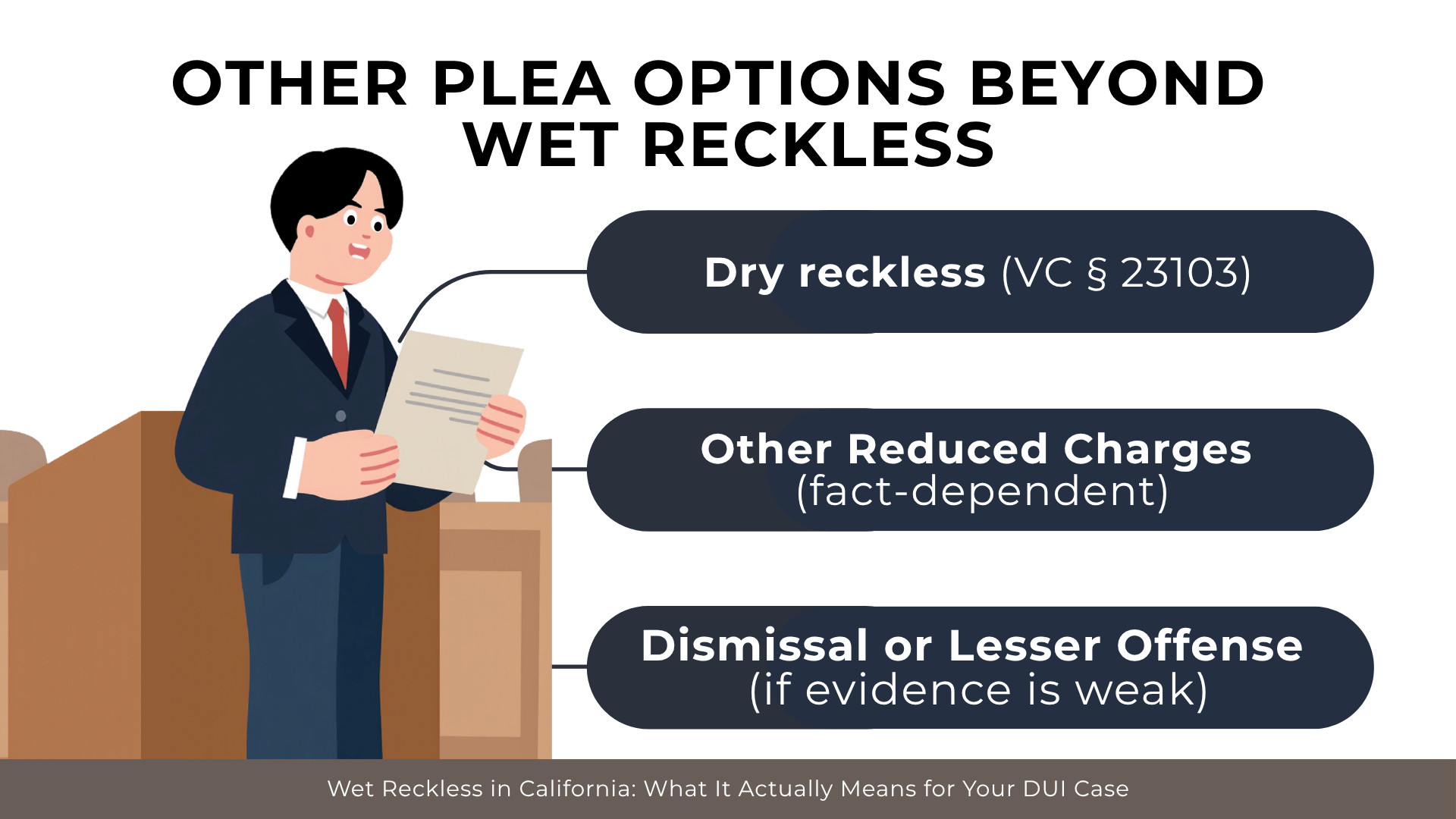
A wet reckless is the most commonly discussed reduced plea in DUI cases, but it’s not the only possibility. A dry reckless under Vehicle Code § 23103 is a standard reckless driving conviction with no alcohol notation. It is not priorable as a DUI and carries lower penalties. It is also generally harder to obtain — prosecutors are less likely to offer it unless the case has substantial evidentiary weaknesses.
Other reduced charges may be available depending on the facts of your case. For instance, in situations where the evidence of “driving” is weak — such as when a defendant is found in a parked vehicle — the legal standard established in Mercer v. Department of Motor Vehicles requiring volitional movement of the vehicle may open the door to alternative resolutions. Each alternative carries different consequences for your record, your license, your insurance, and your exposure to enhanced penalties if there is ever a future incident. The viability of any particular plea depends entirely on the specific facts of your case and the discretion of the prosecutor.
What to Do Next
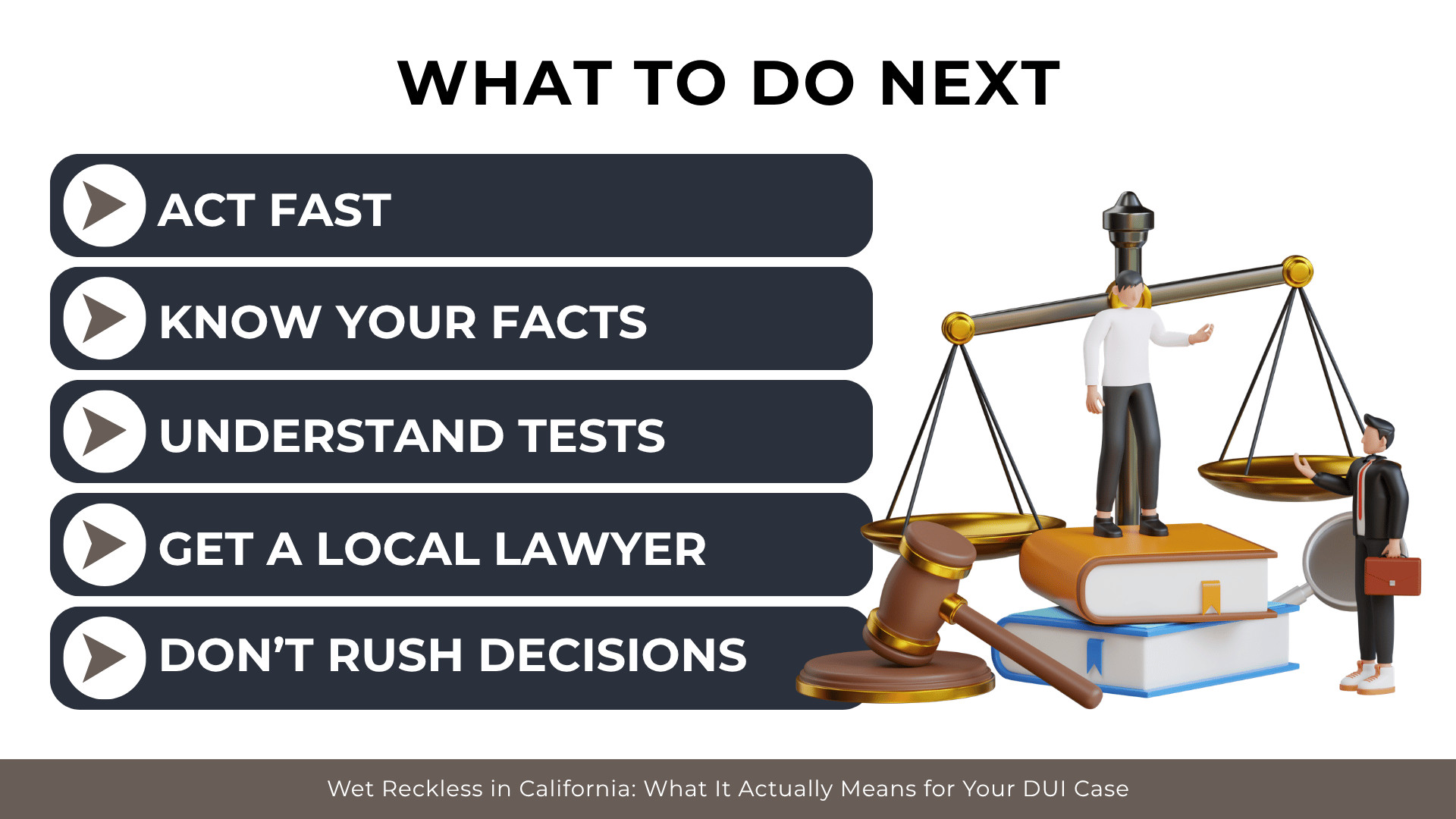
If you were recently arrested for DUI in California, here is how to orient yourself.
Protect the 10-day DMV deadline first. Whatever else is happening with your case, request your APS hearing before this window closes. This preserves your right to contest the administrative license suspension and may allow you to keep driving while the hearing is pending.
Gather the facts that matter for a wet reckless evaluation. What was your BAC reading? Was there an accident? Were there any aggravating factors like a minor in the car or a refusal to test? Were there any issues with the traffic stop itself — because under People v. Bell and Terry v. Ohio, the stop must be based on specific articulable facts suggesting a violation, not a hunch? These details determine whether a wet reckless is a realistic negotiation target or a long shot.
Understand that field sobriety tests were voluntary. If you performed them, that’s done. But it’s worth knowing that California imposes no statutory penalty for refusing field sobriety tests, and the preliminary alcohol screening (PAS) breath test is also voluntary for drivers over 21 who are not on DUI probation under Vehicle Code § 23612(h)-(i). The post-arrest chemical test at the station is a different matter — refusal there triggers a one-year license suspension for a first offense under Vehicle Code § 13353.
Consult with a DUI defense attorney who practices in your county. County-level variation in conviction rates and plea practices means that local experience matters. An attorney familiar with the prosecutors and courts in your jurisdiction can give you a realistic assessment based on how similar cases are actually handled there — not just what the statute says. Angelo J. Reyes of Law Office of Angelo Reyes, APC, based in Carlsbad, is a San Diego criminal defense attorney serving clients throughout San Diego County. Recognized by the National Trial Lawyers as a Top 40 Under 40 attorney and admitted to the State Bar of California and the U.S. District Court for the Southern District of California, he brings extensive trial experience to DUI defense — preparing every case as though it will go to trial, whether the goal is negotiating a reduced plea or contesting the charges outright.
A DUI arrest is disorienting, and the pressure to “fix it” can lead to decisions made without enough information. A wet reckless may be the right outcome for your case — or it may not be the most important thing to fight for. The answer depends on your specific facts, your county, and what you need to protect. Start with the deadline, gather the details, and get an informed assessment before committing to a direction.