

Possession with intent to sell is a straight felony under California law. It carries penalties that are far more serious than simple drug possession. If you or someone close to you is facing this charge, the most important thing to understand immediately is that California prosecutors do not need to prove that a sale actually happened. They only need to prove that the drugs were possessed with the intent to sell them. They routinely build that case using circumstantial evidence that has nothing to do with an actual transaction.
This page breaks down exactly how the charge works: the specific statutes involved, how prosecutors prove intent, what the penalties look like, and how an experienced defense attorney challenges the intent element that makes or breaks these cases.
The gap between simple possession and possession for sale is enormous. Simple possession under Health & Safety Code § 11350 is generally a misdemeanor — up to six months in county jail and a fine of up to $1,000. Possession for sale under § 11351 is a straight felony carrying two, three, or four years in custody and fines up to $20,000. That is not a difference in degree. It is a difference in kind, and it often turns on the thinnest of circumstantial evidence.
How Do Prosecutors Prove You Intended to Sell?
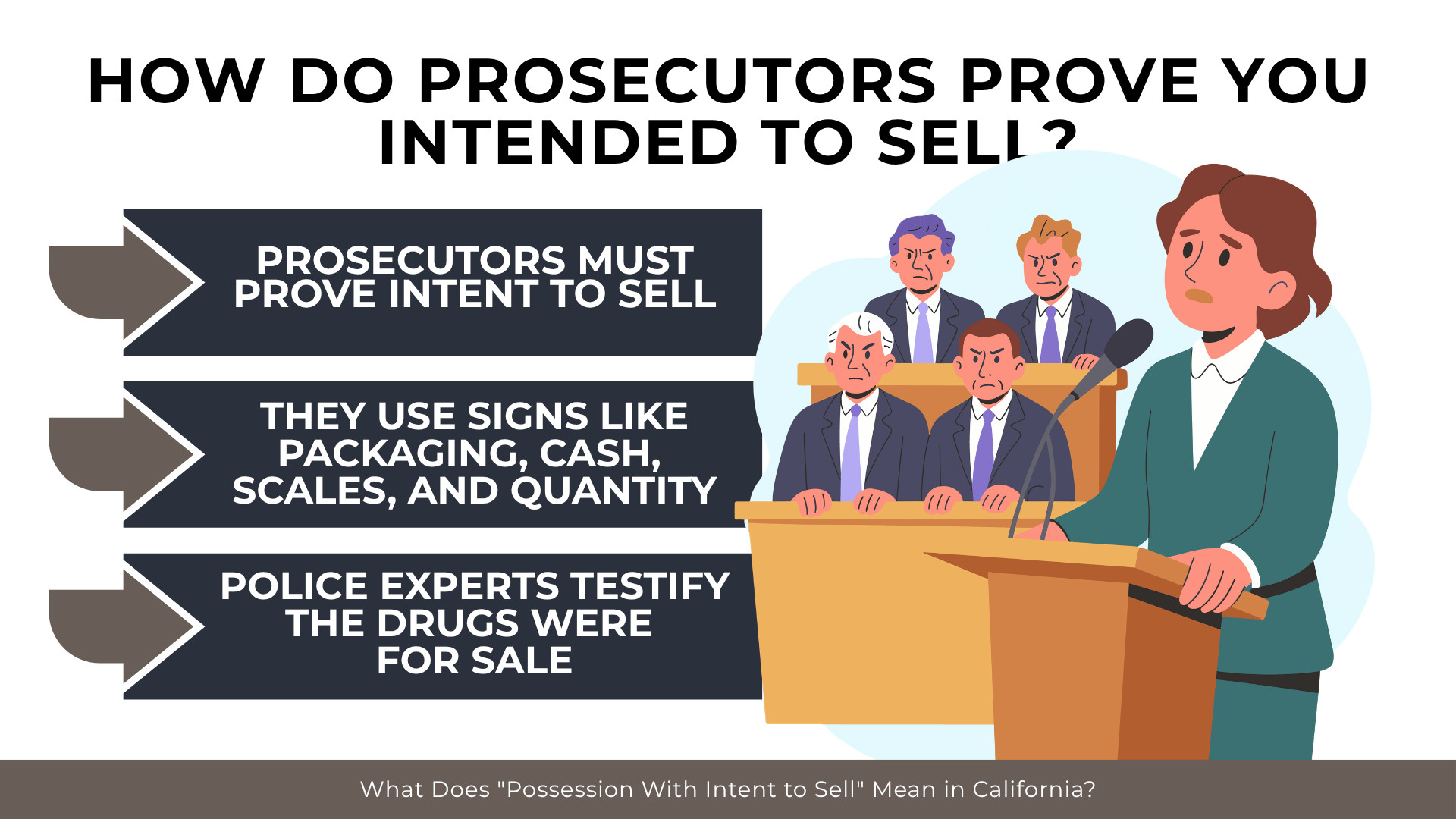
There is no weight threshold in California law that automatically elevates a possession charge to possession for sale. The prosecution must prove specific intent to sell beyond a reasonable doubt. Because people rarely announce their plans to distribute drugs, that proof almost always comes through circumstantial evidence that law enforcement calls “indicia of sale.”
These indicia typically include the quantity of drugs recovered, how they were packaged (individually wrapped bindles, baggies, or balloons), the presence of digital scales, pay-owe ledgers or text messages suggesting transactions, large amounts of cash in small denominations, multiple cell phones, and the absence of paraphernalia associated with personal use — pipes, syringes, or other consumption tools. No single factor is enough on its own. Prosecutors stack them to build an overall picture of someone who was holding drugs for distribution rather than personal consumption.
A critical piece of this puzzle is narcotics-expert testimony. Under People v. Parra (1999) 70 Cal. App. 4th 222, California courts allow experienced officers to testify, based on factors like quantity and packaging, that drugs were possessed for sale. In practice, this means a detective or narcotics officer will take the stand and offer their opinion that the evidence is “consistent with possession for sale” rather than personal use. That opinion often becomes the key piece of the prosecution’s case.
The key legal standard comes from People v. Newman (1971) 5 Cal.3d 48, which established that possession for sale is determined by physical or constructive possession along with knowledge of the presence and narcotic character of the drug. The specific intent to sell is a separate element the prosecution must prove on top of those possession and knowledge requirements. Every element must be proven independently, and the intent element is where most of these cases are won or lost.
What Are the Penalties for Possession With Intent to Sell in California?
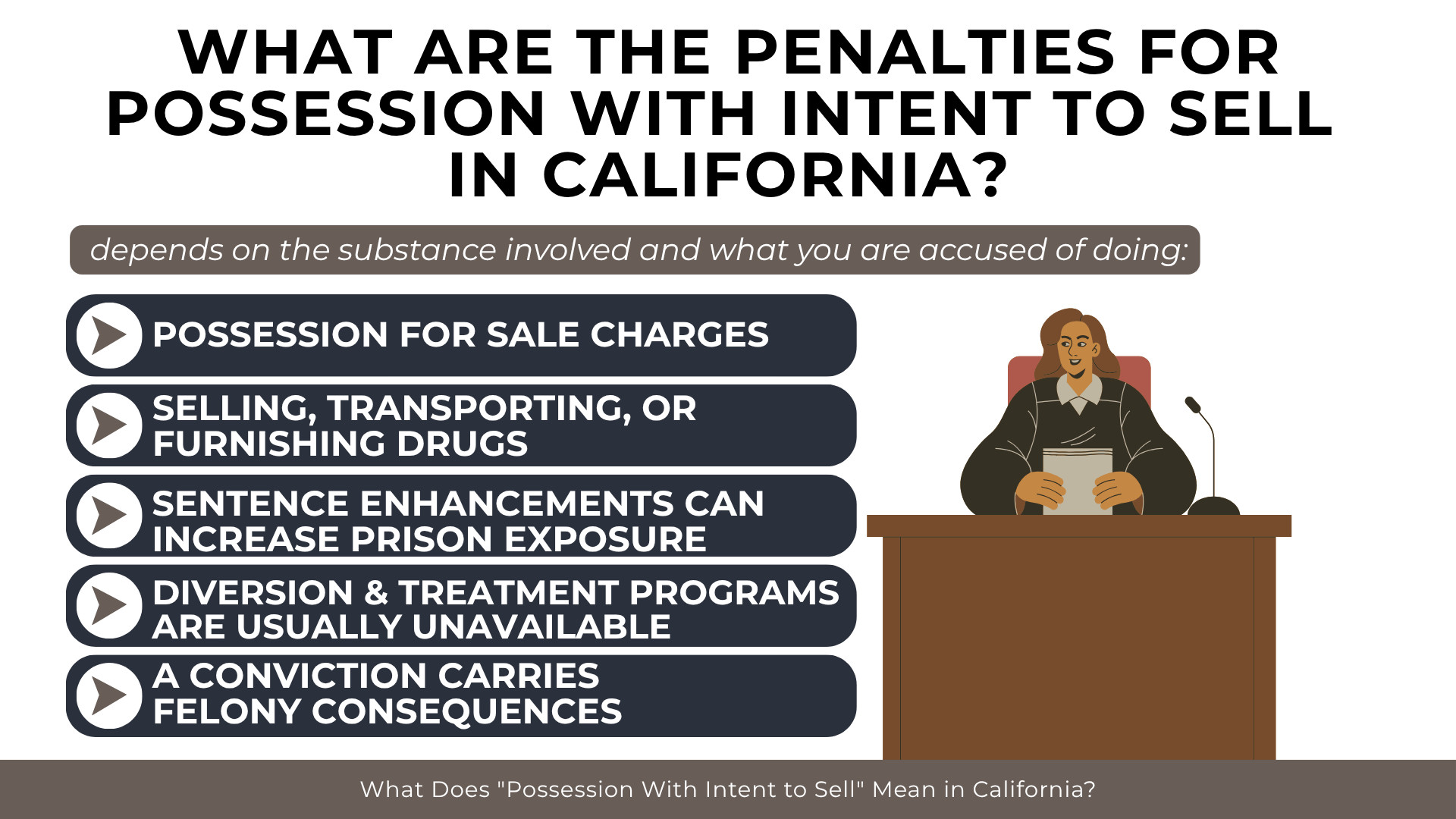
The penalties depend on which statute you are charged under, which in turn depends on the substance involved and what you are accused of doing.
Possession for sale under Health & Safety Code § 11351 carries two, three, or four years in county jail under Penal Code § 1170(h) plus fines up to $20,000. Section 11378 covers the same conduct for non-narcotic controlled substances like methamphetamine. If the charge escalates to actual sale or transportation under § 11352, the range jumps to three, four, or five years — and crosses two non-contiguous counties, that becomes three, six, or nine years. Enhancements under §§ 11370.2 and 11370.4 can add three to twenty-five additional years.
One of the most important realities of a possession-for-sale charge is what it takes off the table. California’s diversion programs — PC 1000, Prop 36 treatment, and drug court — are not available for sales charges. There is no treatment-based off-ramp that results in a dismissal. The case resolves either through a successful defense, a negotiated reduction to a lesser charge, or a conviction with felony consequences. That makes the fight over the intent element — which separates a felony sales charge from a misdemeanor simple-possession charge — the highest-stakes battle in the case.
How Can You Fight a Possession-for-Sale Charge?
Possession-for-sale cases are built on circumstantial evidence and inferences. That makes the intent element — the factor that separates this felony from a misdemeanor simple-possession charge — where most defense strategies focus.
How Do You Challenge the Intent to Sell? The prosecution must prove intent to sell — not just possession. If the quantity recovered is consistent with personal use, if you had paraphernalia for consumption, if there are no pay-owe records or transaction-related communications, the “indicia of sale” argument weakens. Your defense attorney can present expert testimony to counter the prosecution’s narcotics officer, offering an alternative interpretation of the same evidence. There is no statutory weight-based presumption of intent in California. The prosecution carries the full burden of proving this element beyond a reasonable doubt.
Can the Charge Be Reduced to Simple Possession? Even where the evidence is strong, an experienced attorney can often negotiate a reduction from possession for sale to simple possession. That result preserves eligibility for diversion, dramatically reduces custody time, and changes the long-term outcome of the case. This negotiation is most effective when your defense attorney has done the work to identify every vulnerability in the prosecution’s intent theory — and the prosecutor understands that a trial carries real risk.

Why Does the Attorney You Choose for This Charge Matter?
A possession-for-sale charge is a felony with no diversion safety net and penalties that can reach decades when enhancements apply. The prosecution’s case depends on circumstantial inferences — an officer’s opinion about what baggies and cash “mean.” Those inferences can be challenged, reframed, and contested by an attorney who understands how these cases are actually built and tried.
At Angelo Reyes Law in Carlsbad, California, every case is prepared as if it is going to a jury. That trial-first approach builds leverage whether the case ultimately resolves through negotiation or at trial. Clients work directly with Angelo Reyes — not a paralegal, not an associate — from the first conversation through resolution. With thousands of criminal cases handled across San Diego County and experience that includes felony strike exposures reduced to simple misdemeanors, Angelo Reyes understands what is at stake in a possession-for-sale case and how to fight it.
If you are facing this charge, the window to build the strongest possible defense starts now. Contact Angelo Reyes Law for a consultation.
