A first-offense charge for possession of drug paraphernalia in California is a misdemeanor — not a felony. In most cases, you are unlikely to serve jail time because California law offers clear paths to get the charge dismissed entirely. The difference between a dismissal and a conviction that follows you for years usually comes down to what you do in the weeks immediately after the charge.
This page covers what California law classifies as drug paraphernalia and how the charge compares to other drug offenses. It also explains what a conviction could mean for your immigration status, financial aid, and professional licensing — consequences that often matter more than the criminal penalty itself.
What Counts as “Drug Paraphernalia” Under California Law?
Health and Safety Code § 11364 covers the possession of paraphernalia used for unlawfully consuming a controlled substance. Charges under this law typically involve items like glass pipes, syringes, spoons with residue, and similar objects associated with drug use.
Two details matter here. First, the item has to be connected to an unlawful controlled substance. Cannabis accessories are not drug paraphernalia for adults 21 and older under Proposition 64. That law — under Health and Safety Code § 11362.1 — permits adults to possess and use cannabis within specific limits, including up to 28.5 grams of cannabis and 8 grams of concentrated cannabis. If the item relates only to lawful cannabis use, it doesn’t fall under § 11364.
Second, the prosecution has to prove that the item was actually used for, or intended for use with, a controlled substance. A glass pipe sitting on a shelf is not automatically paraphernalia. Context — residue, proximity to a controlled substance, statements made at the scene — is what turns a household object into a criminal charge. That distinction matters, and it’s one of the reasons these charges can be challenged.

Is Possession of Drug Paraphernalia a Misdemeanor or a Felony?
It’s a misdemeanor. To put that in perspective, even possessing the controlled substance itself is a misdemeanor. Simple possession charges under Health and Safety Code § 11350 were reclassified by Proposition 47 and are now punishable by up to six months in county jail under Penal Code § 19 and/or a $1,000 fine. Paraphernalia sits below that in seriousness.
Maximum penalties and actual outcomes are not the same thing. Across all California felony cases, roughly 75% end in guilty pleas, about 20% end in dismissals, and fewer than 3% ever reach trial. Misdemeanor paraphernalia cases resolve even more quickly — and if this is your first offense, the most common resolution isn’t a conviction at all. It’s diversion.
Could This Charge Affect My Immigration Status, Gun Rights, or Financial Aid?
A paraphernalia charge might seem minor in the criminal system, but its collateral consequences — the effects outside the courtroom — deserve serious attention, particularly for non-citizens.
Immigration. Under 8 U.S.C. § 1227(a)(2)(B)(i), a conviction relating to a controlled substance can trigger deportation. However, the U.S. Supreme Court addressed paraphernalia convictions directly in Mellouli v. Lynch, 575 U.S. 798 (2015). The Court held that a state conviction for possessing drug paraphernalia involving unidentified pills did not automatically trigger deportation under federal immigration law. The reason: the conviction did not necessarily relate to a substance on the federal controlled-substance schedules. That ruling narrowed the government’s ability to use state paraphernalia convictions as a deportation trigger — but it did not eliminate immigration risk entirely. The outcome depends on the specific facts of your case, what substance was involved, and how the conviction is classified. The Supreme Court’s earlier decision in Padilla v. Kentucky, 559 U.S. 356 (2010), established a related rule. Defense counsel’s failure to correctly advise a defendant of the deportation consequences of a guilty plea amounted to constitutionally deficient assistance under prevailing professional norms. If you are not a U.S. citizen, your attorney must understand both the criminal and immigration sides of your case before you make any decision about how to resolve it.
Financial aid. The FAFSA Simplification Act, enacted December 27, 2020, removed automatic Title IV student-aid ineligibility for drug convictions. The U.S. Department of Education confirmed in Dear Colleague Letter GEN-21-04 (June 11, 2021) that the drug-conviction question would be completely removed from the FAFSA beginning with the 2023–24 award year. A paraphernalia conviction should not affect federal student aid eligibility.
Professional licensing. California licensing boards for healthcare, law, education, and other regulated professions ask about criminal convictions on their applications. A misdemeanor paraphernalia conviction — especially one that was later expunged — may not be disqualifying, but it can trigger additional review, disclosure requirements, or delays. Dismissal through diversion avoids this issue altogether.
The broader point is that collateral consequences are often more disruptive than the criminal penalty itself. Several of them survive expungement under PC 1203.4. Especially for federal immigration purposes, California expungement generally does not eliminate a conviction. Diversion — which prevents a conviction from ever existing — is the strongest protection available.

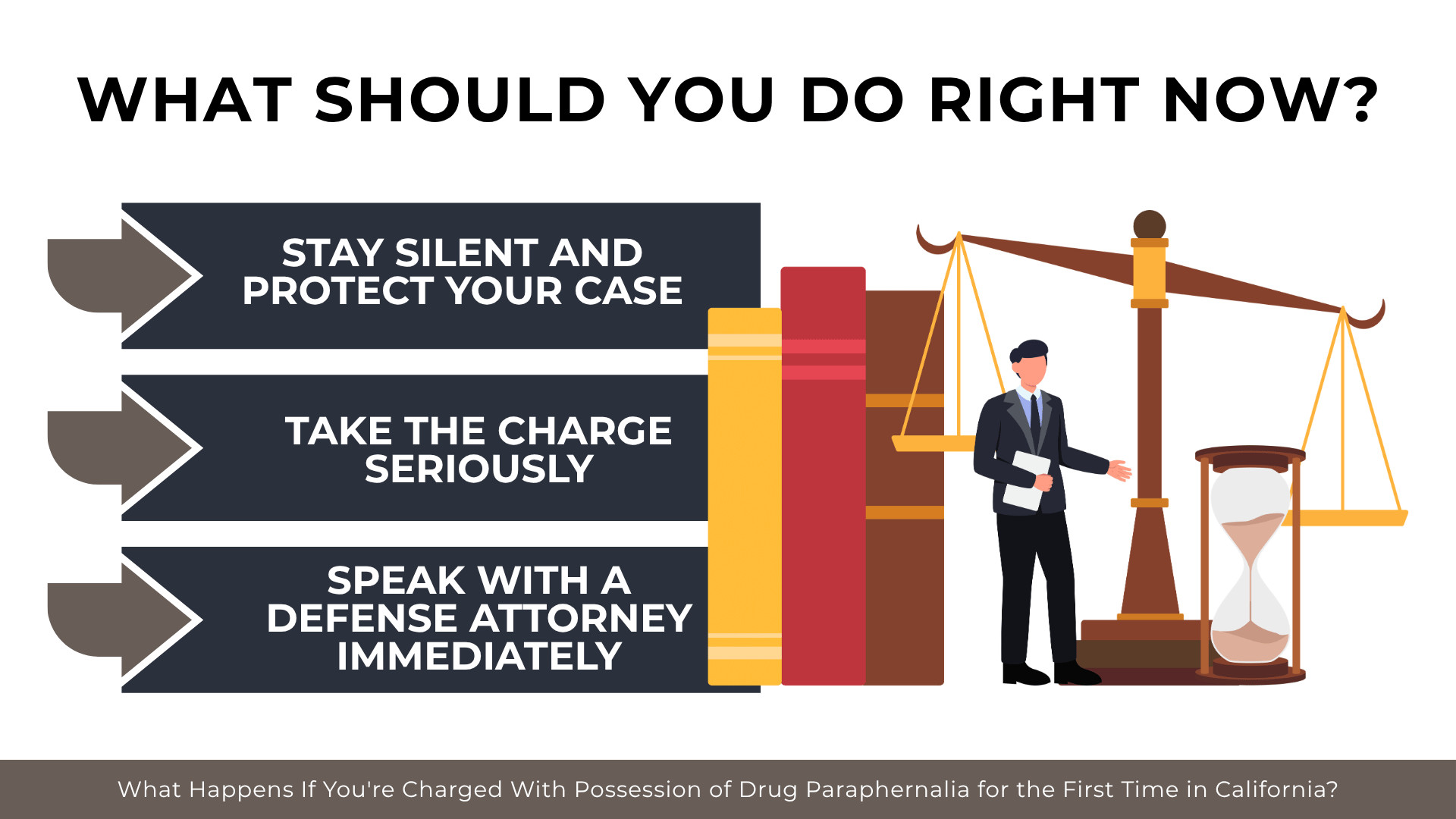
What Should You Do Right Now?
If you’ve been charged with possession of drug paraphernalia for the first time, the single most important thing to understand is that this charge is more defensible at this moment than it will ever be again. How the charge is classified, whether the item qualifies as paraphernalia at all, and what collateral consequences come with a conviction versus a dismissal — these are all questions with better answers the earlier they’re raised.
Do not discuss the case with anyone other than your attorney. Do not post about it. Do not assume it will resolve on its own. Even a misdemeanor requires a court appearance. Failing to appear creates a new problem on top of the existing one.
Contact a criminal defense attorney before your arraignment. Angelo Reyes Law, based in Carlsbad, California, handles drug-offense cases across San Diego County. Attorney Angelo Reyes works directly with every client, and every case is prepared as if it’s going to jury, to build leverage whether the matter resolves through negotiation or at trial. If you’re facing a first-offense paraphernalia charge and want to understand your options, contact Angelo Reyes Law for a consultation.