
If you’re reading this, there’s a good chance you or someone close to you was recently arrested for a DUI in California. You’re probably still processing what happened — and trying to figure out what comes next. That’s exactly what this article covers.
Here’s the first thing to understand: a California DUI triggers two separate processes that run on their own tracks. One is a criminal case handled by the courts. The other is an administrative action handled by the DMV that can suspend your license independently of what happens in court. Both have their own timelines, their own rules, and their own consequences.
You’re far from alone in this situation. California sees well over 100,000 DUI arrests every year, and roughly 95% of those are charged as misdemeanors, not felonies. That doesn’t make it less serious — but it does mean there’s a well-established process ahead of you, and understanding it is the first step toward navigating it.
The Night Of: What Happens at the Traffic Stop and Arrest
A DUI stop begins with what the law calls reasonable suspicion. An officer needs specific, articulable facts suggesting a traffic violation or criminal activity before pulling you over — weaving between lanes, running a stop sign, a broken taillight. A hunch isn’t enough. DUI checkpoints are a separate category; they don’t require individualized suspicion but must satisfy the eight-factor administrative framework established in Ingersoll v. Palmer, including supervision by command personnel, neutral vehicle selection criteria, adequate safety measures, reasonable location, advance publicity, and minimal detention.
Once you’re pulled over, the officer is observing you from the moment they approach your window — how you speak, whether you fumble for your documents, whether they detect the odor of alcohol. If they suspect impairment, they’ll likely ask you to perform field sobriety tests. What many people don’t realize is that these tests are entirely voluntary in California. There is no statutory penalty for refusing them. However, your refusal can be admitted in court as consciousness of guilt.
The officer may also ask you to blow into a handheld breathalyzer at the roadside, known as a preliminary alcohol screening test. For drivers over 21 who are not on DUI probation, this is also voluntary — the officer is required to tell you that you have the right to refuse it, and refusing carries no penalty under California Vehicle Code § 23612.
Everything changes once you’re placed under arrest. At that point, California’s implied consent law kicks in. By driving on California roads, you are deemed to have already consented to a chemical test of your blood or breath following a lawful DUI arrest. Refusing this post-arrest test carries serious standalone consequences: a one-year license suspension for a first refusal, two years for a second, and three years for a third — with no eligibility for a restricted license.
One important note: roadside questioning during a traffic stop is not considered custodial interrogation under the law. Miranda warnings are not required until detention transforms into actual custody, which is why officers can ask you questions at the roadside without first reading you your rights.

The 10-Day Clock: Your License and the DMV
This is the most time-sensitive issue you face, and it’s the one most people don’t know about until it’s almost too late.
When the officer takes your physical license at the time of arrest, they’ll hand you a temporary license and a notice of suspension. That notice starts a 10-day countdown. Under California Vehicle Code § 13558, you have exactly 10 days from the date you receive that notice to contact the DMV and request an Administrative Per Se hearing. If you don’t request this hearing within that window, the suspension takes effect automatically — typically 30 days after the arrest.
The DMV’s APS process is a civil proceeding, completely independent from your criminal case. The burden of proof is lower — preponderance of the evidence rather than beyond a reasonable doubt. California courts have established that this administrative suspension is a civil remedial measure, not criminal punishment, which means Double Jeopardy protections don’t apply. You can be suspended by the DMV and penalized by the court for the same arrest.
What the DMV has to prove at the APS hearing is relatively narrow: that the officer had reasonable cause to believe you were driving under the influence, that you were lawfully arrested, and that your blood alcohol concentration was 0.08% or higher (or that you refused testing). If you win the hearing, the suspension is set aside. If you lose — or never request the hearing — the suspension stands.
A critical point many people miss: even if you are later acquitted in criminal court, that doesn’t automatically reverse the DMV suspension. The DMV makes its own independent determination. In 2020 alone, over 91,000 APS license actions were taken statewide.
If you do nothing else after reading this article, request that DMV hearing before your 10 days expire.

The Criminal Case: Arraignment Through Sentencing
The criminal side moves on a separate, generally slower timeline. Here’s what the process typically looks like.
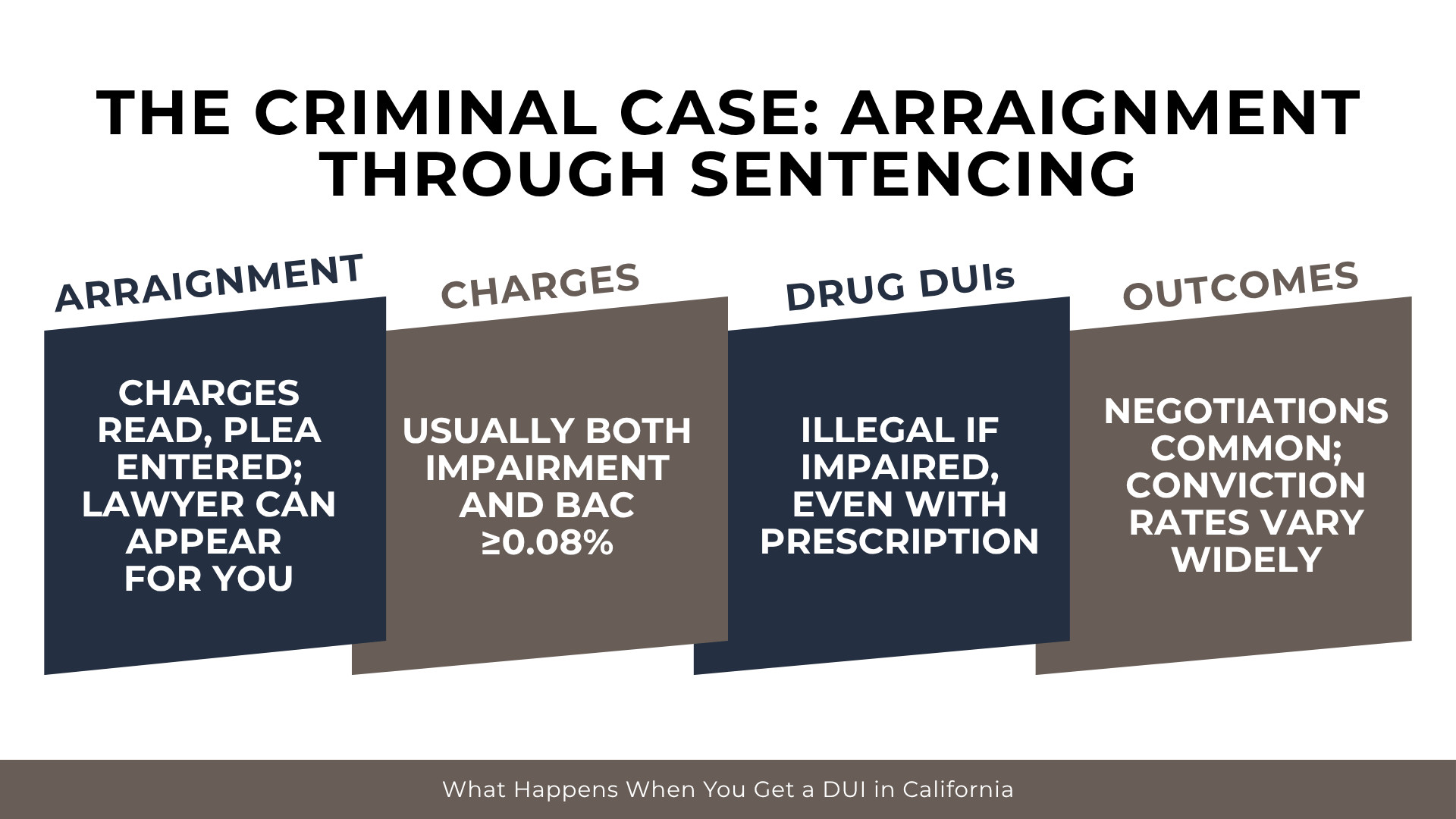
Your first court date is the arraignment, where you’re formally told the charges against you and asked to enter a plea. For a standard misdemeanor DUI, you don’t always need to appear personally — an attorney can appear on your behalf in most California courts.
The prosecution will typically charge you under two theories simultaneously. The first is California Vehicle Code § 23152(a), the impairment theory, which requires proving that alcohol or drugs impaired your ability to drive with the caution of a sober person exercising ordinary care. The second is § 23152(b), the per se theory, which requires only proof that your BAC was at or above 0.08% at the time you were driving — regardless of how impaired you appeared. Prosecutors charge both because either theory independently supports a conviction, though a conviction on both counts is treated as a single DUI offense for sentencing purposes.
If your arrest involved drugs rather than alcohol, the charge falls under § 23152(f), and combined alcohol-and-drug impairment is covered by § 23152(g). A prescription for the substance is not a defense — the question is whether it impaired your driving, not whether you had a legal right to take it.
Between arraignment and resolution, there’s usually a period of pre-trial negotiation. This is where the specifics of your case — the strength of the evidence, the circumstances of the stop, the BAC level, your history — shape the range of realistic outcomes.
The numbers give some perspective on how these cases resolve statewide. Approximately 68.9% of DUI arrests result in a DUI conviction. Among those convicted, about 7.9% were convicted of a “wet reckless” — an alcohol-related reckless driving plea that carries lighter penalties but still counts as a prior DUI offense if you’re arrested again. Roughly 20.5% of DUI arrests show no corresponding conviction on DMV records, a figure that has been gradually increasing over the past decade. Individual outcomes vary enormously depending on the facts of the case and the county where it’s prosecuted — conviction rates across California counties have historically ranged from 41% to nearly 92%.
Penalties for a First DUI in California
If this is your first DUI offense, here’s the realistic range of what you’re facing under California Vehicle Code § 23536.
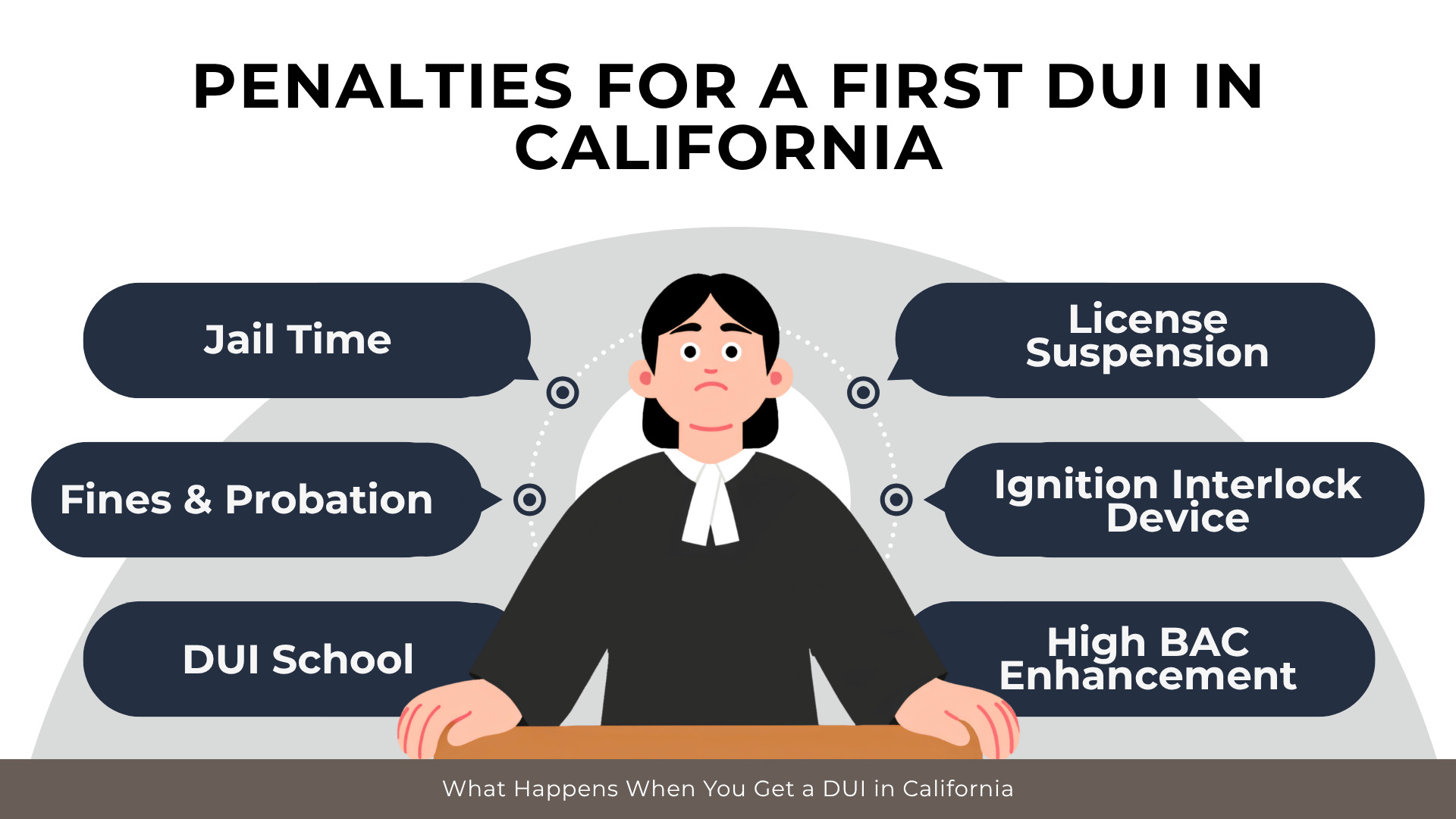
Jail time. The statutory range is 96 hours to 6 months in county jail, with a minimum of 48 continuous hours. In practice, jail time for a first offense is frequently minimal — many first offenders receive little to no actual time behind bars, particularly when granted probation. About 66.3% of first DUI offenders are sentenced to jail, though a sentence doesn’t always mean time served, as many are suspended or converted to alternatives.
Fines. The base fine ranges from $390 to $1,000. But that number is misleading on its own — California adds penalty assessments, court fees, and surcharges that push the actual amount you pay significantly higher. When you factor in fines, fees, insurance increases, DUI school costs, attorney fees, and lost wages, the California Office of Traffic Safety estimates the total cost of a first DUI at approximately $13,500.
Probation. This is nearly universal. Roughly 95.9% of convicted DUI offenders receive probation, which runs 3 to 5 years under Vehicle Code § 23600. DUI probation comes with a zero-tolerance alcohol condition — any measurable BAC while driving during your probation period is a separate violation.
DUI school. First offenders are typically required to complete a 3-month program. If your BAC was 0.20% or higher, Vehicle Code § 23538(b)(2) mandates a longer 9-month program.
License suspension. A court-ordered suspension of 6 months for a first conviction under Vehicle Code § 13352, running separately from any APS administrative suspension.
Ignition interlock device. Under California’s statewide IID program established by SB 1046, first offenders may be required to install an ignition interlock device. Installation rates have been climbing significantly — and many offenders install one voluntarily because it allows them to obtain a restricted license and keep driving.
High BAC enhancement. If your BAC was 0.15% or above, Vehicle Code § 23578 gives the court discretion to impose enhanced penalties. This is worth noting because the median BAC among convicted DUI offenders in California is 0.16% — double the legal limit — meaning a significant number of first offenders fall into this range.
Second, Third, and Felony DUI Penalties
California uses a 10-year lookback period measured from arrest date to arrest date. Any prior DUI within that window increases the penalties on a subsequent conviction.
Second DUI (Vehicle Code § 23540): 90 days to 1 year in county jail, $390–$1,000 in base fines, an 18- to 30-month DUI program, and a 2-year license suspension. 95.2% of repeat offenders are sentenced to jail, compared to 66.3% of first offenders. The completion rate for the longer DUI programs drops significantly — only about 42.1% of second offenders who enroll complete the program, compared to 83.9% of first offenders.
Third DUI (Vehicle Code § 23546): 120 days to 1 year in county jail, $390–$1,000 in base fines, a 30-month DUI program, and a 3-year license revocation.
Fourth or subsequent DUI within 10 years (Vehicle Code § 23550): this crosses into felony territory. Penalties include 16 months, 2 years, or 3 years in state prison, or 180 days to 1 year in county jail, plus $390–$1,000 in base fines and a 4-year license revocation.
Several factors can elevate penalties at any offense level. A BAC of 0.15% or above triggers discretionary enhancement under § 23578. Having a child under 14 in the vehicle adds mandatory consecutive jail time under § 23572 — 48 hours for a first offense, 10 days for a second, 30 days for a third, and 90 days for a fourth or more. This enhancement applies only to misdemeanor DUI and does not apply to wet reckless pleas or felony DUI. DUI causing injury to another person is charged under Vehicle Code § 23153 as a felony wobbler, with an additional 3 to 6 years possible under Penal Code § 12022.7 if the injury qualifies as great bodily injury.
At the extreme end, California courts have held since People v. Watson (1981) that driving under the influence with conscious disregard for human life constitutes implied malice sufficient to support a charge of second-degree murder. This is not theoretical — Watson murder charges are filed in DUI fatality cases, particularly where the driver has prior DUI convictions or had received prior warnings about the risks.
One additional point worth knowing: DUI offenses are categorically excluded from judicial diversion programs in California. Vehicle Code § 23640 expressly prohibits it, and recent appellate decisions in Grassi v. Superior Court (2021) and Tan v. Superior Court (2022) have confirmed this exclusion applies even under the broader misdemeanor diversion statute. Military diversion under Penal Code § 1001.80 remains available for qualifying veterans and active-duty service members.

Your Driving Privileges: Suspension, Restricted Licenses, and IID
Losing the ability to drive is often the most immediately disruptive consequence of a DUI. The system is confusing because multiple suspensions can overlap, so here’s how it works.
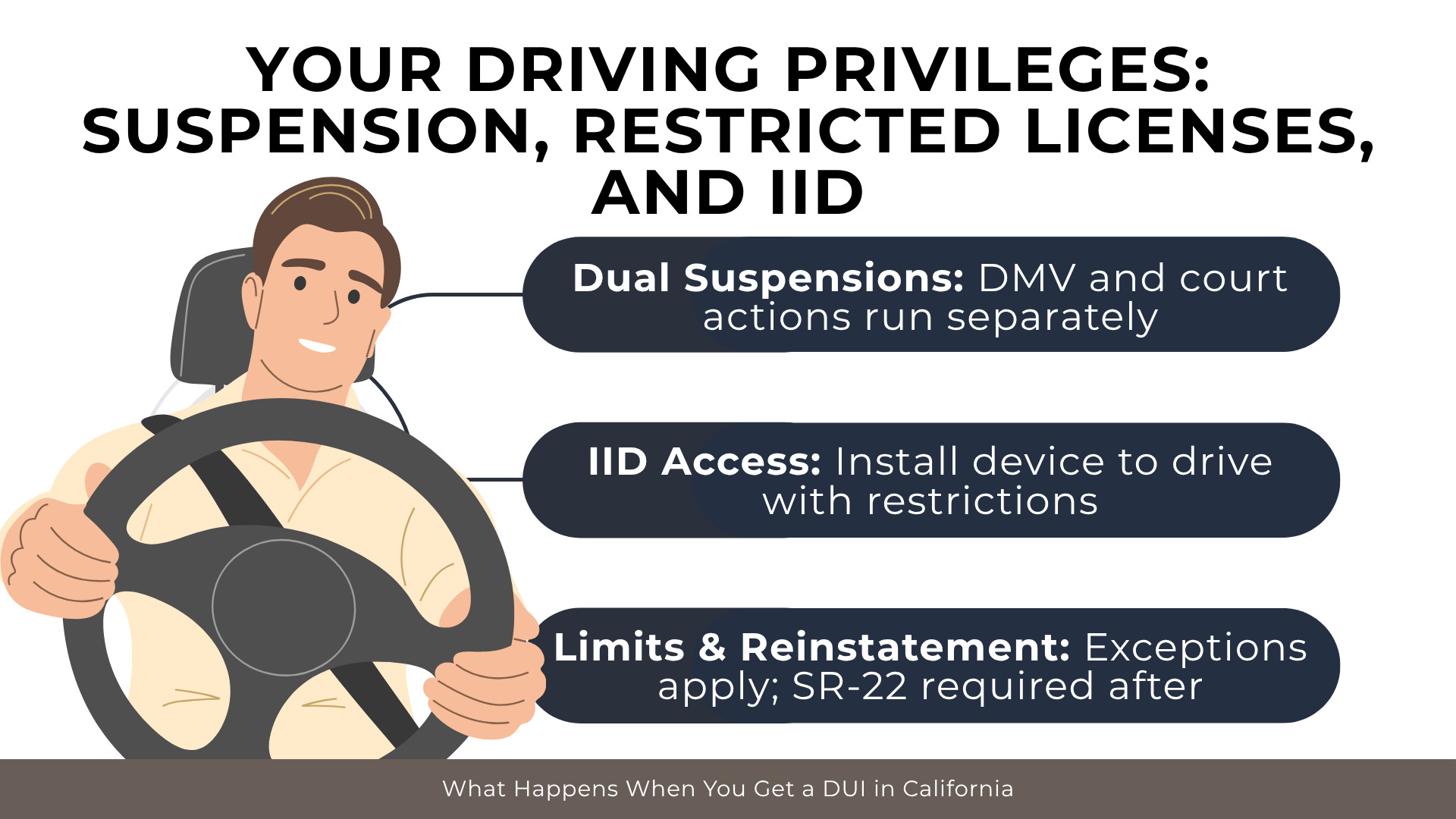
The APS administrative suspension (from the DMV) and the court-ordered suspension (from a conviction) are separate actions. For a first offense, the APS suspension is typically 4 months, while the court-ordered suspension under § 13352 is 6 months. These can run concurrently in some circumstances, but they operate on independent tracks — which is why total mandatory license actions in 2020 exceeded 157,000, combining both pre-conviction and post-conviction suspensions.
For most alcohol-related DUI offenders, the fastest path back behind the wheel is installing an ignition interlock device. The IID allows you to obtain a restricted license so you can drive to work, school, and other essential destinations while your suspension is in effect. The required IID period scales with offense history under Vehicle Code § 23575.3: 6 months for a first injury-related DUI, 12 months for a second offense, 24 months for a third, and 36 to 48 months for a fourth or more.
There are two important exceptions. If you refused the post-arrest chemical test, you are not eligible for a restricted license during your refusal suspension. And if your DUI involved only drugs with no alcohol component, you are not eligible for an IID-restricted license — the device only detects alcohol.
After your suspension period ends, reinstatement isn’t automatic. You’ll need to file an SR-22 certificate of financial responsibility with the DMV, which your insurance company provides. Under Vehicle Code § 13352.4, you’re required to maintain that SR-22 for 3 years. This filing typically results in substantially higher insurance premiums for that entire period.
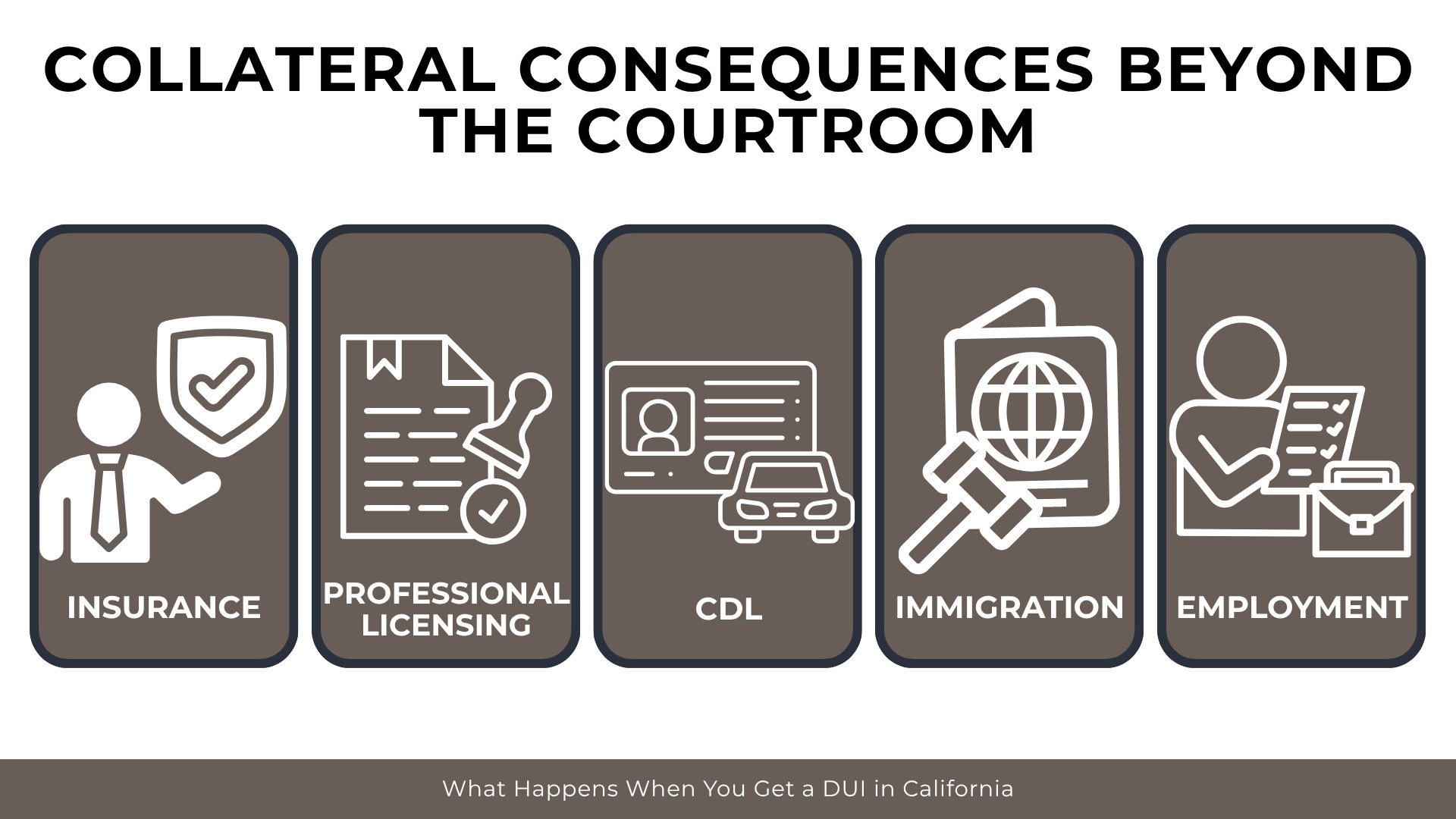
Collateral Consequences Beyond the Courtroom
The criminal penalties and license suspension are the official consequences. But for many people, it’s the ripple effects through the rest of their life that cause the most lasting disruption.
Insurance. Beyond the SR-22 filing requirement, a DUI conviction will significantly increase your insurance rates. This increase typically persists for several years and is one of the largest components of the total estimated $13,500 cost of a first DUI.
Professional licensing. If you hold a professional license, a DUI conviction may trigger mandatory self-reporting obligations. Physicians must report a conviction to their licensing board within 30 days under Business and Professions Code § 802.1. Attorneys must self-report felony charges under § 6068(o). Other licensed professionals — nurses, teachers, real estate agents, contractors — face their own board-specific reporting requirements and potential disciplinary action.
Commercial driver’s license. The consequences here are especially severe. Federal regulations under 49 C.F.R. § 383.51 require a one-year CDL disqualification for a first DUI offense. A second offense results in a lifetime CDL disqualification. For anyone whose livelihood depends on a CDL, a DUI can have career-ending consequences.
Immigration. A simple DUI is generally not considered a crime involving moral turpitude or an aggravated felony under federal immigration law — the Supreme Court addressed this in Leocal v. Ashcroft (2004), and the Board of Immigration Appeals held in Matter of Torres-Varela (2001) that simple DUI does not involve moral turpitude. However, multiple DUI convictions can raise a “habitual drunkard” bar to establishing good moral character for naturalization under INA § 101(f). And for DACA recipients, a single misdemeanor DUI is classified as a significant misdemeanor that bars eligibility. Anyone with immigration concerns should consult an immigration attorney in addition to a criminal defense lawyer.
Employment. A misdemeanor DUI will appear on background checks and can affect job applications, particularly for positions involving driving, security clearances, or working with vulnerable populations.
Defenses and How a DUI Lawyer Can Help
A DUI arrest is not a conviction. The gap between the two is where legal defense operates — and the data bears this out. With roughly 20% of DUI arrests resulting in no conviction and nearly 8% of convictions reduced to lesser charges, the outcome of a DUI case depends heavily on the facts and how they’re examined.
An experienced DUI attorney evaluates the case from the ground up. That starts with the traffic stop itself — whether the officer had the required reasonable suspicion to pull you over, and whether a checkpoint complied with the constitutional standards set out in Ingersoll v. Palmer, which require supervision by command personnel, neutral vehicle selection criteria, adequate safety measures, reasonable location, advance publicity, and minimal detention.
From there, the scrutiny moves to the investigation. Were field sobriety tests administered under proper conditions? Was the preliminary breath test handled correctly? Were you properly advised of your rights regarding voluntary and mandatory testing?
Chemical test evidence — often treated as the centerpiece of a DUI prosecution — has its own vulnerabilities. The per se DUI statute under § 23152(b) requires proof of your BAC at the time of driving, not at the time of testing. Because blood alcohol continues to rise after your last drink, a test taken 30 or 60 minutes after a stop may reflect a higher BAC than what was actually in your system while you were behind the wheel. This is the foundation of what’s known as the rising blood alcohol defense, recognized by the California Supreme Court in People v. McNeal (2009). Blood test challenges can also involve chain of custody issues, calibration records, and storage conditions.
If you were subjected to questioning after being taken into custody without receiving Miranda warnings, statements obtained during that interrogation may be suppressible. The legal line here is whether the encounter had transformed from a roadside detention — where Miranda doesn’t apply under Berkemer v. McCarty (1984) — into actual custody.
Every case is different. The strength of these defenses depends entirely on what happened during your specific stop, arrest, and testing. An attorney who regularly handles DUI cases in San Diego County courts will know how these issues play out locally — from how specific judges handle suppression motions to how county prosecutors approach plea negotiations.

What to Do Right Now
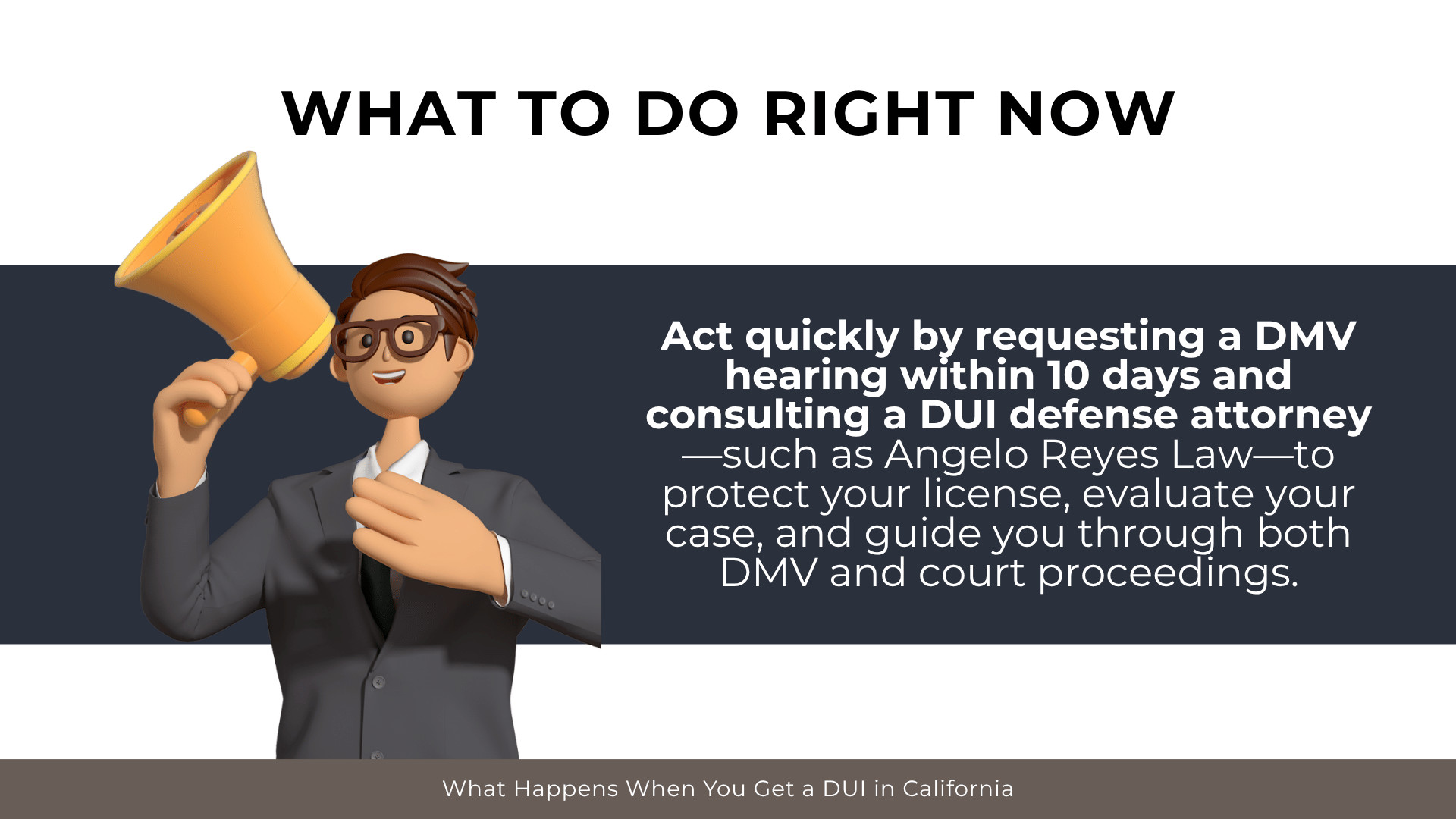
You have two immediate priorities. First, contact the DMV within 10 days of your arrest to request an Administrative Per Se hearing — this is the only way to contest the automatic suspension of your license. Second, consult with a DUI defense attorney who can evaluate the specific facts of your case and represent you in both the DMV hearing and the criminal proceedings.
Law Office of Angelo Reyes, APC, based in Carlsbad, represents clients facing DUI charges throughout San Diego County. Attorney Angelo J. Reyes is a courtroom advocate with extensive trial experience who prepares every matter for trial — recognized by the National Trial Lawyers as a Top 40 Under 40 attorney and admitted to the State Bar of California and the U.S. District Court for the Southern District of California.
If you or someone you care about was recently arrested for a DUI in California, the decisions you make in the next few days matter. Reach out for a consultation so you understand your options before any deadlines pass.