
A drug diversion program in California allows you to complete treatment or education instead of serving a criminal sentence if you are charged with a drug offense. If you finish the program successfully, the charge is dismissed. That is not a technicality or a loophole. It is a structured legal pathway written into California statute, available for qualifying drug offenses, and it results in the case being dropped from your criminal record.
Most people who first encounter the term don’t realize that “diversion” is not one program. California has three distinct tracks, each with different timing, different requirements, and different eligibility rules. Which one applies — and whether it’s offered at all — depends on how the charge is filed, what’s in your criminal history, and in many cases, how the defense presents the case to the prosecutor or judge. This article breaks down each program, who qualifies, what completion involves, and what happens to the charge afterward.
Which Diversion Programs Exist in California?
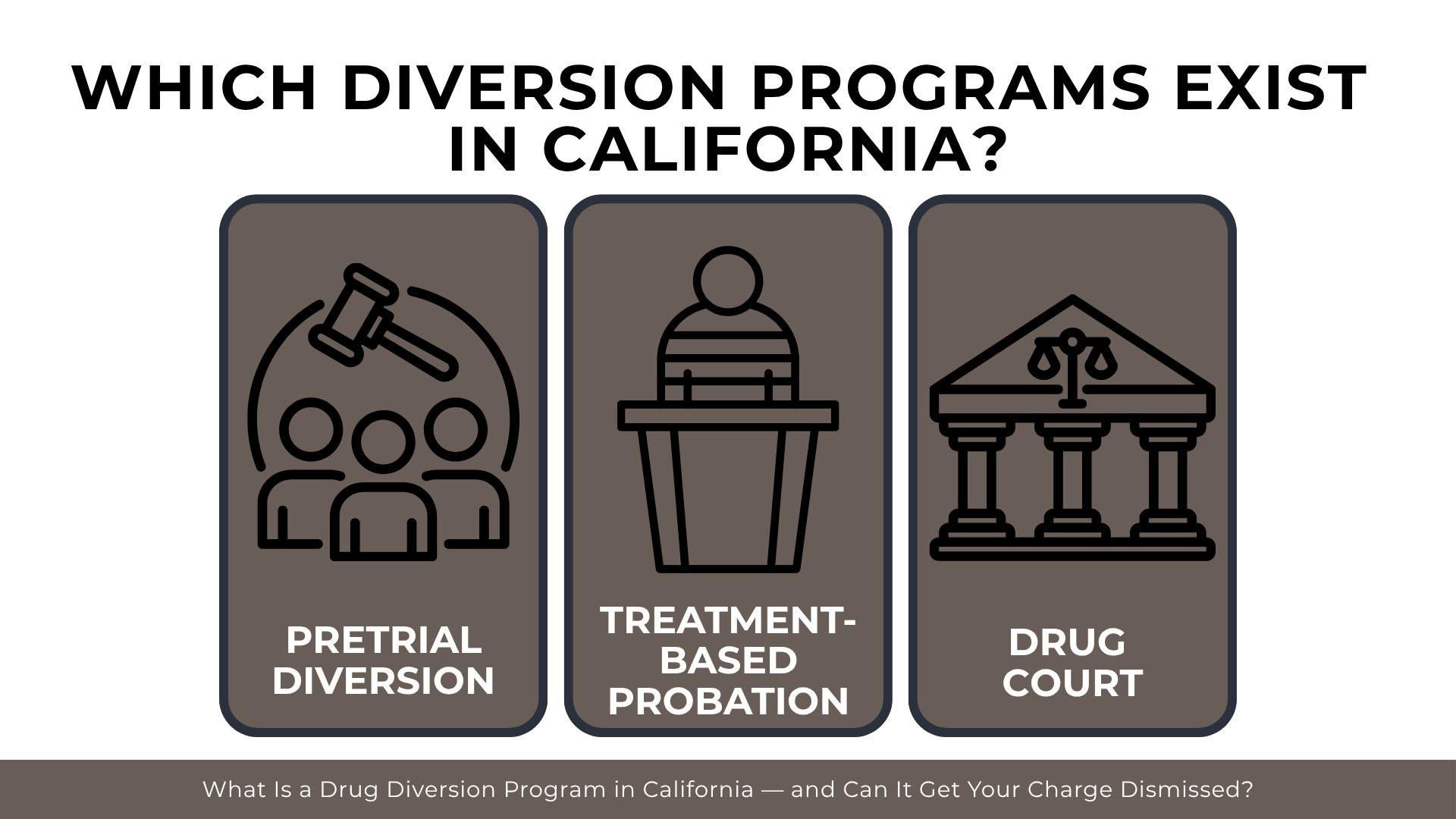
California law provides three main diversion tracks for drug offenses. They share a common destination — dismissal of the charge — but they work differently, and understanding the distinctions matters because not everyone qualifies for all three.
PC 1000 — Pretrial Diversion. This is the most common pathway for first-time, low-level drug charges. Under Penal Code § 1000 et seq., you enter a not-guilty plea and the charges are held in suspension while you complete a drug education or treatment program. The case never reaches a conviction. If the program is completed, the charges are dismissed. AB 208 restructured PC 1000 in 2017 to require only a not-guilty plea and a waiver of the speedy-trial clock. That change simplified entry into the program considerably.
Proposition 36 — Treatment-Based Probation. Enacted in 2000 as the Substance Abuse and Crime Prevention Act, Prop 36 operates under Penal Code §§ 1210 and 1210.1. Unlike PC 1000, this is a post-conviction track. You are convicted but sentenced to probation with required drug treatment instead of incarceration. Successful completion leads to dismissal of the conviction. Prop 36 was designed for people whose offenses are driven by addiction, and the treatment component is more intensive than the education courses typical of PC 1000.
Drug Court — PC 1000.5. Drug court is a collaborative court program under Penal Code § 1000.5. It involves regular judicial supervision, frequent drug testing, phased treatment programming, and ongoing court appearances before a dedicated drug court judge. It is the most structured of the three tracks and is typically reserved for people with more significant substance use issues or repeated contact with the system. The level of accountability is high, but so is the support — and the data reflects that. A statewide evaluation found that drug court participants who completed the program had an 85% reduction in arrests and a 77% reduction in convictions compared to those who did not complete it.
Each of these programs ends the same way if completed: the charge is dismissed. But entry into any of them is not automatic.
Do I Qualify for Drug Diversion?
Eligibility is the question that matters most, and the answer depends on two things: what the charge is and what your criminal history looks like.
The charge must be a nonviolent drug possession offense. California diversion programs are built for personal-use cases. Simple possession under Health & Safety Code § 11350 (narcotics) or § 11377 (non-narcotics such as methamphetamine) is the typical qualifying charge. Possession of drug paraphernalia also generally qualifies. What does not qualify — under any circumstances — is any charge involving sale, transportation, manufacturing, or possession while armed. Specifically, possession for sale under H&S Code § 11351, transportation under § 11352, manufacturing under § 11379.6, and armed possession under § 11370.1 are all excluded from diversion eligibility.
This distinction is critical because the line between “possession” and “possession for sale” is not always obvious, and it is not always drawn correctly. A charge filed as possession for sale rather than simple possession can shut the door on diversion entirely. That is why how the charge is filed is as important as what actually happened.
Criminal history creates additional barriers. Prop 36 diversion is unavailable if you have a prior strike conviction within five years or a prior non-drug felony within five years. Courts have enforced these exclusions strictly — a prior strike combined with a recent felony conviction, or even a nondrug-related felony within the lookback window, is enough to disqualify a defendant. The rationale is that diversion was not intended for people with serious, ongoing felony records in the period immediately preceding the drug offense.
The 2024 Prop 36 changes are shifting the diversion landscape. The new law created a “treatment-mandated felony” under Health and Safety Code § 11395 for repeat drug possession with two or more qualifying priors — restoring felony exposure that Proposition 47 had eliminated. What matters for diversion eligibility is that this new charge is itself treatment-oriented: defendants who complete court-ordered treatment have the felony dismissed, while those who fail face up to three years. If you are facing a repeat possession charge, the question is no longer just whether you qualify for traditional diversion under PC 1000 or Prop 36 probation — it is also whether the treatment-mandated felony pathway applies to your situation, and which track produces the best outcome.

What Happens During a Diversion Program?
The specifics vary by program, but every track requires active participation over an extended period — typically twelve to eighteen months, depending on the program and the county.
PC 1000 is the lightest lift. It usually involves completing a certified drug education course, which may run several months and include classes on substance use, decision-making, and community impact. Some counties also require community service or periodic check-ins. There is no ongoing judicial supervision.
Prop 36 treatment probation is more intensive. You are placed on probation and required to complete a drug treatment program. That program can include outpatient counseling, residential treatment, or a combination depending on how serious the substance use issues are. Regular drug testing is standard. Violations — missed sessions, failed tests, new arrests — can result in increasing consequences, and repeated violations can lead to revocation and resentencing.
Drug court is the most demanding track. Participants appear before a drug court judge on a regular schedule, sometimes weekly in the early phases. The program is structured in phases that increase in responsibility, each with its own benchmarks for attendance, testing, and treatment participation. The tradeoff for this level of oversight is that drug court provides the most direct support, the most structured accountability, and — based on available outcome data — the strongest long-term results.
Across all three programs, the core expectation is the same: show up, stay compliant, and complete what is asked. The programs are not easy, but they are finite. And they end with dismissal.

What Happens to My Record If I Complete the Program?
Successful completion results in dismissal of the original charge. For PC 1000, the charges that were held in suspension are formally dismissed. For Prop 36, the conviction that was entered at sentencing is set aside and the case is dismissed. For drug court under PC 1000.5, the same dismissal mechanism applies.
A dismissed charge generally does not appear on standard criminal background checks, and the arrest record can typically be sealed. For most purposes — employment applications, housing, education — a completed diversion means the case does not follow you forward.
But “dismissed” does not mean “erased for every purpose,” and there are exceptions serious enough to require specific attention.
Immigration consequences are the most significant. A controlled-substance offense can trigger deportability under 8 U.S.C. § 1227(a)(2)(B)(i), and California expungement under Penal Code § 1203.4 generally does not eliminate a conviction for federal immigration purposes. That is precisely why the type of diversion matters. PC 1000 pretrial diversion — which requires only a not-guilty plea — avoids the immigration exposure that comes with any program requiring a guilty plea or conviction. If you have immigration exposure, the choice between diversion tracks is not just a procedural question — it can determine whether the case triggers removal proceedings.
Firearm restrictions also survive in certain circumstances. A prior felony drug conviction triggers a lifetime firearm prohibition under Penal Code § 29800, and a Prop 47 reclassification from felony to misdemeanor does not restore firearm rights for the original felony.
None of this diminishes the value of diversion — dismissal is by far the best outcome available for a qualifying drug charge. But the exceptions mean that a blanket assurance of “it’ll all go away” can be misleading, and the analysis of these additional consequences needs to happen before the program begins, not after it ends.

Talk to a Defense Attorney About Your Diversion Options
Whether diversion is available in a given case depends on how the charge is filed, what the person’s record looks like, and which program fits the circumstances — questions that require case-specific legal analysis, not general reading. Angelo Reyes Law, based in Carlsbad, California, handles drug offense cases across San Diego County, including cases where identifying and securing the right diversion pathway is the central objective. Attorney Angelo Reyes works directly with every client and prepares every case as if it is going to trial, building leverage whether the matter resolves through negotiation or at trial.
If you or someone you know is facing a drug charge in California and wants to understand whether a diversion program applies, contact Angelo Reyes Law for a consultation.
