
Deferred entry of judgment was a California program that allowed people charged with certain drug offenses to complete a treatment or education program and have the charge dismissed — without a conviction ever appearing on their record. If you’re searching for this term now, what you need to know is that the program has changed. In 2017, California replaced deferred entry of judgment with a stronger version of the same concept: pretrial drug diversion under Penal Code § 1000. The goal is the same — complete a program, get the case dismissed — but the new structure removes a serious risk that existed under the old one.
This page covers how the original program worked, why it was replaced, who qualifies for the current version, what the program requires, what happens to your record afterward, and what happens if you don’t finish.
How Did DEJ Work, and Why Did California Replace It?
The key to understanding the change is what AB 208 did in 2017. Before that law took effect, Penal Code § 1000 operated as a deferred entry of judgment program — one that required a guilty plea. AB 208 restructured Penal Code § 1000 to require only a not-guilty plea and a waiver of time. Under the current system, charges are put on hold while you participate in diversion. No guilty plea is ever entered.
That change matters because, under the old structure, a guilty plea existed on the record during the program. For immigration purposes, a guilty plea to a controlled substance offense can trigger deportability under 8 U.S.C. § 1227(a)(2)(B)(i). Federal immigration authorities are not required to wait for a state court to decide whether judgment will ultimately be entered. The Supreme Court held in Padilla v. Kentucky, 559 U.S. 356 (2010), that defense counsel has a constitutional obligation to advise a client about the deportation consequences of a guilty plea. Beyond immigration, employers running background checks, licensing boards reviewing applications, and housing authorities screening tenants could all potentially see that open guilty plea during the diversion period.
The current pretrial diversion system eliminates that exposure entirely. If you’re reading about “deferred entry of judgment” because someone mentioned it in connection with your case, the program you’re actually looking at is this current version of PC 1000 pretrial diversion.
Do I Qualify for Pretrial Drug Diversion Under PC 1000?
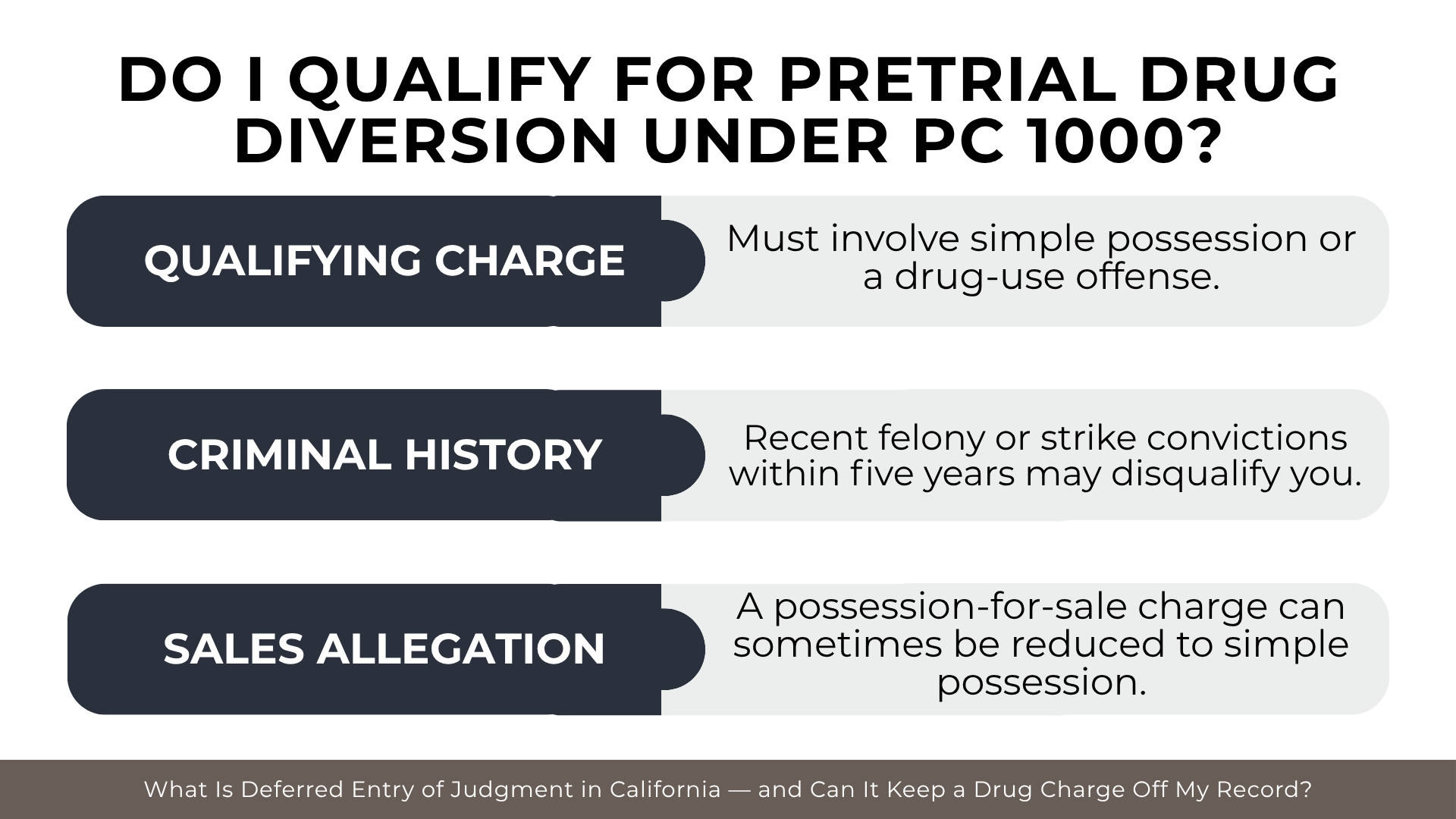
Eligibility depends on what you’re charged with and your criminal history.
The charge must be for simple possession or a use-related drug offense. Penal Code § 1000 et seq. sets the boundaries. The following offenses are automatically excluded from diversion: possession for sale under Health & Safety Code § 11351, transportation or sale under Health & Safety Code § 11352, manufacturing under Health & Safety Code § 11379.6, and possession while armed under Health & Safety Code § 11370.1. Prior strike convictions within five years and prior felonies within five years can also disqualify you.
The distinction between simple possession and possession for sale is often where eligibility disputes arise. Possession for sale is a separate felony that requires proof of specific intent to sell — an element proven through circumstantial evidence, not a statutory weight threshold. There is no automatic line. Under People v. Parra (1999) 70 Cal. App. 4th 222, experienced officers may offer an opinion that drugs were possessed for sale, but that opinion is not the final word. The prosecution still bears the full burden of proving intent beyond a reasonable doubt.
This matters for diversion because a charge of possession for sale does not necessarily mean the evidence supports it. If a defense attorney can challenge the sales allegation and secure a reduction to simple possession, the door to PC 1000 diversion opens. That charge-level fight — which happens before the diversion question is even reached — is frequently the most consequential step in the case.
What Happens During the Program — and How Long Does It Take?
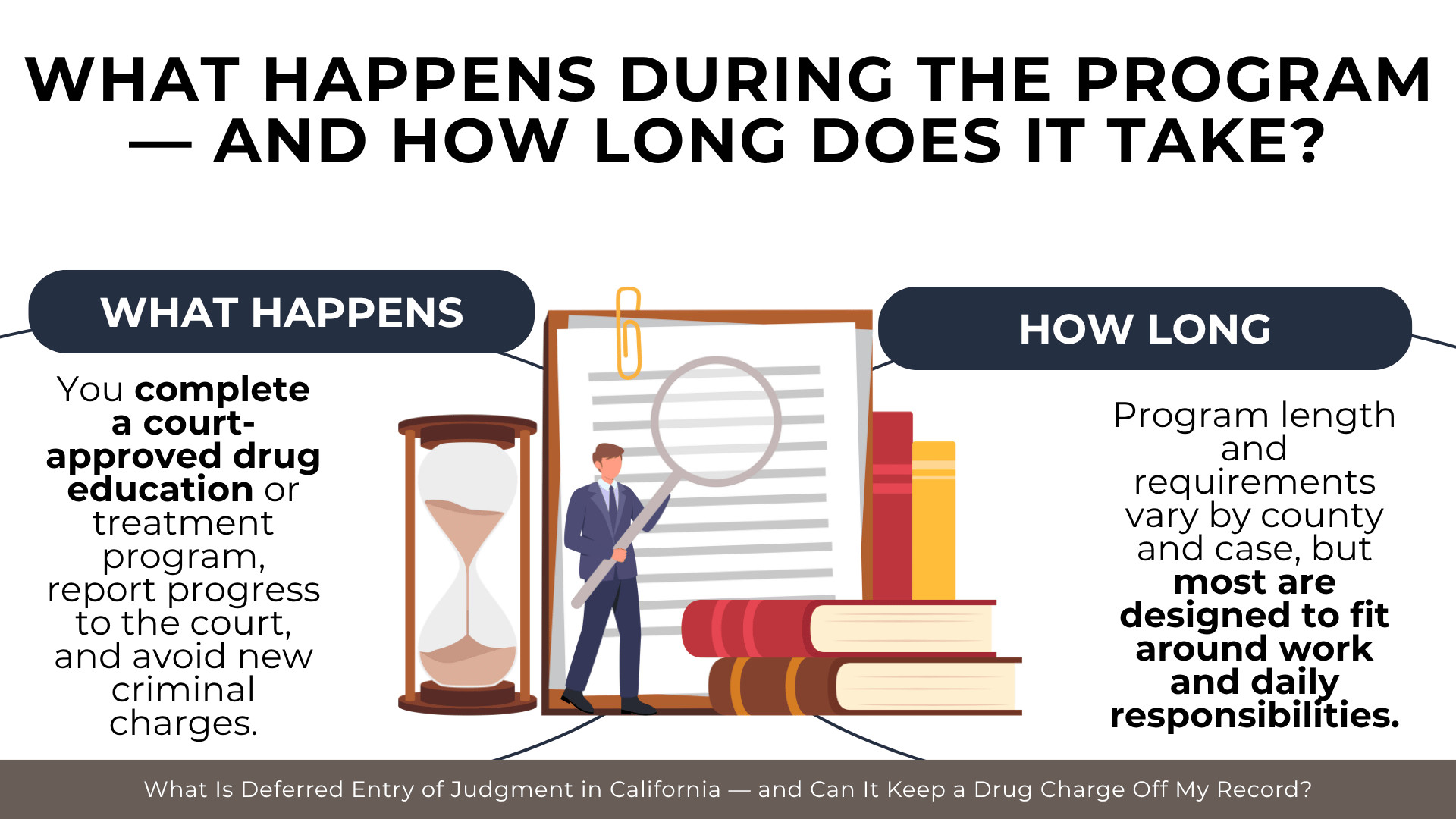
During the diversion period, you participate in an approved drug education or treatment program. You report progress to the court and avoid any new criminal arrests or charges. The specific program requirements and timeline vary by county and by the court’s assessment of your case. Some participants are placed in outpatient education courses that meet a few hours per week. Others may be directed toward more intensive treatment depending on the circumstances.
For most people, the program is designed to be manageable alongside work and daily responsibilities. It is not incarceration. It is not residential treatment, unless the court specifically orders it in unusual circumstances. And it does not require you to stop working or upend your life. The obligation is real, but it is structured to be completable.
What Happens to My Record If I Complete the Program?
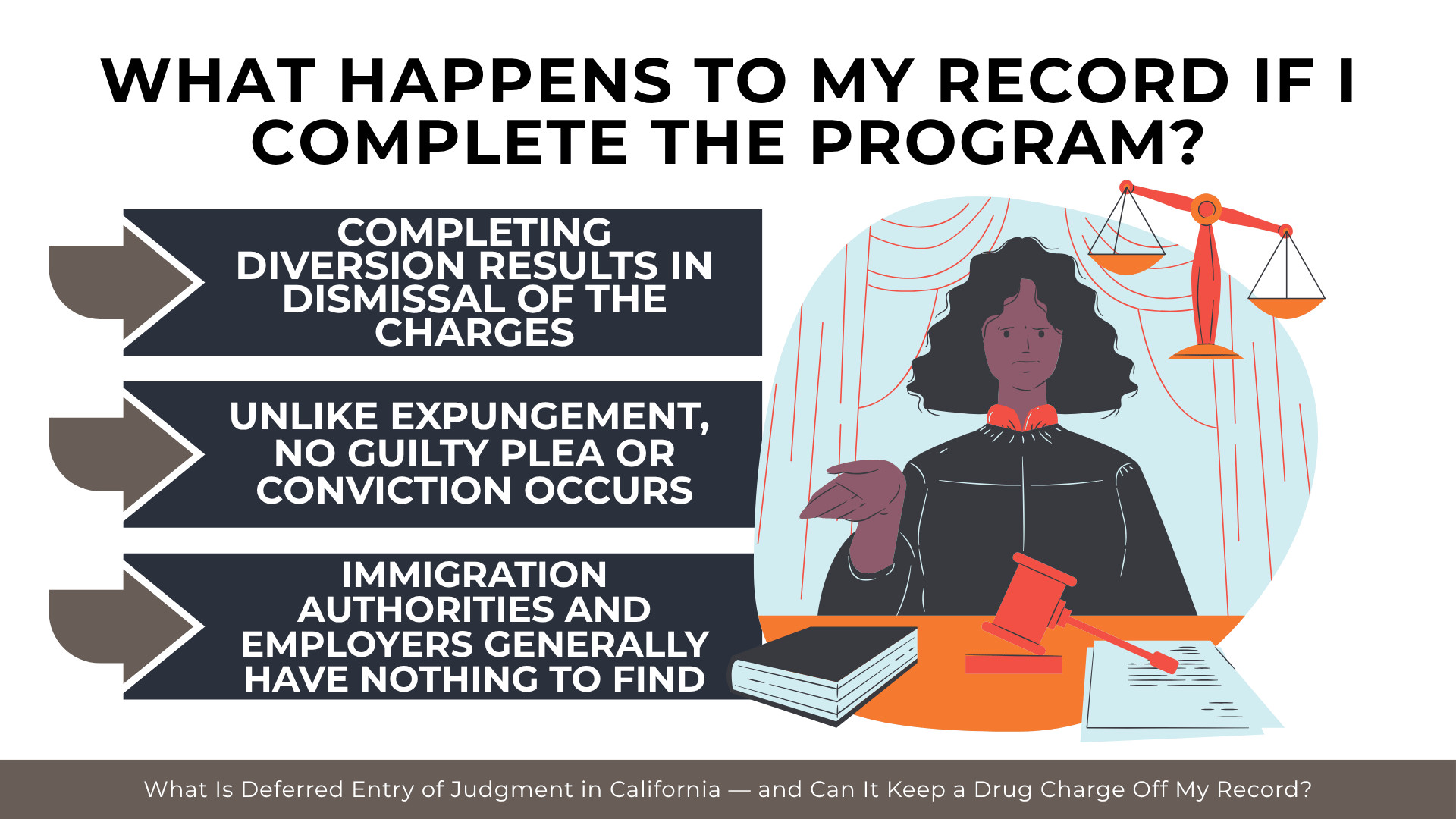
This is usually the first question — and the answer is the reason diversion exists. After successful completion, the charges are dismissed under Penal Code § 1000 et seq., and the arrest is deemed not to have occurred for most purposes.
That outcome is fundamentally different from — and stronger than — an expungement under Penal Code § 1203.4. Expungement applies after a conviction has already been entered; it withdraws the guilty plea and dismisses the case, but the conviction still existed. Some agencies and background-check systems can still see it. For federal immigration purposes, a conviction that has been expunged under § 1203.4 may still be treated as a conviction. The Board of Immigration Appeals held in In re Roldan-Santoyo, 22 I. & N. Dec. 512 (1999), that California expungement does not eliminate a conviction for purposes of federal immigration law.
Pretrial diversion avoids that problem entirely. Because no guilty plea is ever entered and no conviction ever occurs, there is nothing for immigration authorities, employers, or licensing boards to find. The case was filed, it was diverted, and it was dismissed. For anyone concerned about the long-term consequences of a drug charge — particularly non-citizens navigating where criminal and immigration law overlap — that distinction is significant.
What Happens If I Don’t Finish — or Pick Up a New Case?
Under the old DEJ framework, because a guilty plea had been entered, failing the program meant that plea could be converted into a conviction.
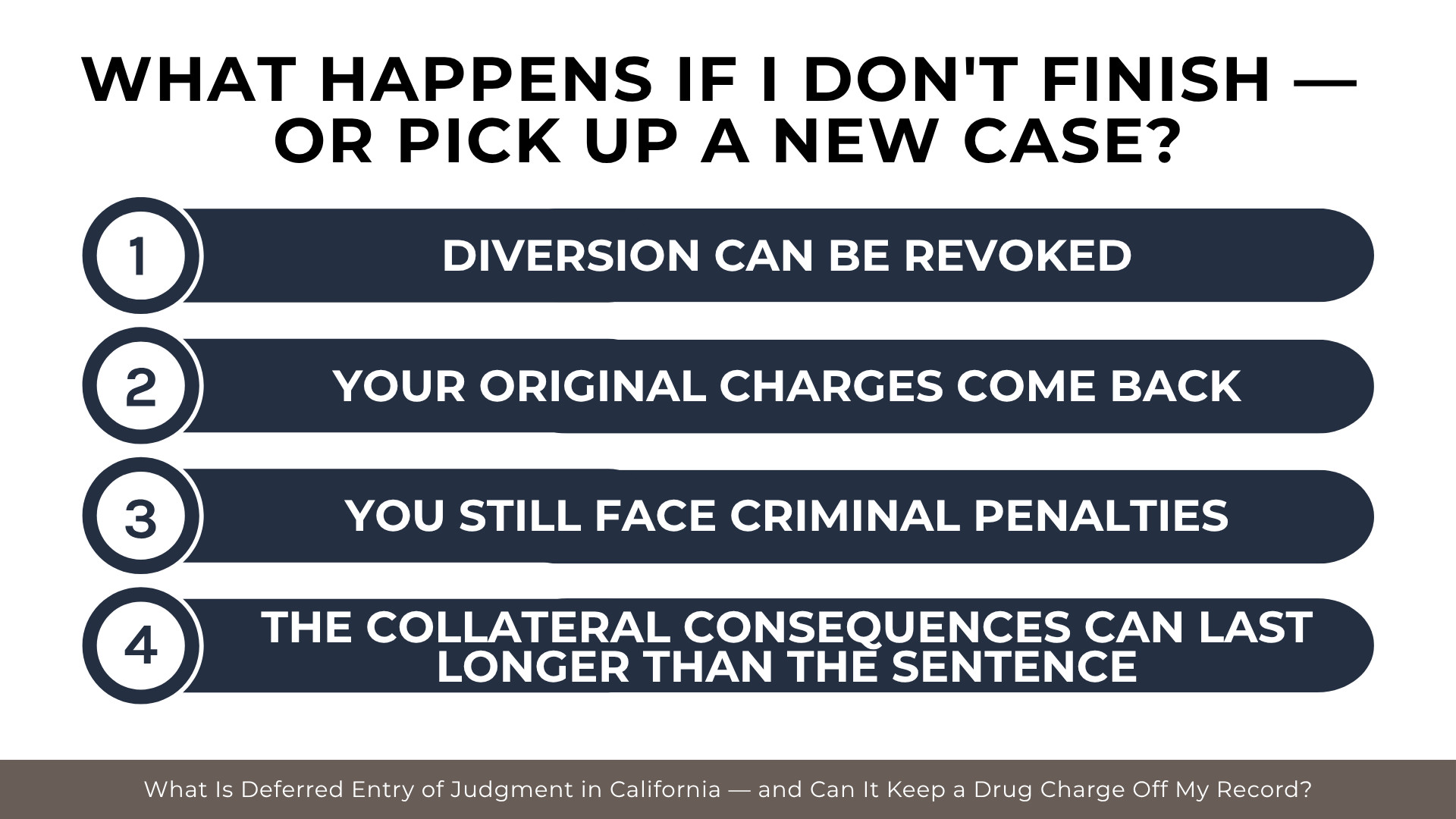
Under the current pretrial diversion structure, the consequence is different but still serious. Because no guilty plea was entered, there is no plea to convert into a conviction. Instead, the diversion is revoked, and the case resumes from where it left off. The prosecution moves forward on the original charges, and you face the same exposure you would have faced had diversion never been granted.
What that exposure looks like depends on the charge. Post-Proposition 47, simple possession under Health & Safety Code § 11350 is generally a misdemeanor. Statewide data show that the most common sentence for a California felony conviction is probation with jail — not a prison term — and approximately 3% of California’s state prison population in 2025 was imprisoned for drug crimes.
But the sentence is rarely the most lasting consequence. A drug conviction — even a misdemeanor — can trigger deportability for non-citizens under 8 U.S.C. § 1227(a)(2)(B)(i). It can result in a lifetime firearm prohibition under California Penal Code § 29800 if the underlying offense was a felony. And it can create barriers to housing, since federal regulations under 24 C.F.R. § 982.553 allow public housing authorities to deny or terminate assistance based on criminal history. These indirect consequences frequently outlive the criminal sentence itself and, in many cases, survive expungement.
Failing diversion is not the end of a case, and it does not automatically mean the worst outcome. But it does mean giving up the cleanest available path to dismissal.
Why Does It Matter Who Represents You in a San Diego Drug Diversion Case?
Eligibility for PC 1000 diversion is not always straightforward, and it is not always uncontested. The prosecution can argue that the evidence supports a possession-for-sale charge rather than simple possession, which would disqualify you entirely. Prior criminal history can create eligibility disputes. And in San Diego County specifically, the local District Attorney’s office has shown an aggressive approach on drug-offense filings — early implementation data on recently enacted felony drug statutes shows that in San Diego and Orange counties, more than 80% of felony filings under those statutes are drug-related, well above the statewide average.
At Angelo Reyes Law in Carlsbad, every case is prepared as if it’s going to jury — even when the goal is diversion. That approach strengthens your position. When the prosecution knows the defense has built a trial-ready case, negotiations over charge reductions and diversion eligibility can happen on stronger footing. Angelo Reyes handles criminal defense cases directly — clients work with him, not a paralegal or associate. His experience across thousands of criminal cases in San Diego County includes drug offenses ranging from simple possession to felony strike exposures where charges were reduced to simple misdemeanors.
If you or someone close to you is facing a drug charge in the San Diego area and wants to know whether diversion is an option, the next step is a consultation. That consultation will evaluate the specific charges, the evidence, and the available pathways. The earlier that conversation happens, the more options remain on the table.