
Possession of a controlled substance is a criminal charge meaning that a person knowingly had an illegal drug in their custody or control. In California, it is one of the most commonly charged drug offenses. If you’re reading this because you or someone close to you is facing this charge, the first thing worth knowing is that it is generally a misdemeanor, not a felony. The law also provides specific grounds to fight it.
That said, the specifics matter enormously. Whether the charge stays a misdemeanor or becomes a felony depends on your prior record and recent changes in California law. And regardless of the charge level, what the prosecution must actually prove to convict is more demanding than most people expect. This page breaks down the penalties you’re facing and the elements prosecutors must prove — because understanding both is what puts you in a position to make informed decisions about your case.
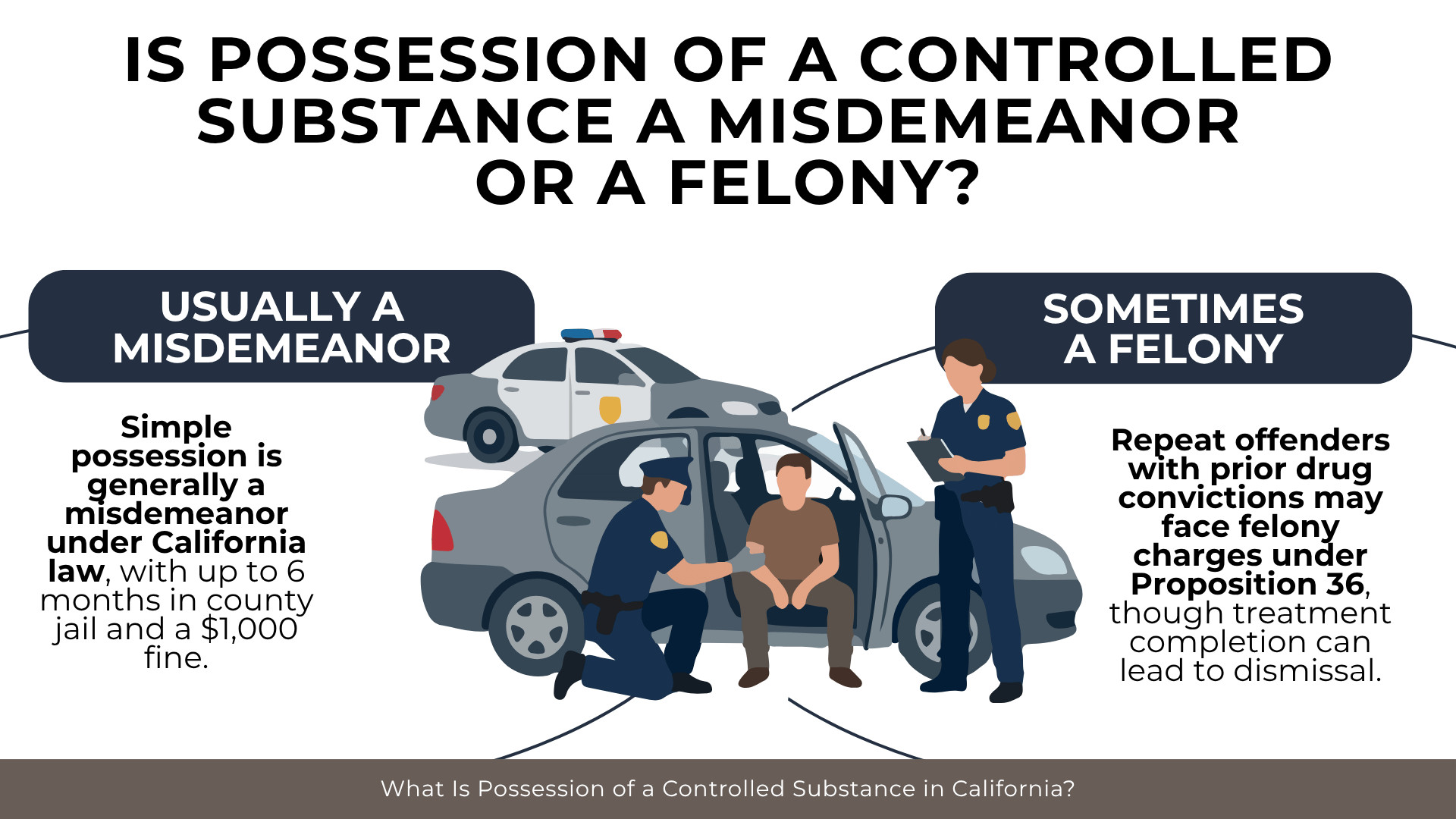
Is Possession of a Controlled Substance a Misdemeanor or a Felony?
For most people, this is the most urgent question — and the answer, for the majority of simple possession cases, is that it’s a misdemeanor.
Proposition 47, passed by California voters in November 2014, reclassified simple possession under HSC § 11350 (narcotics like heroin, cocaine, and opioids) and HSC § 11377 (non-narcotics like methamphetamine) from felonies to misdemeanors. The penalty is up to six months in county jail under Penal Code § 19 and a fine of up to $1,000. Felony exposure — 16 months, 2 years, or 3 years in state prison — applies only to defendants with prior “super-strike” convictions under Penal Code § 667(e)(2)(C)(iv) or those required to register as sex offenders under Penal Code § 290.
There is a recent and significant change. Proposition 36, the Homelessness, Drug Addiction, and Theft Reduction Act, passed in November 2024 and took effect December 18, 2024. It created a new “wobbler” offense under HSC § 11395 for possession of hard drugs by a person with two or more prior drug-related convictions. This means simple possession can once again be charged as a felony for repeat offenders. But there is a critical feature: defendants who complete the court-ordered treatment program have the felony dismissed. Those who fail treatment face up to three years in state prison or county jail. Early data show roughly 1,900 Prop 36 drug felonies were filed in the first two months of implementation, and charging patterns vary widely by county — in San Diego and Orange County, over 80% of Prop 36 felony filings are drug-related, while in Alameda and Sacramento, fewer than 20% are.
Even where possession is charged as a felony, state prison is far from automatic. Only about 19.7% of drug-offense felony convictions in California resulted in state prison in 2023 — the most common sentence is probation with jail time.
What Does the Prosecution Actually Have to Prove?
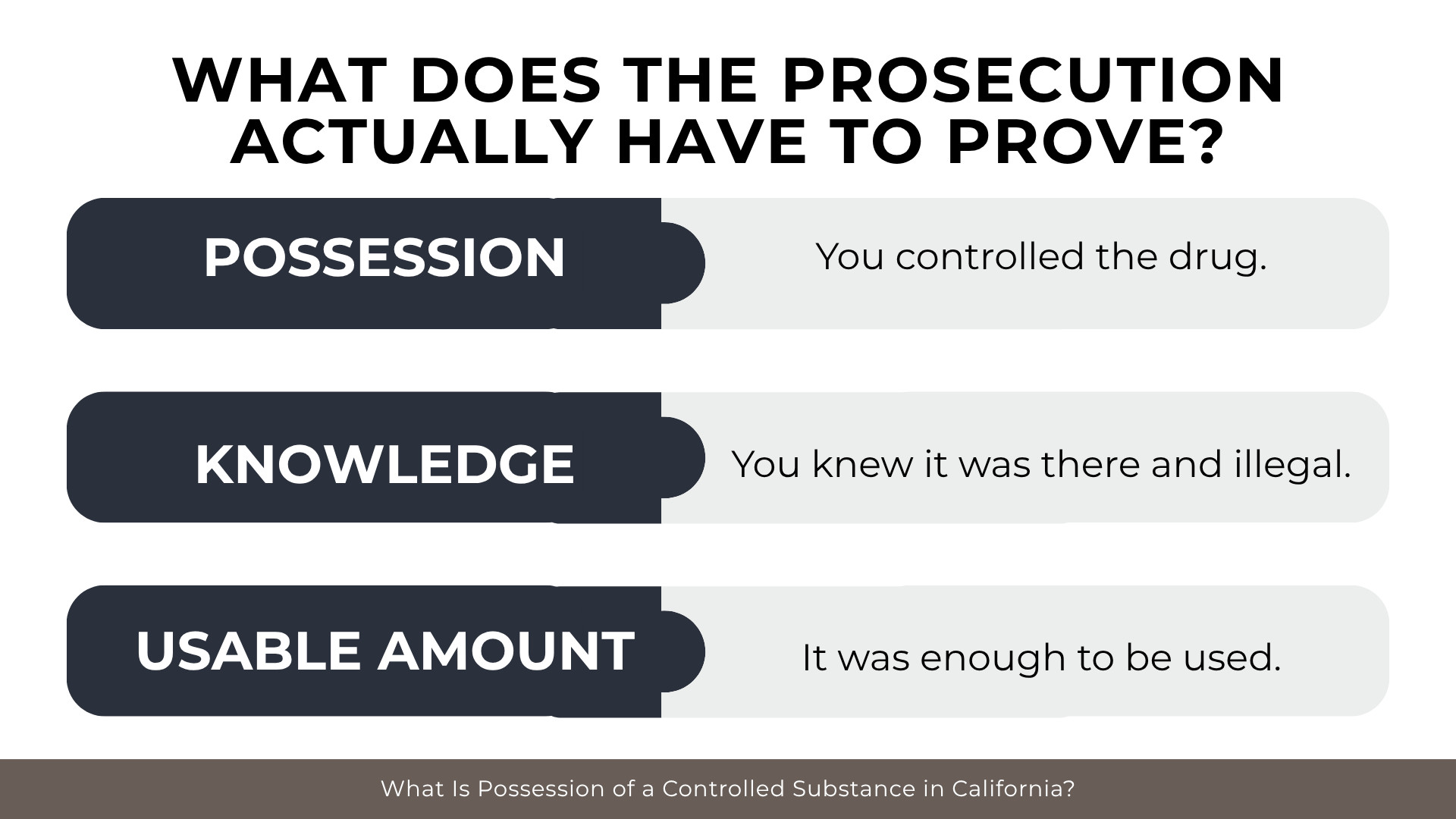
A possession charge is not self-proving. To convict, prosecutors must prove three elements beyond a reasonable doubt.
Dominion and control. You must have had actual or constructive possession of the substance. Actual possession means it was on your person. Constructive possession means it was in a place you controlled — a car, a bag, a room — and you had the ability to control it. The California Supreme Court held in People v. Williams (1971) that presence alone near drugs, such as being a passenger in a vehicle where drugs are found, is not enough. The prosecution must show possession along with knowledge, not just proximity.
Knowledge. You must have known both that the substance was there and that it was a controlled substance. As the court stated in People v. Rubacalba (1993), the real test is whether the defendant was aware of the presence of the narcotic. If someone slips something into your bag without your knowledge, the knowledge element isn’t met.
Usable quantity. The amount must be enough to actually be used as a drug. The California Supreme Court established this rule in People v. Leal (1966), holding that a tiny crystalline residue of narcotic useless for either sale or consumption is not enough evidence to support a conviction. But the threshold is lower than many people assume. Rubacalba clarified that the usable-quantity rule only bars conviction where the substance simply cannot be used, such as a blackened residue or useless trace. It does not need to be pure, and no particular purity or narcotic effect must be proven.
There are also recognized defenses beyond challenging these elements. Momentary or transitory possession only to dispose of the drug is a defense, as established in People v. Mijares (1971). And a valid prescription from a licensed practitioner removes the unlawfulness element entirely under HSC § 11350(a).
What Should You Do After Being Charged With Possession?
Roughly 75% of California felony cases resolve through guilty pleas, and fewer than 3% go to trial. That means in most cases, the outcome depends on what happens during negotiation. The factors that matter most are the strength of the defense theory, the credibility of any suppression motion, and whether the attorney has genuinely prepared for trial or is simply processing a plea.
Angelo Reyes Law, based in Carlsbad and serving San Diego County, takes a trial-first approach to every case. Clients work directly with Angelo — not a paralegal or associate — and every case is built as if it’s going to a jury, because that preparation is what creates leverage in negotiation. His track record includes a 25-to-life case dismissed, attempted murder reduced to battery, multiple DUI and grand theft dismissals, and felony strike exposures reduced to simple misdemeanors.
If you or someone you care about is facing a possession charge, the most important thing you can do right now is talk to a defense attorney before making any decisions about a plea. The earlier your lawyer is involved, the more options remain open — including charge reduction and challenging the evidence before it ever reaches a courtroom.
