Simple possession means having a controlled substance for personal use — not for sale, not for distribution, just having it on you or within your reach. Under California law, it is generally a misdemeanor, but the charge still triggers consequences that extend far beyond the criminal sentence. This page covers exactly what prosecutors have to prove, what penalties you’re actually facing, and what defenses apply.
What Does “Simple Possession” Actually Mean in California?
California prosecutes simple possession under two statutes. Health and Safety Code § 11350 covers narcotics and controlled substances listed in Schedules III through V. That includes drugs like heroin, cocaine, and prescription opioids possessed without a valid prescription. Health and Safety Code § 11377 covers non-narcotic controlled substances in the same schedule range, most commonly methamphetamine.
To convict you of simple possession, the prosecution must prove three elements. First, you had dominion and control over the substance. That means either physical possession (it was on your body, in your hand, in a pocket) or constructive possession (it was in a place you controlled, like a car or a bedroom). The California Supreme Court established in People v. Williams (1971) 5 Cal.3d 211 that simply being present near drugs is not enough. The prosecution must show possession combined with knowledge, not merely proximity.
Second, you knew the substance was there and knew it was a controlled substance. As the court stated in People v. Rubacalba (1993) 6 Cal.4th 62, the real test is the defendant’s awareness of the narcotic’s presence.
Third, the substance must have been a “usable quantity” — more than a trace or residue. This rule comes from People v. Leal (1966) 64 Cal.2d 504. The California Supreme Court held that a tiny crystalline residue useless for consumption or sale cannot support a possession conviction. The substance doesn’t need to be pure, and no particular potency has to be proven, but it has to be something a person could actually use.
The distinction that matters most at this stage is between simple possession and possession for sale. Possession for sale — charged under H&S Code § 11351 — requires the same three elements plus a specific intent to sell. Prosecutors prove that intent through circumstantial evidence: quantity, packaging in individual baggies or bindles, scales, pay-owe ledgers, large amounts of cash, multiple phones, and the absence of personal-use paraphernalia. If none of those indicators are present and the quantity is consistent with personal use, the charge should be simple possession. That distinction is the difference between a misdemeanor and a straight felony carrying two, three, or four years in custody.

Is Simple Possession a Felony or a Misdemeanor?
For the vast majority of people, simple possession is a misdemeanor. That changed in 2014 when California voters passed Proposition 47, which downgraded H&S Code §§ 11350 and 11377 from felonies to straight misdemeanors. The maximum penalty is up to six months in county jail under Penal Code § 19 and/or a fine of up to $1,000.
Felony risk still exists, but only in narrow circumstances. If you have a prior “super strike” conviction listed in Penal Code § 667(e)(2)(C)(iv), simple possession can still be charged as a felony. The same is true if you are required to register as a sex offender under Penal Code § 290(c). In either case, the sentence is 16 months, two years, or three years.
There is also a newer law to be aware of. The 2024 Proposition 36 (effective December 18, 2024) created Health and Safety Code § 11395 — a “treatment-mandated felony” for possession of certain hard drugs by someone with two or more qualifying prior drug convictions. If you complete the court-ordered treatment program, the felony is dismissed; if you fail, you face up to three years. Our page on California drug sentencing guidelines covers the details of Prop 36’s impact on sentencing and county-level variation.
If you are facing a first-time simple possession charge with no serious criminal history, the charge is almost certainly a misdemeanor. But “misdemeanor” does not mean the charge can be ignored, which is why knowing the available defenses matters.

What Defenses Can Beat a Simple Possession Charge?
Because the prosecution must prove each of the three elements beyond a reasonable doubt, a defense can succeed by weakening any one of them.
No usable quantity. Under People v. Leal (1966) 64 Cal.2d 504, trace residue or amounts that simply cannot be used do not constitute possession. The prosecution must also prove through competent evidence — not assumption — that the substance is a controlled substance under People v. Davis (2013) 57 Cal.4th 353.
No knowledge or control. If you did not know the substance was present, the knowledge element fails. If you had no dominion or control — such as in a shared car or borrowed bag — the possession element fails. These defenses are especially strong in constructive-possession scenarios, which our page on constructive possession of drugs in California covers in detail.
Transitory possession. Under People v. Mijares (1971) 6 Cal.3d 415, momentary possession solely to dispose of the substance is a recognized defense.
Valid prescription. If the controlled substance was lawfully prescribed by a licensed practitioner, the possession is not unlawful under H&S Code § 11350(a). This comes up frequently with prescription opioids, benzodiazepines, and other Schedule III–V medications.
Unlawful search and seizure. Under Penal Code § 1538.5, evidence obtained through an unconstitutional search — a stop without reasonable suspicion, a warrantless search without a valid exception, or an unlawfully prolonged detention — can be suppressed. If the physical evidence is thrown out, the prosecution’s case collapses. Our page on how to beat a simple possession charge walks through the specific search-and-seizure rules that apply in drug cases.
Which defenses apply depends entirely on the facts — how the drugs were found, where they were, who else was present, what the police did and didn’t do. The details of the arrest matter enormously. An attorney who examines those details from the start, rather than defaulting to a quick plea, makes a real difference.

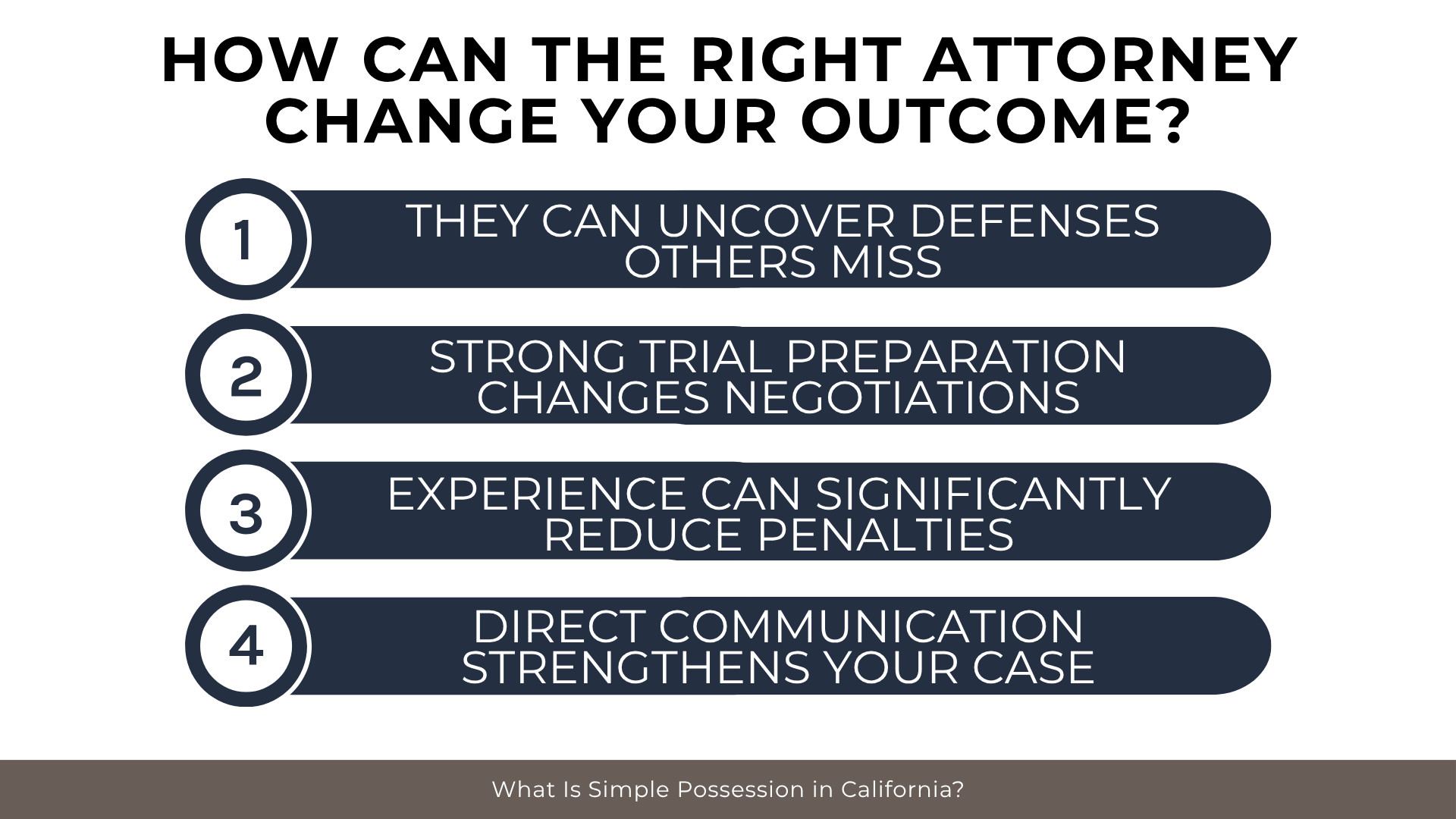
How Can the Right Attorney Change Your Outcome?
The gap between a conviction and a dismissal in a simple possession case is rarely about the facts alone. It’s about whether someone identifies the right defense, files the right motion, and negotiates from a position of genuine trial readiness.
At Angelo Reyes Law in Carlsbad, California, every case is prepared as if it’s going to a jury — because that preparation is what creates real leverage whether the case resolves through negotiation or at trial. Angelo J. Reyes is a trial attorney licensed in California and Washington, admitted to the U.S. District Court for the Southern District of California, and recognized by the National Trial Lawyers Top 40 Under 40. He has handled thousands of criminal cases across San Diego County, with results that include felony strike exposures reduced to simple misdemeanors, cases dismissed outright, and serious charges reduced to lesser offenses.
When you work with Angelo Reyes Law, you work directly with Angelo — not a paralegal, not an associate. That direct relationship matters in a simple possession case because the details that determine whether a suppression motion succeeds or whether the prosecution can actually prove its elements are details that surface in conversation, not in a file summary.
If you or someone close to you is facing a simple possession charge in the San Diego County area, the next step is a conversation about the specific facts of the case — what was found, how it was found, and what options are realistically on the table. You can reach Angelo Reyes Law at angeloreyeslaw.com.