
If you’re reading this, you probably just had one of the worst nights of your life. You may have been handcuffed, taken to a station, and released with paperwork you barely understand. Now you’re searching for the answer to the question that’s keeping you up: am I going to jail?
Here’s the direct answer. California law does allow jail time for a first DUI — anywhere from 96 hours to six months under Vehicle Code § 23536. That’s what the statute says. But what the statute says and what typically happens are two very different things.
The vast majority of DUI arrests in California — 95.6% in 2020 — are charged as misdemeanors, not felonies. And 95.9% of convicted DUI offenders receive probation as their primary court sanction. For a straightforward first offense with no aggravating factors, actual time behind bars is not the most likely outcome. But “not most likely” is not the same as “impossible,” and where your case falls depends on specifics we’ll walk through below.
What California Law Says About First-DUIPenalties
Before you can understand what will probably happen in your case, you need to know what the law allows a judge to impose. Under Vehicle Code § 23536, a first DUI conviction in California carries these potential penalties:
Jail time of 96 hours (with a minimum of 48 continuous hours) up to six months in county jail. If the judge grants probation — which, again, happens in the vast majority of cases — the jail component is often reduced or replaced with alternatives.
Fines ranging from $390 to $1,000. That range sounds manageable until you learn that California adds penalty assessments, fees, and surcharges that push the actual out-of-pocket cost far higher. When you add in DUI school, increased insurance premiums, attorney fees, and lost wages, the California Office of Traffic Safety estimates the total cost of a first DUI at approximately $13,500.
Probation for three to five years under Vehicle Code § 23600(b)(1). DUI probation comes with a zero-tolerance alcohol condition, meaning any detectable BAC while driving during your probation period is a separate violation.
DUI school, typically a three-month program for first offenders. If your BAC was 0.20% or higher, Vehicle Code § 23538(b)(2) mandates a nine-month program instead.
License suspension of six months through the court under Vehicle Code § 13352, though you may be eligible for a restricted license with an ignition interlock device.
That’s the full statutory picture. Now let’s talk about what actually happens with most of these cases.

What Typically Happens in Practice
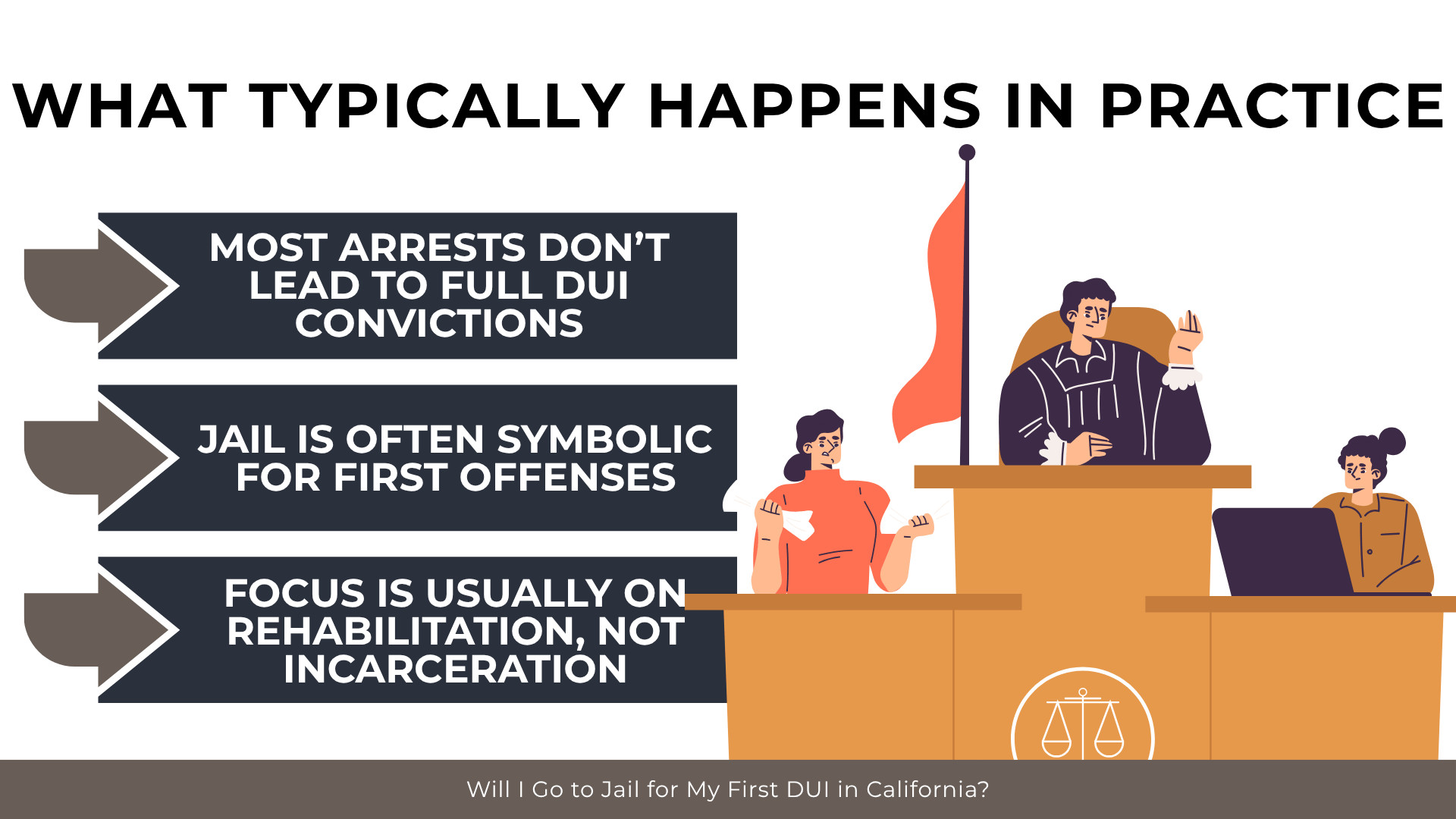
The statistics paint a more nuanced picture than the statute alone. According to the California DMV’s DUI Management Information System report, 68.9% of DUI arrests in 2019 resulted in DUI convictions. That means roughly 31% of arrests did not result in a DUI conviction on the person’s record — some were dismissed, some were reduced to lesser charges, and some fell into other dispositions.
Among those who were convicted, 7.9% were convicted of a reduced “wet reckless” charge — an alcohol- or drug-related reckless driving plea that carries lighter penalties than a full DUI, though it still counts as a prior if you’re ever arrested for DUI again.
As for jail specifically, 66.3% of first DUI offenders were sentenced to jail time. That number sounds alarming, but it requires an important distinction: being sentenced to jail is not the same as serving time in the traditional sense. Many jail sentences are suspended as a condition of probation, meaning you won’t serve the time unless you violate probation. Others are converted to alternatives like community service, work release programs, or Cal-Trans roadside work crews. The sentence exists on paper, but the actual experience often looks very different from what you’re imagining right now.
None of this means you should take a first DUI lightly. It means the system generally treats first offenses without aggravating factors as cases where punishment focuses on education, monitoring, and deterrence rather than incarceration.
Factors That Make Jail Time More Likely
Not every first DUI is treated the same. Several factors can push your case from “probation with conditions” toward actual custody time.
A high BAC reading. If your blood alcohol concentration was 0.15% or above, Vehicle Code § 23578 gives the judge discretion to impose enhanced penalties. At 0.20% or higher, the mandatory DUI school jumps from three months to nine months, and judges tend to view these cases more seriously across the board. For context, the median BAC among convicted DUI offenders in California was 0.16% — double the legal limit — so high-BAC cases are common, but they do carry heavier consequences.
An accident, especially one involving injuries. About 21.4% of DUI arrests in California involve a traffic crash, and 8.3% involve crashes with injuries or fatalities. If someone was hurt, your first DUI can be charged as a felony wobbler under Vehicle Code § 23153, which carries 16 months, 2 years, or 3 years in state prison — a fundamentally different situation from a standard misdemeanor.
A child in the car. If you had a passenger under 14, Vehicle Code § 23572 imposes a mandatory additional 48 hours of jail on a first offense. This enhancement requires consecutive time, meaning it’s added on top of any other jail sentence.
Refusing the chemical test. California’s implied consent law under Vehicle Code § 23612 means that once you’re lawfully arrested for DUI, you’re deemed to have consented to a breath or blood test. Refusing triggers a one-year license suspension with no restricted license eligibility under Vehicle Code § 13353, and prosecutors and judges may treat refusal as an aggravating factor at sentencing.
Reckless driving behavior. Excessive speed, weaving across lanes, or driving the wrong way — anything suggesting a heightened danger to the public — gives the court reason to impose a stiffer sentence even on a first offense.

Factors That Work in Your Favor
Just as certain facts make things worse, others point toward a more favorable outcome.
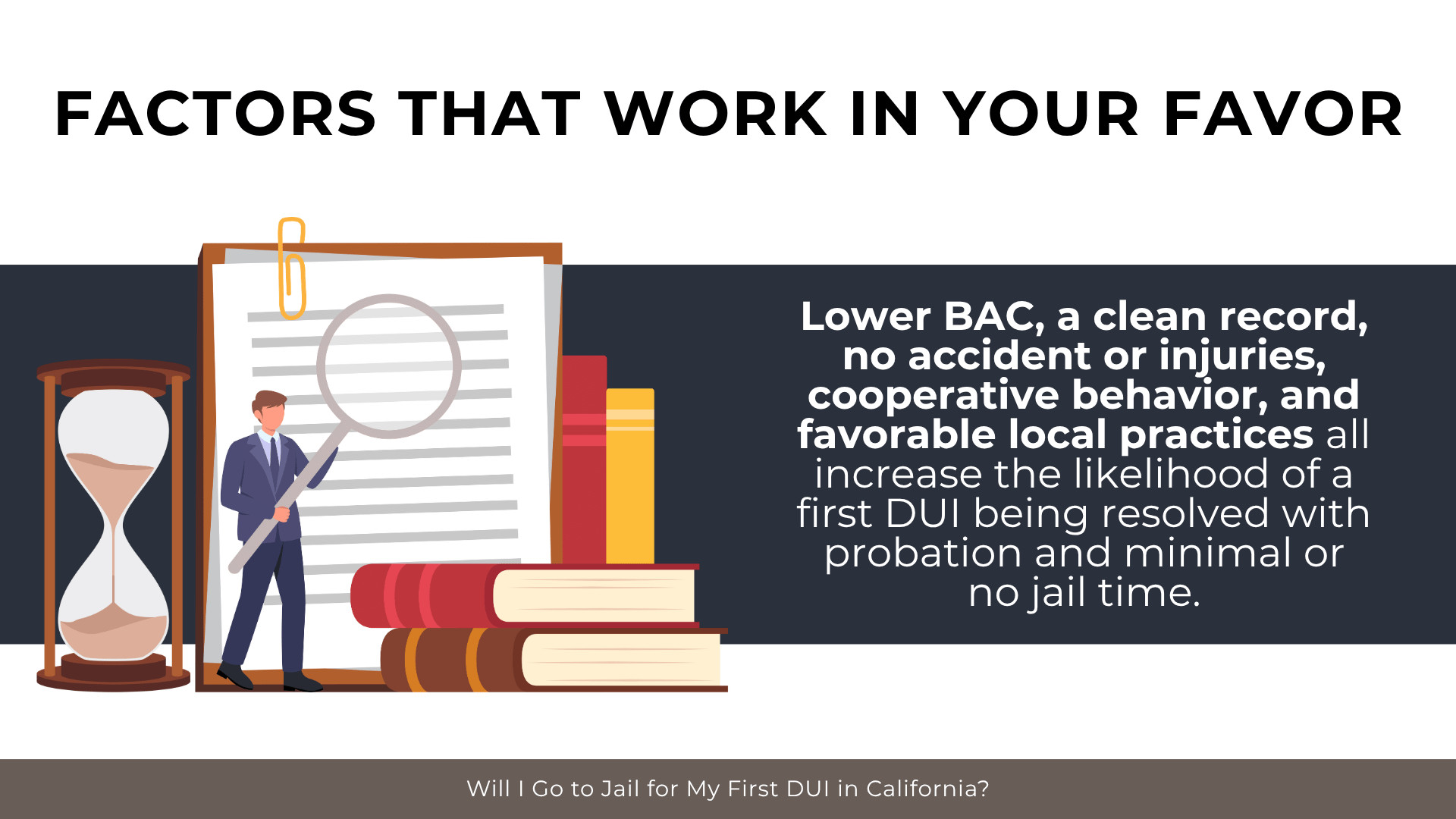
If your BAC was close to 0.08%, you were cooperative during the stop and arrest, there was no accident, no one was hurt, and you have a clean driving record, you’re in the category of cases that courts generally handle with the lightest touch. These are the cases most likely to resolve with probation, fines, DUI school, and a license suspension — without meaningful jail time.
Being polite and compliant during the arrest matters more than people realize. Not because it changes the legal elements of the charge, but because the officer’s report becomes part of the record the prosecutor and judge review. A report describing a cooperative driver reads differently than one describing someone combative or belligerent.
The county where your case is filed also plays a role. A California DMV analysis found that DUI conviction rates across California counties ranged from 41.1% to 91.9%, reflecting meaningful differences in how local prosecutors and courts handle these cases.
The Penalties Beyond Jail You Should Actually Be Worried About
Most people facing a first DUI fixate on jail. That’s understandable — it’s the scariest possibility. But for most first offenders, the consequences that actually disrupt daily life are the ones that have nothing to do with a cell.
Your license suspension starts before you’re ever convicted. California’s Administrative Per Se program under Vehicle Code § 13353.2 means the DMV can suspend your license based solely on a BAC of 0.08% or higher, completely independent of what happens in criminal court. In 2020, the DMV took 91,300 administrative license actions against DUI arrestees.
Insurance costs increase significantly. You’ll need to file an SR-22 certificate of financial responsibility for three years following license reinstatement under Vehicle Code § 13352.4. This typically means substantially higher premiums.
An ignition interlock device may be required. Following SB 1046’s implementation, 23.7% of convicted DUI offenders installed an IID after their arrest — in many cases voluntarily, because installing an IID is the fastest path to getting a restricted license that lets you drive to work.
Professional consequences can be severe. If you hold a commercial driver’s license, a first DUI means a one-year CDL disqualification under federal law (49 C.F.R. § 383.51) — and a second offense means lifetime disqualification. Physicians must report a DUI conviction within 30 days under Business and Professions Code § 802.1. Attorneys face self-reporting requirements under Business and Professions Code § 6068(o) for felony charges.
Immigration consequences are real. While a simple DUI is generally not considered a crime involving moral turpitude under federal immigration law — as established in Matter of Torres-Varela, 23 I&N Dec. 78 (BIA 2001) — a single misdemeanor DUI can bar DACA eligibility as a “significant misdemeanor.” Multiple DUIs can raise issues with naturalization under INA § 101(f). If you are not a U.S. citizen, this is something to discuss with an attorney who understands both DUI defense and immigration law.

Two Separate Proceedings: Criminal Court and the DMV
One thing that catches almost everyone off guard is that a DUI arrest triggers two completely separate proceedings that run on different tracks.
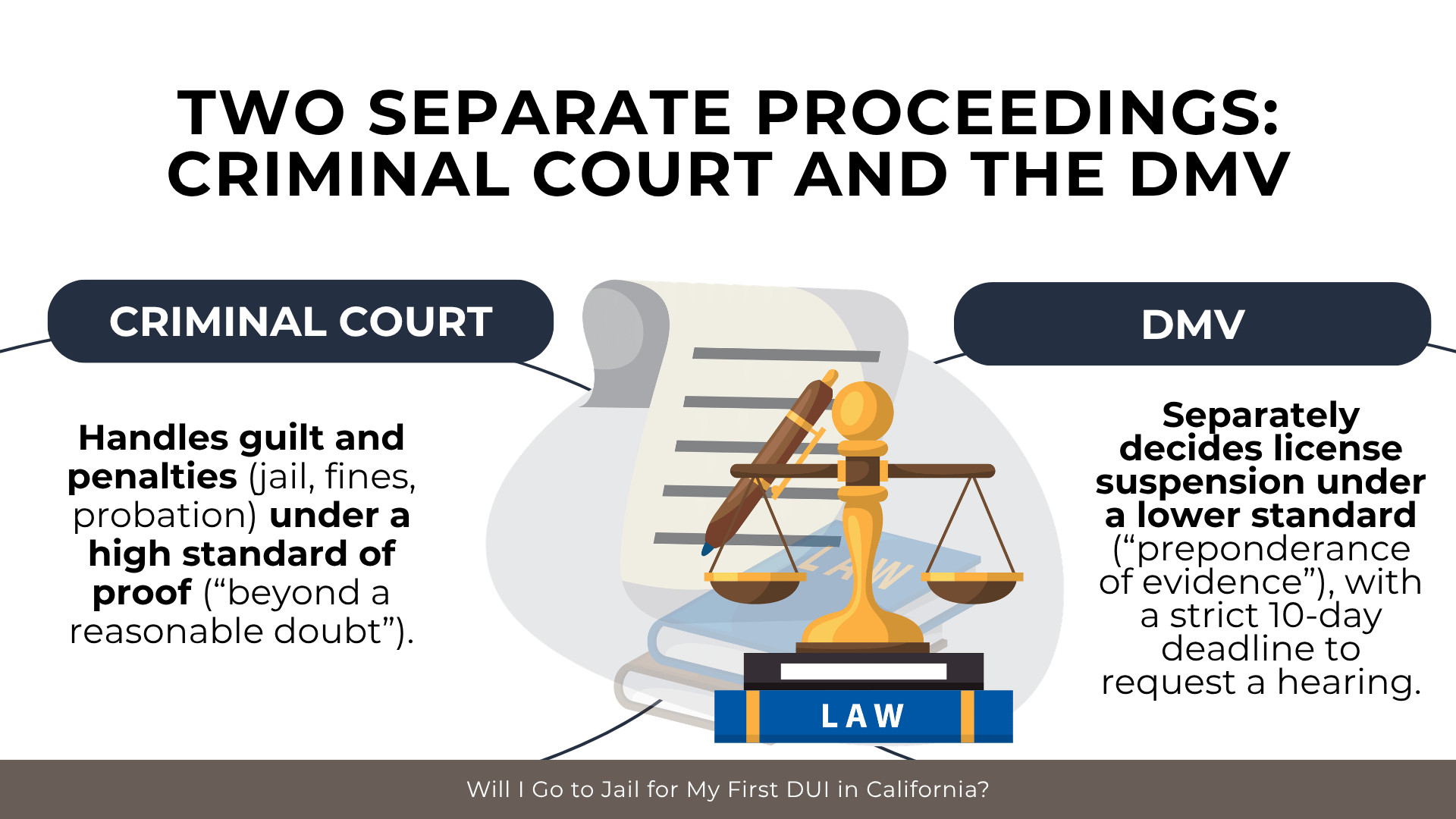
The criminal case is what you probably picture when you think about going to court — a prosecutor, a judge, potential plea negotiations, and the possibility of jail, fines, and probation. The burden of proof is beyond a reasonable doubt.
The DMV administrative hearing is a civil proceeding under a lower standard — preponderance of the evidence. As the California Supreme Court confirmed in Lake v. Reed, 16 Cal. 4th 448 (1997), the APS suspension is a civil remedial measure, not criminal punishment. This means being found not guilty in criminal court does not automatically save your license. The DMV makes its own independent determination.
The critical deadline here is ten days. Under Vehicle Code § 13558, you have ten calendar days from the date you receive the suspension notice to request an APS hearing. Miss that window and you lose the right to contest the suspension and any chance at a stay that keeps you driving while the hearing is pending. If you were recently arrested, count the days from your arrest date. This is the single most time-sensitive action item you face.
What to Do Right Now
If you’ve read this far, you have a much better understanding of where things stand than you did when you started searching. Here’s what to focus on in the immediate term.
Request your DMV hearing within ten days. This is non-negotiable and urgent. Whether or not you hire an attorney, this deadline does not wait.
Write down everything you remember about the stop and arrest. Where you were pulled over, what the officer said, what you said, whether field sobriety tests were administered (which are voluntary in California with no statutory penalty for refusal), and whether you were advised of your rights before any questioning after you were taken into custody. Details fade quickly, and this information matters.
Understand that diversion is not available. Unlike many other misdemeanors in California, DUI offenses are categorically excluded from judicial diversion programs. Vehicle Code § 23640 expressly prohibits it, and California courts confirmed this in Grassi v. Superior Court, 73 Cal. App. 5th 283 (2021) and Tan v. Superior Court, 76 Cal. App. 5th 130 (2022). The exception is military diversion under Penal Code § 1001.80, which remains available to qualifying veterans and active-duty service members.
Talk to a DUI attorney. The specifics of your case — your BAC, the circumstances of the stop, how the chemical test was administered, whether proper procedures were followed — determine your options. A DUI attorney in your county can assess whether there are grounds to challenge the stop itself (which requires reasonable suspicion under People v. Bell, 43 Cal. App. 4th 754), whether rising blood alcohol could be a factor (under People v. McNeal, 46 Cal. 4th 1183, the prosecution must prove BAC at the time of driving, not just at the time of testing), and how your local court typically handles cases like yours.
At Law Office of Angelo Reyes, APC in Carlsbad, attorney Angelo J. Reyes handles DUI defense throughout San Diego County with extensive trial experience and a practice built around preparing every case for trial. If your arrest happened in San Diego County, a consultation can help you understand exactly where your case stands and what realistic outcomes look like.
A first DUI in California is serious. But it is not the end of the road. The one-year reoffense rate for first DUI offenders is just 3.7% — down from 7.6% in 1990 — which means the vast majority of people in your position right now handle this, learn from it, and move forward. The key is making informed decisions starting today.
