A domestic violence restraining order in California is not a criminal conviction, but it is not invisible either. A DVRO is a civil court order issued under California Family Code § 6300. It creates a court record, triggers a firearms prohibition, and can influence custody proceedings — even though no criminal charge was ever filed.
That distinction between a civil restraining order and a criminal record is the single most important thing to understand about this question. The consequences of a DVRO are real, but they are different in kind from the consequences of a conviction. What follows covers what kind of record a DVRO creates, what it can affect, how long it lasts, and what options exist to contest or resolve one.
Where Does a DVRO Show Up on a Background Check?
A DVRO is a civil court order issued by a California Superior Court under Family Code § 6300. It is not a criminal conviction — it does not arise from criminal charges and carries no criminal sentence.
A DVRO does, however, feed directly into California’s firearms enforcement system. According to the California Department of Justice’s 2024 Armed and Prohibited Persons System report, 25,911 prohibited persons were on the APPS list as of January 2025. Individuals prohibited at least in part due to a restraining order make up over half of those disarmed. Under Penal Code § 29825, possessing a firearm while subject to a DVRO is itself a criminal offense. The state actively tracks who is subject to these orders and enforces the prohibition.
Can a Restraining Order Cost You Your Job or a Professional License?
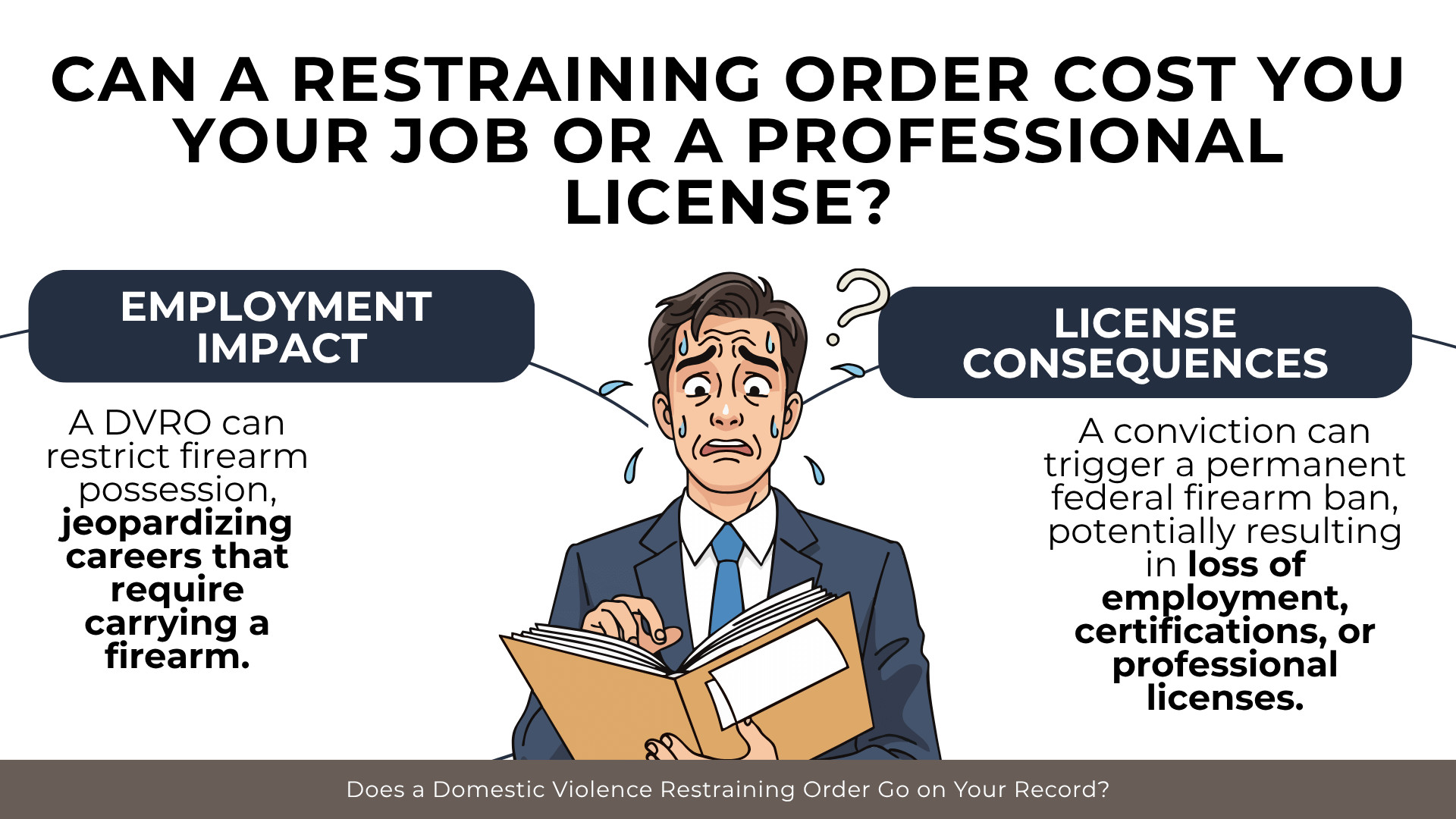
Under California Penal Code § 29825, possessing a firearm while subject to a qualifying protective order — including a DVRO — is a wobbler offense. That means it can be charged as either a misdemeanor or a felony. If your profession requires carrying a personal firearm, a DVRO creates a direct conflict.
For law enforcement and military personnel, the federal rules are more nuanced than they may first appear. The federal firearms prohibition under 18 U.S.C. § 922(g)(8) applies to individuals subject to a qualifying restraining order. However, it includes an official-use exemption under 18 U.S.C. § 925(a)(1). This means law enforcement and military personnel may still possess firearms for official duties while under a qualifying order. That exemption disappears entirely if the matter leads to a criminal conviction.
Under the Lautenberg Amendment at 18 U.S.C. § 922(g)(9), a misdemeanor domestic violence conviction permanently bars firearms possession with no exception for military or law enforcement personnel. Because military service requires firearms proficiency, a qualifying conviction can effectively end a military career. It makes the service member non-deployable, and administrative separation typically follows.
Will a DVRO Affect Your Gun Rights?
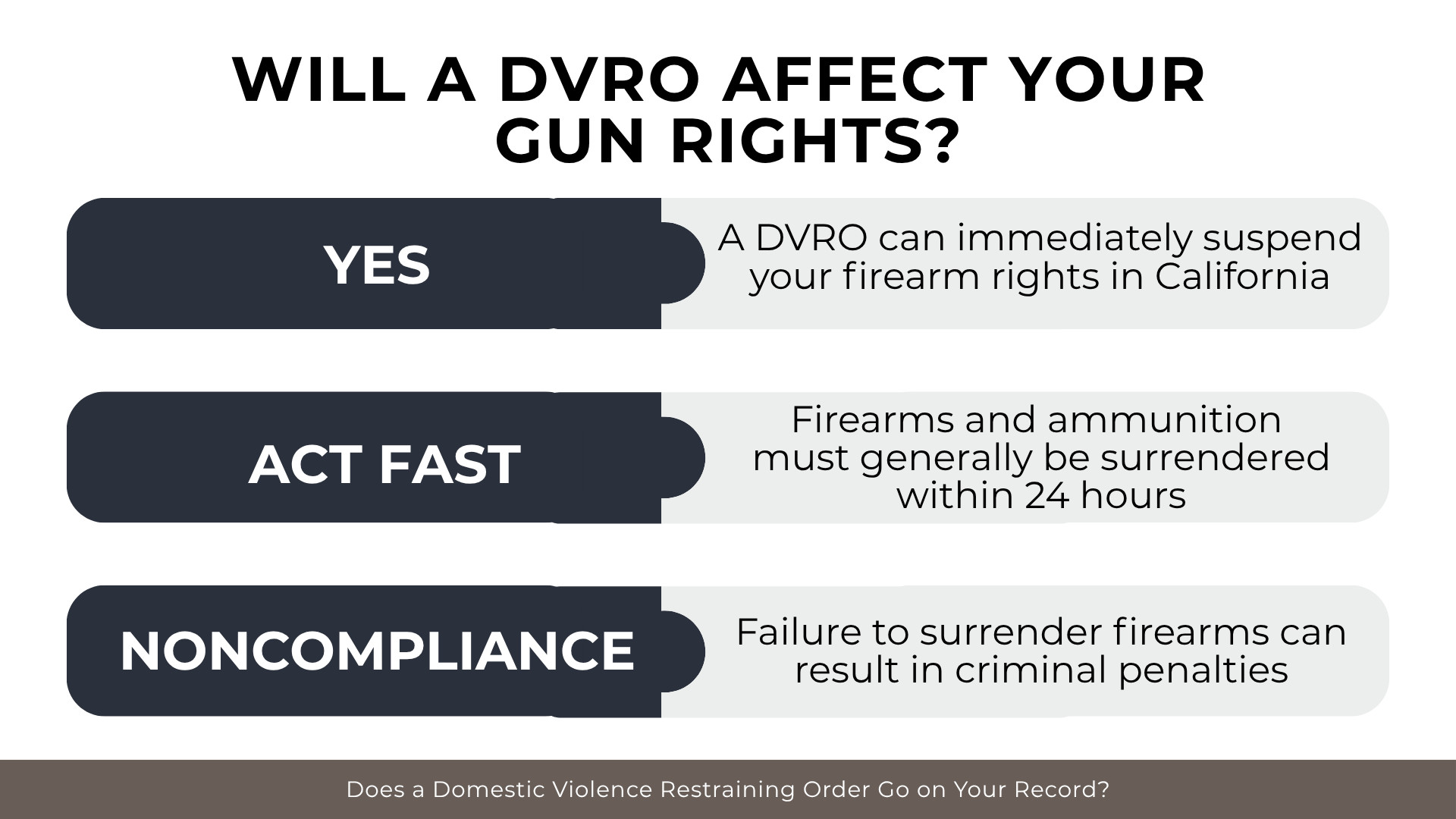
Yes, and this is one of the most immediate consequences.
California law is broader than federal law on this point. Under Penal Code § 29825, California’s firearms prohibition applies to ex parte and temporary orders — not just orders issued after a full hearing. This means a TRO issued before you even have a chance to appear in court can trigger the state-level firearms prohibition.
Federal law under 18 U.S.C. § 922(g)(8) is narrower in one respect: the federal prohibition only applies to orders issued after a hearing where you received actual notice and had the opportunity to participate. But when a DVRO is issued after the noticed hearing, the federal prohibition applies in addition to the state prohibition.
The practical requirements are immediate. Under California Family Code § 6389, if you are subject to a DVRO, you must surrender all firearms and ammunition within 24 hours to local law enforcement or a licensed dealer. You must also file proof of compliance with the court within 48 hours. Failing to surrender firearms is itself a criminal offense.
In 2024, the U.S. Supreme Court confirmed the constitutionality of these restrictions in United States v. Rahimi. The Court held 8–1 that an individual found by a court to pose a credible threat to another’s physical safety may be temporarily disarmed consistent with the Second Amendment. California reinforced its enforcement system with a $40 million allocation in 2022 to establish the nation’s largest court-based firearm relinquishment program for individuals prohibited under domestic violence-related orders.
How Does a Restraining Order Affect Child Custody?
A DVRO can reshape a custody case. This is where the practical consequences of a civil restraining order extend furthest beyond the order itself.
California Family Code § 3044 creates a rebuttable presumption that it is detrimental to a child’s best interest to award sole or joint custody to a parent convicted of domestic violence within the previous five years. This applies after a trial or a plea of guilty or no contest to a qualifying offense. A civil DVRO alone does not trigger the § 3044 presumption. But the DVRO hearing itself can still reshape custody through a different route.
Under Family Code § 6323, a court issuing a DVRO can make temporary custody and visitation orders at the same hearing. Under Family Code § 3044, the statutory preference for frequent and continuing contact with both parents cannot be used to overcome the presumption against custody for a domestic violence perpetrator.
If a domestic violence matter does result in a criminal conviction alongside or instead of a civil DVRO, the § 3044 presumption applies. Its requirements are demanding. Overcoming the presumption requires a preponderance of the evidence and specific written findings on each statutory rebuttal factor.
In Jaime G. v. H.L. (2018), the California Court of Appeal held that a trial court must make findings on each factor before determining the presumption has been rebutted. Those factors include completion of a batterer’s treatment program, substance abuse counseling, parenting classes, compliance with probation, parole, and protective orders, and absence of further domestic violence.
In Celia S. v. Hugo H. (2016), the court held that a 50/50 visitation timeshare is functionally a joint custody order. It cannot be used to get around the § 3044 presumption by relabeling it as sole custody with generous visitation.
The takeaway is that what happens at the DVRO hearing does not stay at the DVRO hearing. The temporary custody and visitation orders a court makes under § 6323 take immediate effect. If the matter involves a separate criminal case, the § 3044 presumption may come into play as well.
How Long Does a Domestic Violence Restraining Order Stay on Your Record?
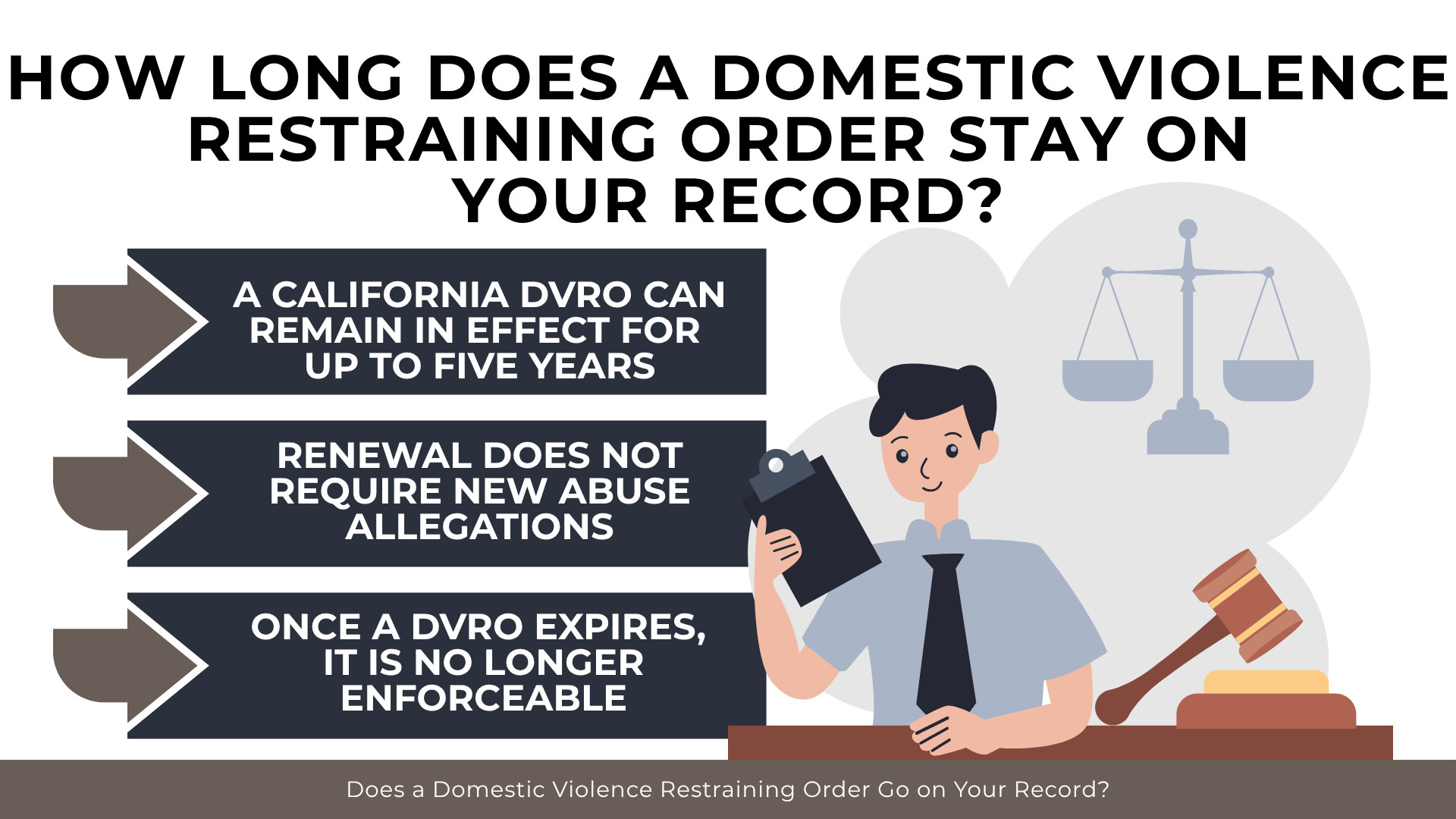
A DVRO can last up to five years from the date of issuance under California Family Code § 6345(a). Before it expires, the protected party can petition to renew it for an additional five or more years, or permanently.
Renewal does not require proof of new abuse. In Ritchie v. Konrad (2004), the California Court of Appeal held that a court should renew a DVRO if it finds by a preponderance of the evidence that the protected party has a reasonable apprehension of future abuse. The petitioner does not need to show that you committed any new acts since the original order was issued. This means a DVRO issued today could, through repeated renewals, remain in effect indefinitely.
The distinction between the active duration of the order and the persistence of the court record matters. An expired DVRO is no longer enforceable — the firearms prohibition lifts, the stay-away requirements end, and the active legal consequences end. But the active order, while in effect, is tracked through state enforcement systems and carries all of the consequences discussed in this article.
California processes tens of thousands of these cases each year. DVRO filings in California Superior Courts reached 74,223 in the 2021–22 fiscal year, partially recovering from a pandemic-era low of 66,286 in 2020–21 after peaking at 83,982 in 2017–18.
Can You Fight a Domestic Violence Restraining Order?
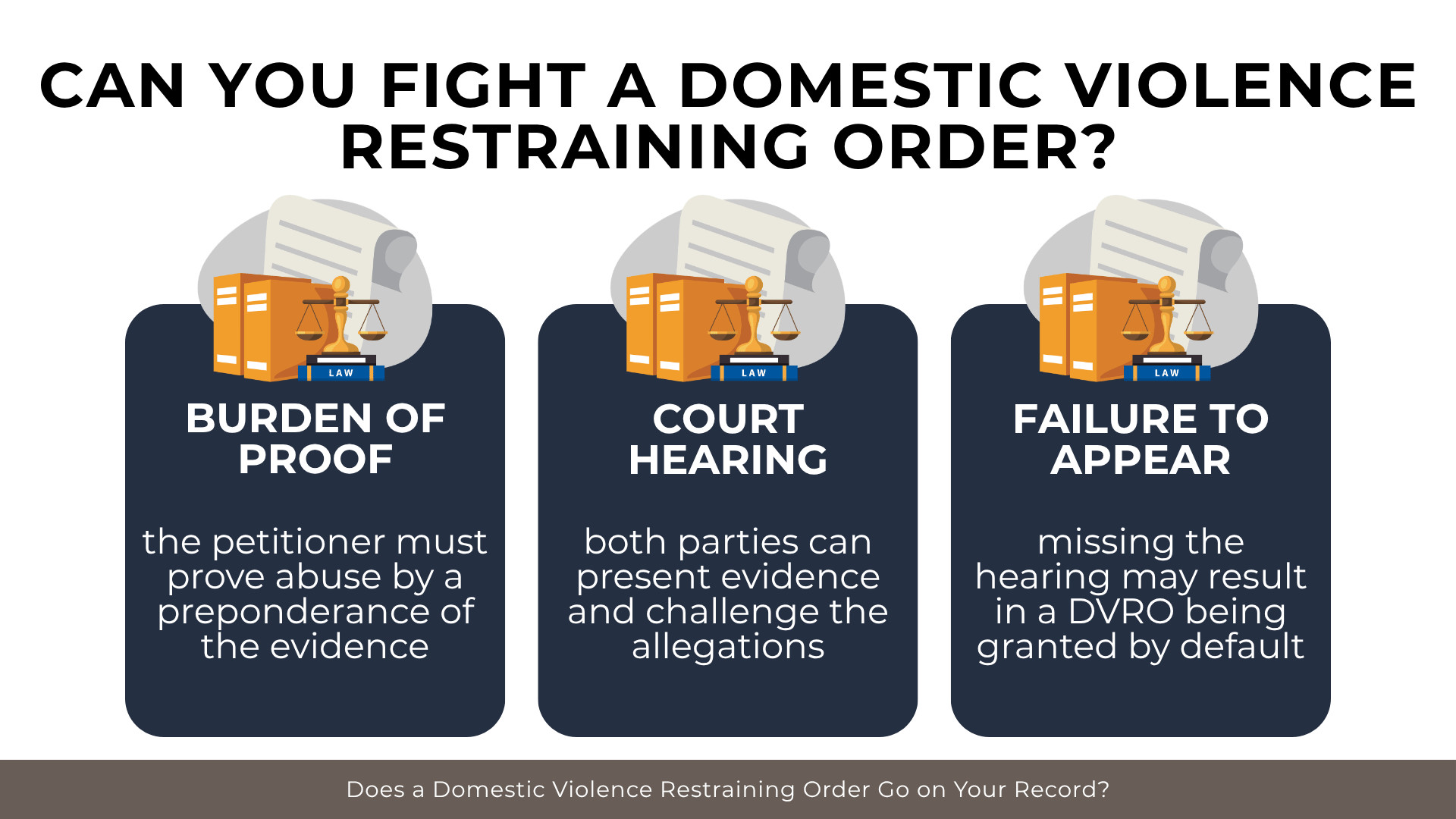
Yes. The DVRO hearing is the opportunity to contest the order, and it is the most important moment in the process.
After a TRO is issued, a hearing is scheduled — typically within 20 to 25 days — where both parties can appear, present evidence, and argue their case. The petitioner must prove by a preponderance of the evidence that a past act of abuse occurred.
“Abuse” is defined broadly under Family Code § 6203. It includes intentionally or recklessly causing or attempting to cause bodily injury, sexual assault, placing a person in reasonable apprehension of imminent serious bodily injury, or engaging in behavior that could be prohibited by court order under Family Code § 6320. Abuse under the DVPA is not limited to physical injury.
The standard cuts both ways. Preponderance of the evidence is lower than the beyond-a-reasonable-doubt standard in criminal cases. But it still requires the petitioner to carry the burden of proof. The court must weigh the evidence presented by both sides.
In Nakamura v. Parker (2007), the Court of Appeal held that a trial court abused its discretion by denying a DVPA application without a hearing or explanation when the application stated a valid claim on its face. That means courts take these proceedings seriously in both directions.
If you do not appear at the hearing, the court can issue the DVRO by default. That default order carries every consequence discussed in this article — firearms prohibition, custody implications, court record — without you ever having presented your side.
Mutual restraining orders are restricted under Family Code § 6305(a). A court cannot issue a mutual order unless both parties personally appear and each presents written evidence of abuse in a required Judicial Council form. The court must also make detailed findings that both parties acted primarily as aggressors and neither acted primarily in self-defense.
Can a Domestic Violence Restraining Order Be Removed From Your Record?
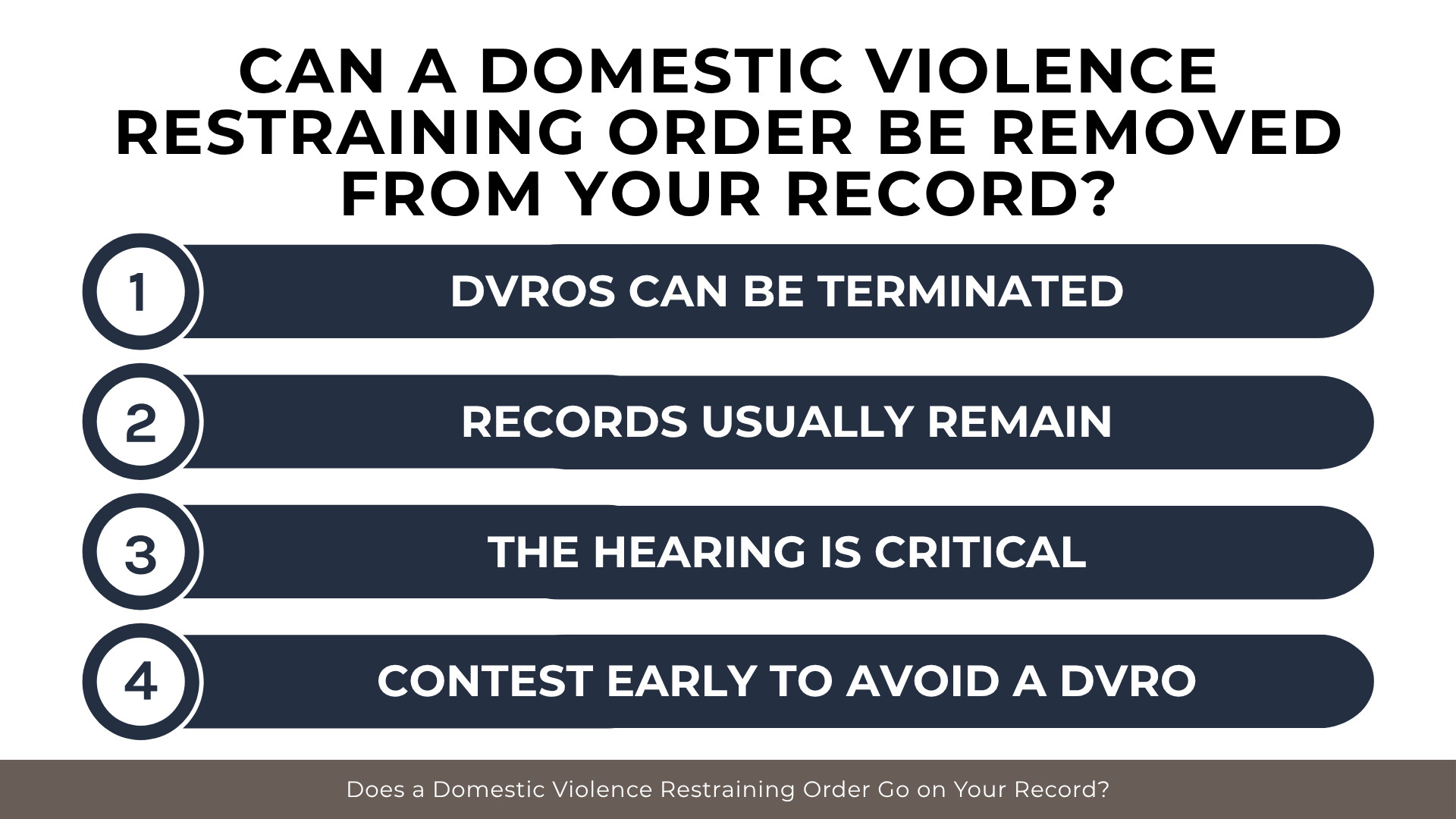
Whether and how your DVRO can be dissolved or modified before it expires, and what happens to the court record afterward, depends on the specific circumstances and stage of your case.
What the law does establish is that the initial hearing is the point of greatest consequence. The DVRO is either issued or denied at that hearing. If you do not appear, you risk a default order carrying every consequence discussed in this article. Preventing the order from being issued in the first place, or contesting its scope at the hearing, avoids the need to undo consequences later.
Talk to a Criminal Defense Attorney Before Your DVRO Hearing
The outcome of a DVRO hearing can affect firearms rights, custody, employment, and what shows up in court records for years — or permanently, if the order is renewed. These consequences flow from a single civil proceeding, and they begin adding up from the moment a temporary order is issued.
Angelo Reyes Law in Carlsbad, California handles domestic violence defense matters across San Diego County. Attorney Angelo Reyes prepares every case as if it’s going to jury, whether the matter resolves through negotiation or at trial. Clients work directly with Angelo, not a paralegal or associate. If you are facing a DVRO hearing or any domestic violence-related proceeding, contact Angelo Reyes Law to discuss your situation.