
Does Domestic Violence Actually Matter in a California Custody Case?
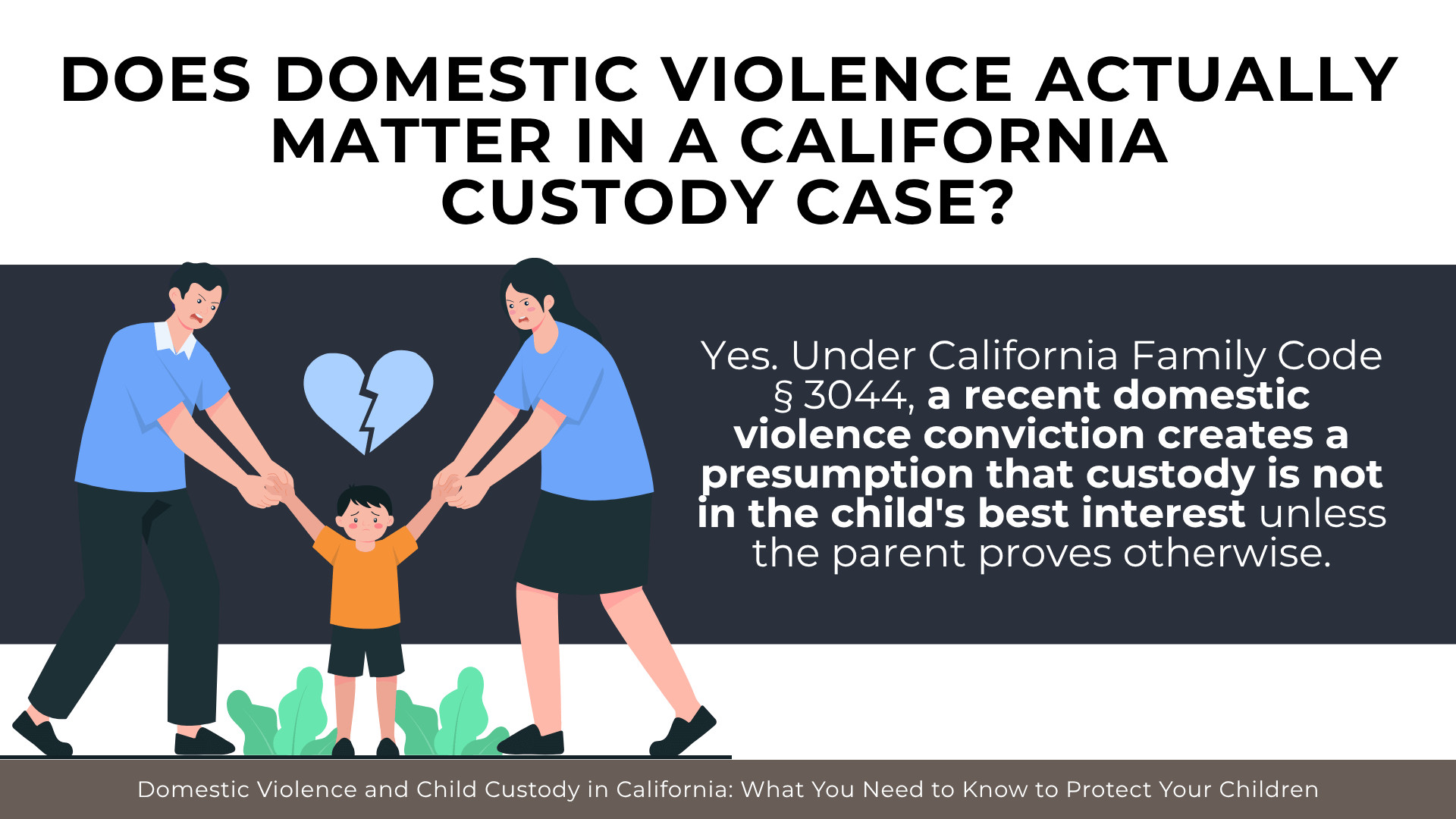
Yes. California law creates a legal presumption that giving custody to a parent who has committed domestic violence is harmful to the child. That presumption is set out in California Family Code § 3044. It is one of the most powerful tools in California family law — yet if you are searching for answers about domestic violence and child custody, you may not know it exists.
Here is how it works. If a court finds that a parent seeking custody has been convicted of a qualifying domestic violence offense within the previous five years — after a trial or a plea of guilty or no contest — California law presumes that awarding that parent sole or joint custody is harmful to the best interest of the child. The presumption shifts the burden to the offending parent to prove they should have custody — not the other way around.
This article covers how that presumption works, what qualifies as domestic violence in a custody case, what evidence courts look at, and what steps matter most right now. Every legal standard discussed below reflects current California law as of 2026.
What Is the Presumption Against Custody, and How Does It Work?
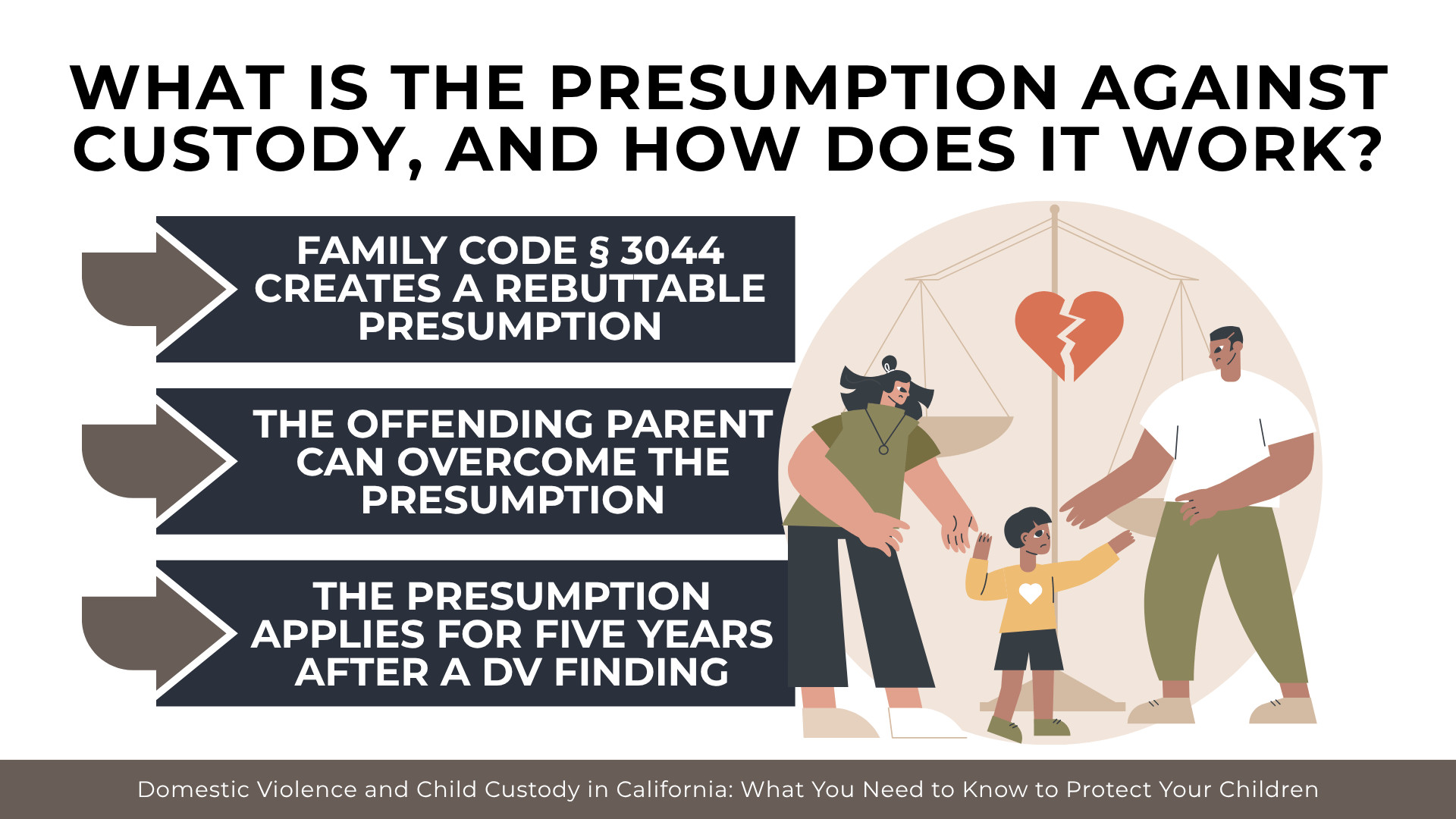
Family Code § 3044 operates on a simple principle: a parent who has been found to have committed domestic violence starts at a disadvantage in a custody proceeding. The court presumes that granting sole or joint custody to that parent would not serve the child’s best interest.
The presumption is “rebuttable,” which means the offending parent can attempt to overcome it — but only by meeting a specific burden. They must prove, by a preponderance of the evidence, that custody would serve the child’s best interest despite the history of domestic violence. And the court cannot simply accept a general argument. Under Jaime G. v. H.L., 25 Cal.App.5th 794 (2018), the trial court must make specific written findings — or state its reasoning on the record — addressing each of the rebuttal factors listed in the statute. If the court does not do this, it has abused its discretion.
The presumption applies within a five-year window. A conviction or court finding of domestic violence that occurred more than five years before the custody proceeding does not automatically trigger it. However, the history may still be relevant to the broader best-interest analysis.
One additional rule matters here. In Celia S. v. Hugo H., 3 Cal.App.5th 655 (2016), the court held that a 50/50 visitation timeshare is effectively a joint custody arrangement. That means a court cannot sidestep the § 3044 presumption by labeling an arrangement “sole custody with visitation” while actually splitting time equally. If the practical effect is joint custody, the presumption applies and must be properly addressed.
What Counts as “Domestic Violence” in a Custody Case?
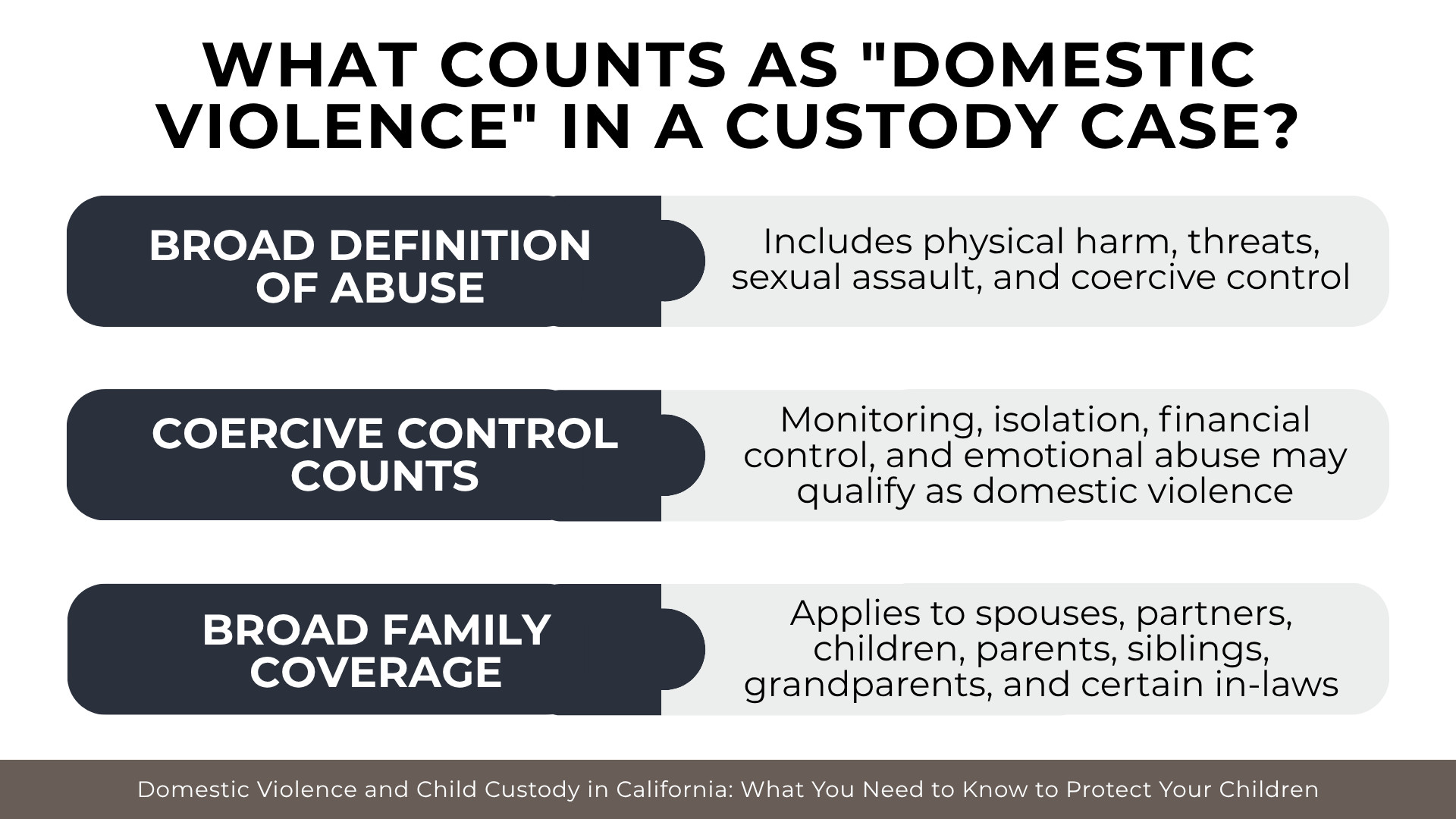
California defines “abuse” more broadly than most people expect. Under Family Code § 6203, abuse includes intentionally or recklessly causing or attempting to cause bodily injury, sexual assault, placing a person in reasonable apprehension of imminent serious bodily injury, or engaging in any behavior that has been or could be enjoined under Family Code § 6320. That last category is critical. Section 6320 now includes coercive control — a pattern of behavior that does not necessarily involve physical violence but that restricts, isolates, or dominates the other person.
In Rodriguez v. Menjivar, 243 Cal.App.4th 816 (2015), the court held that controlling and coercive behavior — including isolation, monitoring, and emotional abuse — counts as abuse under the Domestic Violence Prevention Act. The trial court in that case had refused to consider such conduct, and the appellate court reversed, finding that the lower court was wrong. This means a pattern of surveillance, financial control, threats, or psychological manipulation can support a DVRO and, in turn, a custody finding under § 3044.
The Family Code definitions also reach further than the Penal Code when it comes to who qualifies as a protected person. Under Family Code § 6211, domestic violence applies not only to spouses, former spouses, cohabitants, and dating partners, but also to children of a party, children who are the subject of a parentage action, and any person related by blood or marriage within the second degree — parents, siblings, grandparents, in-laws. This broader definition applies in civil protective order and custody cases, even though the criminal statutes are narrower.
An estimated 15.5 million children in the United States live in households where physical intimate partner violence occurred in the prior year. Understanding what the law recognizes as abuse is the first step toward ensuring that children in those households have legal protection.
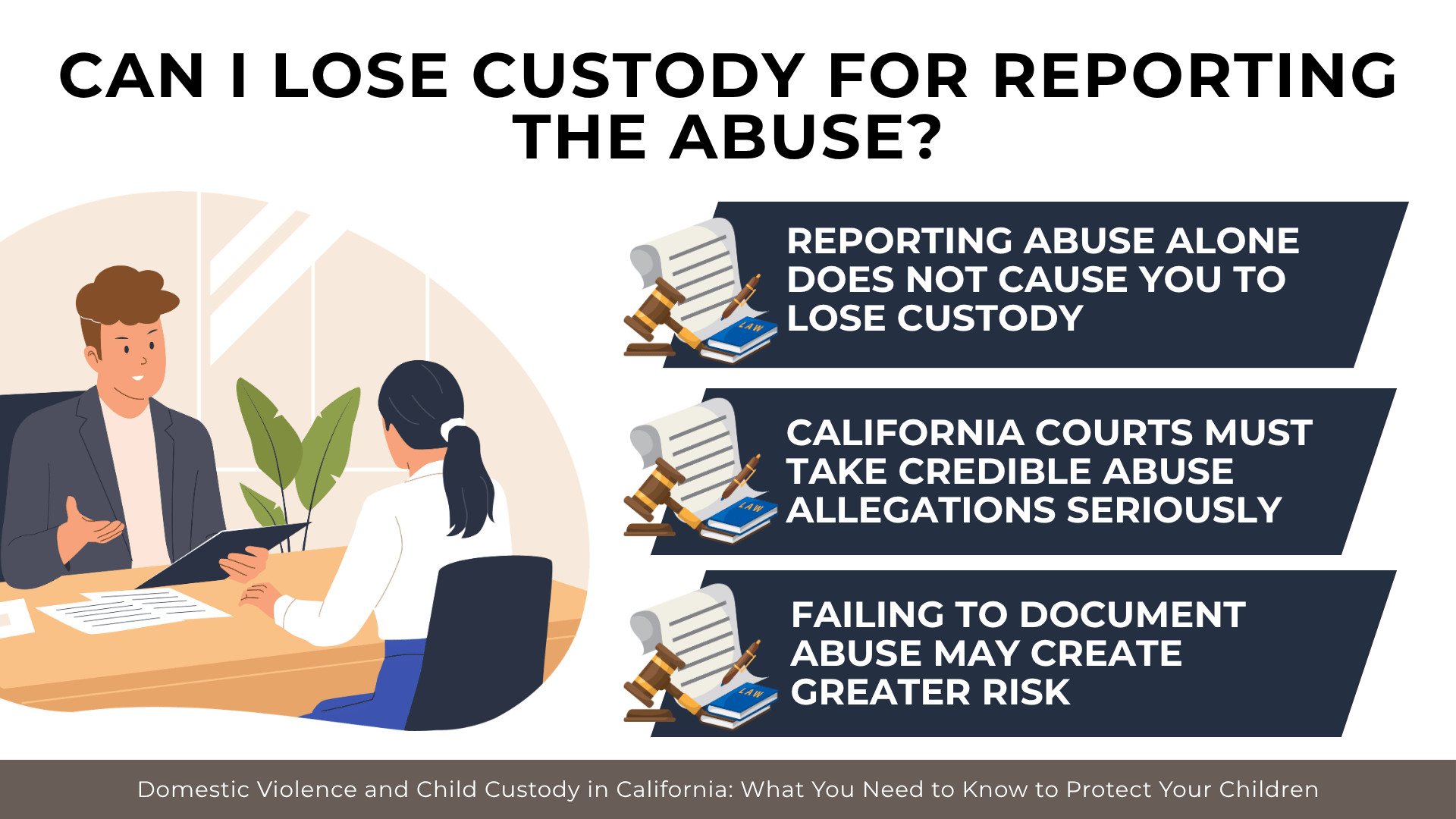
Can I Lose Custody for Reporting the Abuse?
If you are considering legal action, this is likely one of your biggest fears. It is worth addressing directly, because the fear itself can become a barrier to seeking protection.
California law includes specific safeguards against the misuse of mutual restraining orders. Under Family Code § 6305(a), a court may not issue a mutual restraining order unless three conditions are met. Both parties must personally appear in court. Each must file a separate written application with evidence of abuse using the mandatory Judicial Council form. And the court must make detailed findings that both parties acted primarily as aggressors and that neither acted primarily in self-defense. This is a high bar. A responding party cannot simply show up and claim mutual abuse to defeat a legitimate protective order.
In Nakamura v. Parker, 156 Cal.App.4th 327 (2007), the court held that a trial court abused its discretion by denying a DVPA application — without a hearing or explanation — that was supported by allegations of abuse sufficient on their face. The law requires that claims of abuse be heard, not dismissed at the threshold.
The greater risk, in practice, often runs in the opposite direction. If you fail to document abuse, delay seeking protective orders, or do not report violence, the absence of a record made at the time may weaken your position later. Courts assess the evidence in front of them. Building that evidence — through police reports, protective order filings, medical documentation, and consistent testimony — is not an act of aggression. It is the legal foundation for protecting a child.
What Evidence Does the Court Need to See?
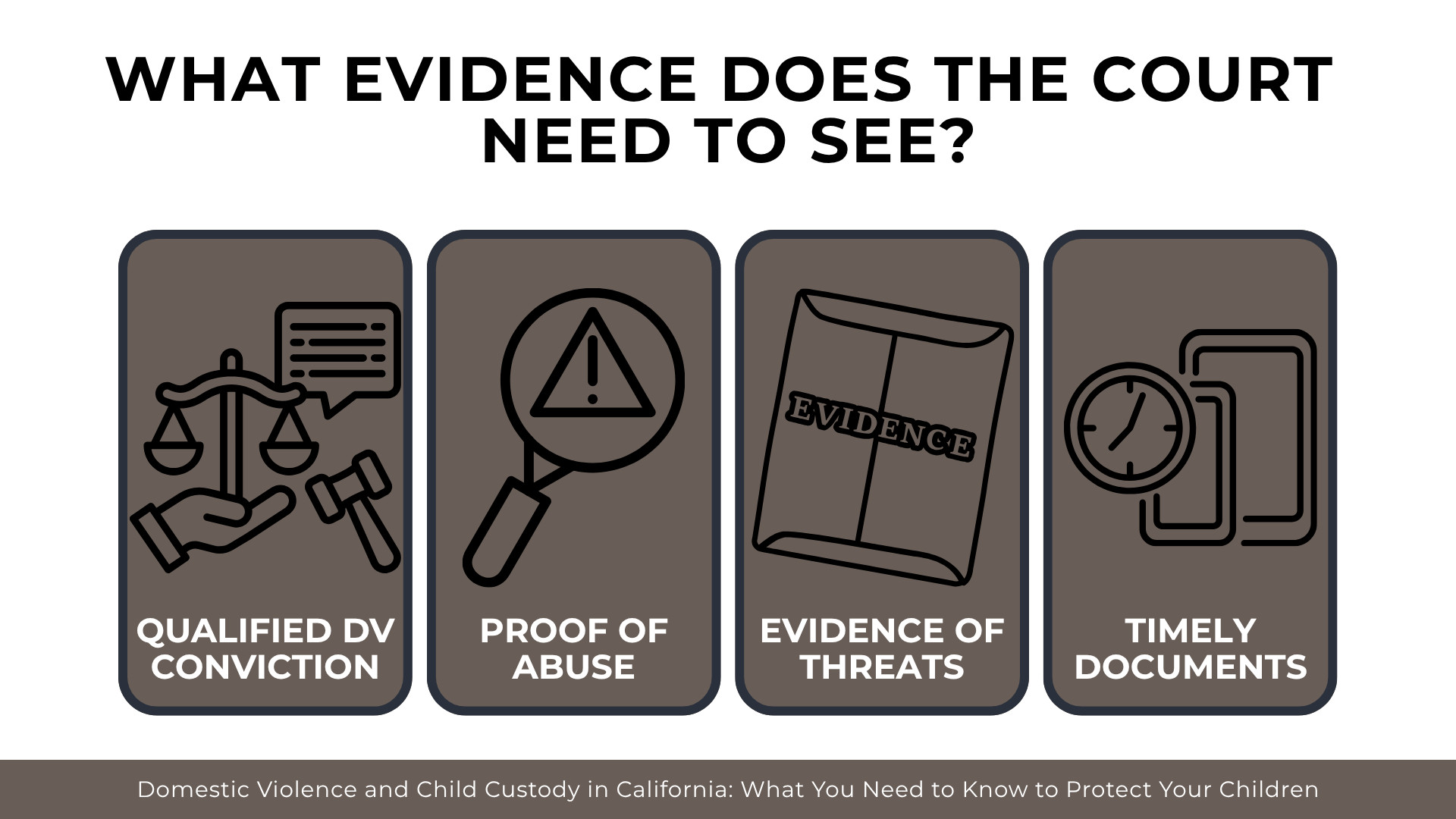
The § 3044 custody presumption is triggered by a qualifying conviction. The court must find that a parent seeking custody was convicted within the previous five years — after a trial or a plea of guilty or no contest — of a crime against the other party that falls within the definition of domestic violence under Family Code § 6211 and abuse under Family Code § 6203.
The evidence relevant to a custody case, however, extends beyond the conviction itself. The DVRO standard is preponderance of the evidence: reasonable proof of a past act of abuse. This is a lower threshold than the “beyond a reasonable doubt” standard in criminal court. A DVRO proceeding and a § 3044 custody presumption are separate legal processes. But the evidence documented through protective order filings, police reports, and related proceedings can matter in the broader custody analysis.
What counts as sufficient proof depends on the specific facts, but the statute points toward several types of evidence. Abuse under Family Code § 6203 includes physical injury, sexual assault, threats of imminent serious bodily injury, and conduct that can be enjoined under § 6320 — including coercive control after Rodriguez v. Menjivar. The evidence that supports a finding can therefore include records of physical harm, communications containing threats or controlling behavior, testimony about patterns of isolation or surveillance, and any prior protective order history. Police reports and medical records carry particular weight because they are created close to the events they describe.
The critical point is timing. Evidence is strongest when it is created close to the events in question. If you are considering seeking custody protection, the documentation you create now — or fail to create — will shape what a court can consider months or years later.
What Will the Other Parent Argue to Get Custody Back?
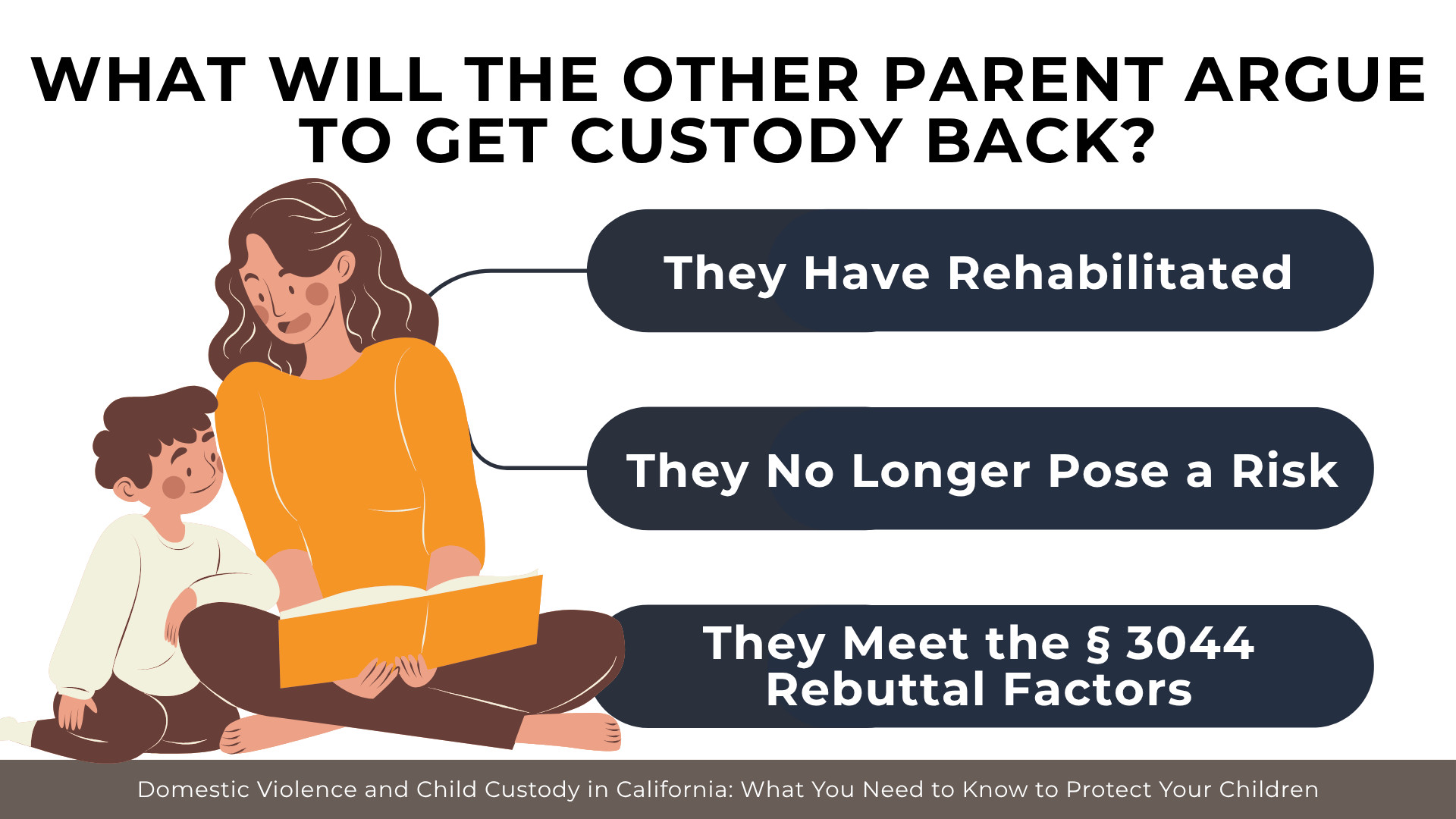
The § 3044 presumption is rebuttable, and a parent subject to it will typically attempt to show rehabilitation. The statute identifies specific factors the court must evaluate, and you should understand what they are.
The rebuttal factors under § 3044(b) include whether the offending parent has successfully completed a batterer’s intervention program, completed substance abuse counseling where relevant, completed a parenting class, followed the terms of probation or parole, complied with all restraining or protective orders, and committed no further acts of domestic violence.
One data point is worth knowing in this context: a California State Auditor investigation found that 46 out of every 100 domestic violence offenders ordered to complete the mandated 52-week batterer intervention program did not finish it. Among those who failed to complete the program, 65% went on to commit new domestic violence or abuse-related crimes, compared to 20% of those who completed it. Courts imposed consequences for only about 9% of known violations. Completion of a batterer’s intervention program is a rebuttal factor. But whether the other parent actually completed it — and whether they complied with its terms in good faith — is a question you should examine closely.
There is also one argument the offending parent cannot make. Family Code § 3044(a) directly states that the general statutory preference for frequent and continuing contact with both parents may not be used to rebut the presumption, in whole or in part. A parent who committed domestic violence cannot argue that children simply “need both parents” to overcome the custody presumption. The court must evaluate the specific rebuttal factors, not general policy preferences.
What Should You Do Right Now?
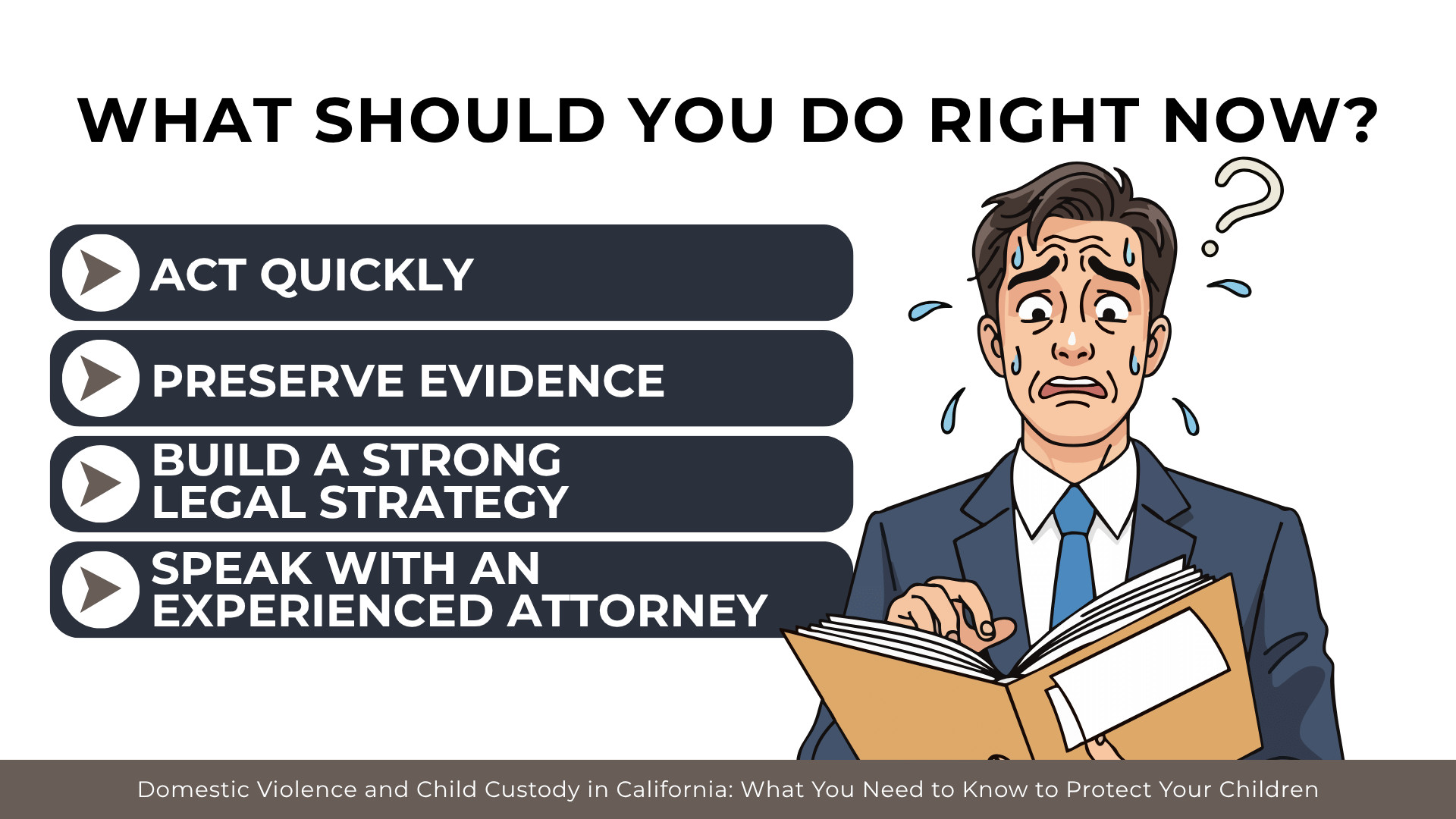
The legal protections described in this article — the § 3044 custody presumption, the broad definition of abuse that can trigger it, and the specific rebuttal factors a court must evaluate — are powerful. But they depend on action taken at the right time, with the right evidence, under the right legal strategy.
The § 3044 presumption has a five-year window. Evidence degrades. The documentation you create now — or fail to create — will shape what a court can consider when custody is at stake.
At Angelo Reyes Law in Carlsbad, California, criminal defense attorney Angelo Reyes prepares every domestic violence case as if it is going to jury. That level of preparation matters whether the matter resolves through negotiation or at trial. Clients work directly with Angelo, not a paralegal or associate.
If you are facing a situation involving domestic violence and child custody — whether you need protection or are defending against allegations — the most important thing you can do is speak with an attorney who understands what is at stake. Contact Angelo Reyes Law to discuss your case.