Yes. If domestic violence charges are dismissed before a conviction enters the record, the primary deportation trigger under federal immigration law does not apply. That distinction — conviction versus no conviction — can be the difference between remaining in the United States and facing mandatory removal.
This page covers why domestic violence charges create a specific immigration emergency and what actually counts as a deportable event. It also explains how dismissal and other defense strategies can prevent that outcome, and why the difference between dismissal and a plea deal matters more than most people realize.
Can a Domestic Violence Conviction Get Me Deported?
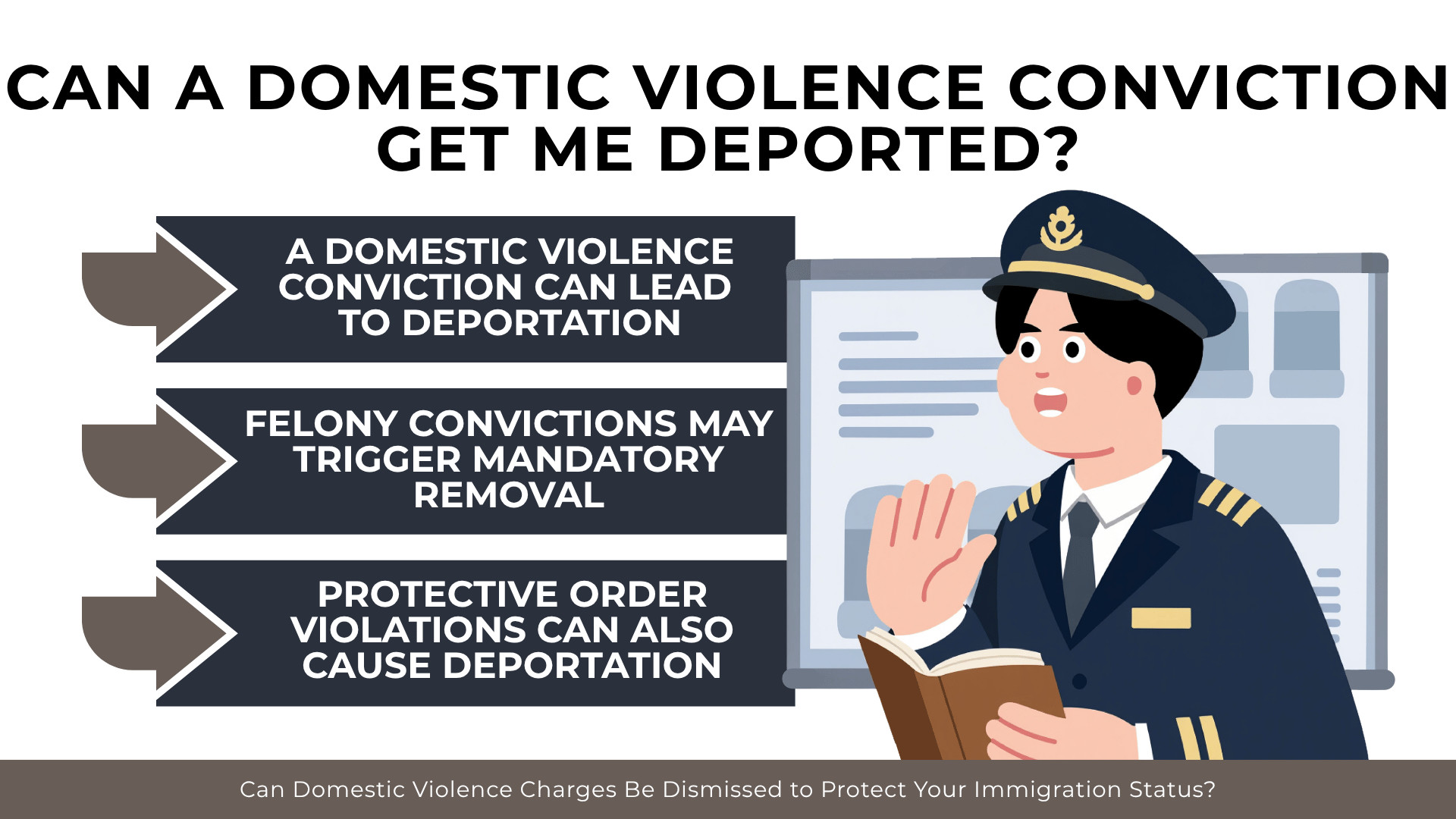
It can. Under INA § 237(a)(2)(E), any noncitizen convicted of a crime of domestic violence is deportable. It does not matter how long they have lived in the country, whether they hold a green card, or whether the offense was charged as a misdemeanor.
That alone makes domestic violence one of the most serious charges in California criminal law for noncitizens. But the risk gets worse. If the domestic violence offense qualifies as a “crime of violence” carrying a sentence of one year or more, it may qualify as an aggravated felony under INA § 101(a)(43)(F). An aggravated felony triggers mandatory removal and a permanent bar to most forms of immigration relief. There is effectively no coming back from that classification.
In California, a felony conviction under Penal Code § 273.5 — corporal injury to a spouse or cohabitant — carries a sentencing range of two, three, or four years in state prison. That places it squarely within the range that can qualify as an aggravated felony for immigration purposes.
And it does not stop at convictions. A court finding that a person violated a protective order can trigger deportation under § 237(a)(2)(E)(ii) without any criminal conviction at all.
Can a “Good” Outcome in Criminal Court Still Hurt My Immigration Status?
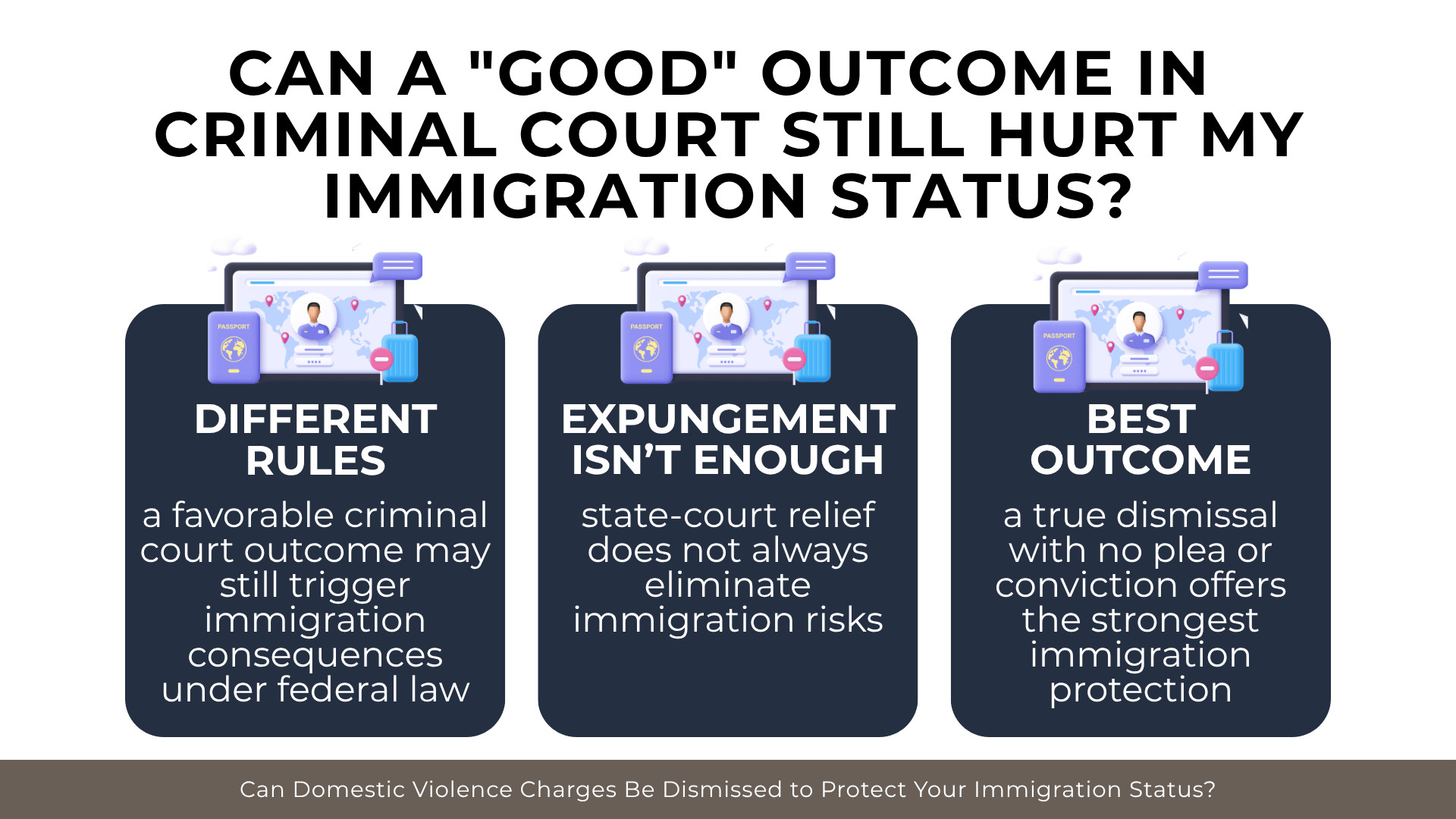
This is where cases go wrong. A criminal defense attorney unfamiliar with immigration law may negotiate an outcome that looks efficient in state court. But that same outcome can create a permanent deportation problem under federal law.
The reason is that criminal court and immigration law do not use the same definitions. California’s expungement statute under Penal Code § 1203.4, for example, allows a court to withdraw a guilty or no-contest plea, or set aside a guilty verdict after trial. In state court, that looks like the conviction has been cleared. But under federal law, the analysis is different. The research on federal firearms disabilities illustrates the problem. California expungement under PC § 1203.4 does not remove the permanent federal firearms ban created by a misdemeanor domestic violence conviction. That is because California’s expungement explicitly does not restore firearms rights. The federal system treats certain California outcomes differently than California courts do.
This is why the goal is not just resolving the criminal case. The goal is resolving it in a way that does not create a federal deportation event in the first place.
A true dismissal — where no guilty or no-contest plea is ever entered, no conviction is entered on your record, and the case ends without an admission — is the cleanest outcome for immigration purposes. It leaves no conviction for INA § 237(a)(2)(E) to act on.
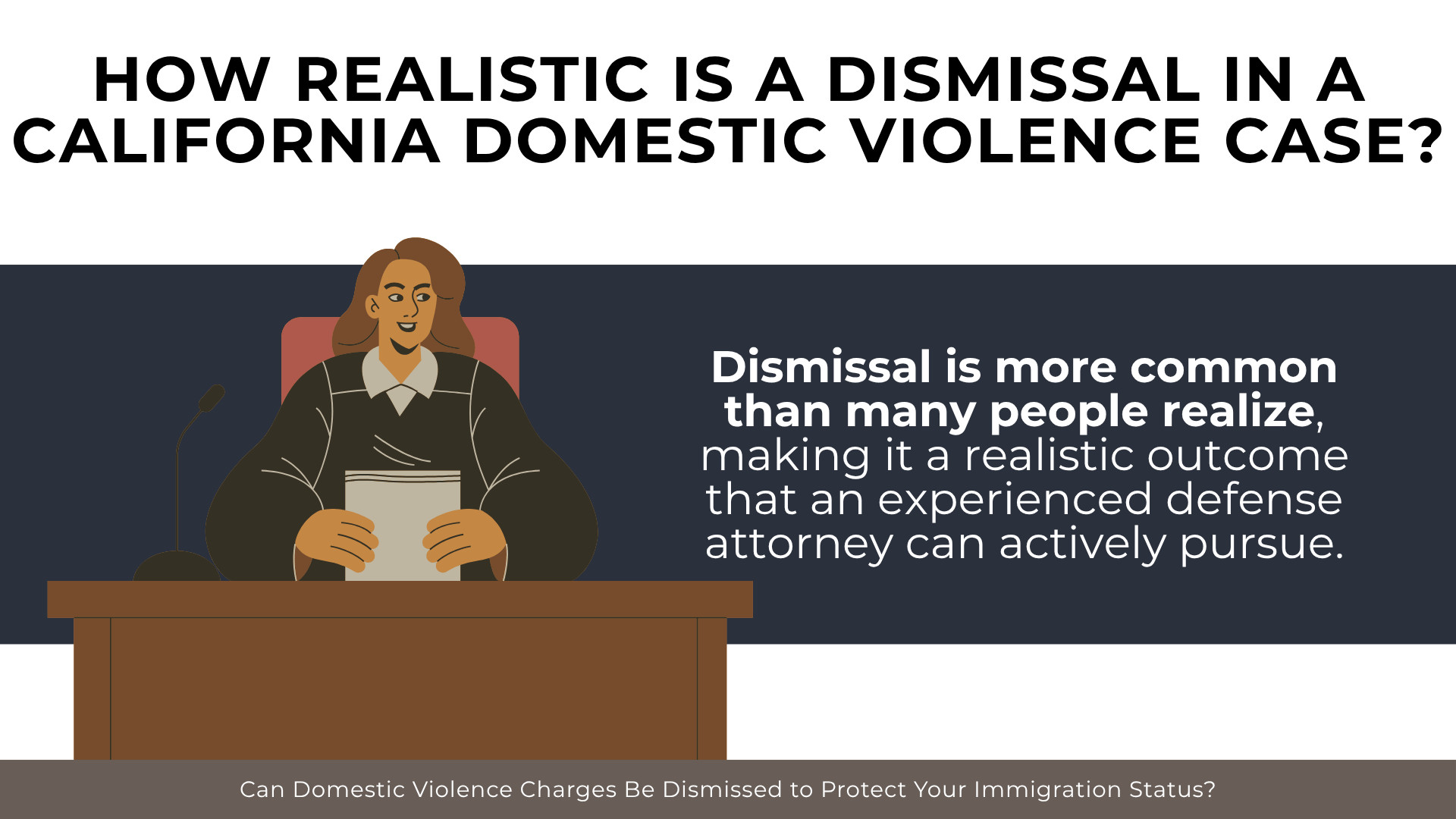
How Realistic Is a Dismissal in a California Domestic Violence Case?
More realistic than most people assume when you are looking at criminal charges.
When a first-responding officer conducts only a basic investigation, prosecutors decline to file criminal charges approximately 70% of the time. Among cases that are filed but later dismissed, 78% are dismissed because the victim does not cooperate with prosecution. A large-scale review of 135 studies found that roughly one-third of reported intimate partner violence offenses result in prosecution. About half of those prosecutions result in conviction.
None of this means dismissal is automatic. It means dismissal is a real outcome that a prepared defense attorney can pursue — not a long shot that only happens by luck.
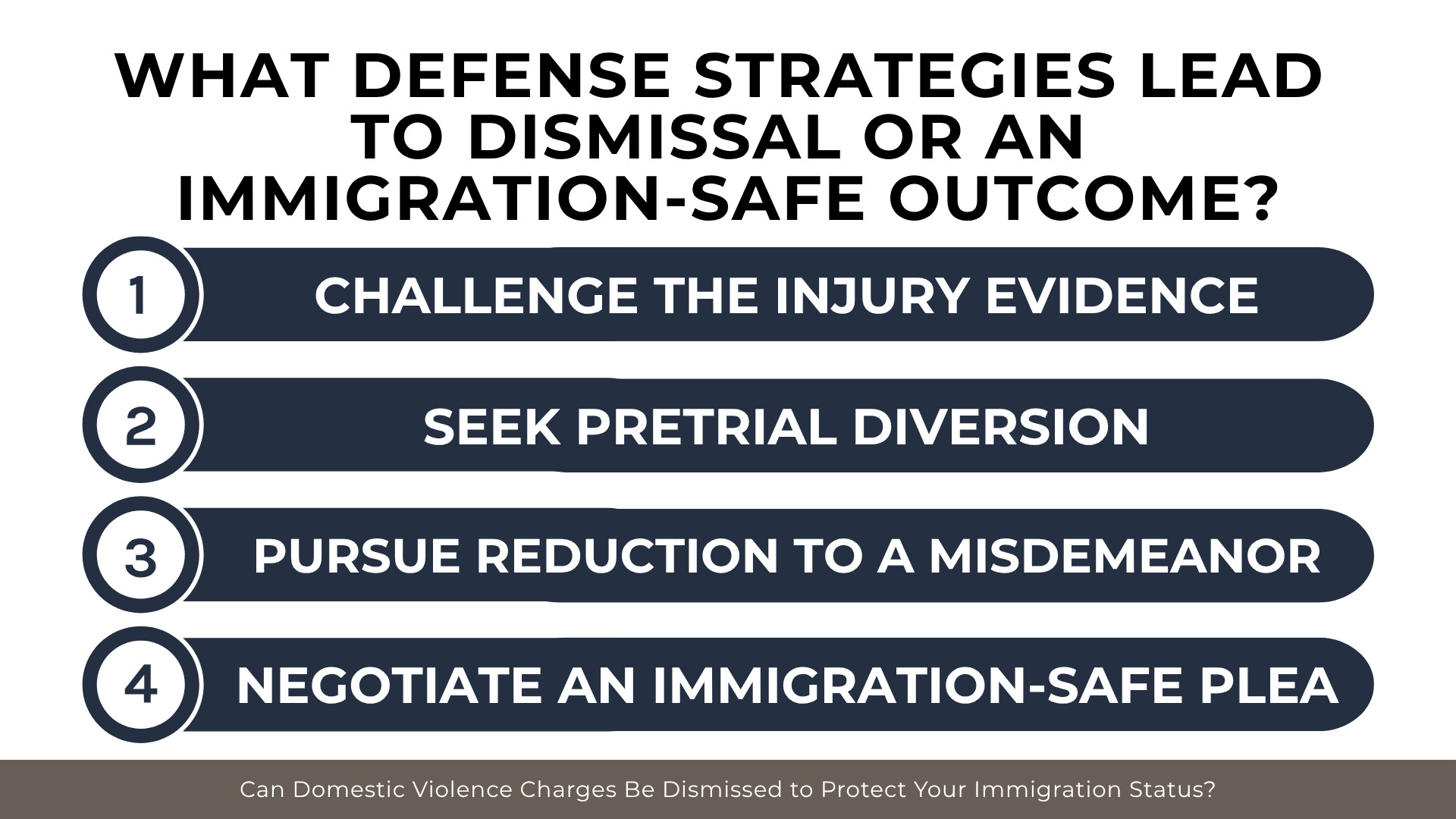
What Defense Strategies Lead to Dismissal or an Immigration-Safe Outcome?
Several pathways exist in California, and the right one depends on the specific charges, the evidence, and your immigration situation.
Challenging the evidence for a traumatic condition. California’s corporal injury statute, Penal Code § 273.5, requires proof that the defendant inflicted a “traumatic condition” — an actual physical injury, however minor, caused by physical force. In People v. Abrego, the Court of Appeal held that pain alone, such as soreness and tenderness, without evidence of even a minor physical injury, is insufficient to establish a traumatic condition under § 273.5. In People v. Jackson, the court held that an indirect injury — the victim falling after being pushed — did not satisfy the statute’s requirement that the injury result from a direct application of force. The court reduced the conviction to misdemeanor domestic battery under Penal Code § 243(e)(1).
Where the prosecution cannot prove a traumatic condition, the felony charge may collapse entirely or reduce to a misdemeanor. That evidence requirement is a pressure point a defense attorney can use to push for dismissal or, at minimum, to prevent the kind of conviction that triggers the most severe immigration consequences.
Pretrial diversion. Diversion programs that result in a case being dismissed upon completion — without a formal conviction ever entering the record — may prevent deportation under INA § 237(a)(2)(E)(i) entirely. The research packet identifies diversion eligibility as a critical consideration in domestic violence defense specifically because of its ability to eliminate both firearms disabilities and immigration consequences at the same time. Whether you qualify for diversion depends on your charges, criminal history, and the policies of the local prosecutor’s office.
Reduction from felony to misdemeanor. Penal Code § 273.5 is a “wobbler.” It can be charged as a felony or a misdemeanor at the prosecutor’s discretion. A court can also reduce a felony filing to a misdemeanor. A misdemeanor domestic violence conviction still triggers deportation under INA § 237(a)(2)(E). But reducing the offense can prevent the aggravated felony classification under INA § 101(a)(43)(F) that comes with a sentence of one year or more. That difference matters a great deal. A deportable offense may still allow certain forms of relief. An aggravated felony triggers mandatory removal with a permanent bar to most remedies.
Negotiating how any plea is structured. If dismissal or diversion is not available, the specific language of a plea can still determine the immigration outcome. What matters is whether the conviction qualifies as a “crime of domestic violence” or a “crime of violence” under the federal definitions that trigger deportation. This is technical work that requires the defense attorney to understand exactly which elements of the plea will be examined by immigration authorities — and to negotiate with that in mind.
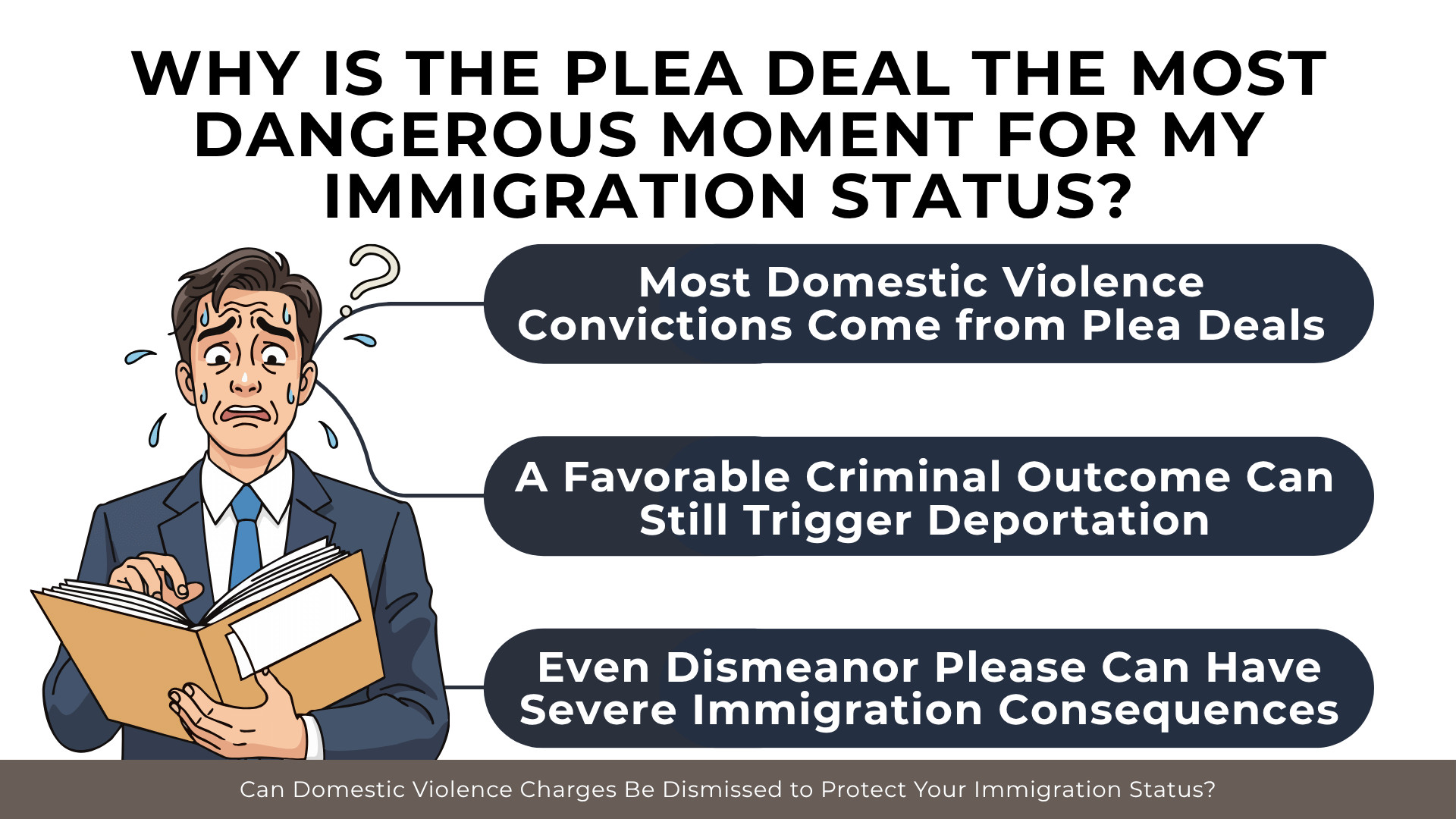
Why Is the Plea Deal the Most Dangerous Moment for My Immigration Status?
The data on this point is stark. Of all defendants convicted of felony domestic violence aggravated assault, 92.9% were convicted through guilty pleas. Only 3–7% of domestic violence convictions result from trial. The overwhelming majority of these cases end with a negotiated plea.
That means the moment of greatest risk for you is not the trial — it is the plea negotiation. A plea deal that resolves a criminal case quickly and with minimal jail time may look like a good outcome in the courtroom. But if that plea creates a conviction for a crime of domestic violence under federal law, it can permanently end your ability to live in the United States.
Approximately 80% of domestic violence cases nationwide are filed as misdemeanors. A misdemeanor plea may feel minor. It is not minor for immigration. A misdemeanor crime of domestic violence is a deportable offense under INA § 237(a)(2)(E), full stop.
Talk to a Defense Attorney Who Understands What’s at Stake
Angelo Reyes Law in Carlsbad, California handles criminal defense cases across San Diego County with an approach built around exactly this kind of high-stakes preparation. Attorney Angelo Reyes prepares every case as if it is going to jury — not because every case goes to trial, but because that level of preparation creates leverage whether the matter resolves through negotiation or at trial.
That approach has produced outcomes in serious cases: a 25-to-life case dismissed, attempted murder reduced to battery, multiple DUI and grand theft dismissals, and felony strike exposures reduced to simple misdemeanors. Clients work directly with Angelo — not a paralegal or associate — from the first conversation through resolution.
Angelo Reyes is licensed in California and Washington and admitted to the U.S. District Court for the Southern District of California. If you or a family member are facing domestic violence charges and your immigration status is on the line, the time to get the right attorney involved is before any plea is entered.
Contact Angelo Reyes Law to discuss your case.