California passed a package of domestic violence laws in 2024 and 2025. These laws expanded how long prosecutors can bring charges and how long protective orders can last. They also changed how aggressively law enforcement can seize firearms at the scene of a DV call. The most impactful changes took effect on January 1, 2025, with an additional expansion following on January 1, 2026. Whether you’re researching these changes because of a charge, an arrest, a protective order, or a situation involving someone close to you, this page explains each new law, what it does, and what it means from a criminal defense perspective.
These are not minor procedural adjustments. Taken together, the new laws represent the most significant tightening of California’s domestic violence framework in years. They apply to cases being investigated, charged, and resolved right now.
What Domestic Violence Laws Did California Change in 2025 and 2026?
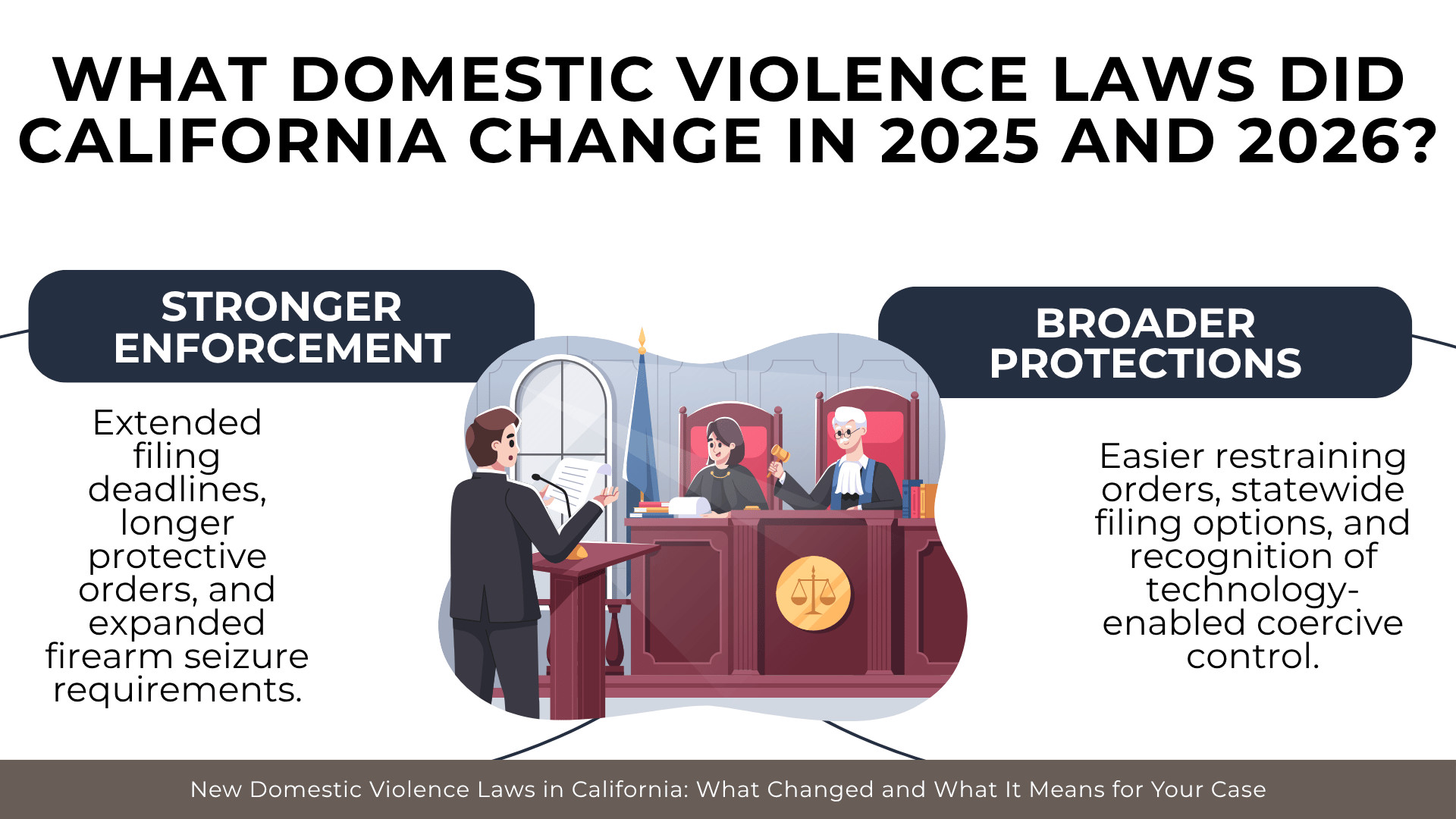
Between September 2024 and October 2025, Governor Newsom signed several bills that reshaped how domestic violence cases are investigated, charged, and punished across the state.
SB 690 extended the statute of limitations for felony domestic violence under Penal Code § 273.5 from five years to seven. AB 2308 raised the maximum duration of post-conviction criminal protective orders from 10 years to 15. AB 2907 now requires law enforcement officers responding to a DV call to run an immediate check of the state firearms database and seize any registered weapons on the spot. AB 2024 streamlined the process for obtaining restraining orders. SB 554 allows those orders to be filed in any California county rather than only in the jurisdiction where the alleged abuse took place. Effective January 1, 2026, SB 50 amended Family Code § 6320 to explicitly recognize the misuse of smart home devices and connected technology as a form of coercive control.
Each of these changes carries specific consequences depending on the facts of a case. Here is what they mean in practice.
Can I Be Charged for Something That Happened Years Ago?
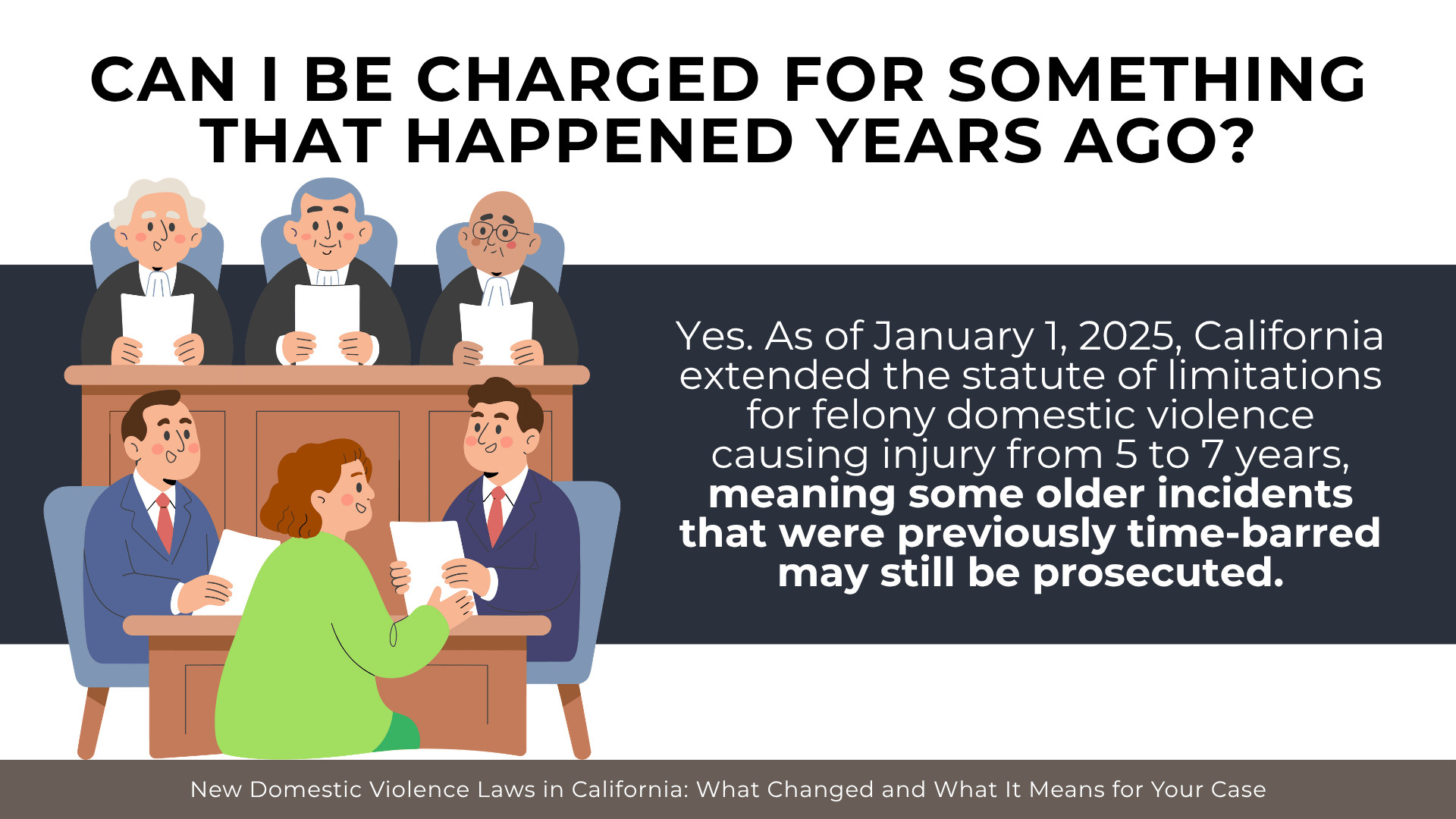
Under SB 690 — sometimes called the Phoenix Act 2.0 — the statute of limitations for prosecuting felony corporal injury under Penal Code § 273.5 increased from five years to seven years, effective January 1, 2025. The law applies not only to offenses committed on or after that date but also retroactively to any offense where the previous five-year window had not yet expired as of January 1, 2025.
This is a meaningful expansion. An incident from 2020 that would have been time-barred under the old law may now fall within the new seven-year window. Prosecutors who previously faced a tighter deadline now have additional time to build a case, locate witnesses, or wait for a reluctant victim to cooperate.
Two limits are worth understanding. First, this extended timeline covers only felony charges under PC 273.5, which requires proof that the defendant willfully inflicted corporal injury resulting in a “traumatic condition.” Under § 273.5(d), that term means a condition of the body, such as a wound, or external or internal injury, including but not limited to injury as a result of strangulation or suffocation, whether of a minor or serious nature, caused by physical force. Second, misdemeanor domestic battery under Penal Code § 243(e)(1), which requires no injury and covers any willful and unlawful touching in a rude or angry manner, remains subject to a one-year limitations period. The distinction between these two charges, and which one a prosecutor decides to file, now matters even more given the different timelines at stake.
How Long Can a Restraining Order Last Against Me Now?
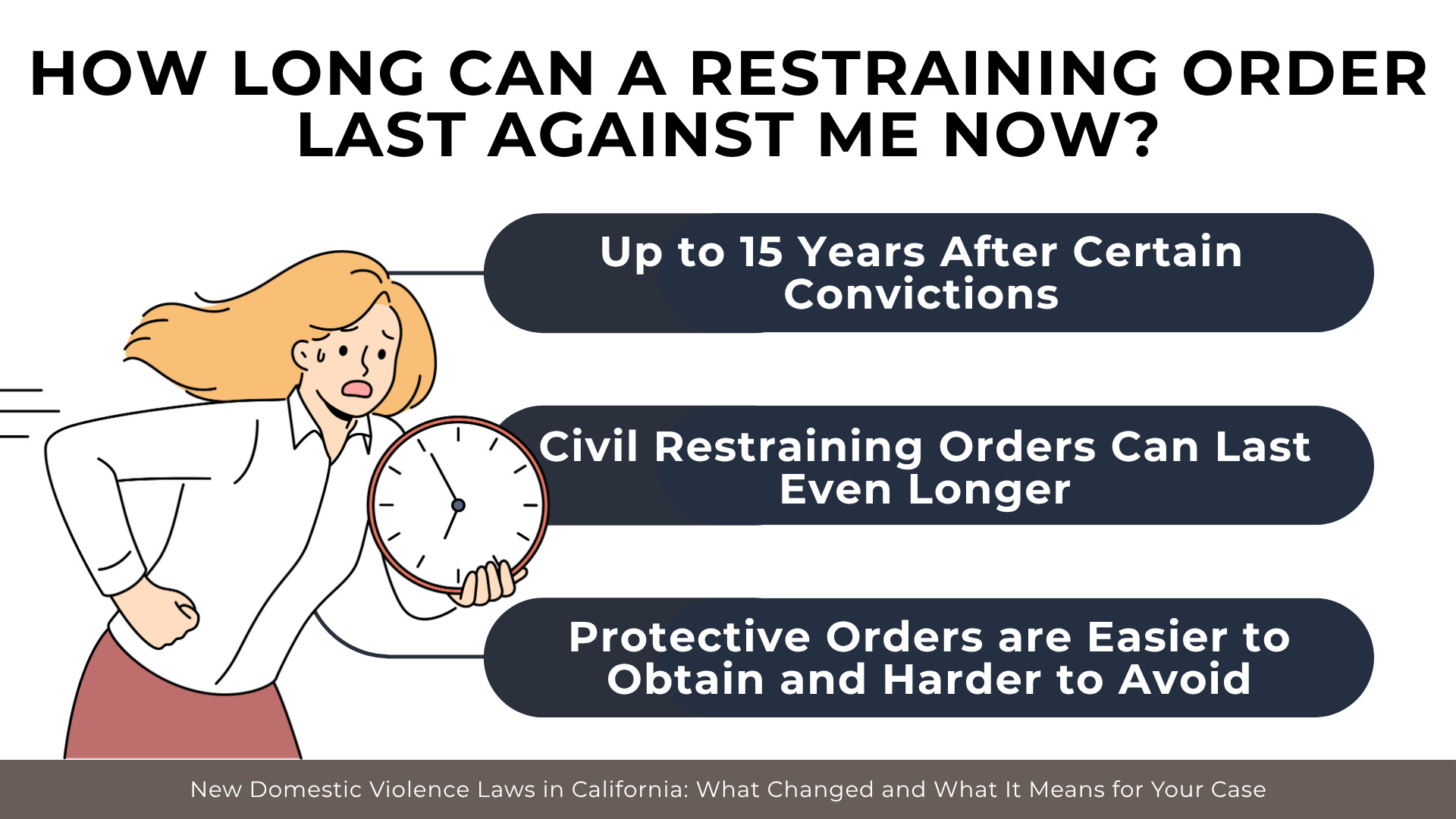
Before 2025, courts could issue a post-conviction criminal protective order under Penal Code § 136.2(i)(1) for up to 10 years. AB 2308 raised that ceiling to 15 years for convictions involving willful infliction of corporal injury under Penal Code § 273.5(j). A single conviction can now result in a protective order restricting where you can go, who you can contact, and whether you can possess firearms for a decade and a half.
AB 2308 also created a process for modification or termination of the order for good cause. It requires a written petition by the prosecutor, defendant, or victim and at least 15 days’ notice before a hearing. But the default trend is clear: protective orders are getting longer.
Two related bills added to this shift. AB 2024 changed how courts evaluate restraining order requests. Judges must now grant protective orders that meet minimum statutory requirements, and courts have less discretion to deny them on technical grounds. SB 554 removed the jurisdictional limitation that previously required a person seeking protection to file only in the county where the alleged abuse occurred. A protective order can now be filed from anywhere in California.
To understand what this means in a criminal case, it helps to know the difference between the two protective orders most commonly at issue. A criminal protective order under PC 136.2 is issued by the criminal court during or after a DV case and can now last up to 15 years post-conviction for § 273.5 offenses. A domestic violence restraining order, or DVRO, is a civil order under Family Code § 6300. It lasts up to five years and can be renewed for five or more years — or permanently — without a showing of further abuse under Family Code § 6345(a). During a pending criminal case, the CPO takes precedence over the DVRO under Penal Code § 136.2(e)(2), except for emergency protective orders. But both can exist at the same time. The DVRO provides remedies the CPO does not, including temporary child custody under Family Code § 6323, spousal support under Family Code § 4325, and property control under Family Code § 6324.
The practical takeaway is that the window of time during which a conviction controls your daily life has expanded significantly. The process for obtaining a protective order has also become faster and more accessible for the person requesting it.
What Happens to My Firearms if Police Respond to a DV Call?
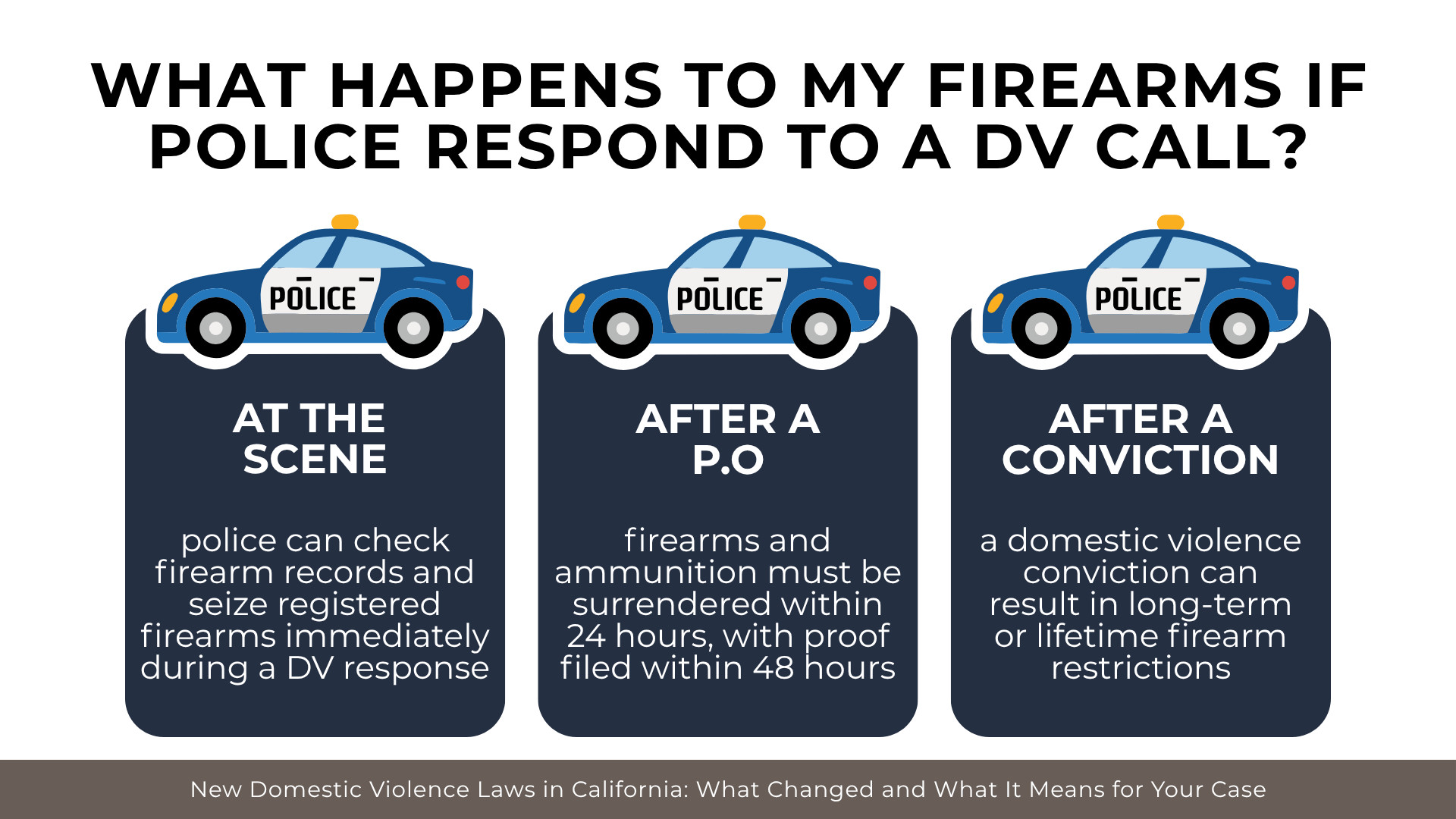
This is where the 2025 changes hit hardest and fastest. AB 2907 requires law enforcement officers responding to a domestic violence call to query the Automated Firearms System — California’s database of registered gun owners — at the scene. If the database shows firearms registered to you, officers are directed to seize them immediately. That information is then forwarded to both the prosecutor and the court, where it affects protective order conditions and bail decisions.
Firearms consequences no longer begin at conviction or even at arraignment. They begin the moment an officer arrives.
California law already imposed strict surrender requirements. Under Penal Code § 136.2(d), if you are subject to a criminal protective order in a DV case, you must surrender all firearms and ammunition within 24 hours of service to local law enforcement or a licensed dealer. You must also file proof of compliance with the court within 48 hours. Family Code § 6389 imposes similar requirements for civil DVROs. AB 2907 moved the starting line earlier — to the initial police contact — and eliminated the gap between the call and the court order where firearms might otherwise remain accessible.
The constitutional foundation for these restrictions was reinforced in 2024. In United States v. Rahimi, 602 U.S. 680 (2024), the Supreme Court held 8–1 that 18 U.S.C. § 922(g)(8) — the federal statute barring firearms possession by persons subject to qualifying DV restraining orders — is consistent with the Second Amendment. The Court identified Founding-era surety laws and “going armed” statutes as sufficient historical analogues under the Bruen framework. That holding settled years of post-Bruen uncertainty about whether DV-related firearms restrictions could survive constitutional challenge.
California is actively enforcing these provisions. As of January 1, 2025, the state’s Armed and Prohibited Persons System identified 25,911 prohibited persons among California’s 3.63 million known firearm owners. The Department of Justice recovered 1,520 firearms from illegally armed individuals. Individuals prohibited at least in part due to a restraining order make up over half of those disarmed. In 2022, California allocated $40 million to establish the nation’s largest court-based firearm relinquishment program for DV-prohibited individuals.
The most important piece of this picture is often the one people learn about too late. The federal firearms disability under 18 U.S.C. § 922(g)(9) — the Lautenberg Amendment — permanently bars firearms and ammunition possession after conviction of a misdemeanor crime of domestic violence. This is a lifetime ban with no federal restoration process. California’s expungement under Penal Code § 1203.4 does not remove it. The statute explicitly does not restore firearms rights, which means the federal exception for expunged convictions at § 921(a)(33)(B)(ii) does not apply. Reliable paths to restoration may include a full and unconditional governor’s or presidential pardon, administrative relief from ATF, or, in limited cases, court-based relief under a specific state program.
Can I Be Charged for Controlling Behavior That Wasn’t Physical?
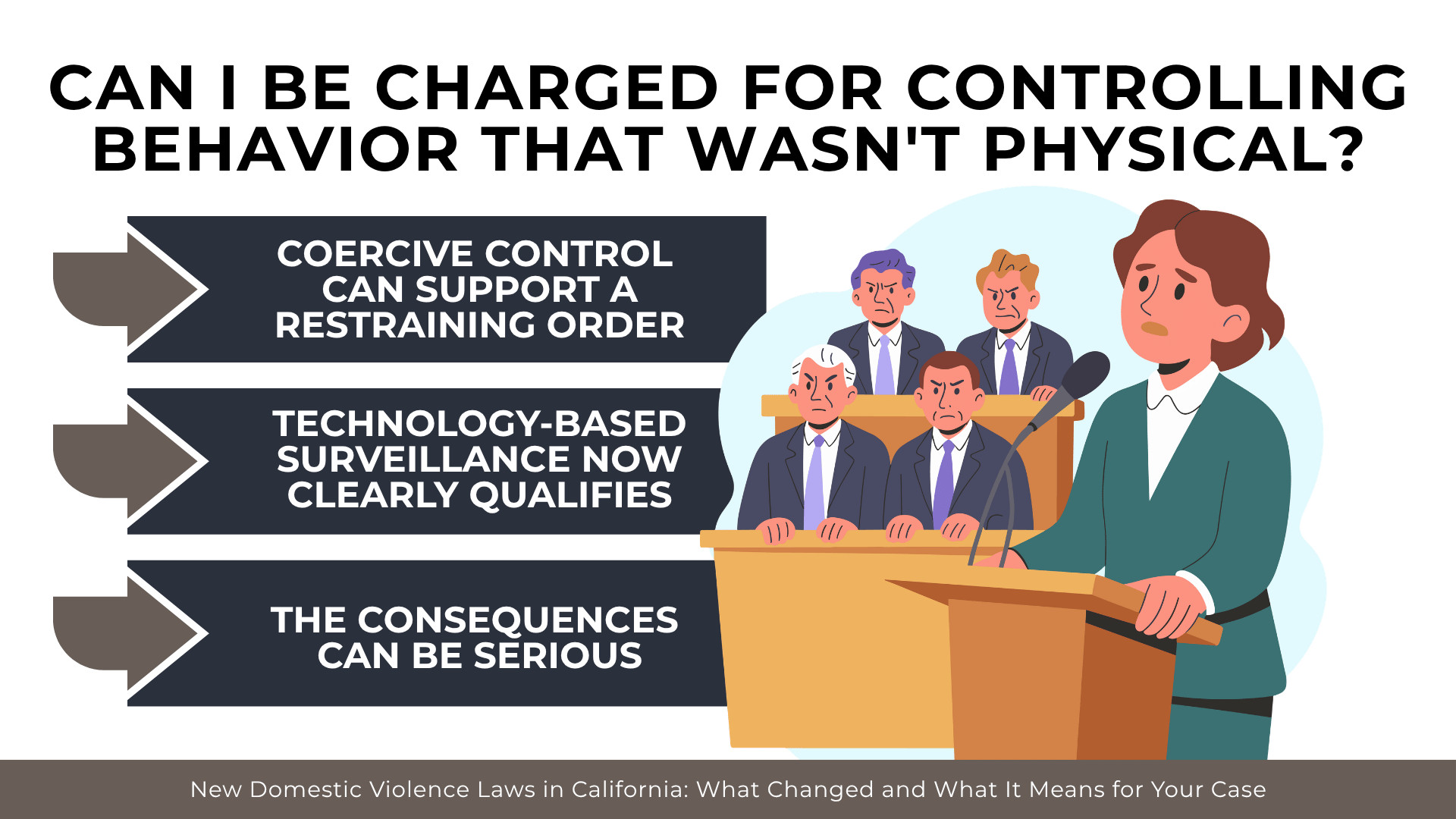
California has been expanding the legal definition of domestic violence beyond physical acts for several years, and the most recent change continued that trend. Effective January 1, 2026, SB 50 amended Family Code § 6320 to explicitly include the misuse of connected devices — smart home systems, location-tracking technology, and internet-connected platforms — as a form of coercive control. The same bill added reproductive coercion to the statutory examples of coercive control, defined as control over another person’s reproductive autonomy through force, threat of force, or intimidation.
This builds on the rules California established when it added coercive control to § 6320’s definition of “disturbing the peace of the other party.” Under that provision, abuse is not limited to physical injury. It includes a pattern of behavior that unreasonably interferes with a person’s free will and personal liberty — conduct such as isolating someone from friends and family, controlling their finances, depriving them of basic necessities, monitoring their movements, and threatening to report their immigration status.
SB 50 did not create a new criminal offense. What it did is make explicit that surveillance and control carried out through connected technology qualifies as conduct that can support a DVRO. If you are accused of monitoring a partner through a shared smart home system, tracking their location via a connected vehicle, or remotely controlling household devices, this amendment removes any remaining question. That behavior falls within the statute’s reach.
What this means for your defense is clear: the range of behavior that can trigger a restraining order — and the firearms prohibitions, custody implications, and other consequences that follow from it — continues to grow.
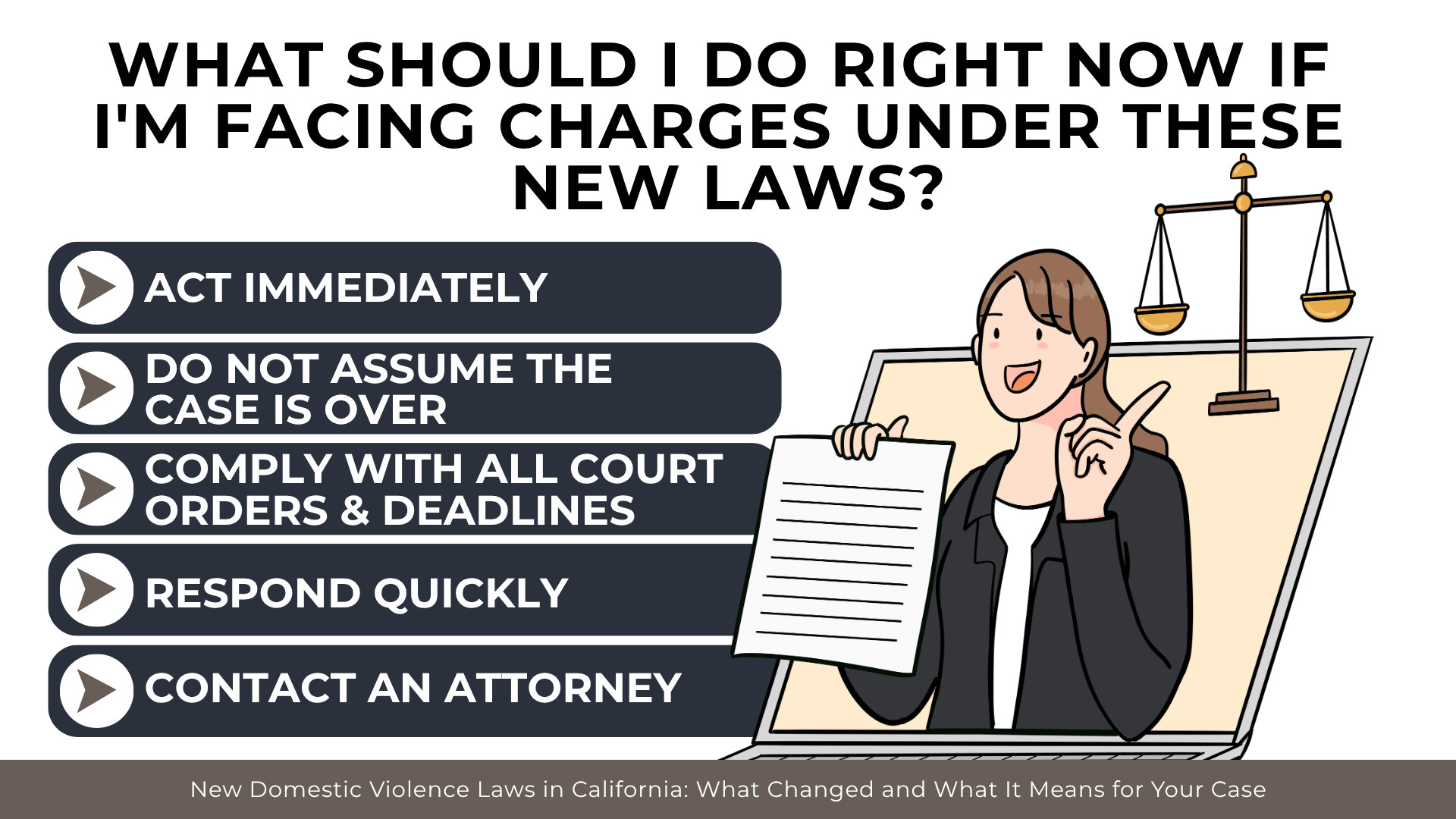
What Should I Do Right Now if I’m Facing Charges Under These New Laws?
The changes California made in 2025 and 2026 shortened the timeline for action at every stage. Firearms can be seized at the scene before charges are filed. Protective orders can be requested from any county in the state through a streamlined process that limits a court’s ability to deny them on procedural grounds. Prosecutors now have seven years to file felony charges under PC 273.5, meaning an investigation that appeared to have gone quiet may not be over.
What this means practically is that waiting — to retain a lawyer, to understand the charges, to respond to a protective order — carries more risk now than it did before these laws took effect. The 24-hour firearms surrender deadline, the 48-hour proof-of-compliance filing, and the shortened restraining order process all create pressure points. The wrong move — or no move at all — can produce consequences that last for years.
At Angelo Reyes Law in Carlsbad, attorney Angelo Reyes handles criminal defense cases across San Diego County with a trial-first approach — preparing every case as though it is going to a jury, which creates leverage whether the matter resolves through negotiation or at trial. Clients work directly with Angelo, not a paralegal or associate. His case results include a 25-to-life case dismissed, attempted murder reduced to battery, and felony strike exposures reduced to simple misdemeanors.
If you are dealing with a domestic violence charge, a protective order, or a situation that could become either one, the time to get legal counsel is before the next deadline — not after it passes. Contact Angelo Reyes Law for a consultation.