Being charged with being under the influence of a controlled substance in California means the prosecution believes you willfully used a drug listed on California’s controlled substance schedules. It also means they believe you were impaired by that drug at the time law enforcement made contact with you. This is a charge under California Health and Safety Code § 11550, and it is generally treated as a misdemeanor. But it is also one of the most defensible drug charges in California, with multiple paths to getting the case dismissed entirely.
This page covers what the prosecution typically has to prove, what penalties you may be facing, which defense strategies work, and what to do next.
What Does “Under the Influence of a Controlled Substance” Actually Mean in California?
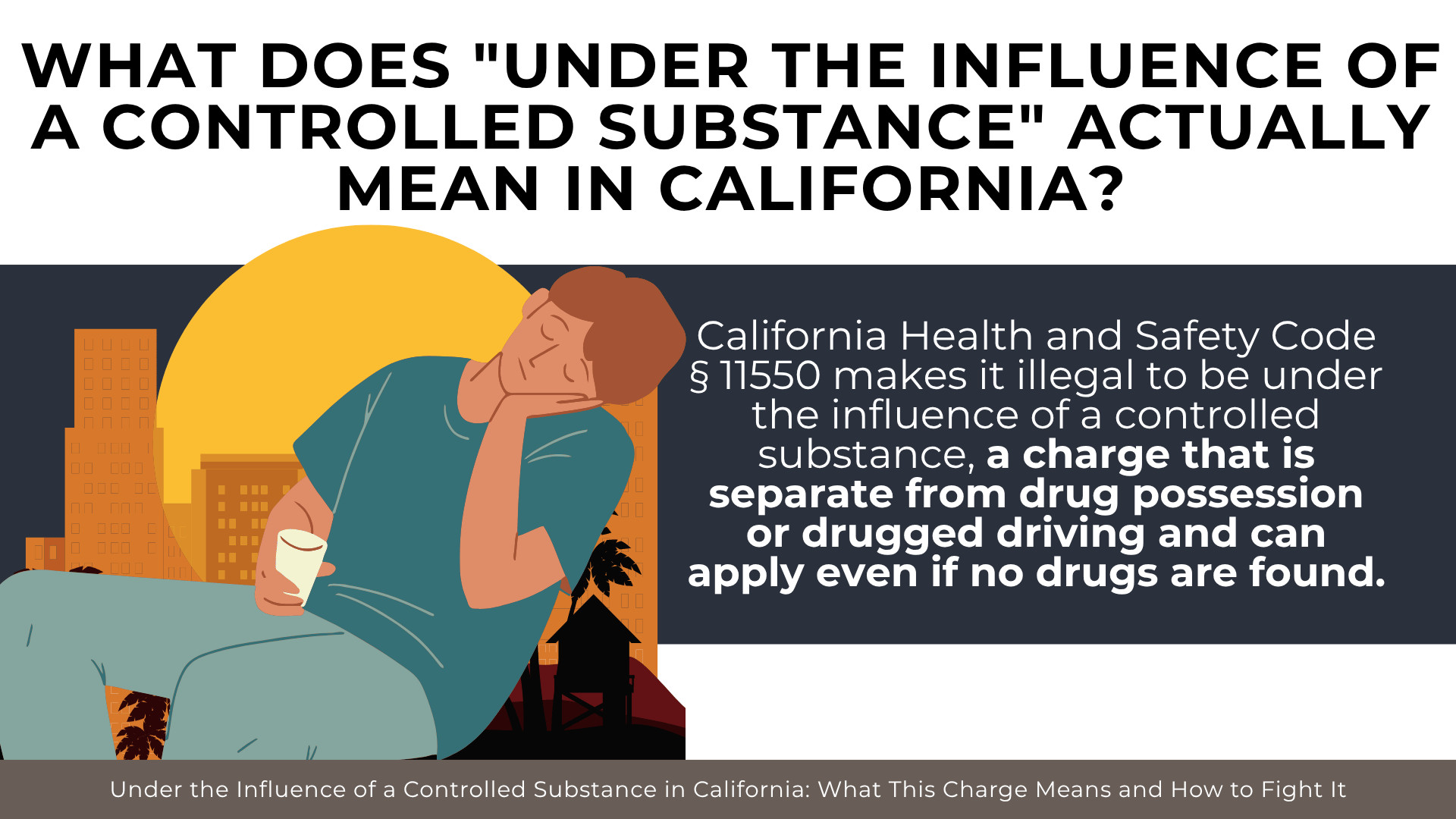
California Health and Safety Code § 11550 makes it an offense to be under the influence of a controlled substance. That sounds straightforward, but the legal definition is narrower than most people assume.
The substance must appear on California’s controlled substance schedules, listed in Health and Safety Code §§ 11054–11058. These five schedules cover drugs from heroin and LSD (Schedule I) to methamphetamine, cocaine, and fentanyl (Schedule II), along with lower-schedule substances. Cannabis is carved out for adult personal use under Proposition 64. The schedule requirement matters because not every substance an officer suspects is illegal actually qualifies — and the prosecution must prove the substance is in fact a controlled substance, not merely assert it.
This charge is not the same as drug possession, and it is not the same as driving under the influence of drugs. It is its own offense, with its own elements, its own evidence requirements, and its own defense strategies. You can be charged under § 11550 even if police never found drugs on you. On the other hand, someone found holding a controlled substance might face a possession charge but not an under-the-influence charge. Understanding this distinction is the starting point for understanding the case.
What Does the Prosecution Have to Prove to Convict Me?
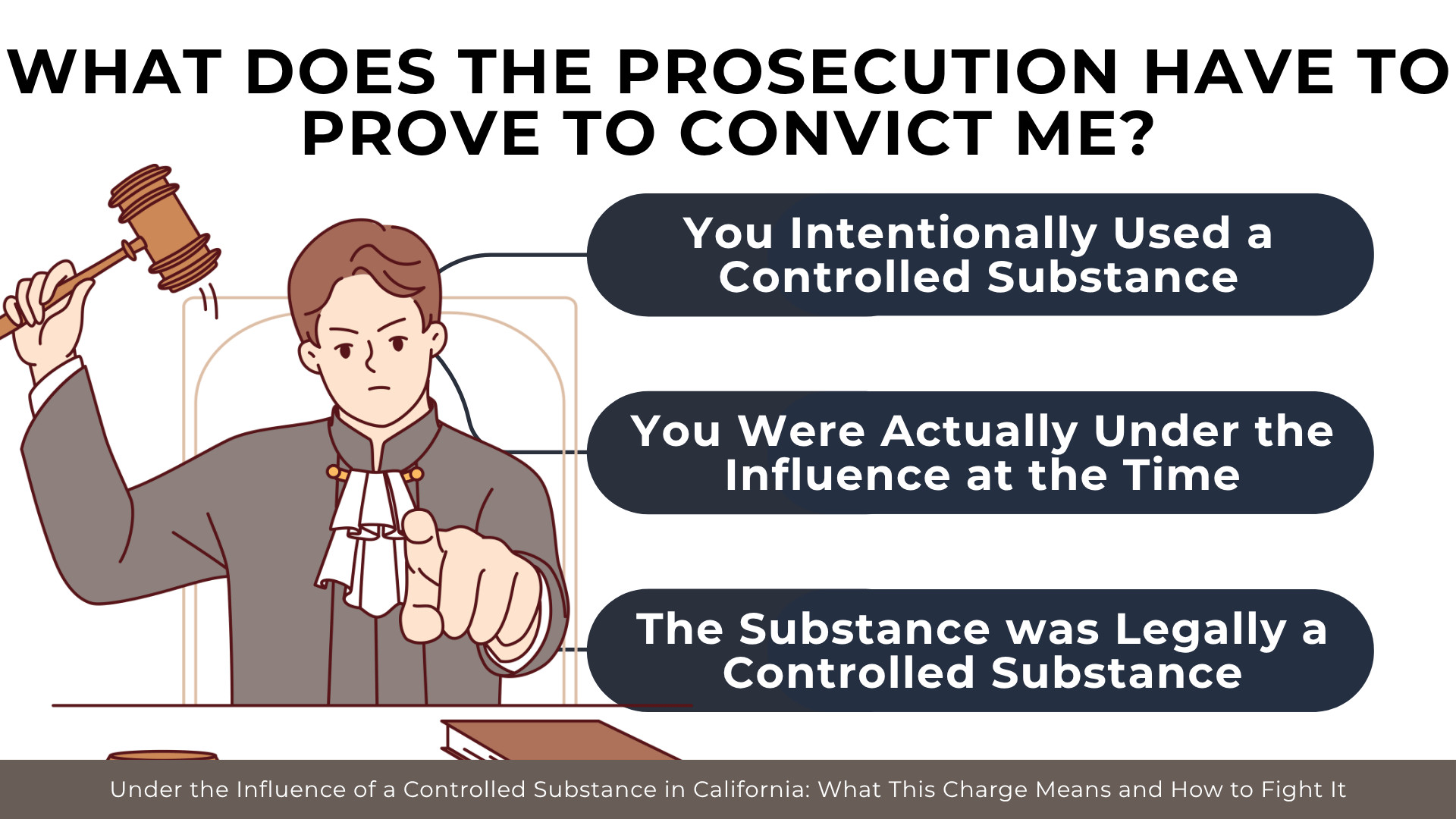
To secure a conviction under § 11550, the prosecution generally must establish several things beyond a reasonable doubt.
First, that you willfully used a controlled substance. “Willfully” means the use was intentional — not accidental, unknowing, or coerced. Someone who was drugged without their knowledge, or who took a substance not realizing what it contained, has not willfully used a controlled substance.
Second, that you were under the influence of that substance at the time of contact with law enforcement. This typically means more than just having a substance in your system. The prosecution must show the substance noticeably affected your nervous system, brain, or muscles, or impaired your ability to function in the way an unimpaired person would under similar circumstances. Prosecutors typically try to prove this through the arresting officer’s observations — things like pupil dilation, slurred speech, unsteady walking, or erratic behavior. They may also rely on Drug Recognition Expert evaluations and chemical testing of blood or urine.
Third, that the substance in question is actually a controlled substance under California law. This is not a formality. Under People v. Davis (2013) 57 Cal. 4th 353, the People must show competent evidence or a stipulation about a substance’s chemical structure or effects to establish that it qualifies as a controlled substance. The prosecution cannot simply assert that a substance is illegal — they must prove it.
Each of these elements is a separate point where the prosecution’s case can fail, and each one opens a distinct line of defense.
What Are the Penalties If I’m Convicted?
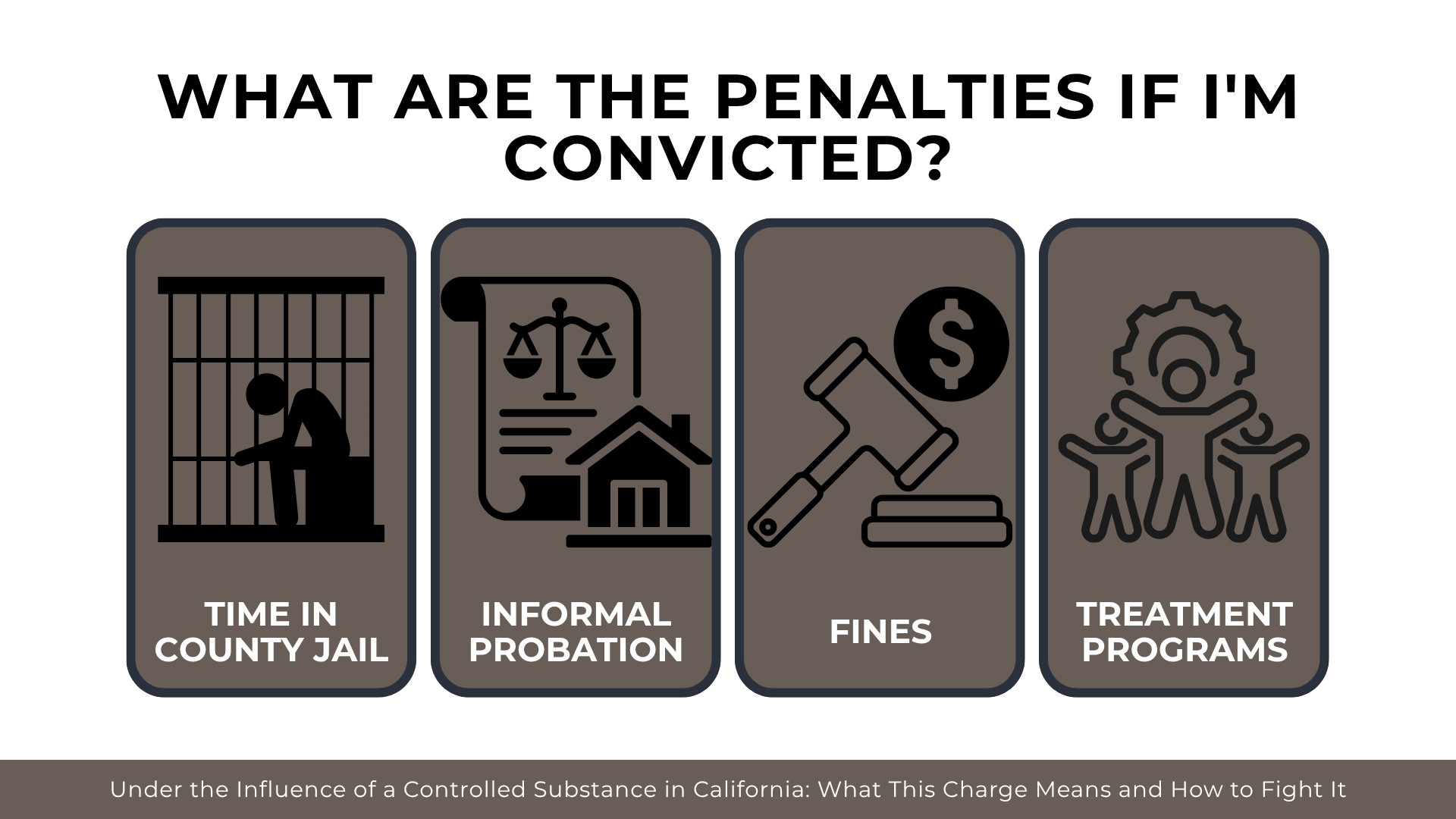
A conviction under Health and Safety Code § 11550 is generally a misdemeanor. Penalties may include up to one year in county jail, informal probation, fines, and mandatory participation in a drug counseling or treatment program. Repeat offenses or cases involving specific aggravating circumstances can carry increased mandatory minimum jail terms.
Context matters here. The reality of how California handles drug cases in practice is considerably less severe than the maximum penalties allowed by law suggest. Statewide, approximately 3% of California’s state prison population in 2025 was imprisoned for drug crimes. The most common sentence for adult felony convictions overall is probation with jail — not a prison term. For a misdemeanor under-the-influence charge, the likelihood of significant custody time is lower still. That is especially true for a first offense and when the defense presents a credible case for treatment.
What Defenses Actually Work Against This Charge?
The prosecution’s case under § 11550 depends on subjective observations, interpretive evaluations, and chemical tests that measure presence rather than impairment. Each of these creates a realistic avenue of attack.
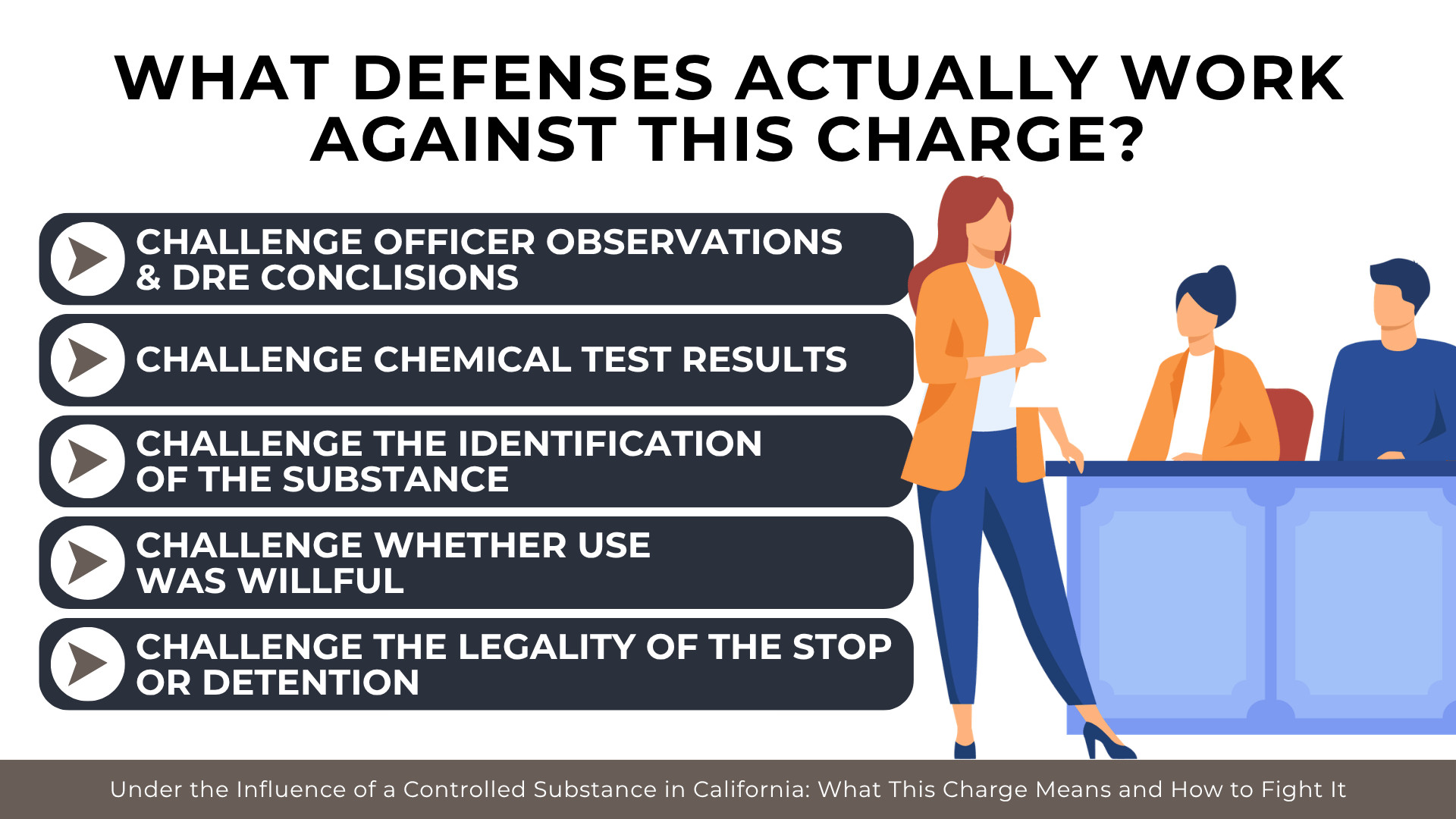
Challenging officer observations and DRE conclusions. The symptoms officers document as signs of drug influence — pupil dilation, sweating, rapid heartbeat, unsteady balance, disorientation — can all have entirely innocent explanations. Medical conditions, prescription medications, fatigue, anxiety, and even the stress of being stopped by police can produce identical symptoms. If the prosecution’s case rests heavily on what the officer saw and interpreted, the defense can introduce alternative explanations. Those alternatives can create reasonable doubt about whether any controlled substance was actually causing what the officer observed.
Challenging chemical test results. Blood and urine tests can confirm the presence of a substance in the body, but presence is not the same as impairment. Many substances remain detectable in blood or urine long after their effects have worn off. A positive test result does not, by itself, prove that a person was under the influence at the time of the encounter. Chain-of-custody errors, contamination, and testing-protocol failures can further undermine the reliability of chemical evidence.
Challenging the identification of the substance. Under People v. Davis, the prosecution must present competent evidence that the substance involved is actually a controlled substance listed on the California schedules. If the chemical evidence is ambiguous, contested, or absent, this element is vulnerable.
Challenging whether use was willful. If you were unknowingly exposed to a controlled substance — through a spiked drink, mislabeled medication, or secondhand contact — the willfulness element fails. This defense requires supporting evidence, but it is legally recognized and can apply in certain situations.
Challenging the legality of the stop or detention. If law enforcement’s initial contact with you violated the Fourth Amendment or California’s parallel protections under Article I, § 13 of the California Constitution, any evidence obtained may be suppressed under Penal Code § 1538.5. If the encounter that led to the charge was itself unlawful, the evidence it produced may not be admissible — and without that evidence, the case collapses.
At Angelo Reyes Law in Carlsbad, California, every case is prepared as if it’s going to a jury trial. That trial-first approach can create real leverage regardless of whether the matter ultimately resolves through negotiation or at trial. Prosecutors evaluate the strength of a case based on what would happen if it went to verdict. A defense that is visibly prepared to try the case can command different plea offers than one that isn’t.
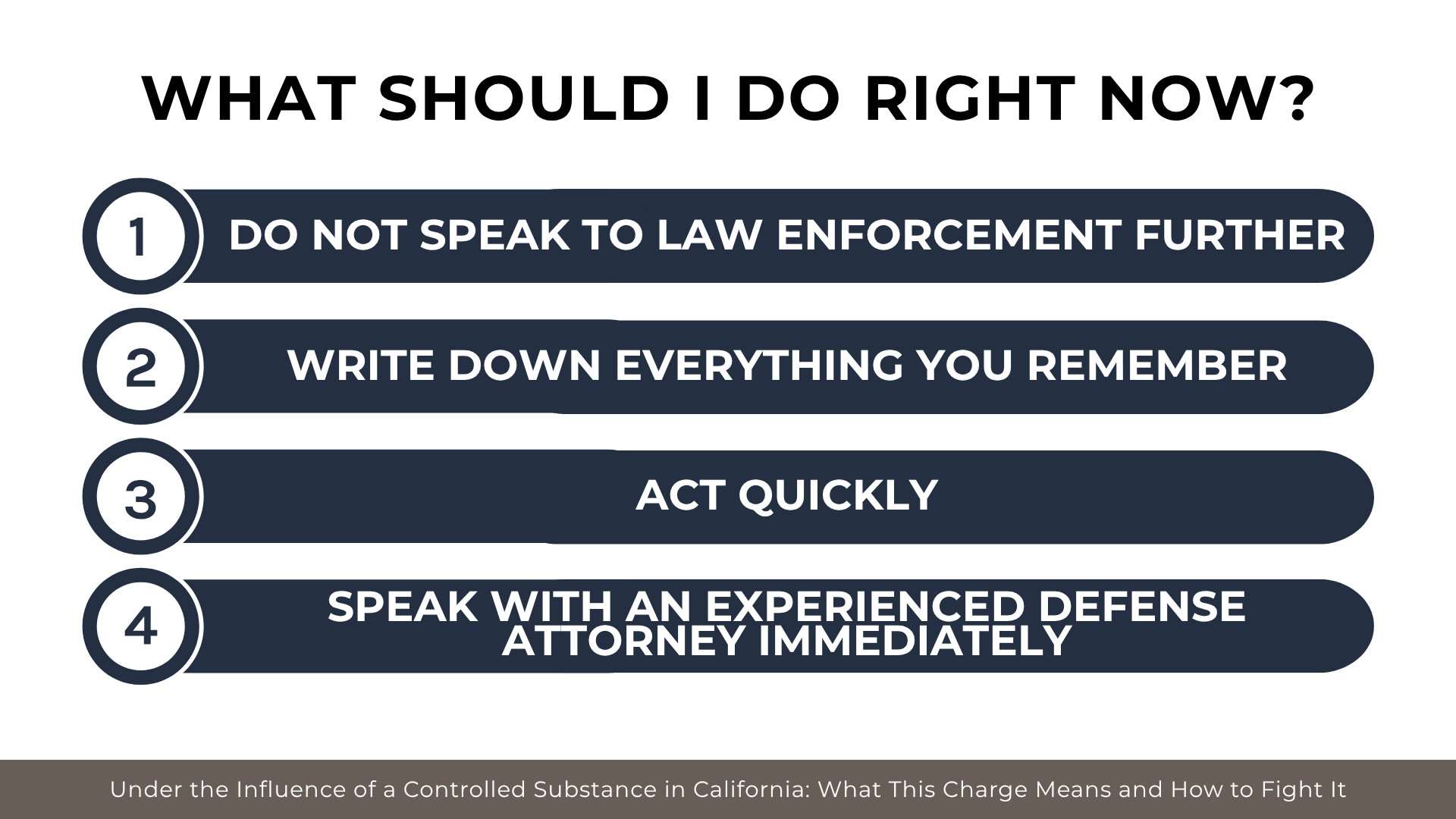
What Should I Do Right Now?
The decisions made in the days immediately following an arrest or charge have a major effect on what outcomes remain available. A few things matter most.
Do not make additional statements to law enforcement about the incident. Anything said can become evidence, and there is no legal obligation to help the prosecution build its case.
Write down everything that can be remembered about the encounter — what was said, what happened, who was present, and in what sequence. Memory degrades quickly, and details that seem minor now may become critical to a defense strategy later.
Understand that time affects what is available. Evidence preservation and witness availability both have windows that narrow as a case ages. The earlier a defense attorney is involved, the more options remain on the table.
Angelo Reyes handles every client’s case personally — not through a paralegal or associate — and has handled thousands of criminal cases across San Diego County. His track record includes felony strike exposures reduced to simple misdemeanors, a 25-to-life case dismissed, and multiple DUI and grand theft dismissals. A consultation is the step that can turn uncertainty into a concrete plan for what comes next.