Roughly seven out of ten domestic violence investigations in California never result in a criminal case being filed. When prosecutors receive only a basic investigation from responding officers, they decline to file charges approximately 70% of the time. A separate review of 135 studies found that only about one-third of reported intimate partner violence offenses result in prosecution. Of those that are prosecuted, roughly half end in conviction.
Those numbers probably feel like a lifeline if you or someone you care about is facing a DV charge. But a system-wide average doesn’t predict what happens in any individual case. Whether a specific case gets dismissed depends on the evidence, the charges, the alleged victim’s cooperation, and the defense strategy — none of which are captured in a single statistic. This page breaks down what the data actually says, why California DV cases get dismissed, what factors push a case in one direction or the other, and how defense attorneys build toward dismissal.
Where Do These Numbers Actually Come From?
California does not publish a single statewide domestic violence dismissal rate. There is no dashboard or annual report that tracks how many DV cases were filed and how many were dismissed across all 58 counties. The statistics that do exist come from a handful of thorough but limited sources.
The most detailed study of DV case processing was conducted by the Bureau of Justice Statistics, which examined 15 large urban counties — including Alameda, Orange, Riverside, San Diego, and Santa Clara. That study found high conviction rates among cases that were actually prosecuted. But it tracked cases from 2002 filings, and no comparable study has been conducted since. The 70% non-filing figure comes from the FBI Law Enforcement Bulletin’s research on how investigation quality affects prosecution outcomes. And the one-third prosecution rate comes from a review of 135 studies across multiple jurisdictions.
What this means for anyone reading this page: the percentages you see quoted online are combinations drawn from different time periods, jurisdictions, and methods. They describe broad patterns in how the system handles DV cases. They do not describe your case. The value in understanding them is not to calculate your odds — it’s to understand what forces actually drive dismissals so you can evaluate where your situation fits.
Why Do Most Domestic Violence Cases Get Dismissed?
DV cases fall apart for clear, recurring reasons. Understanding them matters because each one represents something a defense attorney can investigate, challenge, or leverage.
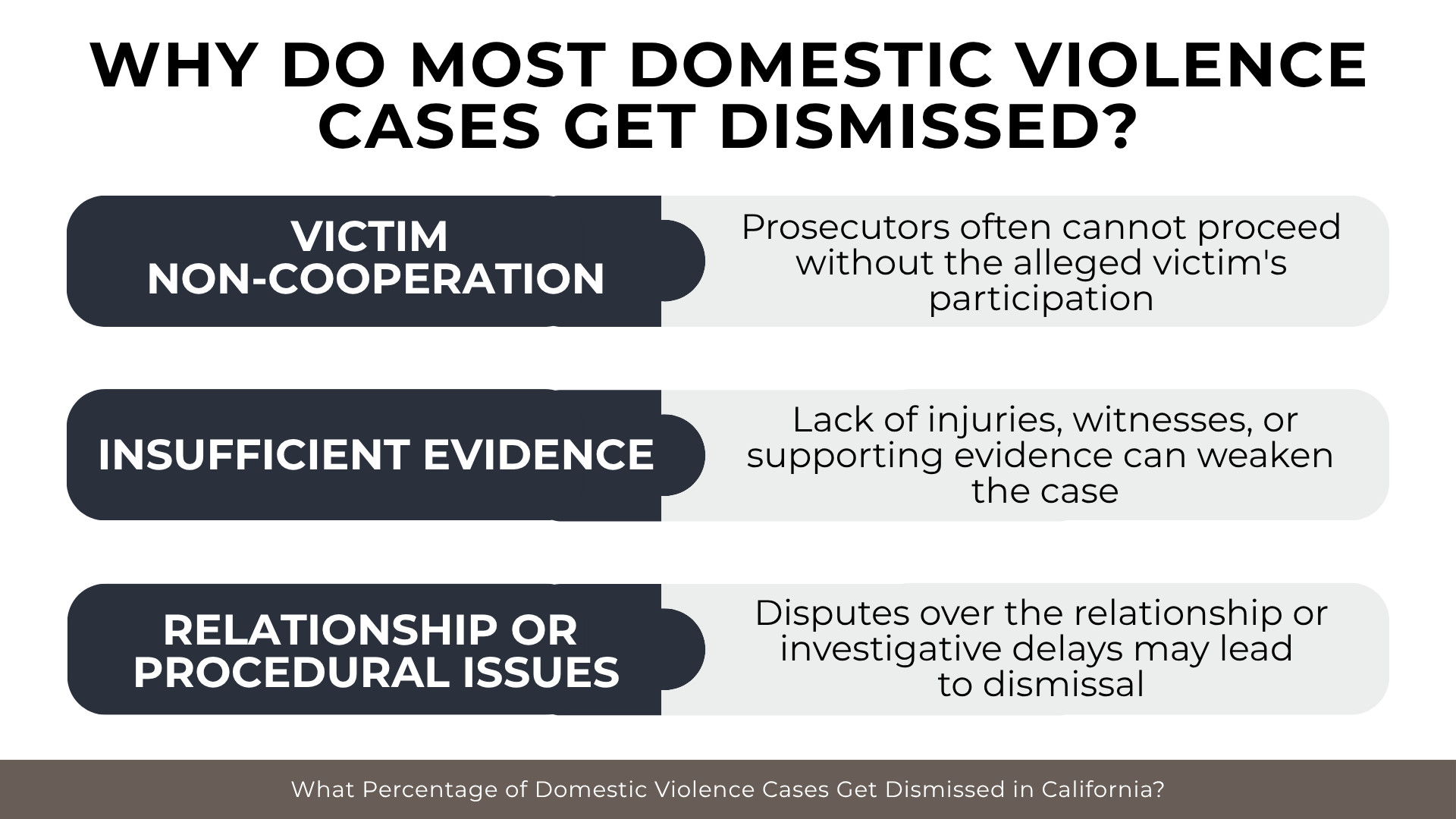
The single largest factor is victim non-cooperation. According to the BJS study of large urban counties, 78% of DV cases that were not prosecuted were dismissed because victims would not cooperate with the prosecution. This doesn’t mean victims formally “dropped charges.” The data reflects prosecutorial decisions about which cases could move forward. In 78% of dismissed cases, the prosecution determined it could not proceed without victim cooperation.
The second major driver is weak or missing evidence of physical injury. Under California Penal Code § 273.5, the more serious DV charge of corporal injury to a spouse or cohabitant requires proof of a “traumatic condition.” The statute defines that as a condition of the body, such as a wound, or external or internal injury, including, but not limited to, injury as a result of strangulation or suffocation, whether of a minor or serious nature, caused by a physical force. Where the prosecution cannot document visible or verifiable injury, charges under PC 273.5 may collapse. The charge may be reduced to misdemeanor domestic battery under PC 243(e)(1), which requires no injury at all — just willful, unlawful touching. Or it may be dismissed entirely if the remaining evidence is thin.
A third reason involves the relationship element itself. California’s criminal DV statutes apply only when the defendant and alleged victim share a qualifying relationship: spouse or former spouse, cohabitant or former cohabitant, fiancé, someone with whom the defendant has or had a dating or engagement relationship, or parent of the defendant’s child. Without that relationship, identical conduct is charged as simple assault or battery rather than a domestic violence offense. Courts have defined “cohabiting” to require a substantial relationship manifested by permanence and sexual or amorous intimacy — as the Court of Appeal held in People v. Holifield, 205 Cal.App.3d 993 (1988). Where the nature of the relationship is truly disputed, the DV classification itself can be challenged.
Finally, delays in the investigative process matter more than most people realize. Research cited in the FBI Law Enforcement Bulletin found that when a police report takes more than 30 days to reach the prosecutor, prosecution likelihood drops by 50%. Evidence weakens, witnesses become harder to locate, and the case loses momentum.
What Makes a Specific Case More Likely to Be Dismissed?
The factors that push toward dismissal are the mirror image of what makes a case strong for the prosecution. Here’s what tends to matter most.
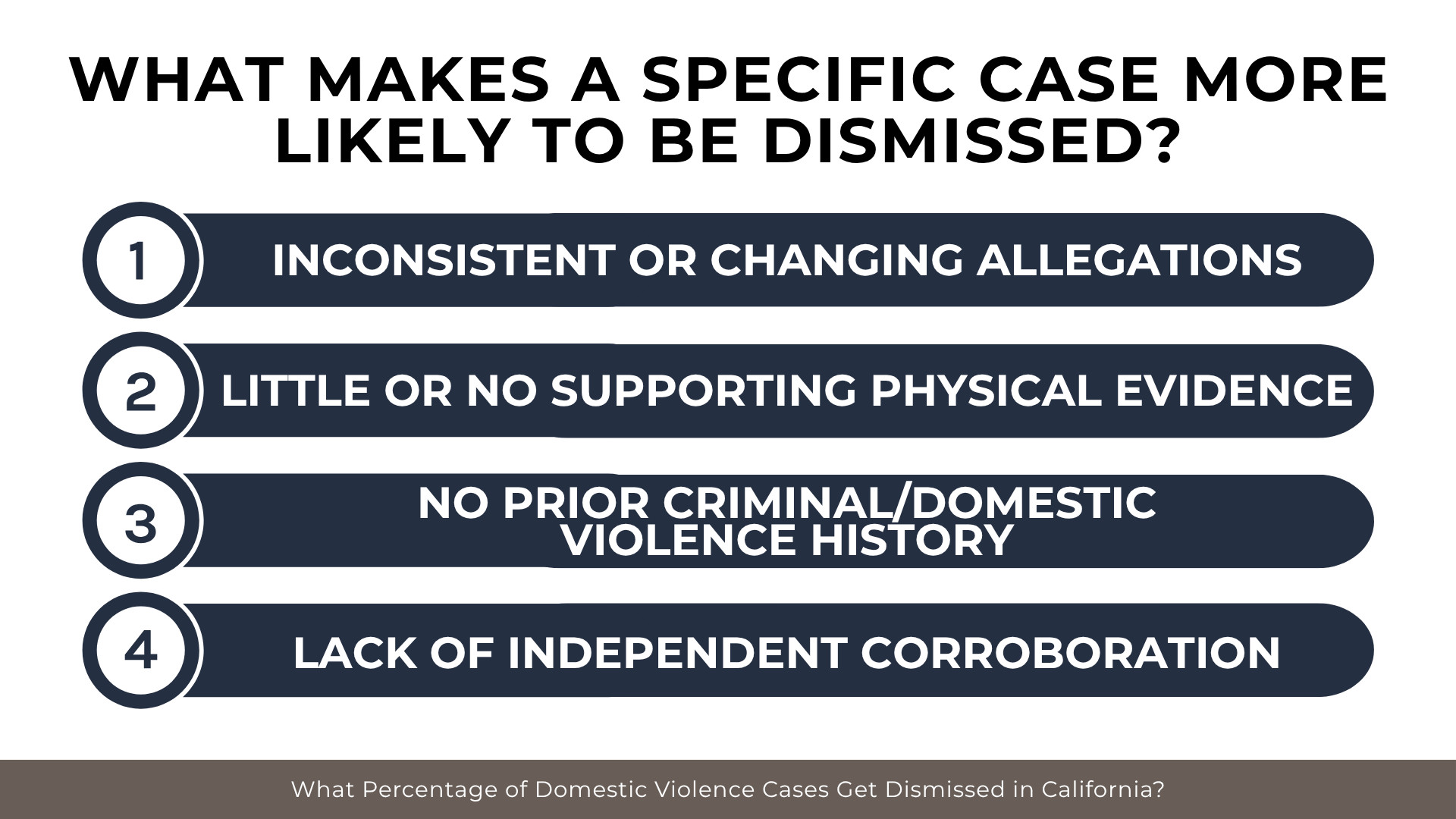
The strength and consistency of the alleged victim’s account is central. If the alleged victim’s statements to police, in 911 calls, and in later interviews contain significant inconsistencies, the prosecution’s case weakens. If the alleged victim later takes back their statement or provides a significantly different version of events, the problem deepens. Prosecutors may still proceed using the original statements, though.
Physical evidence — or the lack of it — carries a lot of weight. Photographs of injuries, medical records, and body camera footage from responding officers can make a case difficult to challenge. On the other hand, the absence of visible injury, a lack of photographs, or medical records that don’t support the allegations can make it difficult for the prosecution to meet its burden, particularly on the traumatic-condition element required for PC 273.5.
Prior criminal history changes the equation significantly. The BJS study found that DV aggravated assault defendants in large urban counties had an overall conviction rate of 86.5%. That figure includes cases with defendants who had prior records. A first-time accusation with no criminal history presents a very different situation for the prosecution than a case involving someone with prior DV convictions.
Whether independent witnesses or supporting evidence exist also matters. A case that relies entirely on one person’s account, with no 911 recording, no eyewitnesses, no photographs, and no medical documentation, is far more vulnerable to dismissal than one supported by multiple forms of evidence. Research shows that when police reports indicate more than one crime occurred, prosecution likelihood improves by 260–300%. This suggests that cases with more evidence of severity are pursued more aggressively.
What Happens If the Alleged Victim Doesn’t Want to Press Charges?
This is often the real question behind the search. Many people searching for dismissal rates are hoping that the alleged victim’s unwillingness to participate will end the case.
It might. But it doesn’t have to.
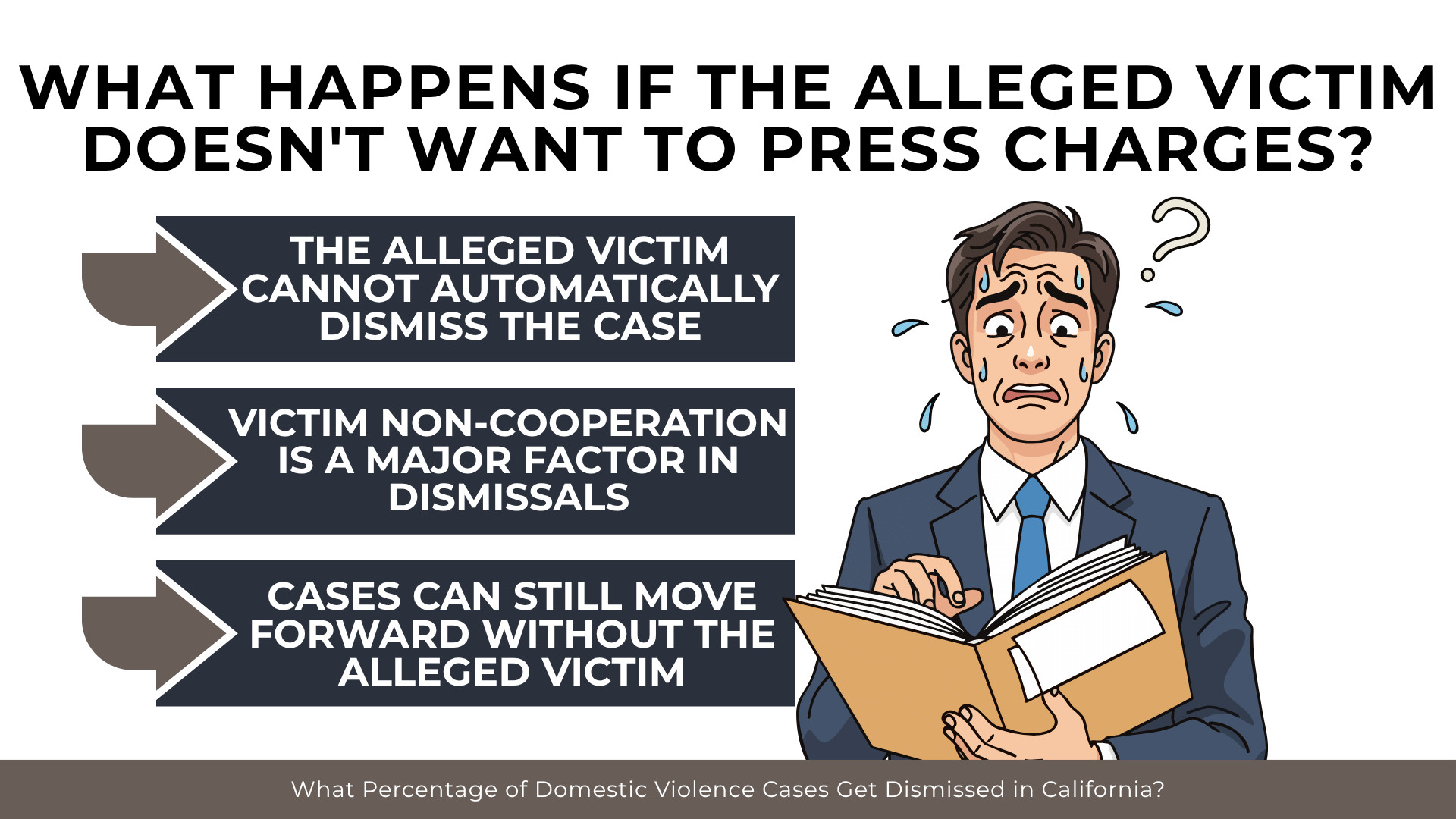
The data in the BJS study reflects prosecutorial decisions — not victim choices — about which cases move forward. The alleged victim does not on their own control whether charges are filed or dropped. That said, the data is clear: victim non-cooperation is the leading documented reason DV cases are dismissed, accounting for 78% of non-prosecuted cases in the BJS study.
The reason this doesn’t guarantee a dismissal is that California prosecutors can build a case using other evidence. That includes 911 call recordings, statements the alleged victim made to officers at the scene, body camera footage, photographs of injuries, medical records, and testimony from neighbors or other witnesses. If that evidence is strong enough, the prosecution can proceed even without the alleged victim’s testimony.
What this means practically is that an uncooperative alleged victim significantly improves the chances of dismissal, but the outcome depends on what other evidence exists. A defense attorney’s job in this situation is to evaluate the full picture of the evidence — not just the alleged victim’s current position. The goal is to identify where the prosecution’s case has gaps that can’t be filled without cooperation that isn’t coming.
How Does a Defense Attorney Actually Get a DV Case Dismissed?
Dismissals don’t happen because you get lucky. They happen because specific weaknesses in the prosecution’s case are identified, documented, and pressed — either through pretrial negotiation or preparation that makes the case impossible to bring to trial.
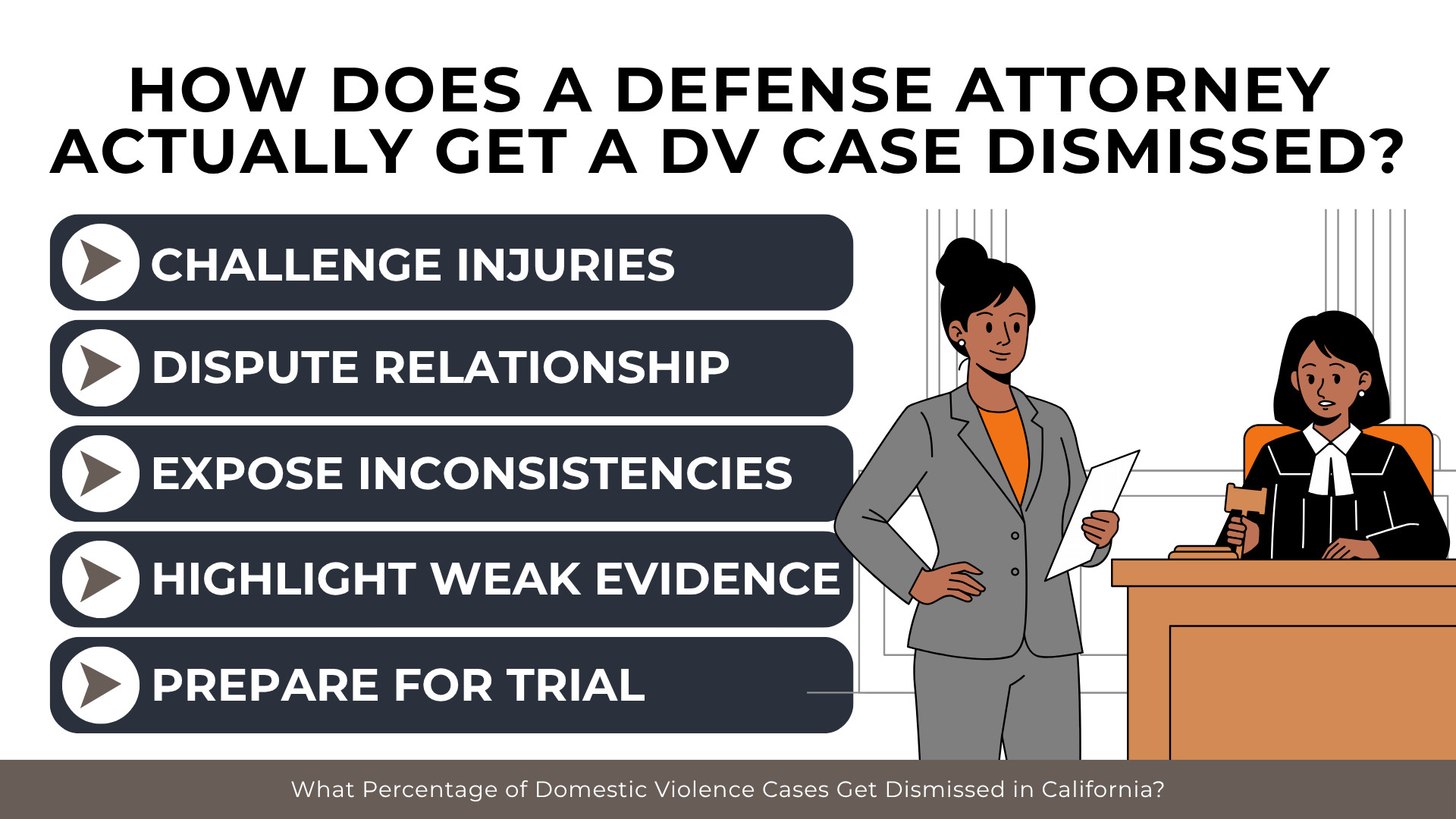
A defense attorney evaluating a DV case for dismissal potential is looking at the same pressure points the data identifies. Is the traumatic-condition element actually supported by evidence, or is the prosecution relying on the alleged victim’s description of pain alone? The Court of Appeal held in People v. Abrego, 21 Cal.App.4th 133 (1993), that pain alone — soreness and tenderness without evidence of even a minor physical injury — is not enough to establish a traumatic condition under PC 273.5. If the evidence doesn’t meet that threshold, the felony charge shouldn’t survive.
Is the relationship element actually established? If you and the alleged victim were not in a qualifying relationship under the statute — if the cohabitation claim doesn’t meet the standard of a substantial relationship manifested by permanence and intimacy — the DV classification can be challenged at its foundation.
Are there inconsistencies in the alleged victim’s account that undermine the prosecution’s ability to prove its case beyond a reasonable doubt? Are there gaps in the physical evidence — missing photographs, missing medical records, no body camera footage — that leave the case dependent on testimony that may not hold up?
And most importantly, is the alleged victim cooperating with the prosecution? If not, what evidence remains, and is it sufficient to support a conviction without that testimony?
Each of these questions is something a defense attorney investigates through discovery review, independent investigation, and witness interviews. The attorneys who get DV cases dismissed most consistently are the ones who prepare every case as though it’s going to trial. That preparation is what creates leverage, whether the case ultimately resolves through negotiation or goes before a jury.
Talk to a California Criminal Defense Attorney About Your Case
Statistics describe what happens across thousands of cases. They don’t describe what will happen in yours. The evidence in your case, the charges filed, the county where it’s being prosecuted, and the alleged victim’s position are what determine the outcome. Those are things that require an attorney to evaluate, not a search engine.
At Angelo Reyes Law in Carlsbad, California, founder and lead trial attorney Angelo J. Reyes handles criminal defense cases across San Diego County with a trial-first preparation approach — every case is prepared as if it’s going to a jury, which creates leverage whether the matter resolves through negotiation or at trial. Clients work directly with Angelo, not a paralegal or associate. If you’re facing a domestic violence charge in California and want to understand where your case stands, contact Angelo Reyes Law to discuss your situation.