
If you’re reading this, chances are you or someone close to you just picked up a third DUI charge in California. You already know this is serious — you’ve been through the system before. But a third offense is a different situation entirely. The penalties get steeper, the mandatory minimums get harder to avoid, and the margin for error shrinks.
Here’s something worth knowing right away: a third DUI in California is still a misdemeanor in most cases. That doesn’t mean the consequences are minor — they aren’t — but it means you’re not automatically facing felony charges. What matters now is understanding exactly what’s on the table and making smart decisions quickly, because some of the most important deadlines start running the day you’re arrested.
California counts prior DUI offenses using a ten-year lookback period measured from arrest date to arrest date. So if your first two DUIs resulted in convictions (or even “wet reckless” plea reductions, which count as priors), and all three arrests fall within the same ten-year window, this one will be sentenced as a third offense with all the enhanced penalties that come with it.
Criminal Penalties for a 3rd DUI in California
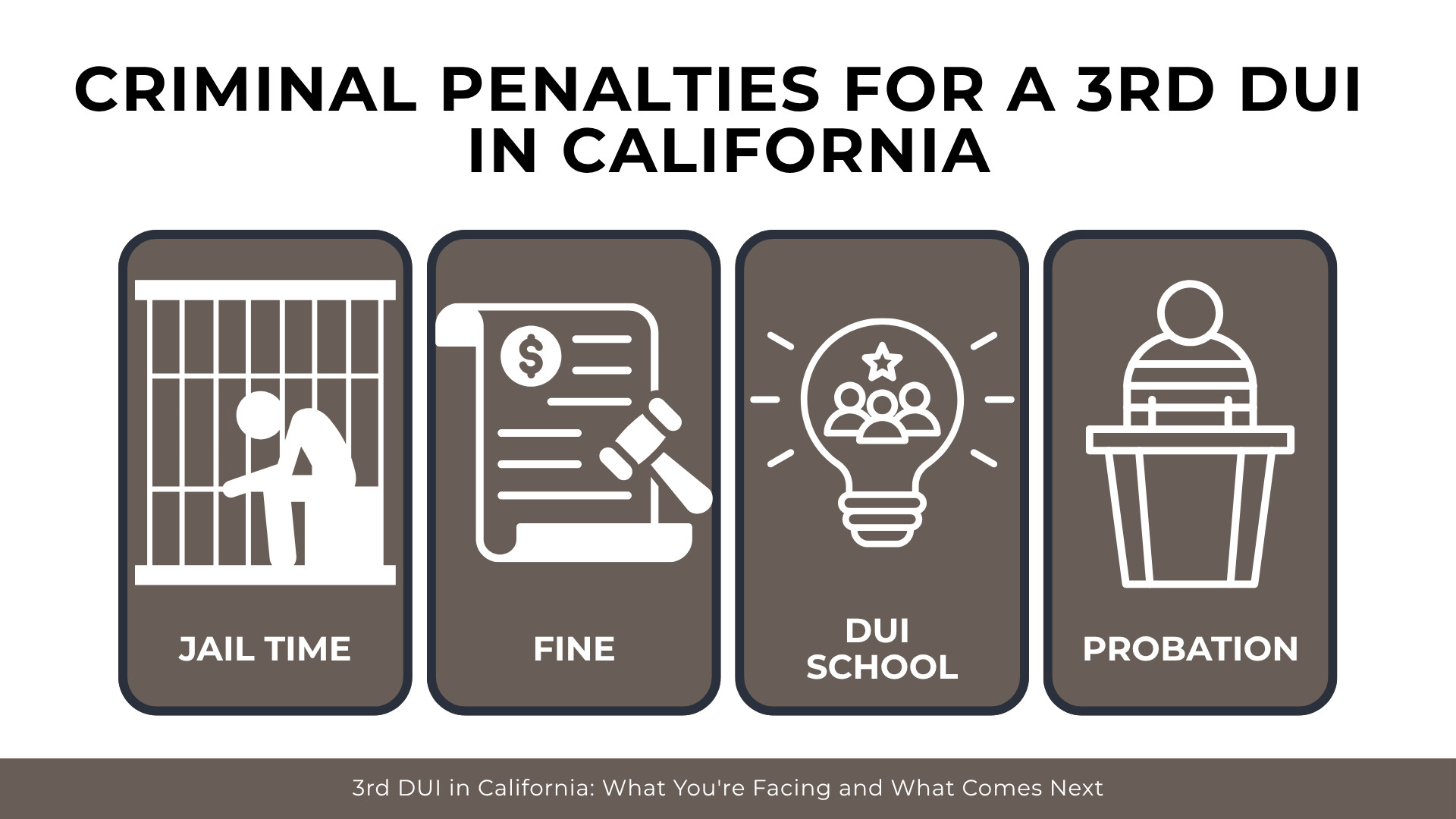
The penalties for a third DUI conviction under California Vehicle Code § 23546 are significantly harsher than what you experienced the first two times around.
Jail time is the biggest change. A third offense carries a mandatory minimum of 120 days in county jail, with a maximum of one year. Unlike a first or second DUI where jail time is often reduced, waived, or converted to community service, the 120-day floor on a third offense is much harder to work around.
Fines range from $390 to $1,000 in base amounts, but that number is misleading. California’s penalty assessments, court fees, and surcharges routinely push the actual out-of-pocket cost to several thousand dollars.
DUI school is mandatory and substantially longer than what’s required for a first or second offense.
Probation will run between three and five years under Vehicle Code § 23600(b)(1), with a zero-tolerance condition — meaning any detectable amount of alcohol while driving during probation is a separate violation.
One thing that catches people off guard: California’s DUI statute under Vehicle Code § 23640 expressly prohibits judicial diversion for DUI offenses. The court in Grassi v. Superior Court (2021) and again in Tan v. Superior Court (2022) confirmed that DUI is categorically excluded from misdemeanor diversion programs. There is no option to complete a program and have the charge dismissed. If you’re convicted, it stays on your record.
What Happens to Your License
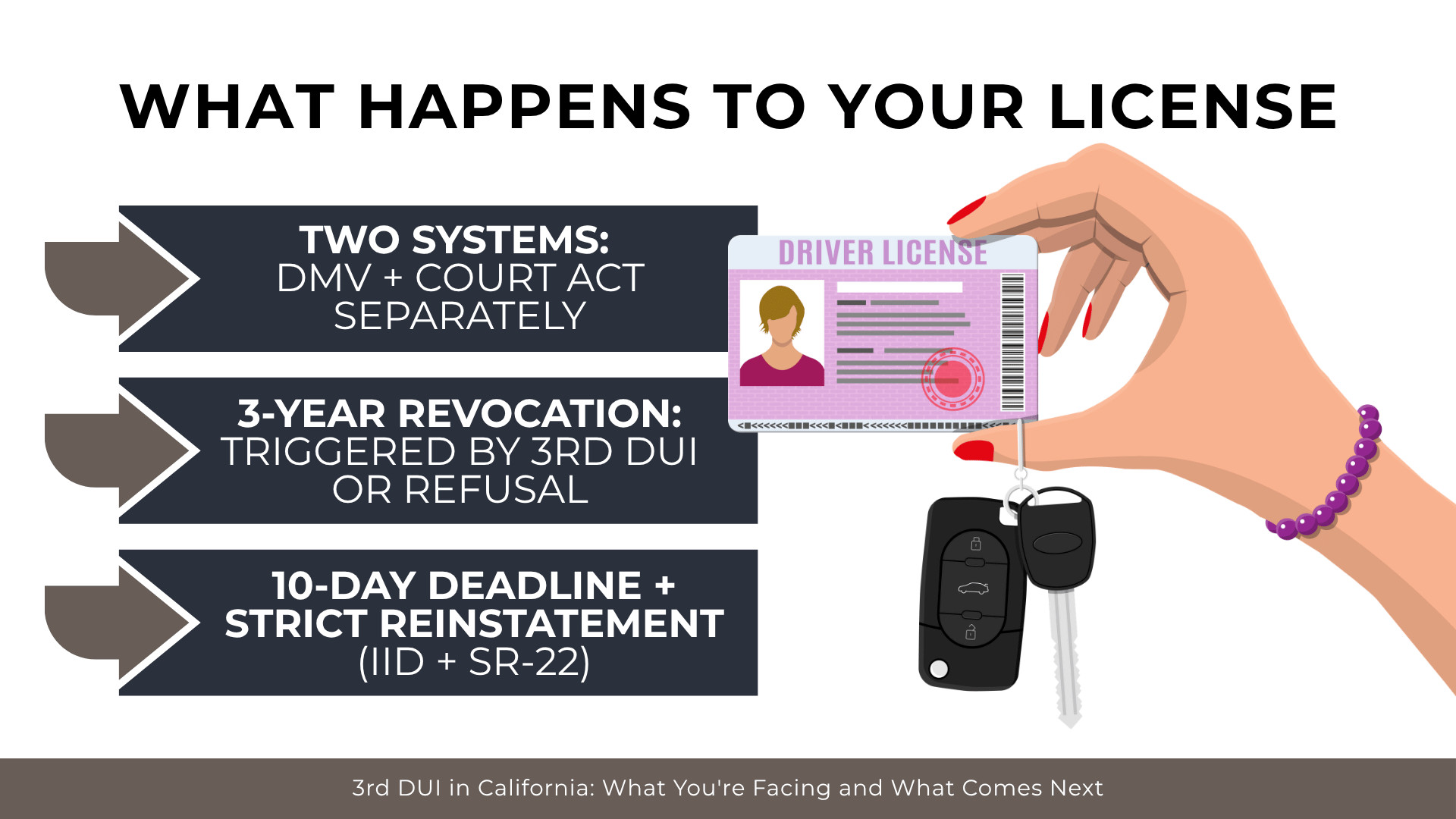
California runs two completely separate proceedings after a DUI arrest — the criminal case in court and an administrative action through the DMV. You can win one and lose the other. They operate on different timelines, different burdens of proof, and different rules.
On the DMV side, the Administrative Per Se (APS) program under Vehicle Code § 13353.2 triggers an automatic license suspension when a chemical test shows a BAC at or above 0.08%. For a third offense, the DMV will revoke your license for three years. If you refused the chemical test, the revocation is also three years under Vehicle Code § 13353, but with an added sting — refusal suspensions carry no eligibility for a restricted license.
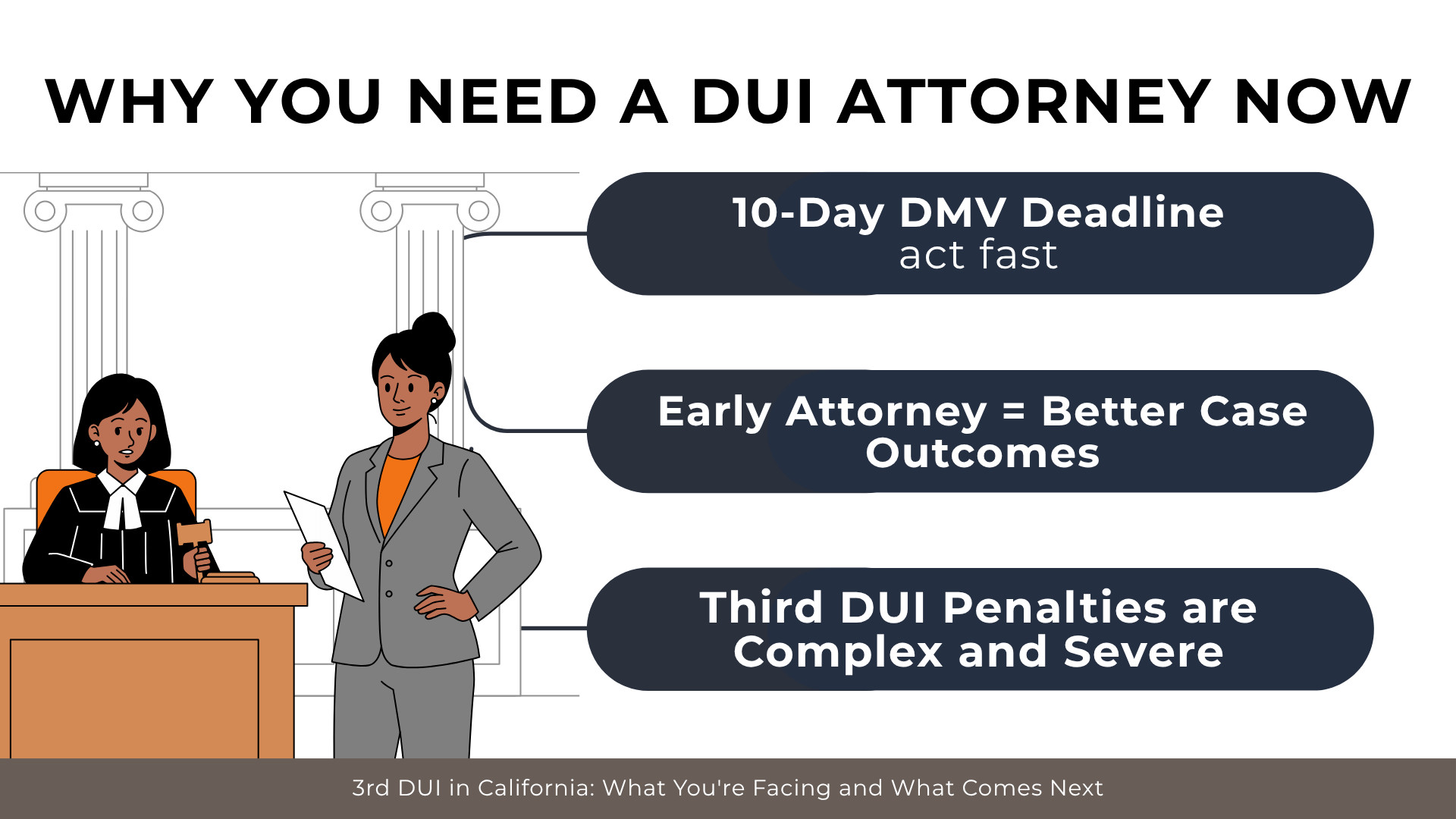
The 10-day deadline matters. Under Vehicle Code § 13558, you have exactly ten calendar days from the date you receive the suspension notice to request an APS hearing. If you miss that window, the suspension takes effect automatically at 30 days with no opportunity to contest it or obtain a stay. This is one of the most time-sensitive decisions you’ll face.
On the court side, a conviction triggers a separate three-year license revocation under Vehicle Code § 13352.
After revocation, reinstatement requires an ignition interlock device (IID) installed for 24 months under the statewide IID program per Vehicle Code § 23575.3, plus SR-22 proof of financial responsibility for three years under Vehicle Code § 13352.4. SR-22 insurance is significantly more expensive than standard coverage, and any lapse restarts the clock.
Aggravating Factors That Can Make It Worse
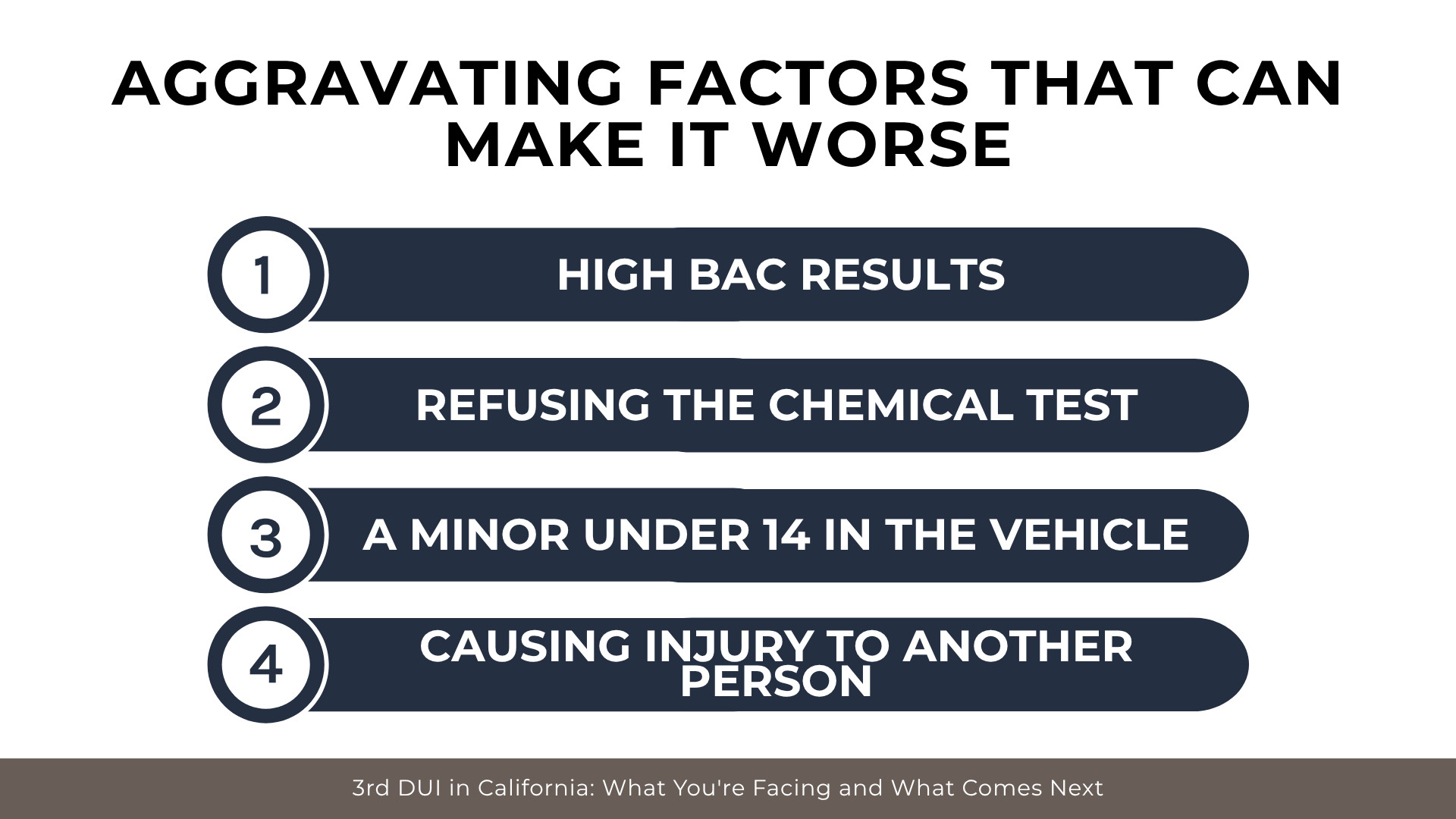
Not every third DUI carries the same consequences. Several factors can push your case toward harsher penalties.
High BAC results change the calculus. A reading at or above 0.15% gives the court discretion to impose additional penalties under Vehicle Code § 23578. At 0.20% or higher, mandatory extended DUI school requirements apply. High BAC is also something prosecutors highlight at sentencing to argue for jail time closer to the one-year maximum rather than the 120-day minimum.
Refusing the chemical test after a lawful arrest triggers a three-year license revocation with no restricted license option, layered on top of whatever the court imposes. Refusal can also be used as a discretionary sentencing enhancement under the same § 23578.
A minor under 14 in the vehicle at the time of the offense triggers a mandatory consecutive jail enhancement under Vehicle Code § 23572 — 30 days added to whatever sentence the court imposes for a third DUI. That time cannot overlap with the base sentence; it’s served in addition to it.
Causing injury to another person fundamentally changes the nature of the charge. DUI with injury under Vehicle Code § 23153 is a “wobbler,” meaning the prosecution can file it as either a misdemeanor or a felony. A felony conviction carries 16 months, two years, or three years in state prison. If the injury qualifies as great bodily injury, Penal Code § 12022.7 adds a consecutive enhancement of three to six additional years.
When a 3rd DUI Becomes a Felony
This is the question a lot of people searching for information about a third DUI are really asking — am I facing a felony?
In most cases, a straight third DUI without injury is charged as a misdemeanor. But there are circumstances that change that.
If someone was injured, the charge can be filed as a felony DUI causing injury under Vehicle Code § 23153 regardless of whether it’s your first offense or your tenth. On a third offense with injuries, prosecutors are far more likely to pursue felony charges.
If the facts suggest extreme recklessness — very high BAC, dangerous driving, a collision — prosecutors have the option of pursuing second-degree murder charges under what’s known as the Watson doctrine. In People v. Watson (1981), the California Supreme Court held that driving under the influence with conscious disregard for human life constitutes implied malice sufficient to support second-degree murder. This is rare, but it’s not theoretical. Prosecutors in California have successfully brought Watson murder charges in DUI fatality cases, and a driver with two prior convictions is in a weaker position to argue they didn’t understand the risks.
There’s also a forward-looking reality to consider: a fourth DUI within ten years is automatically charged as a felony under Vehicle Code § 23550, carrying potential state prison time of 16 months, two years, or three years. A conviction on this third offense starts that clock.

Collateral Consequences Beyond the Courtroom
The criminal penalties and license suspension are the most immediate concerns, but a third DUI conviction radiates into other areas of your life that may not be obvious right now.
A third DUI conviction creates consequences beyond the courtroom: professional licensing boards may require self-reporting (including physicians under Business and Professions Code § 802.1 and attorneys under § 6068(o)), CDL holders face potential lifetime disqualification under 49 C.F.R. § 383.51, non-citizens face immigration scrutiny that increases with multiple convictions, and the SR-22 insurance requirement extends for three years with substantially higher premiums.

How a 3rd DUI Case Can Be Defended
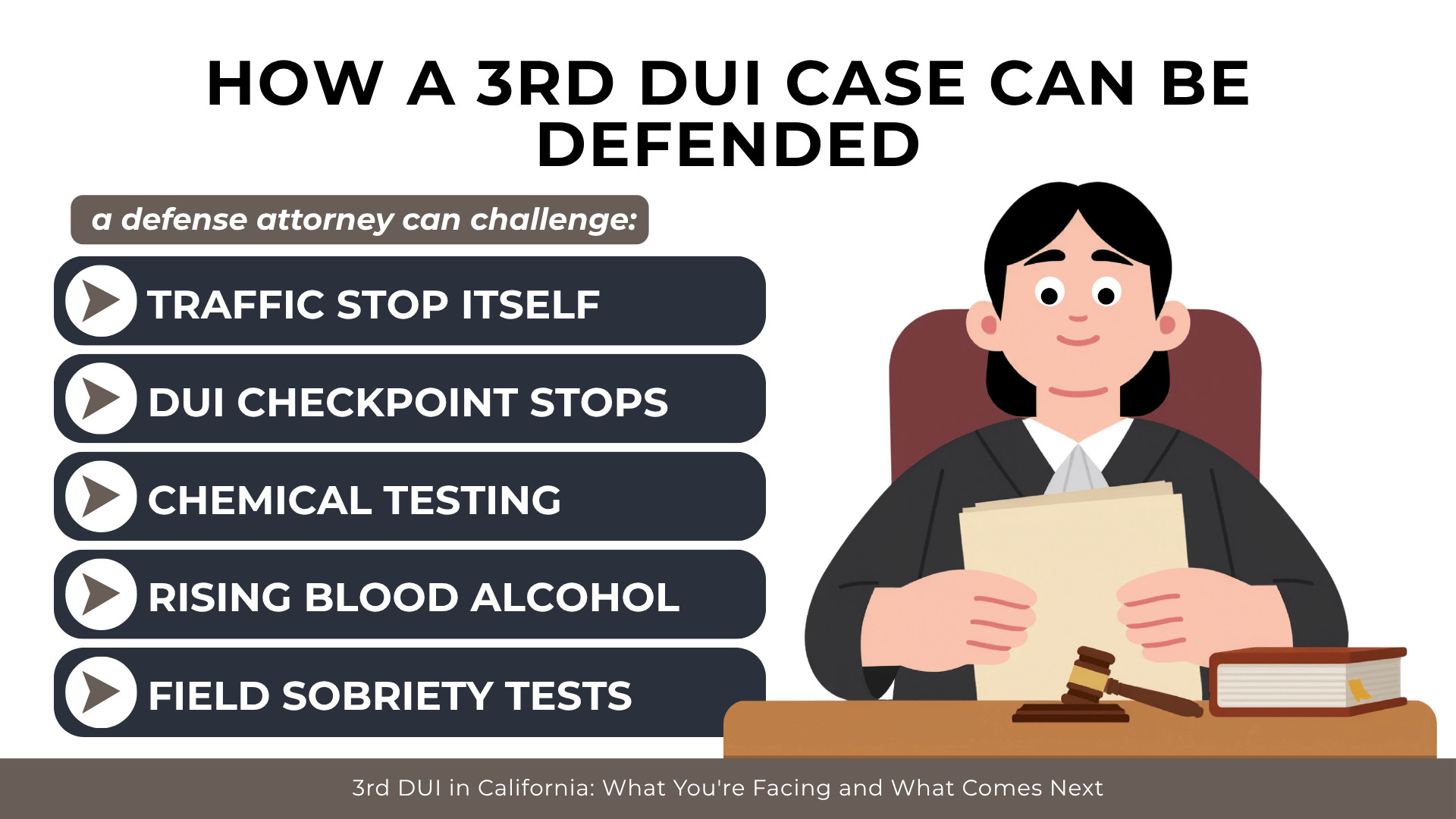
A third DUI charge is serious, but it is not a foregone conclusion. These cases have multiple stages, and each stage presents potential issues that a defense attorney can challenge.
Established defense strategies include challenging the traffic stop under People v. Bell (1996), contesting checkpoint compliance under Ingersoll v. Palmer (1987), scrutinizing chemical test procedures under Missouri v. McNeely (2013) and Birchfield v. North Dakota (2016), raising a rising blood alcohol defense under People v. McNeal (2009), and challenging the reliability of voluntary field sobriety tests. Each defense depends on the specific facts of your arrest — a defense attorney familiar with San Diego courts can assess which are viable in your situation.
None of this means every case can be won. But it does mean every case has angles worth examining — and in a third-offense case where the penalties are this consequential, finding the right angle matters.
Why You Need a DUI Attorney Now
You’ve been through DUI cases before, so you understand the general process. What’s different this time is the severity of what’s at stake and the speed at which key deadlines arrive.
The DMV’s 10-day hearing request window is the most immediate. Missing it forfeits your right to challenge the administrative suspension entirely. Beyond that, early attorney involvement — before charges are formally filed — can influence how the case is charged, whether aggravating factors are pursued, and how negotiations with the prosecutor begin.
Third-offense DUI cases also involve a level of sentencing complexity that first and second offenses simply don’t. The interplay between mandatory minimums, enhancement allegations, probation terms, license consequences, and IID requirements means there are more moving parts and more opportunities for both mistakes and strategic decisions.
Law Office of Angelo Reyes, APC in Carlsbad, California handles DUI defense for clients throughout San Diego County. Attorney Angelo J. Reyes is admitted to the State Bar of California and the U.S. District Court for the Southern District of California, and has been recognized by the National Trial Lawyers as a Top 40 Under 40 attorney. His approach is built around trial preparation — every case is worked up as though it’s going to trial, because that preparation is what creates leverage for better outcomes at every stage.
If you’re facing a third DUI charge, the most productive thing you can do today is talk to a defense attorney who handles these cases specifically. Not next week — the deadlines that matter most are already running.