

California doesn’t have a single BAC limit. It has several, and the one that applies to you depends on your age, what you were driving, and whether you’re on probation. If you’re searching for this right now, you probably need a straight answer — so here it is, followed by everything that answer doesn’t tell you.
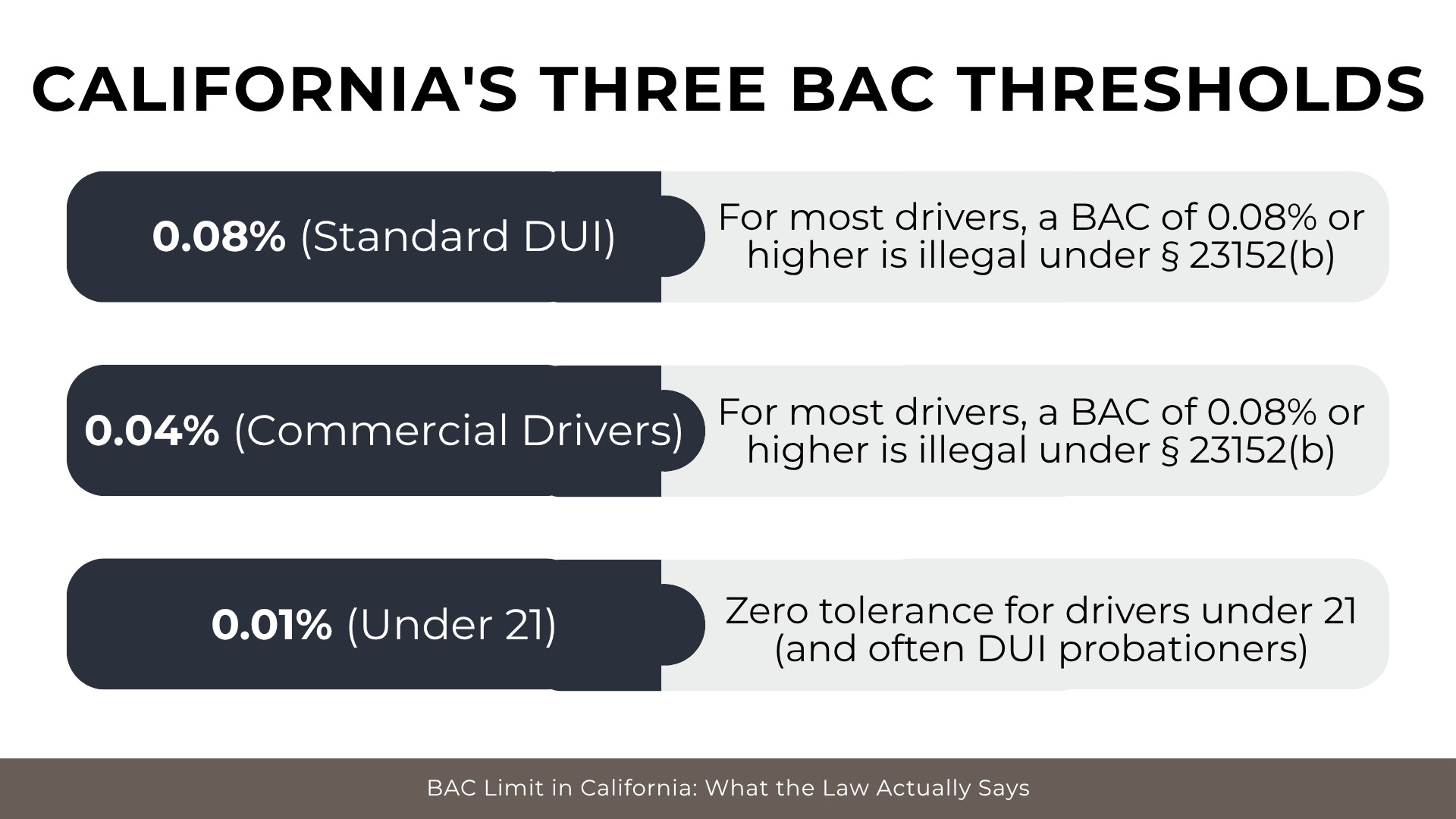
California’s Three BAC Thresholds
The number most people know is 0.08%. Under California Vehicle Code § 23152(b), it is unlawful to drive with a blood alcohol concentration at or above 0.08%. This is the “per se” DUI standard — meaning the prosecution only needs to prove your BAC hit that number. They don’t need to prove you were swerving, slurring, or visibly impaired in any way.
But 0.08% is not the only line California draws.
0.04% for commercial drivers. If you hold a commercial driver’s license and were operating a commercial vehicle, Vehicle Code § 23152(d) cuts the threshold nearly in half. The consequences extend beyond the DUI charge itself — federal regulations under 49 C.F.R. § 383.51 impose a one-year CDL disqualification for a first offense and a lifetime disqualification for a second.
0.01% for drivers under 21. California’s zero-tolerance law under Vehicle Code § 23136 sets the threshold at 0.01% — effectively any detectable amount of alcohol. This isn’t a rounding error or a technicality. It means a single drink can trigger administrative consequences for an underage driver.
Separately, DUI probation terms include zero-tolerance alcohol conditions under § 23600(b)(1), which may effectively impose a similar restriction on probationers regardless of age — though this operates as a condition of probation rather than under § 23136 itself.
What Most People Get Wrong: You Can Be Charged Below 0.08%
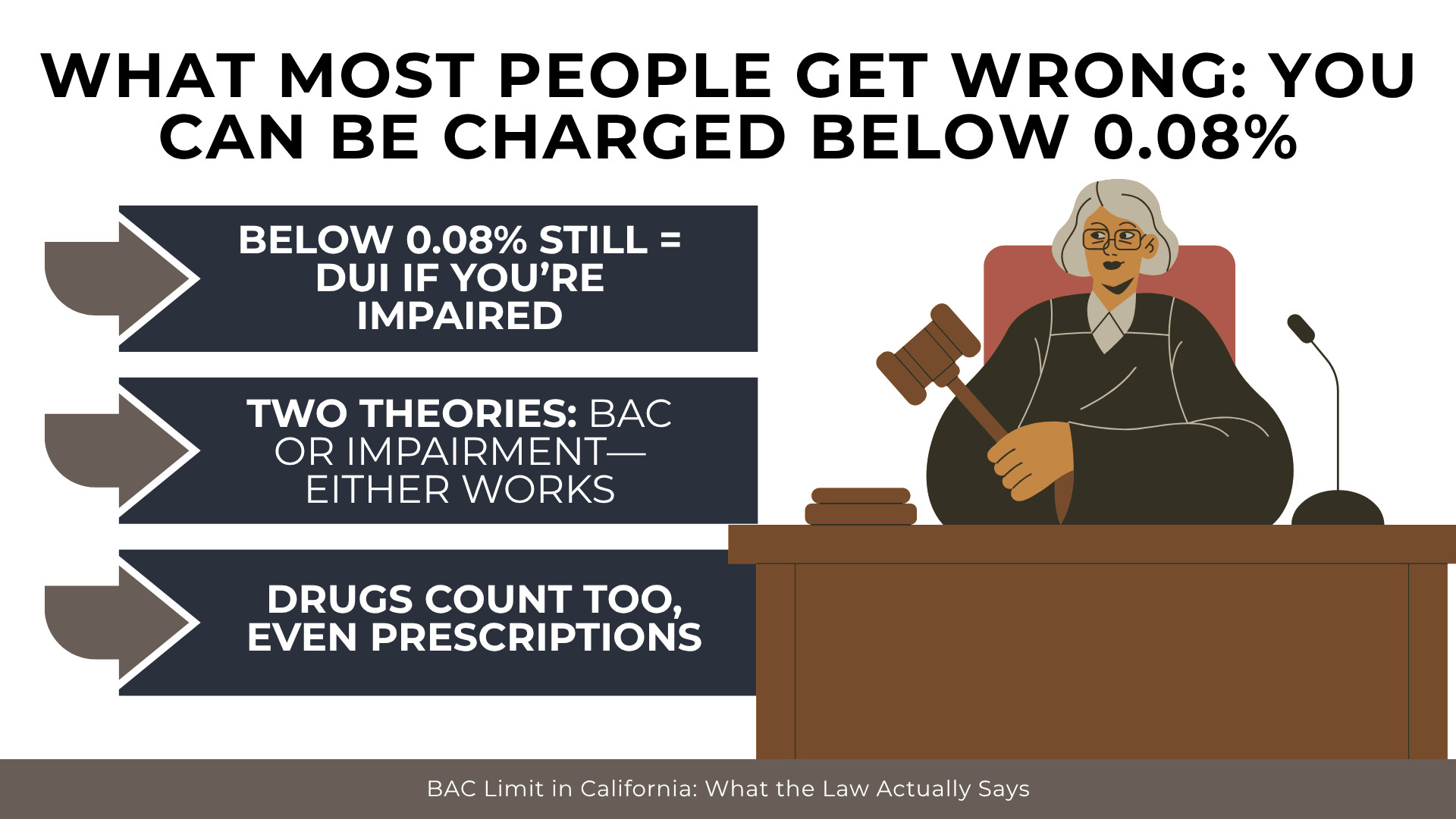
Here’s where the common understanding breaks down. California prosecutes DUI under two independent legal theories, and prosecutors routinely charge both in the same case.
The first is the per se theory under § 23152(b) — the 0.08% line described above. The second is the impairment theory under § 23152(a), which makes it unlawful to drive “under the influence” of alcohol. Under this statute, the prosecution must prove that your mental or physical abilities were so impaired that you could not operate a vehicle with the caution of a sober person of ordinary prudence.
The critical distinction: the impairment theory under § 23152(a) does not depend on any specific BAC number. A driver who blows a 0.06% can still be arrested, charged, and convicted if the prosecution proves impairment through other evidence — officer observations, field sobriety test performance, or driving pattern. The prosecution doesn’t need to prove both theories — either one independently supports a conviction, though conviction on both counts constitutes a single DUI offense for sentencing purposes.
This framework also extends beyond alcohol. Vehicle Code § 23152(f) covers driving under the influence of drugs, and § 23152(g) addresses combined alcohol and drug impairment. Under § 23152(f), prescription drug use is not a defense — the question is impairment, not legality of possession.
How BAC Is Measured and Why It Matters
If you’ve been pulled over or arrested, the BAC number on a test result can feel like a final verdict. It isn’t. How that number was obtained, when it was obtained, and what type of test produced it all carry legal significance.
Implied Consent
California’s implied consent law under Vehicle Code § 23612(a)(1)(A) means that by driving on California roads, you are deemed to have consented to chemical testing of your blood or breath if you are lawfully arrested for DUI. This is a post-arrest obligation — after you’ve been placed under arrest, not during the initial roadside stop.
The distinction matters because the preliminary alcohol screening test (the handheld breathalyzer used at the roadside before arrest) is voluntary for drivers over 21 who are not on DUI probation. Under § 23612(h)-(i), the officer is required to advise you of your right to refuse it, and declining carries no penalty.
Refusing the post-arrest chemical test is a different situation entirely. Under Vehicle Code § 13353, refusal triggers an automatic license suspension: one year for a first offense, two years for a second, and three years for a third. These refusal suspensions carry no restricted license eligibility.
Breath vs. Blood
Following the U.S. Supreme Court’s decision in Birchfield v. North Dakota, 579 U.S. 438 (2016), warrantless breath tests conducted incident to a lawful DUI arrest are constitutional, but warrantless blood draws are not — they require either actual consent or case-specific exigent circumstances. The Court in Missouri v. McNeely, 569 U.S. 141 (2013), established that the natural dissipation of alcohol in the bloodstream does not, by itself, constitute an exigency justifying a warrantless blood draw. If you were suspected of drug-only impairment under § 23152(f), blood testing is required because breath tests detect only alcohol.
The “Time of Driving” Issue
One of the most significant legal nuances around BAC evidence comes from People v. McNeal, 46 Cal.4th 1183 (2009). The California Supreme Court held that per se DUI under § 23152(b) requires proof of BAC at the time of driving, not merely at the time of testing. Because alcohol absorption continues after your last drink, a BAC test administered 30 or 45 minutes after a stop may reflect a higher level than what was present while you were actually behind the wheel. This creates what is known as a “rising blood alcohol” defense — and it’s one reason the specific facts of your stop and testing timeline matter.

Penalties by BAC Level and Offense Number
California’s DUI penalties escalate along two axes: how many prior offenses you have within a ten-year lookback period (measured from arrest date to arrest date), and how high your BAC was at the time of testing.
Base Penalties by Offense
First DUI (§ 23536): 96 hours to 6 months in county jail (with 48 hours served continuously), fines ranging from $390 to $1,000 plus penalty assessments, and 3 to 5 years of probation under § 23600(b)(1). A 68.9% conviction rate means roughly one in three DUI arrests don’t result in a DUI conviction — cases are dismissed, reduced, or resolved in other ways.
Second DUI within 10 years (§ 23540): 90 days to 1 year in county jail, the same fine range, and an 18-month DUI education program. 95.2% of repeat offenders receive jail sentences, compared to 66.3% of first offenders.
Third DUI within 10 years (§ 23546): 120 days to 1 year in county jail, $390 to $1,000 in fines, and a 30-month DUI education program.
Fourth DUI within 10 years (§ 23550): This is a felony. Penalties include 16 months, 2 years, or 3 years in state prison — or 180 days to 1 year in county jail — plus $390 to $1,000 in fines. DUI causing injury to another person under § 23153 is a “wobbler” that can also be charged as a felony, carrying 16 months, 2 years, or 3 years in state prison, with an additional 3 to 6 years consecutive under Penal Code § 12022.7 if great bodily injury is proven.
It’s worth noting that DUI offenses are categorically excluded from California’s judicial diversion programs. Vehicle Code § 23640 expressly prohibits it, a restriction upheld in Grassi v. Superior Court, 73 Cal.App.5th 283 (2021) and confirmed in Tan v. Superior Court, 76 Cal.App.5th 130 (2022). Military diversion under Penal Code § 1001.80 remains available for qualifying veterans and active-duty service members.
BAC-Based Enhancements
Beyond the base penalties, specific BAC thresholds trigger additional consequences.
BAC of 0.15% or higher activates a discretionary sentencing enhancement under Vehicle Code § 23578. The judge may impose additional penalties, though this enhancement is not mandatory. To put this in perspective, the median BAC among convicted DUI offenders in California is 0.16% — double the legal limit. Most people convicted of DUI weren’t borderline; they were well above the line.
BAC of 0.20% or higher triggers a mandatory requirement under § 23538(b)(2) to complete an extended 9-month DUI education program for first offenders, rather than the standard 3-month program.
DUI with a child passenger under 14 adds mandatory consecutive jail time under § 23572: 48 hours for a first offense, 10 days for a second, 30 days for a third, and 90 days for a fourth or subsequent offense. This enhancement applies only to misdemeanor DUI — not to wet reckless pleas or felony DUI charges.
In the most serious cases, People v. Watson, 30 Cal.3d 290 (1981), established that drunk driving with conscious disregard for human life can constitute implied malice sufficient to support a charge of second-degree murder.

The DMV Side: Administrative Consequences That Run in Parallel
One of the most common sources of confusion after a DUI arrest is discovering that you’re facing two entirely separate proceedings: the criminal case in court and an administrative action through the California DMV. These run on independent tracks, with different standards of proof and different decision-makers.
Administrative Per Se Suspension
Under Vehicle Code § 13353.2, the DMV imposes an Administrative Per Se (APS) suspension for any driver who tests at or above 0.08% BAC (0.04% for commercial drivers, 0.01% for drivers under 21). In 2020 alone, 91,300 APS license actions were taken statewide — and that was during a pandemic year with reduced driving.
The DMV’s burden of proof is preponderance of the evidence — significantly lower than the “beyond a reasonable doubt” standard in criminal court. As established in MacDonald v. Gutierrez, 32 Cal.4th 150 (2004), the DMV must prove by preponderance that the officer had reasonable cause to believe you were driving under the influence.
The 10-Day Deadline
This is time-sensitive. Under Vehicle Code § 13558, you have 10 days from receiving the suspension notice to request an APS hearing. Missing this deadline means you lose the right to contest the suspension and any possibility of a stay while the hearing is pending.
Criminal Acquittal Doesn’t Automatically Save Your License
Because the APS proceeding is civil and separate from the criminal case, winning in court doesn’t necessarily undo the DMV’s action. In Lake v. Reed, 16 Cal.4th 448 (1997), the California Supreme Court held that APS suspension is a civil remedial measure, not punishment, and therefore the Double Jeopardy Clause does not apply.
If convicted, court-ordered license suspensions under § 13352 layer on top: 6 months for a first offense, 2 years for a second, 3 years for a third, and 4 years for a fourth. Reinstatement requires SR-22 insurance filings for 3 years under § 13352.4.
Ignition Interlock Device
California’s statewide IID program under § 23575.3 requires installation of an ignition interlock device for varying durations: 6 months for a first injury DUI, 12 months for a second offense, 24 months for a third, and 36 to 48 months for a fourth or subsequent offense. Since SB 1046 took effect in January 2019, IID requirements have expanded significantly — IID sanctions increased 71% in a single year, from 9.3% to 15.9% of convicted offenders.

Collateral Consequences Beyond Court
The penalties described above are what the statutes prescribe. The actual impact of a DUI conviction extends well beyond the courtroom.
Professional licensing. Physicians must report a DUI conviction to their licensing board within 30 days under Business & Professions Code § 802.1. Attorneys must self-report felony charges under § 6068(o). Other licensed professionals face their own reporting requirements and potential disciplinary action.
Immigration consequences. For non-citizens, the stakes can be even higher. While a simple DUI is not considered a crime involving moral turpitude under federal immigration law — as established in Matter of Torres-Varela, 23 I&N Dec. 78 (BIA 2001) — and is not classified as an aggravated felony crime of violence per Leocal v. Ashcroft, 543 U.S. 1 (2004), multiple DUI convictions may bar naturalization under INA § 101(f)’s “habitual drunkard” provision. A single misdemeanor DUI can also bar DACA eligibility as a “significant misdemeanor.”
Financial impact. The California Office of Traffic Safety estimates the total cost of a first-time DUI in California at approximately $13,500 when you account for fines, fees, insurance increases, attorney costs, DUI school, lost wages, and related expenses. This figure doesn’t capture lost professional opportunities, strained relationships, or the long-term insurance premium increases that follow an SR-22 filing.
The human cost is real too. In 2023, 1,355 people were killed in alcohol-impaired traffic crashes in California. Drivers at 0.08% BAC are approximately 4 times more likely to crash than sober drivers; at 0.15%, that risk multiplies to at least 12 times.
What to Do Right Now
If you’re reading this because you or someone you know is facing a DUI situation in California, the most important thing to understand is that timing matters and so do the specific facts.
The 10-day DMV deadline is real. From the date you receive the suspension notice, you have 10 days to request an APS hearing. This deadline does not wait for your criminal case to begin.
Field sobriety tests are voluntary. There is no statutory penalty for declining roadside field sobriety tests in California. In People v. Jackson, 189 Cal.App.4th 1461 (2010), the court held that FST refusal may be admitted as consciousness of guilt, but refusal of the preliminary alcohol screening (PAS) test is inadmissible because you have a statutory right to decline it.
Post-arrest chemical tests are not voluntary. Once you are lawfully arrested, implied consent applies under § 23612. Refusing the post-arrest breath or blood test triggers mandatory license suspension under § 13353 — and refusal suspensions carry no restricted license eligibility.
“Driving” has a specific legal meaning. Under Mercer v. Department of Motor Vehicles, 53 Cal.3d 753 (1991), the term “drive” requires volitional movement of the vehicle. California does not recognize an “actual physical control” standard — sitting in a parked car with the engine running does not constitute driving absent volitional movement.
Not every DUI arrest leads to a DUI conviction. Roughly 20.5% of DUI arrests in California show no corresponding conviction, and another 7.9% are reduced to wet reckless or other lesser charges. The outcome depends on the evidence, the circumstances, and the defense.
A DUI charge is serious, but it is not a foregone conclusion. If you’re facing a DUI in San Diego County, Law Office of Angelo Reyes, APC in Carlsbad handles DUI defense with the kind of courtroom preparation that treats every case as if it’s going to trial. You can reach the firm to discuss your situation and understand your options before any deadline passes.
