
If you’re looking at this page, you probably need answers fast. Here’s what California law prescribes for DUI offenses, organized so you can find your situation in seconds.
California counts prior DUI offenses within a 10-year lookback window, measured from arrest date to arrest date. Where your case falls on this chart depends on how many prior DUI or wet reckless convictions fall within that window. The ranges below are statutory — what a judge actually imposes depends on the facts of your case, your BAC level, whether anyone was hurt, and other aggravating or mitigating circumstances.
California DUI Penalties by Offense
1st DUI Offense (Vehicle Code § 23536)
Jail time: 96 hours (48 hours continuous minimum) up to 6 months
Base fine: $390–$1,000
License suspension (DMV administrative): 4 months under the Administrative Per Se program (Veh. Code § 13353.2)
License suspension (court-ordered upon conviction): 6 months (Veh. Code § 13352)
DUI school: 3-month program (9 months if BAC was 0.20% or higher per § 23538(b)(2))
IID requirement: 6 months for injury-related DUI (Veh. Code § 23575.3)
Probation: 3–5 years (Veh. Code § 23600(b)(1))
2nd DUI Offense Within 10 Years (Vehicle Code § 23540)
Jail time: 90 days up to 1 year
Base fine: $390–$1,000
License suspension (DMV administrative): 1 year (Veh. Code § 13353.2)
License suspension (court-ordered upon conviction): 2 years (Veh. Code § 13352)
DUI school: 18–30 month program
IID requirement: 12 months (Veh. Code § 23575.3)
Probation: 3–5 years
3rd DUI Offense Within 10 Years (Vehicle Code § 23546)
Jail time: 120 days up to 1 year
Base fine: $390–$1,000
License suspension (DMV administrative): 1 year
License suspension (court-ordered upon conviction): 3 years (Veh. Code § 13352)
DUI school: 30-month program
IID requirement: 24 months (Veh. Code § 23575.3)
Probation: 3–5 years
4th DUI Offense Within 10 Years — Felony (Vehicle Code § 23550)
Prison/jail time: 16 months, 2 years, or 3 years in state prison; alternatively 180 days to 1 year in county jail
Base fine: $390–$1,000
License suspension (court-ordered upon conviction): 4 years (Veh. Code § 13352)
DUI school: 30-month program
IID requirement: 36–48 months (Veh. Code § 23575.3)
Probation: Varies; formal/felony probation if granted
DUI Causing Injury — Felony Wobbler (Vehicle Code § 23153)
Prison time: 16 months, 2 years, or 3 years in state prison (if charged as felony)
Additional enhancement for great bodily injury: 3–6 years consecutive (Penal Code § 12022.7)
Base fine: $390–$1,000
License suspension: Varies by prior record
Note: Prosecutors can charge DUI causing injury as a misdemeanor or felony depending on the severity of injuries and prior record.

What the Chart Doesn’t Show: The Real Financial Impact
The base fine range of $390–$1,000 is the number printed in the Vehicle Code, but it’s not the number you’ll actually pay. California adds penalty assessments, court fees, and surcharges that can multiply the base fine several times over.
And fines are only one piece. The California Office of Traffic Safety estimates the total cost of a first-time DUI at approximately $13,500 when you account for attorney fees, increased insurance premiums, the mandatory SR-22 filing you’ll carry for 3 years after license reinstatement (Veh. Code § 13352.4), DUI school tuition, towing and impound fees, and lost wages from court appearances and jail time.
For repeat offenses, the total cost climbs substantially — longer DUI programs, higher insurance surcharges, extended IID rental fees, and the economic disruption of longer license suspensions compound quickly.

Aggravating Factors That Push Penalties Above the Baseline
The chart above reflects standard sentencing ranges. Several circumstances can increase your penalties beyond those baselines.
High BAC (0.15% or above) gives the judge discretion to impose enhanced penalties under Vehicle Code § 23578. This is a discretionary enhancement, meaning the judge decides whether to apply it, but it signals to the court that impairment was severe. For context, the median BAC among convicted DUI offenders in California is 0.16% — double the legal limit — so a significant number of defendants fall into this range.
BAC of 0.20% or above triggers a mandatory sentencing consequence for first offenders: a 9-month DUI education program instead of the standard 3-month program under Vehicle Code § 23538(b)(2).
Minor passenger under age 14 adds mandatory consecutive jail time under Vehicle Code § 23572. The additional time escalates with each offense: 48 hours for a first DUI, 10 days for a second, 30 days for a third, and 90 days for a fourth or subsequent offense. This enhancement applies only to misdemeanor DUI — it does not apply to wet reckless pleas or felony DUI.
Refusal to submit to chemical testing after a lawful DUI arrest triggers additional license consequences under Vehicle Code § 13353, separate from the DUI penalties themselves: a 1-year suspension for a first refusal, 2 years for a second, and 3 years for a third. Critically, test refusal suspensions carry no restricted license eligibility — you cannot drive at all during the suspension period. Note that the preliminary alcohol screening (PAS) breath test administered before arrest is voluntary for drivers over 21 who are not on DUI probation (Veh. Code § 23612(h)-(i)), and refusing it carries no penalty.
DUI causing injury (Veh. Code § 23153) elevates the case to a wobbler offense that prosecutors can file as a felony. If great bodily injury is proven, Penal Code § 12022.7 adds 3 to 6 years of consecutive prison time on top of the base DUI sentence.
DUI causing death occupies the most serious end of the spectrum. Under the doctrine established in People v. Watson, 30 Cal.3d 290 (1981), a DUI that results in a fatality can be prosecuted as second-degree murder if the prosecution proves the driver acted with implied malice — conscious disregard for human life.

License Suspension: Two Separate Proceedings You Need to Understand
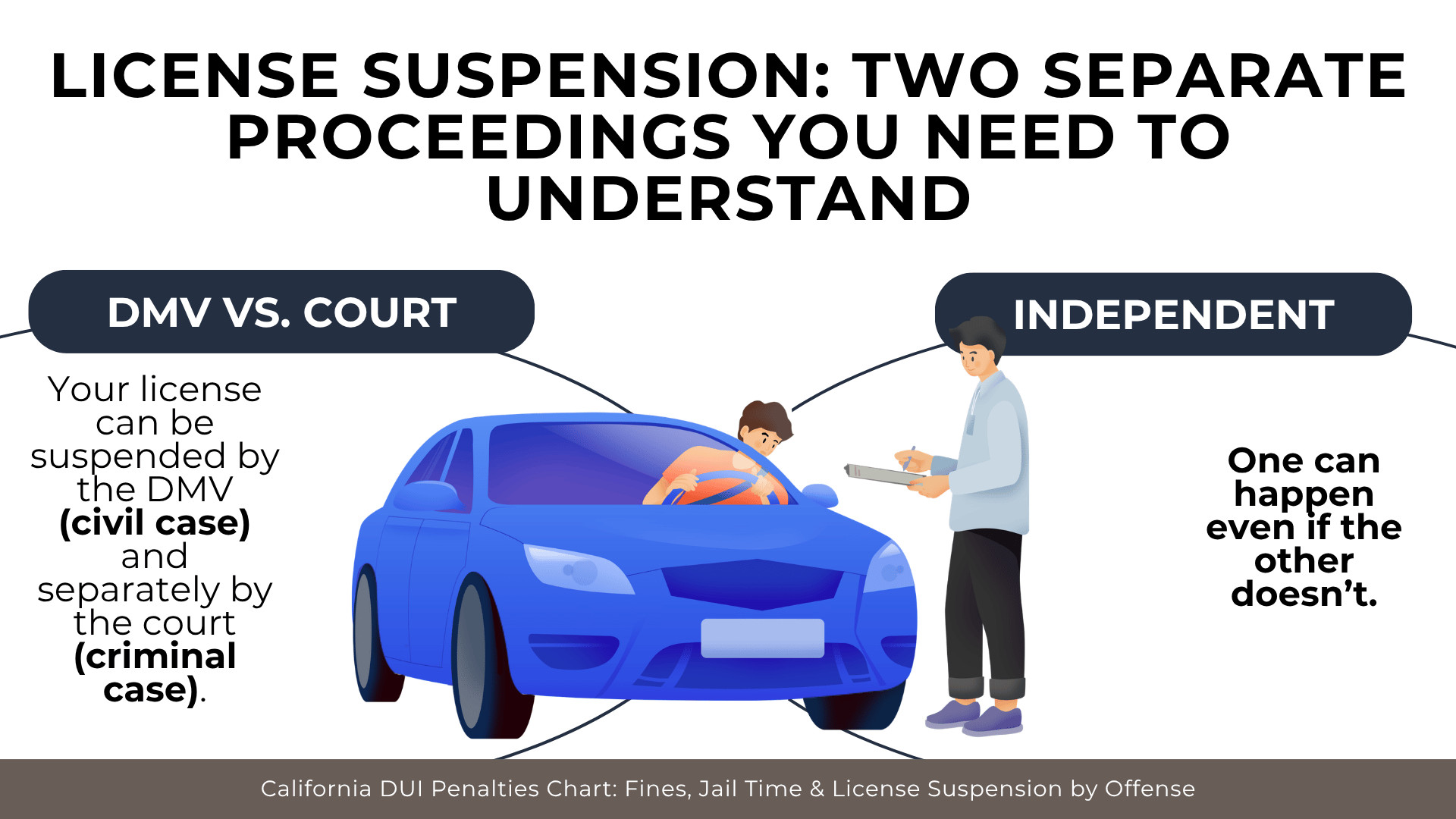
One of the most confusing aspects of a California DUI is that your license faces two independent threats from two different authorities, and many people don’t realize this until it’s too late.
The DMV’s Administrative Per Se (APS) suspension is a civil action, completely separate from your criminal case. If your BAC tested at 0.08% or above (0.04% for commercial drivers, 0.01% for drivers under 21), the DMV initiates an automatic suspension under Vehicle Code § 13353.2. The California Supreme Court has confirmed that this suspension is a civil remedial measure, not criminal punishment, meaning Double Jeopardy protections do not apply (Lake v. Reed, 16 Cal.4th 448 (1997)). Even if you are acquitted of the criminal DUI charge, that does not automatically vacate the APS suspension.
The 10-day deadline is critical. Under Vehicle Code § 13558, you have exactly 10 days from receiving the suspension notice to request an APS hearing with the DMV. If you miss this deadline, you lose the right to contest the suspension and any possibility of staying it while the hearing is pending.
The court-ordered suspension comes separately upon criminal conviction. Under Vehicle Code § 13352, that suspension runs 6 months for a first offense, 2 years for a second, 3 years for a third, and 4 years for a fourth.
In practice, these timelines often overlap or run concurrently, but they are administered independently. The DMV must prove by a preponderance of the evidence that the arresting officer had reasonable cause to believe the driver was driving under the influence (MacDonald v. Gutierrez, 32 Cal.4th 150 (2004)) — a lower standard than the criminal court’s beyond-a-reasonable-doubt requirement.
The IID path to driving privileges: California’s statewide ignition interlock device program under Vehicle Code § 23575.3 allows many DUI offenders to continue driving with an IID installed rather than serving a full hard suspension. IID durations range from 6 months (first offense with injury) to 36–48 months (fourth offense). However, drug-only DUI convictions under § 23152(f) are not eligible for IID-restricted licenses — the program requires alcohol involvement.
What Happens in Practice: How Most California DUI Cases Actually Resolve
The penalty chart reflects what the law allows. Here’s what the data shows about what actually happens.
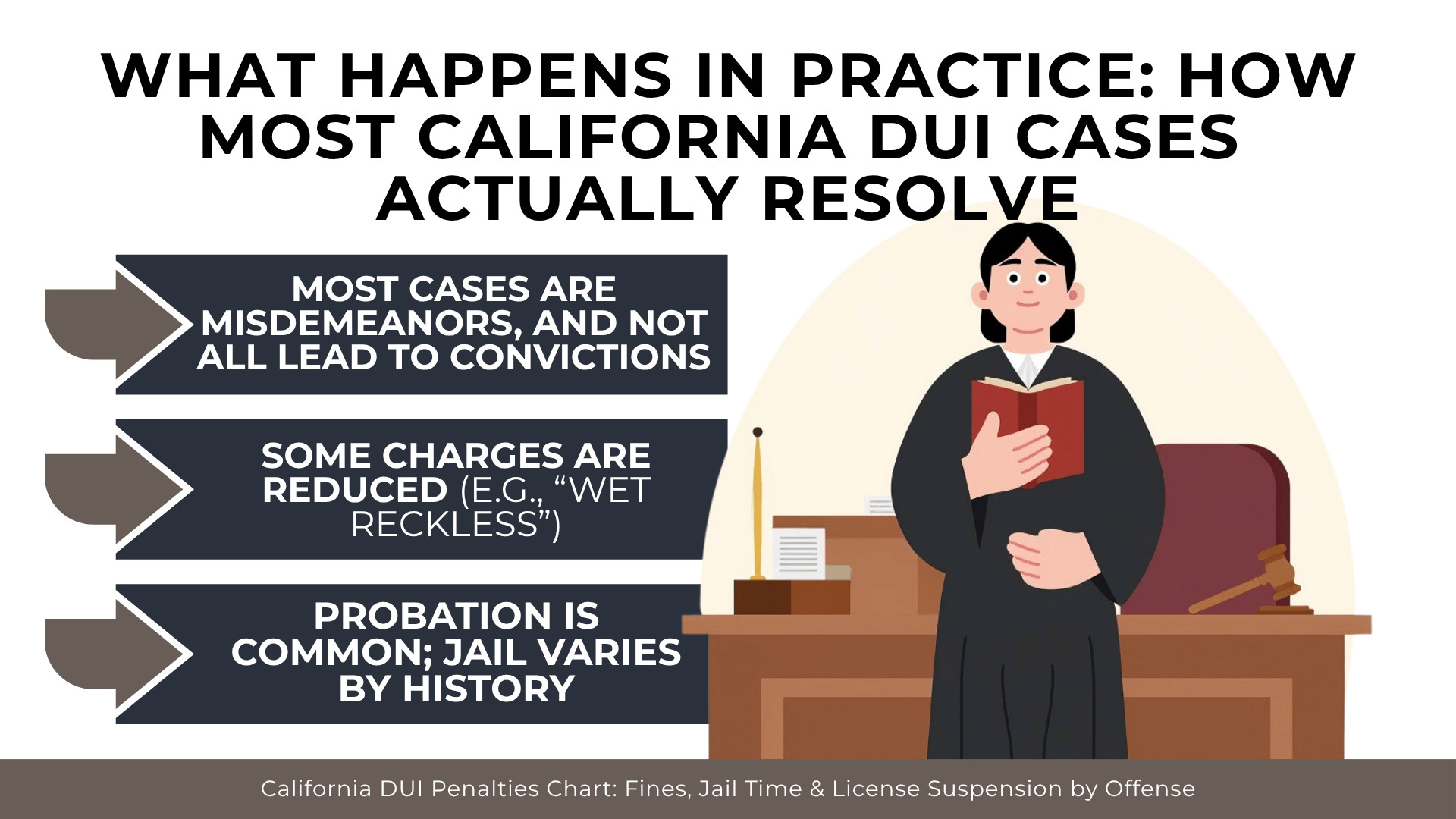
The vast majority of DUI cases are misdemeanor charges. In 2020, 95.6% of all DUI arrests in California were misdemeanors, with only 4.4% charged as felonies. Felony charges typically require a fourth offense within ten years, injury to another person, or a prior felony DUI conviction.
Not every arrest ends in a DUI conviction. Of people arrested for DUI in California in 2019, 68.9% were ultimately convicted of DUI. Another 20.5% showed no corresponding conviction on DMV records — a percentage that has been gradually increasing over the past decade.
Among those who were convicted, not all were convicted of the original DUI charge. About 7.9% of DUI convictions were reduced to alcohol- or drug-related reckless driving — commonly known as a “wet reckless.” A wet reckless carries lighter penalties than a DUI, though it still counts as a prior offense if you are arrested for DUI again within 10 years.
When DUI convictions are imposed, the sentencing patterns are consistent. Nearly 96% of convicted DUI offenders received probation. About 74.1% were sentenced to jail time, though being sentenced to jail doesn’t always mean serving the full term — many sentences are suspended or converted to alternative programs. The gap between first and repeat offenders is stark: 66.3% of first offenders were sentenced to jail, compared to 95.2% of repeat offenders.
The large majority — 72.8% — of convicted DUI offenders are first-time offenders. If this is your first offense, you are in the most common category, not an outlier.
One more data point worth knowing: 83.9% of first-time DUI offenders who enrolled in a court-ordered DUI program completed it. For second offenders — who face much longer 18–30 month programs — the completion rate drops to 42.1%.
The 10-Year Lookback Rule and How Prior Offenses Are Counted
Which column of the penalty chart applies to you depends entirely on how California counts your prior record, and the rules are more specific than most people expect.
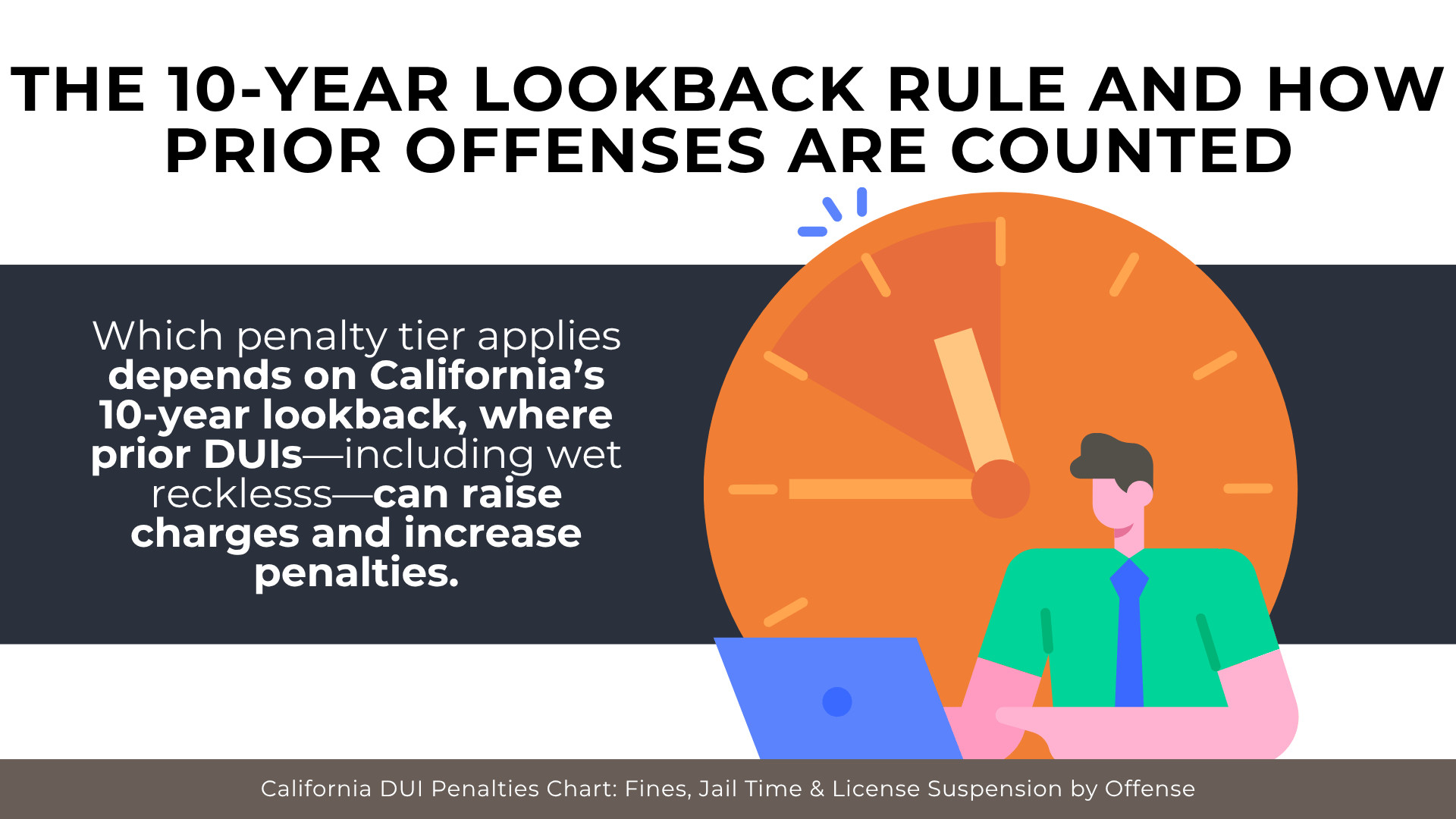
California uses a 10-year lookback window measured from arrest date to arrest date. If your last DUI arrest was more than 10 years before your current arrest, your current case is treated as a first offense for sentencing purposes. If it was within 10 years, it counts as a prior.
Several things count as priors within that window beyond a standard DUI conviction. A wet reckless plea (Veh. Code § 23103.5) counts as a prior DUI offense for enhancement purposes. The California Court of Appeal has also held that prior DUI convictions do not need to stem from separate incidents occurring on different dates — multiple convictions from related conduct can each count (People v. Casillas, 92 Cal.App.4th 171 (2001)).
The lookback period was extended from 7 years to 10 years, which means some drivers who would previously have been treated as first offenders now face second- or third-offense penalties. This distinction has real consequences: the difference between a first and second DUI offense is the difference between a potential 96-hour jail minimum and a 90-day minimum.
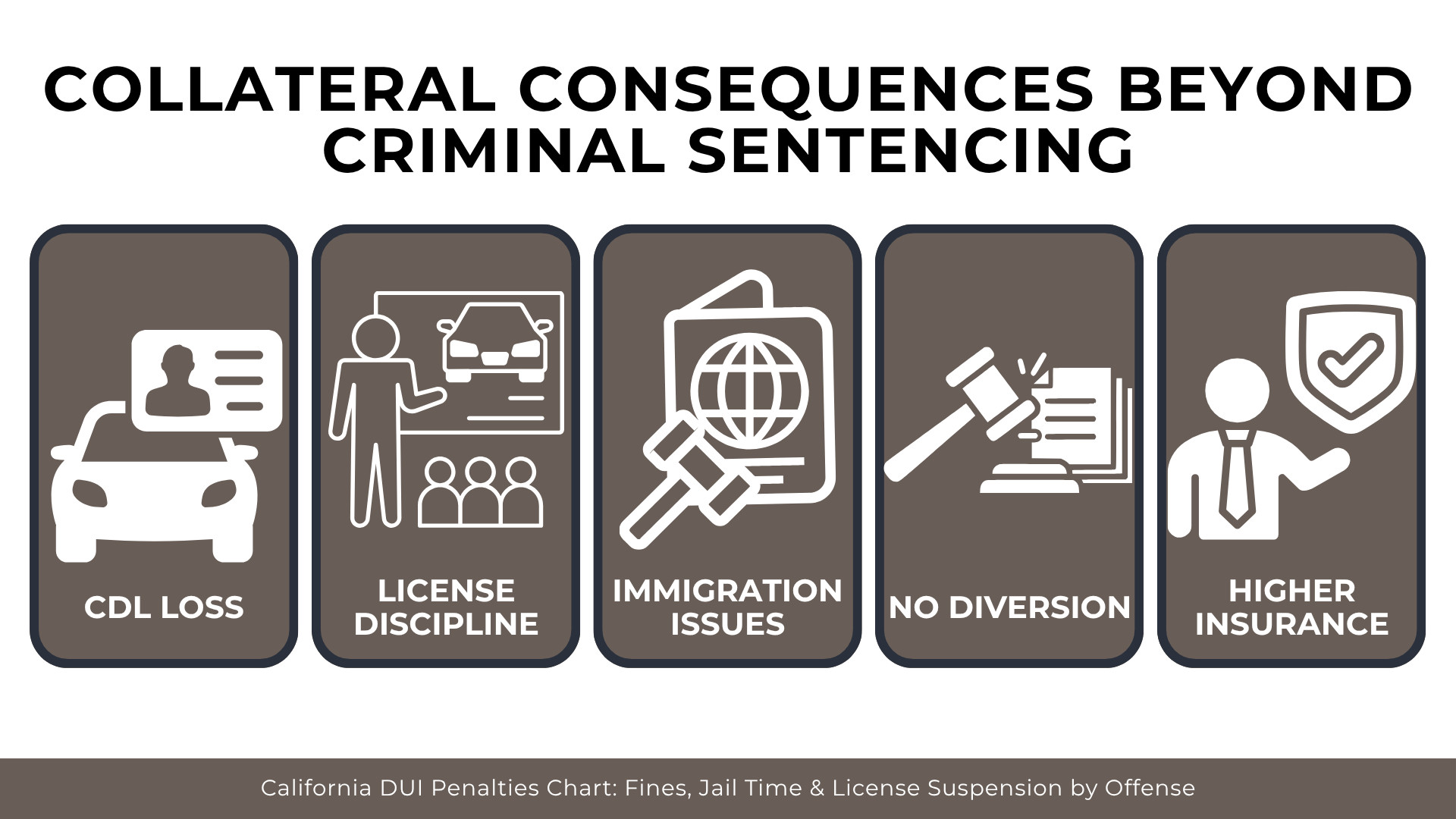
Collateral Consequences Beyond Criminal Sentencing
The penalty chart covers what happens in criminal court. But a DUI conviction triggers consequences that reach into other areas of your life, some of which are not obvious.
Commercial driver’s license: A DUI conviction — even in your personal vehicle — results in a 1-year CDL disqualification for a first offense and a lifetime disqualification for a second offense under federal regulations (49 C.F.R. § 383.51). For anyone who drives commercially for a living, a single DUI can end that career.
Professional licensing: Certain licensed professionals face mandatory self-reporting obligations. Physicians must report a DUI conviction to the Medical Board within 30 days under Business and Professions Code § 802.1. Attorneys must self-report felony DUI charges under Business and Professions Code § 6068(o). Other licensed professionals may face disciplinary proceedings depending on the licensing board’s standards.
Immigration consequences: For non-citizens, the intersection of DUI and immigration law carries specific risks. A simple DUI is generally not considered a crime involving moral turpitude (Matter of Torres-Varela, 23 I&N Dec. 78 (BIA 2001)) and is not classified as an aggravated felony crime of violence (Leocal v. Ashcroft, 543 U.S. 1 (2004)). However, a single misdemeanor DUI is classified as a “significant misdemeanor” that bars DACA eligibility. Multiple DUI convictions may raise “habitual drunkard” concerns under INA § 101(f), which can prevent a showing of good moral character required for naturalization.
No diversion available: Unlike many other misdemeanor offenses in California, DUI is categorically excluded from judicial diversion. Vehicle Code § 23640 expressly prohibits diversion for DUI charges, and appellate courts have confirmed this prohibition applies even after the legislature expanded general misdemeanor diversion under Penal Code § 1001.95 (Grassi v. Superior Court, 73 Cal.App.5th 283 (2021); Tan v. Superior Court, 76 Cal.App.5th 130 (2022)). The one exception: military diversion under Penal Code § 1001.80 remains available for qualifying veterans and active-duty service members.
Insurance: You will be required to file an SR-22 certificate of financial responsibility for 3 years following license reinstatement (Veh. Code § 13352.4). This typically results in significantly higher insurance premiums for the duration of the filing period.
What to Do Right Now
If you’re reading this shortly after a DUI arrest, two things need your immediate attention.
First, protect your driving privileges. You have 10 days from the date you received your suspension notice to request a DMV Administrative Per Se hearing under Vehicle Code § 13558. This deadline is firm. Missing it means the suspension goes into effect automatically with no opportunity to challenge it. An attorney can request this hearing on your behalf and represent you at it.
Second, consult with a DUI defense attorney who can evaluate the specific facts of your case. A DUI charge is not a conviction — the overall conviction rate for DUI arrests in California is about 69%, which means roughly 3 in 10 arrests do not end in a DUI conviction. The outcome depends on details that a penalty chart can’t capture: whether the traffic stop was supported by reasonable suspicion based on specific articulable facts (People v. Bell, 43 Cal.App.4th 754 (1996)), whether a checkpoint complied with the eight-factor administrative framework required under Ingersoll v. Palmer, 43 Cal.3d 1321 (1987), whether chemical testing procedures were properly followed, and whether a rising blood alcohol defense applies — since per se DUI requires proof of BAC at the time of driving, not at the time of testing (People v. McNeal, 46 Cal.4th 1183 (2009)).
Law Office of Angelo Reyes, APC in Carlsbad represents clients facing DUI charges throughout San Diego County. Attorney Angelo J. Reyes brings extensive trial experience to DUI defense and prepares every matter for trial. If you need to understand where your case stands and what options are available, [contact Law Office of Angelo Reyes, APC for a consultation].
This article provides legal information about California DUI penalties for educational purposes. It does not constitute legal advice for any specific case. DUI law involves case-specific facts that affect outcomes — consult a qualified attorney about your situation. Statutory and case law references are current as of early 2026.