
A DUI conviction doesn’t just punish you once. It keeps showing up — on background checks when you’re applying for a better job, on screening reports when you’re trying to rent an apartment, on licensing applications when you’re building a career. If you’re reading this, you probably already know that feeling. Something in your life has bumped up against your record, and you’re wondering whether California law gives you a way forward.
It does. California allows eligible people to petition the court to dismiss a DUI conviction through a process most people call “expungement.” But before you get too far into the details, you need to understand one thing clearly: expungement in California is not the same as erasing your record. The conviction doesn’t vanish as though it never happened. Instead, the court withdraws your guilty or no contest plea, enters a not guilty plea, and formally dismisses the case under California Penal Code Section 1203.4.
That distinction matters, and this guide will walk you through exactly what it means for your situation — who qualifies, what the process looks like, what changes afterward, and what stays the same.
What California DUI Expungement Actually Does (and Doesn’t Do)
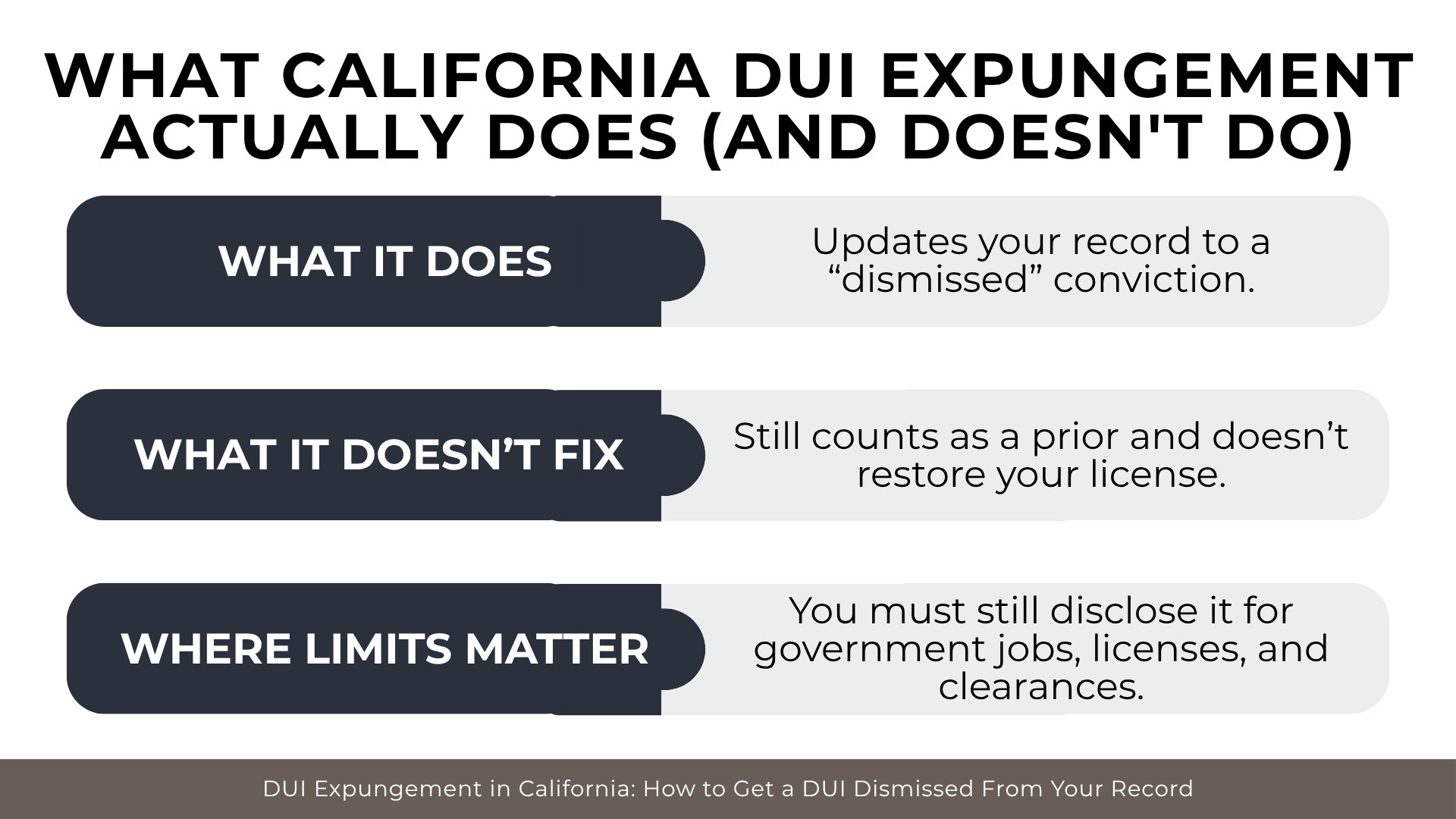
When a court grants your petition under PC 1203.4, your record is updated to show that the conviction was dismissed. This is a meaningful legal change. For most private-sector job applications, you can legally answer “no” when asked whether you’ve been convicted of a crime. Employers running standard background checks will see the dismissal notation rather than an active conviction. That alone can remove a significant barrier to employment, housing, and professional opportunities.
But expungement has hard limits, and understanding them now will save you frustration later.
An expunged DUI still counts as a prior offense. California uses a ten-year lookback period measured from arrest date for prior DUI offenses to enhance penalties on subsequent convictions under Vehicle Code §§ 23540, 23546, and 23550. If you’re charged with another DUI within that window, the dismissed conviction still enhances your penalties as a prior. Expungement does not reset that clock.
It also doesn’t restore a suspended or revoked driver’s license. The DMV’s Administrative Per Se suspension is a civil proceeding entirely separate from your criminal case, and as the California Supreme Court held in Lake v. Reed, 16 Cal. 4th 448 (1997), it’s treated as a civil remedial measure rather than punishment. An expungement in criminal court has no effect on it.
There are also situations where you must still disclose the original conviction even after expungement. If you’re applying for a government job, a position that requires a state-issued professional license, or a role involving a security clearance, the conviction remains visible and you’re expected to acknowledge it — along with the fact that it was later dismissed. California’s Business and Professions Code imposes reporting requirements on certain licensed professionals, including a 30-day conviction reporting requirement for physicians under § 802.1 and a felony self-reporting requirement for attorneys under § 6068(o). Licensing boards can still consider the conviction in their decisions.
For immigration purposes, the picture is nuanced. Simple DUI is generally not considered a crime involving moral turpitude — a principle established in Matter of Torres-Varela, 23 I. & N. Dec. 78 (BIA 2001) — and the U.S. Supreme Court held in Leocal v. Ashcroft, 543 U.S. 1 (2004) that DUI is not an aggravated felony “crime of violence” because it involves negligent rather than intentional conduct. However, expungement under California law does not eliminate immigration consequences. A single misdemeanor DUI can still bar DACA eligibility as a “significant misdemeanor.” If immigration is a concern, speak with an immigration attorney before filing.
None of this means expungement isn’t worth pursuing. For most people, the practical benefits — particularly in private employment and housing — are substantial. You just need to go in with clear eyes about what the process delivers.
Who Qualifies for DUI Expungement in California
Eligibility under PC 1203.4 comes down to a handful of concrete requirements. You either meet them or you don’t, and in most DUI cases, you will.
First, you must have completed probation. That means all of it — every fine paid, every hour of DUI school finished, any community service performed, any restitution satisfied, and any other condition the court imposed. Nearly 96% of convicted DUI offenders in California receive probation as part of their sentence, so this pathway applies to the vast majority of cases. DUI probation in California runs three to five years under Vehicle Code § 23600(b)(1), with zero-tolerance alcohol conditions throughout.
Second, you cannot currently be on probation for any other offense, serving a sentence for any offense, or facing pending criminal charges at the time you file your petition.
Third, you must not have been sentenced to state prison for the DUI conviction. This is where the misdemeanor vs. felony distinction comes into play. The overwhelming majority of DUI cases in California are misdemeanors — 95.6% of all DUI arrests in 2020 were charged at the misdemeanor level. Standard misdemeanor DUI convictions that resulted in probation are generally eligible for expungement.
Felony DUI is more complicated but not necessarily a dead end. A felony DUI that resulted in probation rather than state prison may still qualify. Felony DUI under Vehicle Code § 23550 (fourth DUI within ten years) or § 23153 (DUI causing injury) can carry state prison sentences of 16 months, 2 years, or 3 years, which would generally disqualify you from PC 1203.4 relief. But if you received probation and county jail time instead, the door may still be open. For wobbler offenses — charges that can be filed as either a felony or a misdemeanor — an attorney may be able to petition the court to reduce the felony to a misdemeanor before filing for expungement. An experienced DUI attorney can evaluate whether that option applies to your case.
What If You Don’t Want to Wait Out the Full Probation Period?
You may not have to. California law allows you to petition for early termination of probation. If the court grants it, you can then file your expungement petition. To qualify, you generally need to demonstrate compliance with all probation conditions and show that early termination serves the interests of justice. Courts look at factors like how much of your probation you’ve completed, whether you’ve had any violations, and your overall conduct since sentencing. If you’ve been fulfilling every requirement and are well into your probation term, early termination may be a realistic option — and it’s one worth discussing with an attorney.

The Step-by-Step Process
The expungement process is straightforward in concept, though the paperwork and timing require attention to detail.
Filing the petition. You begin by completing a Petition for Dismissal (form CR-180) and a proposed Order for Dismissal (form CR-181). These are filed with the superior court in the county where your DUI case was handled. There is a filing fee that varies by county; if you cannot afford it, you can submit a Request to Waive Court Fees along with your petition.
Serving the district attorney. After filing, you must serve a copy of the petition on the prosecutor’s office that originally handled your case. This gives them legal notice and an opportunity to review your petition. The DA has the right to object, though in many straightforward cases — particularly first-offense misdemeanor DUIs where probation was completed without incident — they typically don’t.
Court review. A judge reviews your petition to determine whether you meet the eligibility requirements and whether granting dismissal serves the interest of justice. Some courts decide based on the paperwork alone. Others schedule a hearing, particularly if the prosecution objects or if the case has complicating factors.
The ruling. If the petition is granted, the court formally withdraws your guilty or no contest plea, enters a not guilty plea, and dismisses the case. Your criminal record is updated to reflect the dismissal under PC 1203.4.
Timeline. Expect the process to take at minimum eight to ten weeks from filing, and often two to four months depending on court schedules, county workload, and whether a hearing is required. After the court grants the petition, it can take additional time for third-party background check databases to update and reflect the dismissal.

What If Your Probation Wasn’t Perfect?
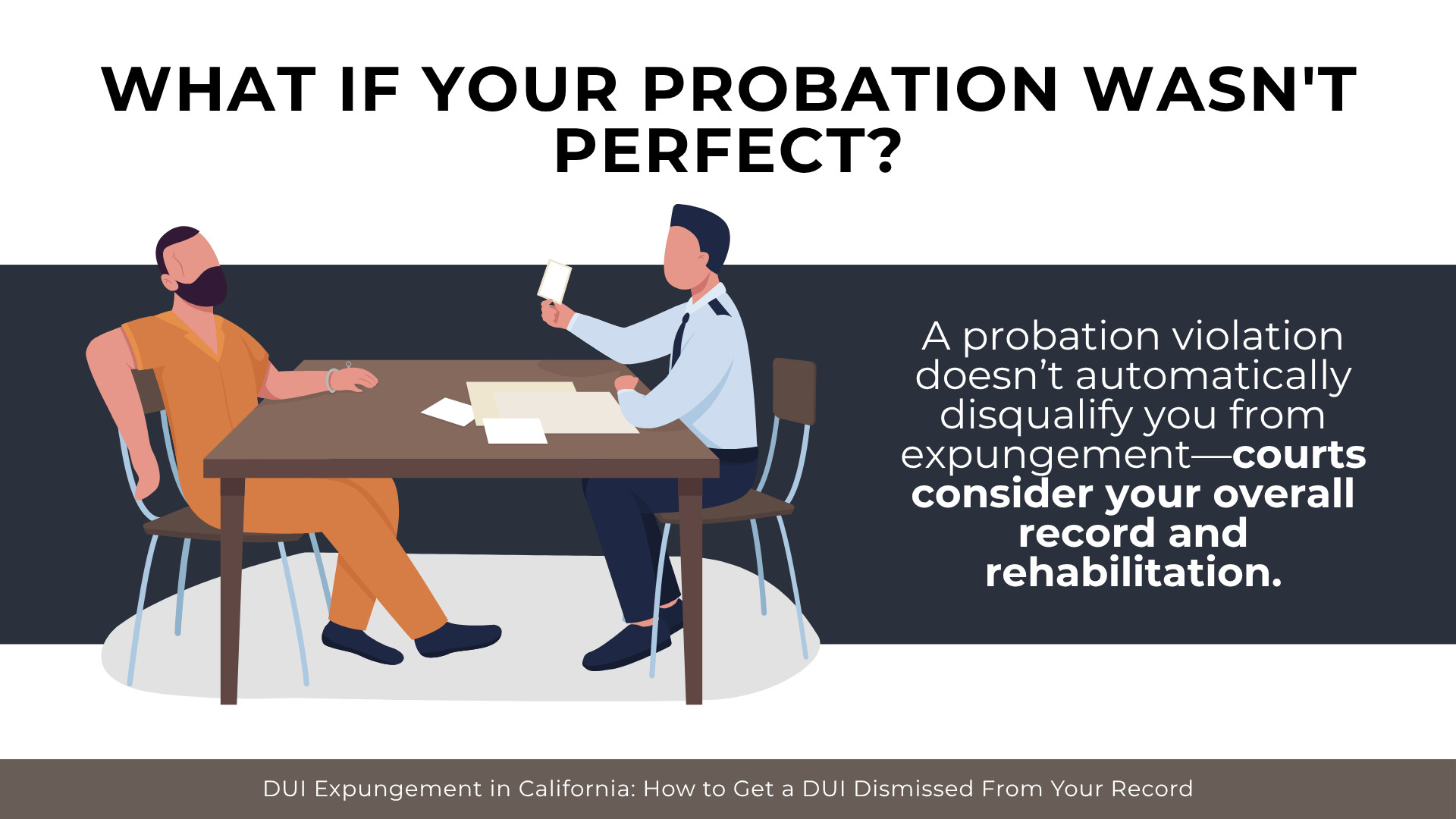
This is where many people stop themselves before they should. If you had a probation violation — a missed class, a late payment, a misstep — you may assume you’re automatically disqualified. That’s not necessarily the case.
A probation violation doesn’t permanently bar you from expungement. The court has discretion under PC 1203.4 to consider the totality of your situation. Judges evaluate factors including your overall performance during probation, the seriousness of the underlying offense, your complete criminal record, and any evidence of rehabilitation you can present.
This is where strong advocacy makes a difference. You or your attorney can present evidence showing why you deserve the dismissal — steady employment, community involvement, family responsibilities, educational achievements, or a concrete opportunity (like a specific job) that the expungement would unlock. Courts respond well to evidence that you’ve genuinely moved on and that the dismissal serves a practical purpose in your life.
The key point: don’t self-disqualify. If your situation is complicated, get a professional assessment before deciding it’s not worth pursuing.
Wet Reckless and Other Reduced Charges
Not every DUI arrest ends in a DUI conviction. Approximately 7.9% of DUI convictions in California are reduced to alcohol- or drug-related reckless driving, commonly known as a “wet reckless.” If your case was resolved through a plea to wet reckless or another reduced charge that involved probation, you are still eligible to petition for dismissal under PC 1203.4.
The same eligibility requirements apply: completed probation, no current charges, no state prison sentence. And the same limitations apply as well — a wet reckless is still a priorable offense, meaning it counts as a prior DUI for enhancement purposes if you’re charged again within ten years.

Filing on Your Own vs. Hiring an Attorney
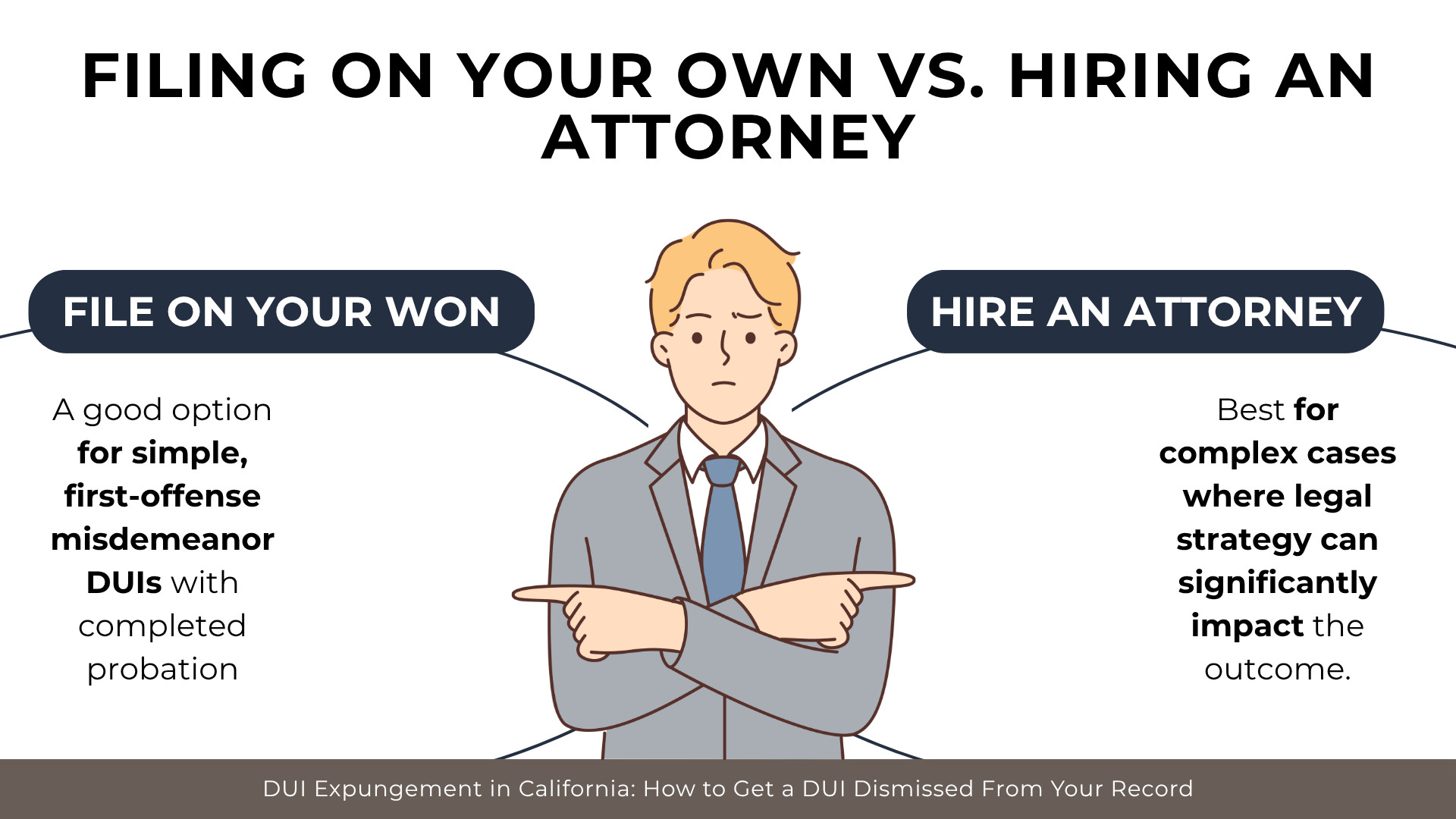
California courts provide the forms, and the process is designed to allow self-filing. For a straightforward first-offense misdemeanor DUI where you completed probation without any issues, filing on your own is a realistic option. The court’s self-help resources and the Petition for Dismissal forms are publicly available.
That said, there are real advantages to working with an attorney, particularly when the case isn’t simple. If you need to petition for early termination of probation first, if you had a probation violation, if your DUI was a felony that may need to be reduced before expungement, or if the DA’s office is likely to object, an experienced attorney can navigate those complications in ways that meaningfully affect the outcome.
Law Office of Angelo Reyes, APC in Carlsbad serves clients throughout San Diego County. Attorney Angelo J. Reyes is a San Diego criminal defense attorney recognized by the National Trial Lawyers as a Top 40 Under 40 attorney. With extensive trial experience, Angelo is a courtroom advocate who prepares every matter for trial — the kind of preparation that matters when a contested expungement hearing requires persuading a judge that dismissal is in the interest of justice.
Whether you file on your own or hire counsel, the most important thing is that you file. The relief is available. The question is whether you take the step.
Life After Expungement
Once the court grants your petition, the practical changes start to take effect — though not always instantly.
On most private-sector job applications, you can now answer “no” when asked about criminal convictions. Your background check will show the case with a dismissal notation under PC 1203.4 rather than an active conviction. For many employers, that’s the difference between moving forward with your application and passing on it.
For government positions, professional licenses, and security clearances, you should disclose the original conviction and the subsequent dismissal. Being upfront about the expungement actually works in your favor in these contexts — it demonstrates that you took responsibility, completed every requirement the court imposed, and pursued the legal process to address your record.
Be aware that background check databases operated by third-party companies can lag behind court records. After your expungement is granted, it’s worth following up to make sure the updated information is reflected. An attorney can advise you on how to monitor this and correct any errors.
If you need further relief beyond what PC 1203.4 provides, additional post-conviction options may exist depending on your circumstances. An experienced DUI attorney can advise you on whether any of those pathways apply. But for most people, expungement is the step that delivers the most immediate, tangible impact.
You made a mistake. You dealt with the consequences. California law recognizes that people who complete their sentence and fulfill every obligation deserve a meaningful path forward. Filing for expungement is how you take it.
