
If you’re reading this, there’s a good chance you’ve recently been arrested for DUI in California — or you’ve already been convicted — and someone has told you that you need an ignition interlock device installed in your vehicle. You may have heard the term for the first time at your arraignment, from your attorney, or on a DMV notice that arrived in the mail. Either way, you’re trying to figure out exactly what this means for your life, your car, and your ability to get to work.
This page walks through how California’s IID requirements actually work, what the process looks like day to day, and where a criminal defense attorney fits into the picture.
What an Ignition Interlock Device Is and Why California Requires One
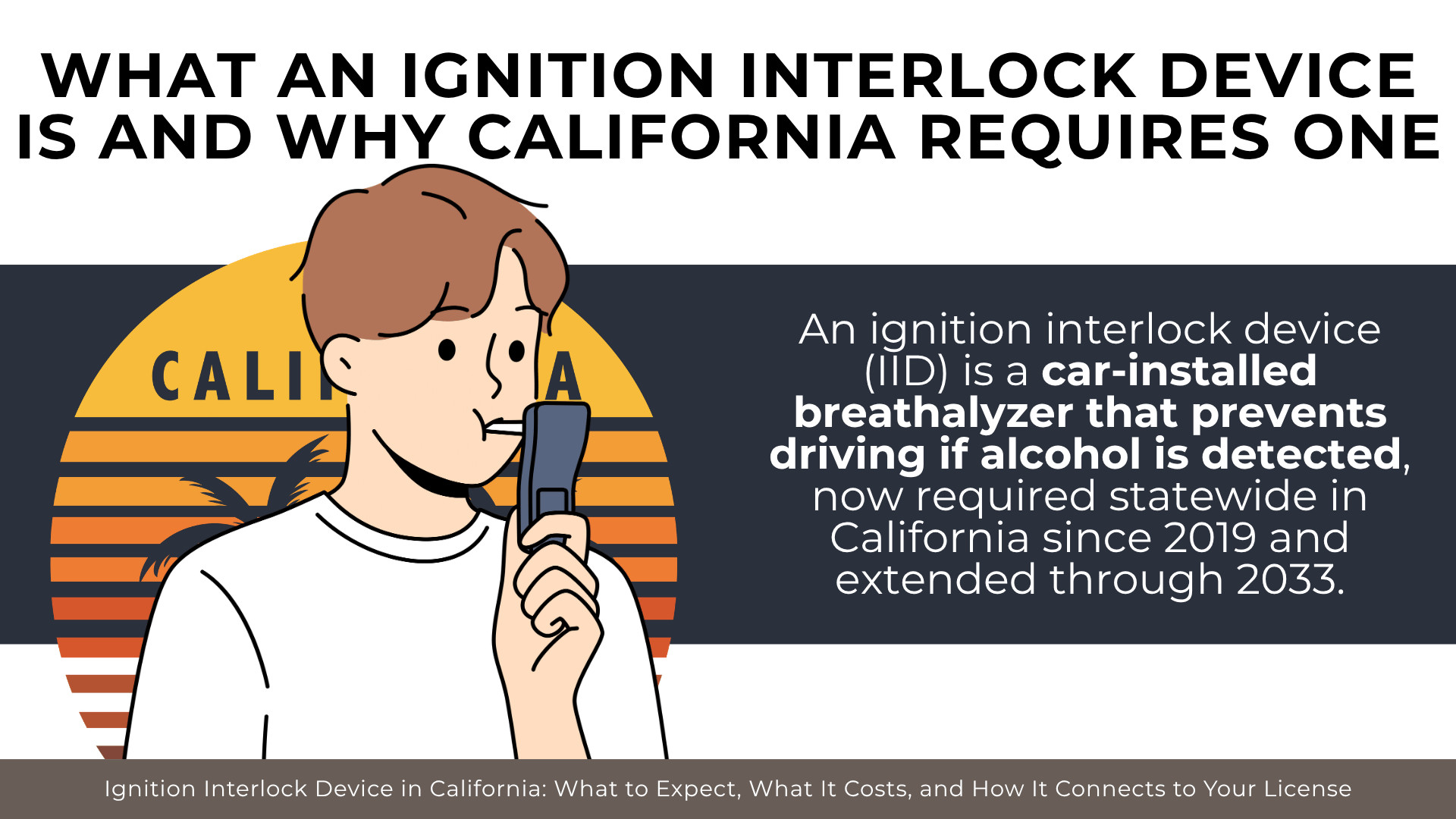
An ignition interlock device is a small breathalyzer unit wired into your vehicle’s ignition system. Before you can start the car, you blow into the device and provide a breath sample. If the device detects alcohol above a preset threshold, the engine will not start. While you’re driving, the device will also prompt random “rolling retests” — requiring you to blow again to confirm you haven’t consumed alcohol since you started the vehicle.
California’s statewide IID mandate took effect on January 1, 2019, under SB 1046. Before that, only four pilot counties — Alameda, Los Angeles, Sacramento, and Tulare — required IID installation for all DUI convictions. Now the requirement applies statewide, governed primarily by Vehicle Code § 23575.3. The shift was significant: IID sanctions among convicted DUI offenders jumped 71% between 2018 and 2019, climbing from 9.3% to 15.9% of all convicted offenders. And actual IID installation rates were even higher — 23.7% of offenders convicted after a 2019 arrest installed a device, because many chose to install voluntarily to regain driving privileges faster.
In 2026, Assembly Bill 366 extended this statewide IID program through January 1, 2033. The device is not going away. Understanding how the requirement works is essential to navigating what comes next.
Who Is Required to Install an IID — and for How Long
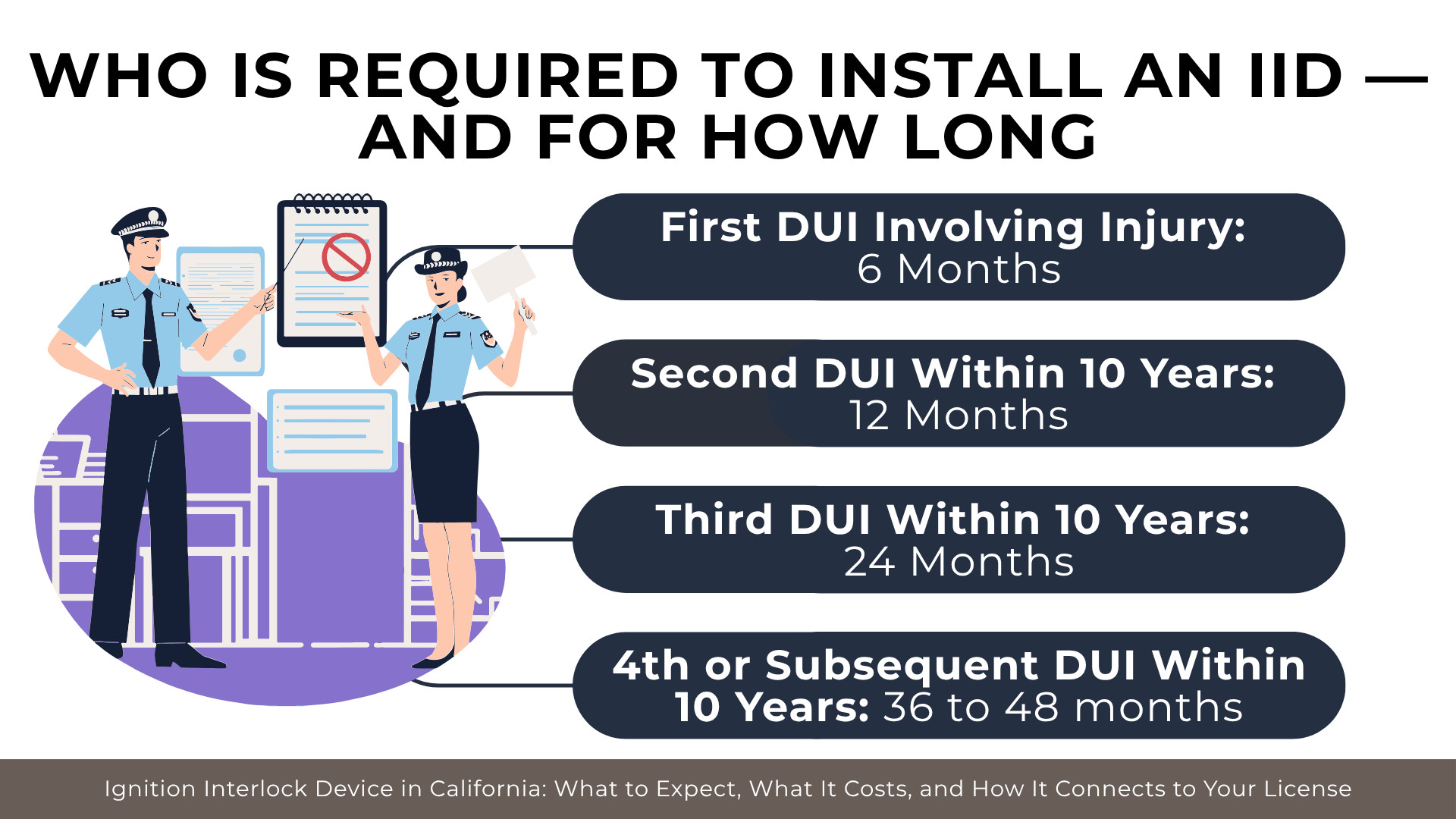
The IID requirement duration depends on your offense level. Under Vehicle Code § 23575.3, the mandatory installation periods are:
First DUI involving injury: 6 months.
Second DUI within 10 years: 12 months.
Third DUI within 10 years: 24 months.
Fourth or subsequent DUI within 10 years: 36 to 48 months.
The question most first-time offenders ask is whether they’re required to install one at all. For a standard first-offense misdemeanor DUI without injury, the IID is not automatically mandatory — the court may order it under Vehicle Code § 23575. But even when the court doesn’t order it, the IID becomes the key to getting back behind the wheel, as explained in the next section.
One critical limitation: if your DUI involved only drugs — charged under Vehicle Code § 23152(f) — you are not eligible for an IID-restricted license. The IID measures breath alcohol content. It cannot detect drug impairment. This means drug-only DUI offenders face a different and more limited path to license reinstatement.
California uses a ten-year lookback period measured from arrest date to determine whether a new offense counts as a second, third, or fourth DUI. If you had a prior DUI conviction eight years ago, it still counts. Understanding where you fall in this framework directly determines your IID timeline.
How the IID Connects to Getting Your License Back
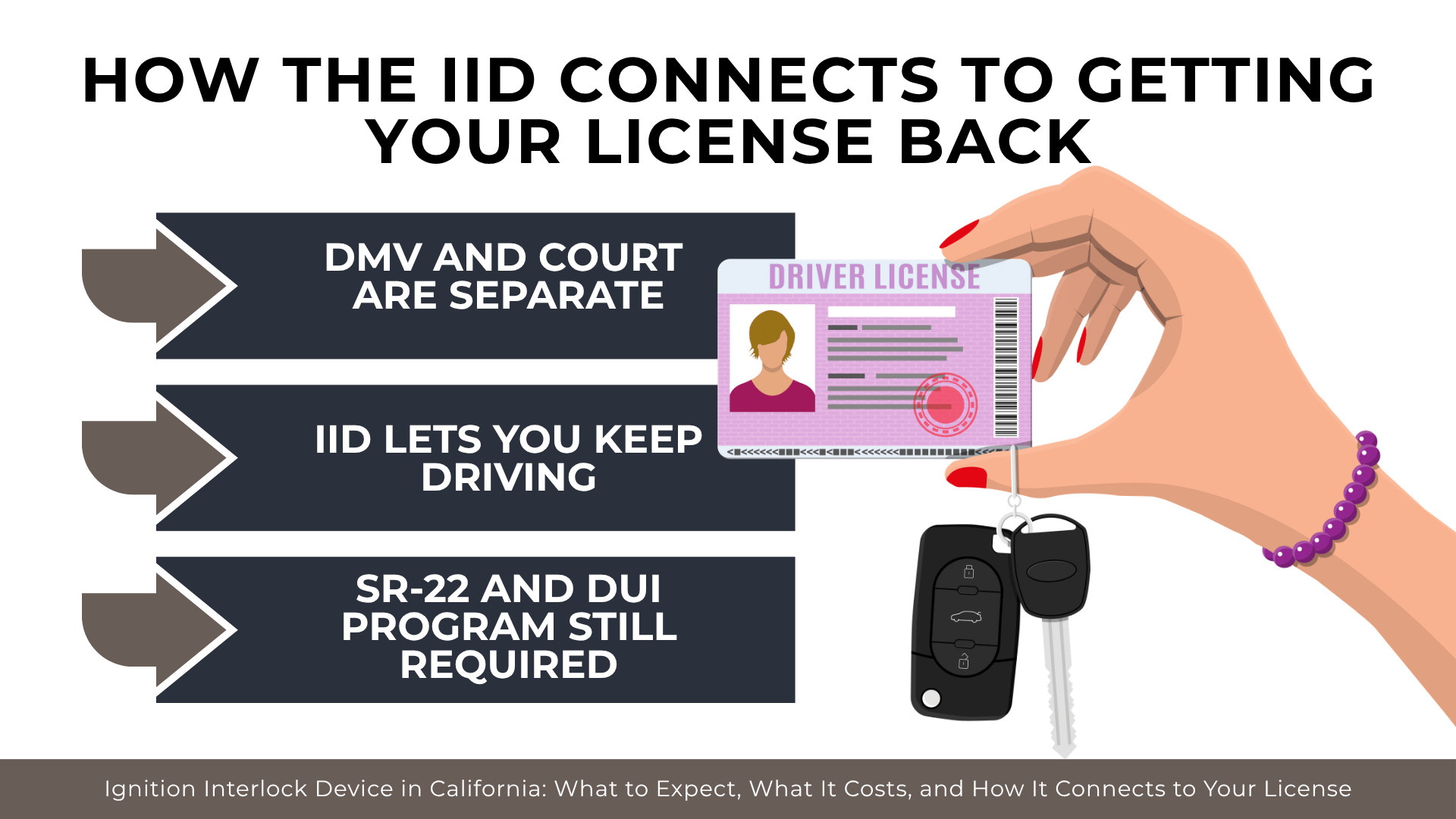
This is the piece that confuses most people, because two separate systems are running at the same time: the criminal court case and the DMV administrative process. They operate independently, with different standards of proof and different consequences — and the IID sits at the intersection of both.
When you’re arrested for DUI in California, the DMV initiates a separate Administrative Per Se suspension under Vehicle Code § 13353.2 — a civil proceeding independent of your criminal case. You have 10 days from your arrest to request an APS hearing under Vehicle Code § 13558, or the suspension takes effect automatically.
Here is where the IID becomes important: for first-time offenders, installing an IID allows you to obtain an IID-restricted license that lets you drive anywhere — with no destination restrictions — during your suspension period. The alternative, a standard restricted license without an IID, limits driving to narrower purposes for a longer period. For most people who need to drive beyond those narrow purposes — picking up children, buying groceries, attending medical appointments — the IID is the practical path forward.
For second and subsequent offenders, the IID is mandatory for license reinstatement. There is no alternative restricted license option.
Beyond the IID itself, you’ll also need to file an SR-22 certificate of financial responsibility, which California requires for three years following reinstatement under Vehicle Code § 13352.4. And you must enroll in a licensed DUI program. The IID doesn’t replace these requirements. It works alongside them.
What Installation Costs and What Daily Life with an IID Looks Like
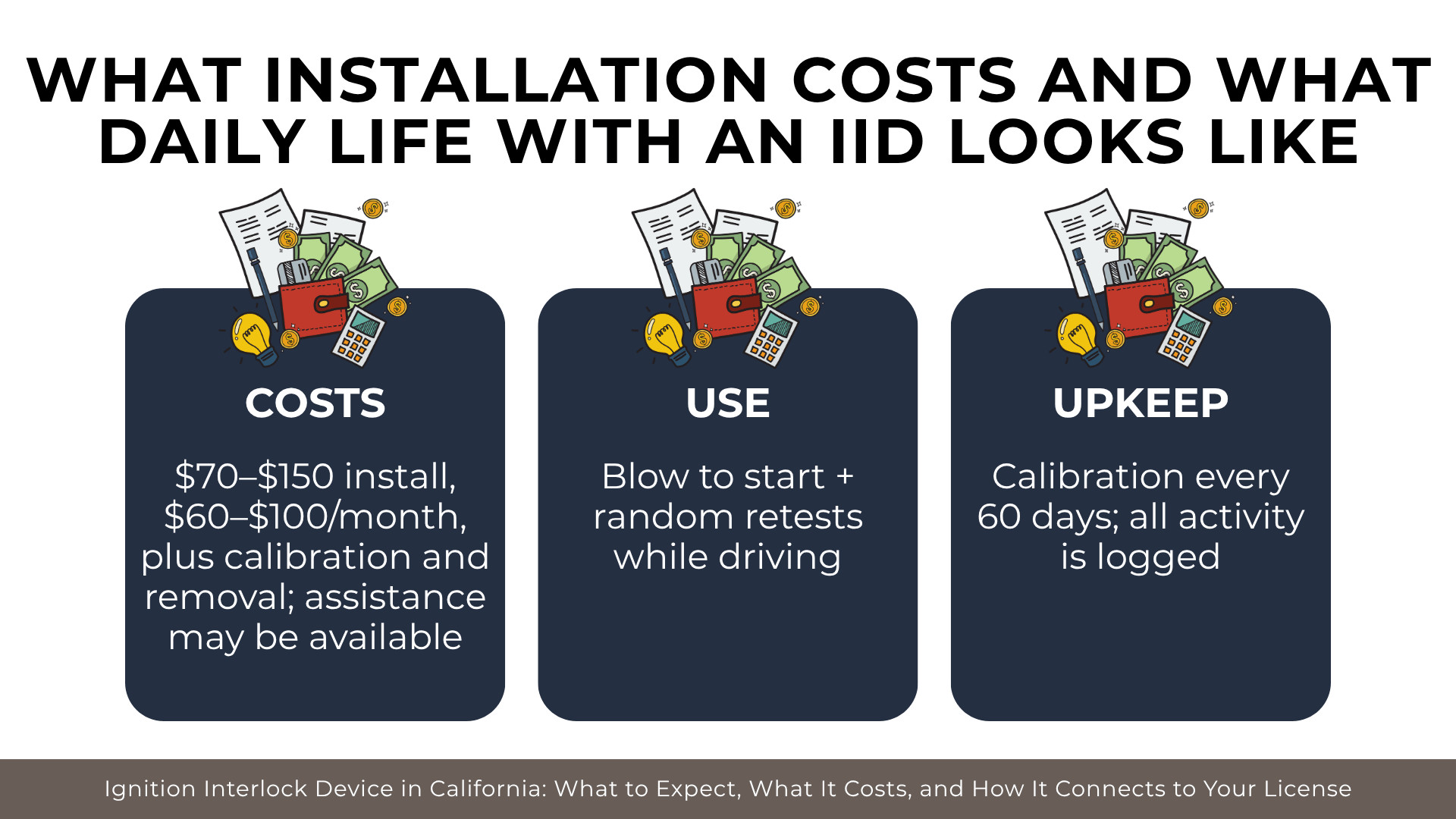
The IID is leased, not purchased. You’ll work with a DMV-approved installation provider, and the process is typically completed in a single appointment. The provider installs the device, demonstrates how to use it, and provides hands-on training.
The costs break down roughly as follows: installation runs between $70 and $150, monthly lease and monitoring fees range from $60 to $100, and calibration appointments — required every 60 days — cost $25 to $75 each. Removal at the end of your term runs $50 to $100. Total costs depend on the length of your IID requirement and can range from a few hundred dollars to a few thousand dollars over the full term.
If you cannot afford these costs, California law requires IID providers to offer reduced rates based on household income. The court can determine whether you qualify for financial assistance and provide documentation to your IID provider.
The daily reality is straightforward but demands consistency. Every time you start your car, you blow into the device. While driving, you’ll be prompted for rolling retests at random intervals. If you fail a retest, the device doesn’t shut off your engine — that would be a safety hazard — but it will trigger your horn and lights until you safely pull over and turn off the vehicle. Every 60 days, you bring the vehicle in for calibration, where the provider downloads the device’s data log and recalibrates the breathalyzer for accuracy.
You’re not alone in dealing with this. Nearly a quarter of all convicted DUI offenders in California installed an IID following a 2019 arrest. The device is a routine part of the DUI process in this state, not an extraordinary punishment.
IID Violations and How to Stay Compliant
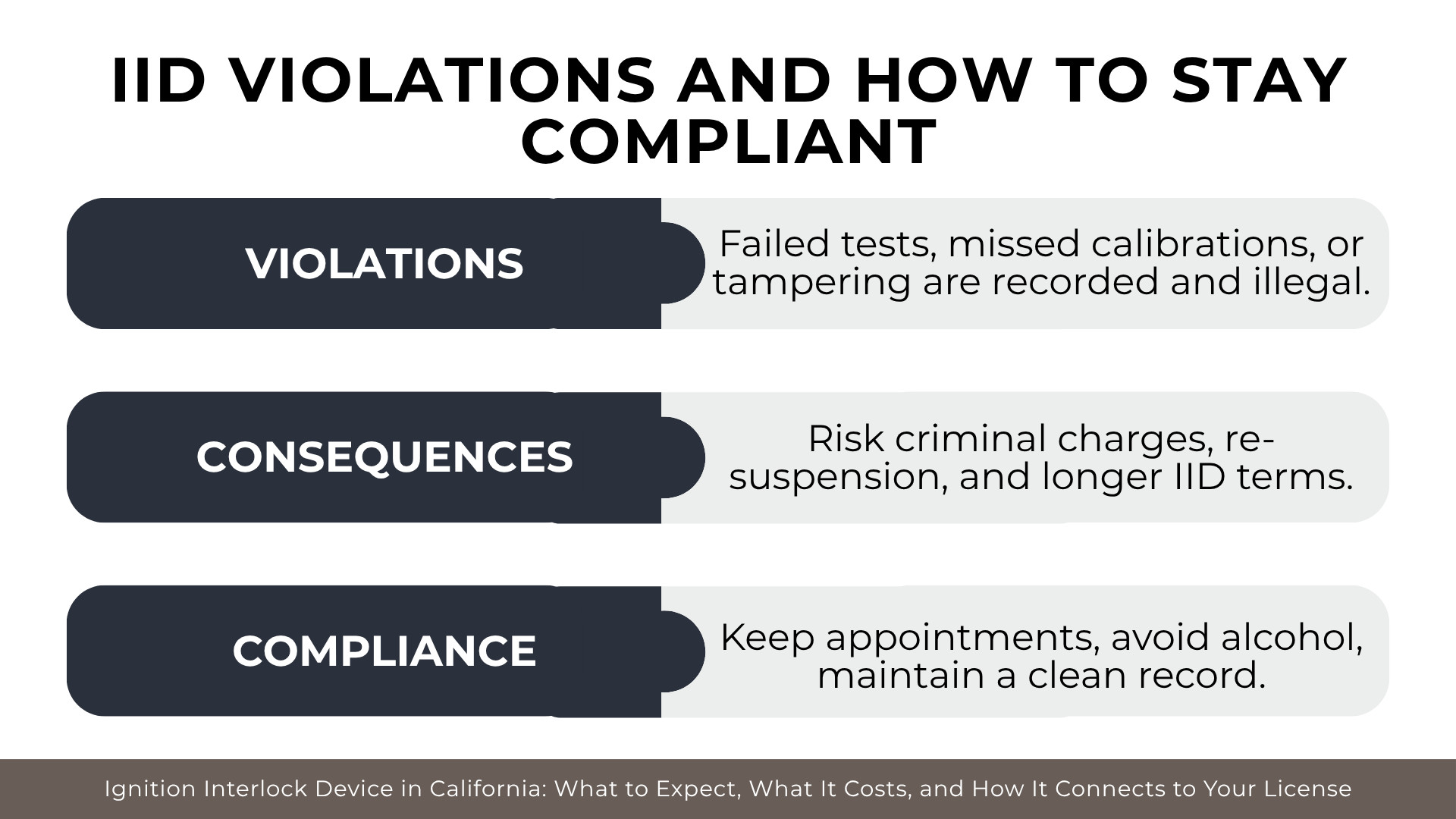
The IID tracks everything. Failed breath tests, missed calibration appointments, evidence of tampering, and attempts to have another person provide the breath sample are all recorded and reported. Under Vehicle Code § 23247, it is unlawful to drive a vehicle without a required IID installed, to tamper with the device, or to ask someone else to blow into it. Violations can carry serious criminal and administrative consequences.
Beyond criminal exposure, IID violations have administrative teeth. If the installer reports violations — failed tests, missed calibrations, or tampering — the DMV can reimpose your suspension and extend the period before you become eligible for reinstatement. The clock on your IID requirement may reset, and any time you spent out of compliance does not count toward your mandatory installation period.
Staying compliant is not complicated, but it requires attention. Keep every calibration appointment. Do not consume any alcohol before driving — even small amounts from mouthwash or certain medications can trigger a reading. If you get a false positive, rinse your mouth with water and retest. Document everything. The device data log is what the DMV will review, and a clean record is what gets you through your IID term and back to full, unrestricted driving privileges.
How a DUI Attorney Can Affect Your IID Requirement
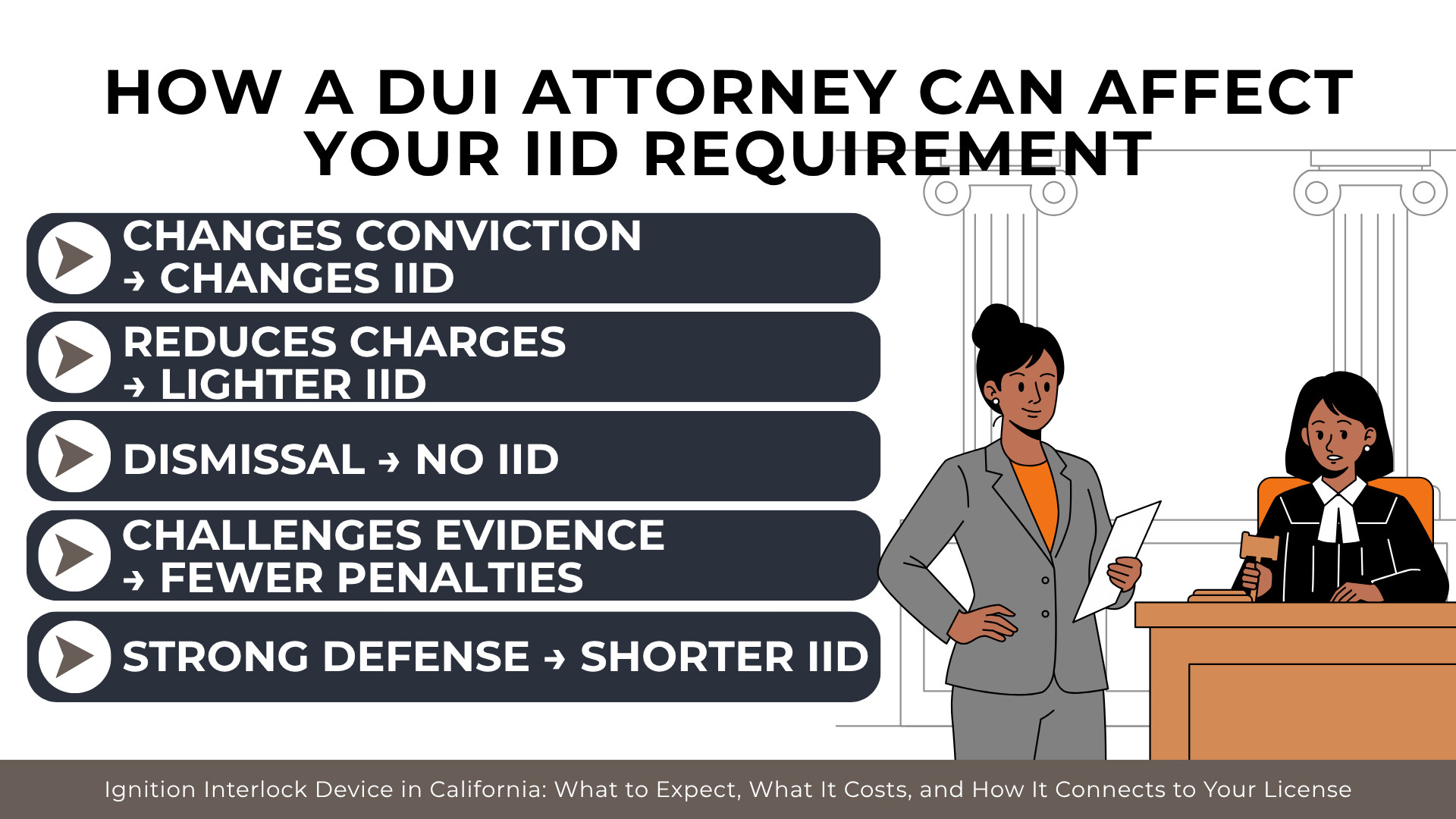
The IID requirement is downstream of the DUI conviction itself. Change the conviction, and you change what happens with the device.
A charge reduction to “wet reckless” under Vehicle Code § 23103.5, for example, alters the IID landscape. Roughly 7.9% of DUI convictions in California were reduced to wet reckless in 2019. A wet reckless conviction may carry different license suspension and IID implications than a full DUI conviction, potentially changing what’s required of you.
More broadly, challenging the underlying DUI case can eliminate the IID requirement entirely. If the traffic stop lacked reasonable suspicion, if the chemical test was improperly obtained, or if the prosecution cannot prove your BAC was at or above 0.08% at the time of driving, the charge itself may be reduced or dismissed — and with it, the IID obligation.
At Law Office of Angelo Reyes, APC in Carlsbad, attorney Angelo J. Reyes handles complex, high-stakes cases as a courtroom advocate who prepares every matter for trial. That matters here, because the IID requirement, the length of your license suspension, and the conditions of your probation all flow from how the criminal case resolves. A case built for trial creates leverage at every stage — from the DMV hearing to plea negotiations to sentencing. Whether the goal is dismissal, charge reduction, or minimizing the IID term, the defense strategy shapes the outcome.
Talk to a DUI Defense Attorney About Your Case
You now understand what an IID is, how long you may need one, what it costs, and how it connects to your license. You also understand that the IID requirement is not set in stone — it depends on the charge, the conviction, and the defense.
If you’re facing a DUI in San Diego County and want to understand your options, contact Law Office of Angelo Reyes, APC for a case evaluation. The sooner a defense attorney examines the facts of your case, the more options remain available — both for the criminal charge and for everything that follows from it, including the IID.