

Cocaine possession in California is charged under Health and Safety Code §11350 and is generally a misdemeanor punishable by up to six months in county jail under Penal Code §19 and a fine of up to $1,000. But that single sentence doesn’t tell the full story. Whether a cocaine case ends with a dismissal or years in state prison depends on what exactly is being charged, what the prosecution can prove, and what defenses apply. This page breaks down the specific charges, penalties, and defenses that come with a cocaine possession case in California.
What Does California Law Actually Consider “Possession of Cocaine”?
Cocaine is classified as a Schedule II controlled substance under California Health and Safety Code §11055. A charge under HSC §11350 — simple possession — requires the prosecution to prove three elements: dominion and control over the substance, knowledge of its presence and character as a controlled substance, and a usable quantity. Each element is an independent point of failure for the prosecution’s case.
In cocaine cases specifically, the usable-quantity requirement under People v. Leal (1966) 64 Cal.2d 504 comes up frequently because cocaine is often found in trace amounts — residue on a surface, powder in the seams of a wallet, or remnants in a container. If the amount cannot actually be used, it cannot sustain a conviction. Constructive possession also creates challenges unique to how cocaine cases arise in practice. A passenger in a car where cocaine is found in the center console, a guest in a home where cocaine is on a table — under People v. Williams (1971) 5 Cal.3d 211, proximity alone is not possession. The prosecution needs affirmative evidence connecting you specifically to the cocaine through knowledge and control.

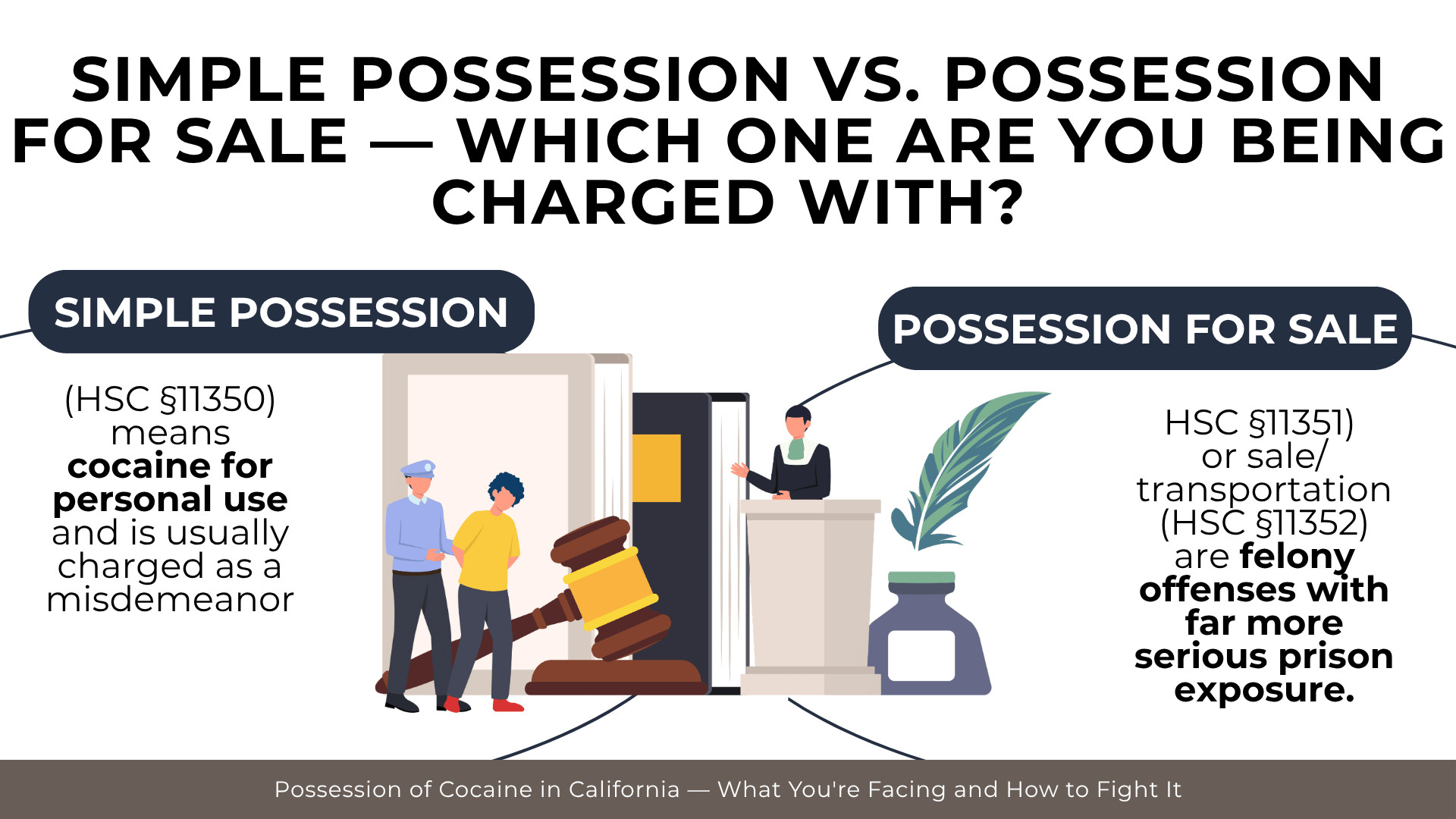
Simple Possession vs. Possession for Sale — Which One Are You Being Charged With?
This is the single most important distinction in any cocaine case, and it determines almost everything that follows.
HSC §11350 is simple possession — having cocaine for personal use. HSC §11351 is possession for sale, and HSC §11352 covers the actual sale, transportation, or furnishing of cocaine. The legal elements of possession and knowledge are the same across all three. The difference is intent, and the consequences of that difference are enormous. Simple possession is typically a misdemeanor. Possession for sale is a straight felony carrying two, three, or four years. Sale or transportation carries three, four, or five years in state prison. If the transportation crossed two or more counties that don’t share a border, that jumps to three, six, or nine years.
There is no statutory weight threshold in California that automatically converts simple possession into possession for sale. The prosecution must prove specific intent to sell beyond a reasonable doubt, and they build that case through circumstantial “indicia of sale” — quantity, packaging, scales, cash, and similar indicators. Under People v. Parra (1999) 70 Cal.App.4th 222, experienced officers may opine that drugs were possessed for sale based on these factors. But every one of those indicators cuts both ways, which is why the intent element is where cocaine cases are most vulnerable to challenge.
Understanding which charge is on the table is the first thing anyone facing a cocaine case needs to figure out, because it controls what the penalty range looks like and how the case can be fought.
What Are the Penalties for Cocaine Possession in California?
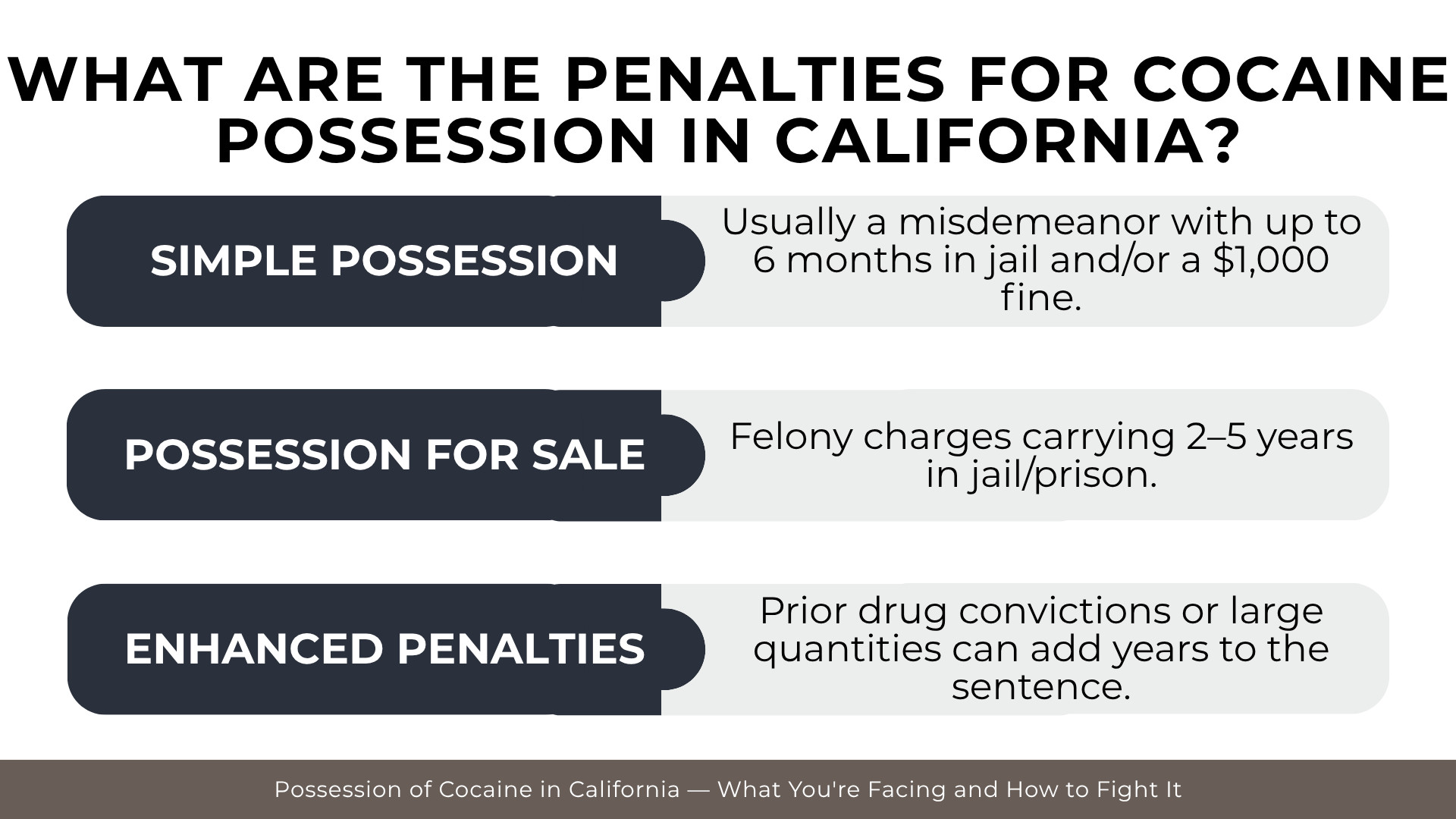
For simple possession of cocaine under HSC §11350, the charge is a misdemeanor for most defendants since Proposition 47 — up to six months in county jail under Penal Code §19 and/or a fine of up to $1,000. The felony line begins at possession for sale. HSC §11351 carries two, three, or four years. Sale or transportation under HSC §11352 carries three, four, or five years — and if the transportation crossed two non-contiguous counties, the range jumps to three, six, or nine years. Enhancements under HSC §11370.2 (three years for a prior drug felony) and HSC §11370.4 (three to twenty-five years for trafficking quantities) can push the total sentence well into double digits.
Those ranges can sound terrifying, but context matters. The statewide felony conviction rate is 60.0% — meaning four in ten felony arrests do not result in a conviction at all. The most common sentence for a California felony conviction is probation with jail time. That does not mean the risk isn’t real — it means the outcome depends heavily on the facts of the case, your history, and the quality of the defense.
What Defenses Can Beat a Cocaine Possession Charge?
Every element the prosecution must prove is a potential point of failure for their case. The defenses that matter most in cocaine cases map directly to those elements.
Lack of knowledge or control. If you did not know the cocaine was there, or had no dominion or control over it, the prosecution’s case fails on its most fundamental elements. These defenses arise frequently in cocaine cases involving shared vehicles, borrowed bags, or multi-person residences where more than one person had access to the location where cocaine was found.
Usable quantity. If the amount recovered is residue, trace powder, or a quantity that simply cannot be used, People v. Leal (1966) 64 Cal.2d 504 prevents conviction.
Transitory possession. Under People v. Mijares (1971) 6 Cal.3d 415, momentary possession solely for the purpose of disposing of the drug is a recognized defense.
Unlawful search and seizure. A motion to suppress evidence under Penal Code §1538.5 challenges whether law enforcement obtained the cocaine through a constitutional search. Cocaine cases frequently begin with traffic stops, vehicle searches, or searches of a person during arrest — each governed by constitutional boundaries that officers regularly approach or exceed. If your case started with a traffic stop, a consent search, or a search of your vehicle or phone, the legality of that search is the first thing a defense attorney should be examining.
Valid prescription. A valid prescription from a licensed practitioner eliminates the unlawfulness element under HSC §11350(a). This defense is narrow but applies where the facts support it.

Why Does It Matter Which Defense Attorney You Choose?
The California criminal system processes drug cases in volume, and the numbers reflect it. The system is built to move cases through plea bargains. The leverage you have in that process depends almost entirely on how prepared your attorney is to go to trial if the offer isn’t good enough.
That leverage gap is made worse by resources. The California Legislative Analyst’s Office has found that public defender offices receive approximately 82% less funding than district attorneys in their counties. On top of that, 24 of California’s 58 counties have no institutional public defender office at all. None of that is a criticism of the public defenders doing the work — it’s a structural reality that affects how much attention any single case can get.
At Angelo Reyes Law in Carlsbad, California, attorney Angelo Reyes takes a trial-first approach to criminal defense — every case is prepared as if it’s going to a jury, which builds leverage whether the case ultimately resolves through negotiation or at trial. Clients work directly with Angelo, not a paralegal or associate. He is licensed in California and Washington, admitted to the U.S. District Court for the Southern District of California, and has been recognized by the National Trial Lawyers as Top 40 Under 40. His results include a 25-to-life case dismissed, attempted murder charges reduced to battery, and felony strike exposures reduced to simple misdemeanors.
If you or someone you care about is facing cocaine possession charges in California, the decisions made in the first days and weeks of the case — what to say, what to challenge, how to handle the arraignment — shape everything that follows. Contact Angelo Reyes Law to discuss your case directly with the attorney who will handle it.
