

Getting arrested for a DUI in San Diego is disorienting. There’s the arrest itself, then the paperwork, the temporary license, the questions from people close to you, and underneath all of it, the sense that your life just split into “before” and “after.” That feeling is understandable. But the decisions you make in the next few days matter more than the ones you made last night, and this guide exists to help you make them clearly.
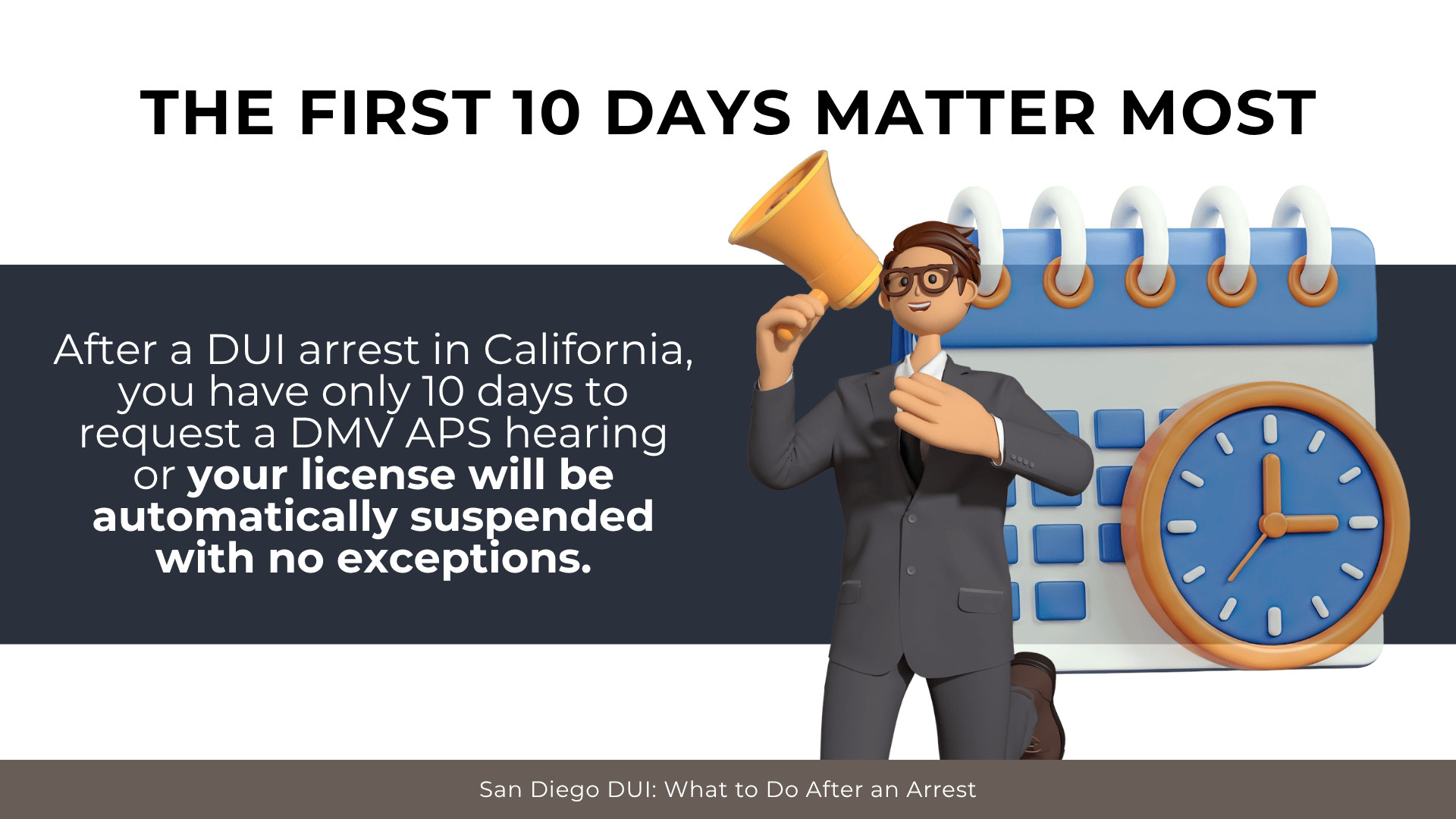
The First 10 Days Matter Most
Before you think about court dates, penalties, or hiring a lawyer, there is one deadline you cannot afford to miss.
When you were arrested, the officer likely confiscated your license and handed you a pink temporary document. That document is both your temporary license and a notice that your driving privileges will be suspended — automatically — unless you take action. Under California Vehicle Code § 13558, you have exactly 10 days from the date of your arrest to contact the DMV and request an Administrative Per Se (APS) hearing. If you don’t request that hearing within 10 days, the suspension goes into effect automatically. There is no extension, no grace period, and no exception.
Requesting the hearing does two things. First, it preserves your right to challenge the suspension with evidence and testimony. Second, it typically stays the suspension while the hearing is pending, meaning you can continue driving on your current license until the DMV makes its decision.
This deadline exists whether or not you’ve spoken to an attorney, whether or not you think the arrest was justified, and whether or not you plan to fight the charge. It is the single most time-sensitive decision in any San Diego DUI case.
How San Diego DUI Charges Actually Work
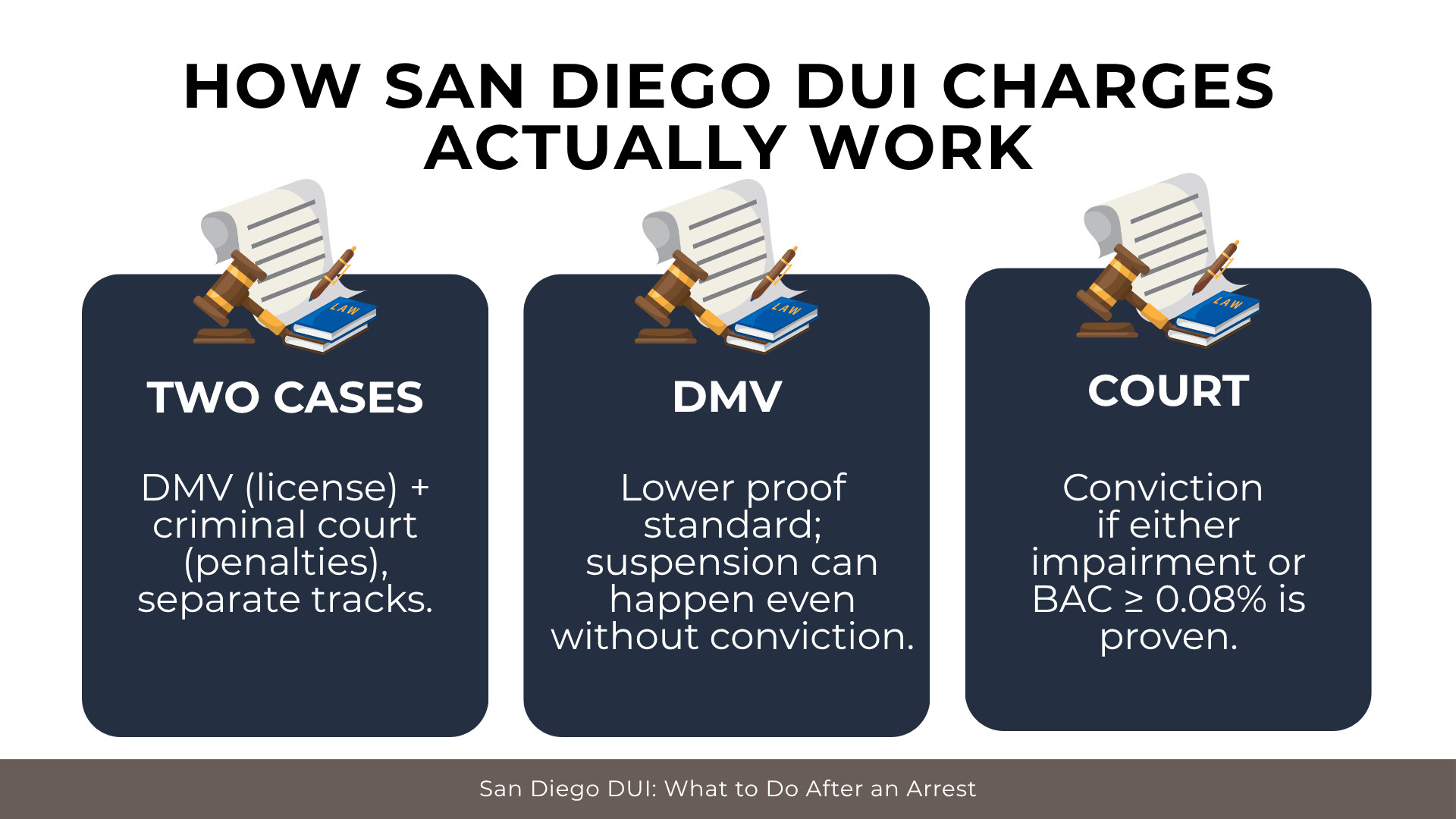
One of the most confusing things about a DUI arrest in California is that it triggers two completely separate cases against you — and most people don’t realize this until one of them has already moved forward without them.
The first case is administrative, handled by the DMV. This is the APS suspension discussed above. It is a civil proceeding with a lower burden of proof. The DMV only needs to show, by a preponderance of evidence, that the officer had reasonable cause to believe you were driving under the influence and that your BAC was at or above the legal limit. The California Supreme Court confirmed in MacDonald v. Gutierrez that this standard applies, and in Lake v. Reed, the court held that the APS suspension is a civil remedial measure — not criminal punishment — which means it proceeds regardless of what happens in your criminal case. A criminal acquittal does not automatically vacate an APS suspension; the DMV must independently determine whether the acquittal constitutes a factual finding precluding administrative action.
The second case is criminal, filed by the San Diego County District Attorney and handled in criminal court. This is where you face fines, jail time, probation, DUI school, and a criminal record. Prosecutors in California routinely charge DUI under two independent theories simultaneously. Under Vehicle Code § 23152(a), the prosecution argues that alcohol or drugs impaired your ability to drive with the caution of a sober person. Under § 23152(b), the prosecution argues simply that your blood alcohol concentration was 0.08% or higher at the time of driving — regardless of whether you appeared impaired. They don’t need to prove both. Either theory, standing alone, supports a conviction.
Understanding this two-track system matters because the strategies, timelines, and outcomes for each are different. You can win one and lose the other.
What Happened at Your Stop — and What Should Have Happened
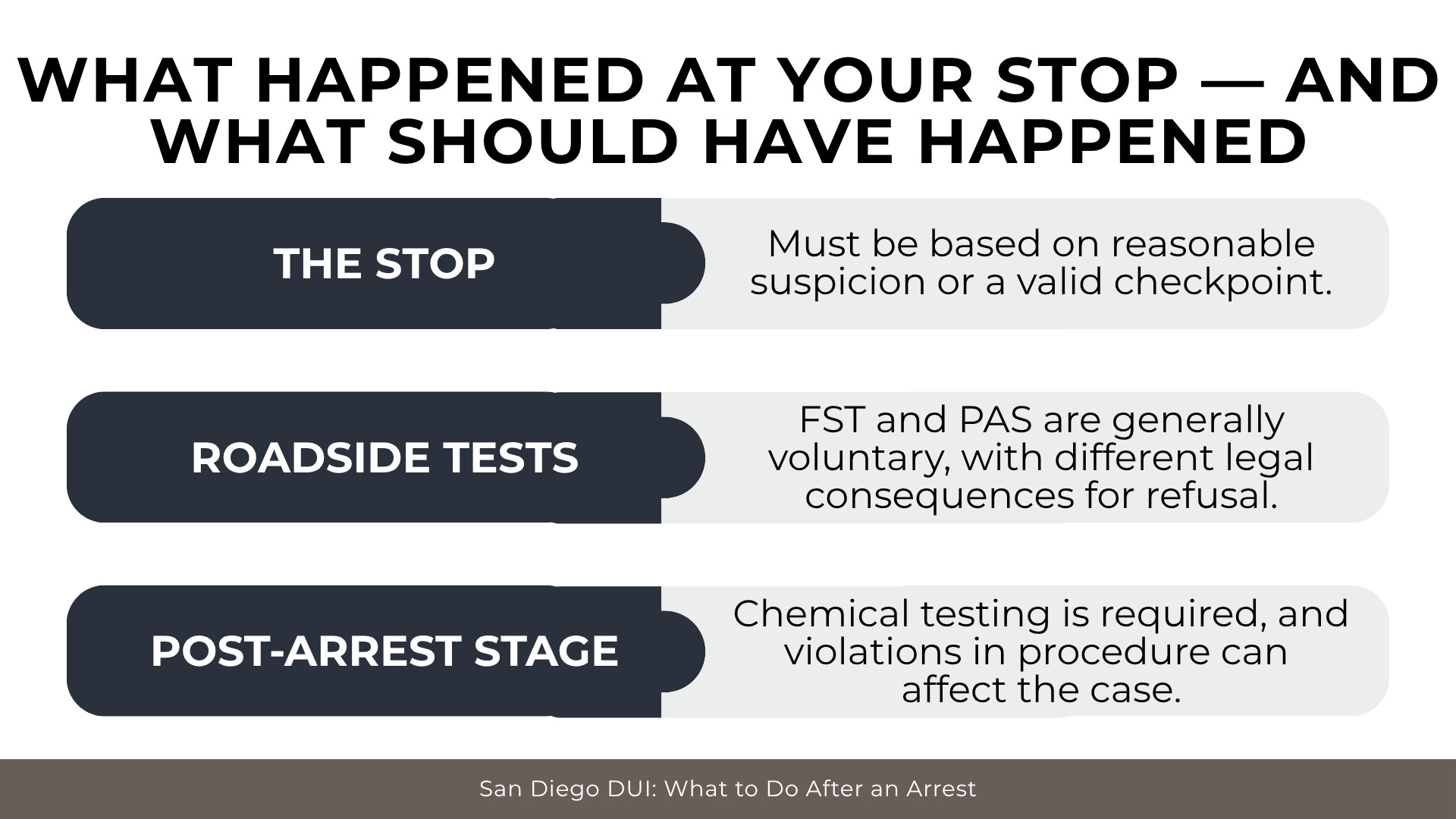
A DUI arrest in San Diego follows a specific sequence, and there are legal requirements at every stage. Where those requirements weren’t met, the evidence collected may be challenged or excluded.
The stop itself. An officer needs reasonable suspicion — specific, articulable facts suggesting a traffic violation or criminal activity — to pull you over. A hunch is not enough. The California Court of Appeal held in People v. Bell that a traffic stop requires reasonable suspicion based on articulable facts, and the U.S. Supreme Court established in Terry v. Ohio that the scope of any investigative detention must be reasonably related to the circumstances that justified it in the first place. If the stop was made at a DUI checkpoint rather than a traffic stop, a different standard applies: no individualized suspicion is required, but the checkpoint must satisfy the eight-factor framework from Ingersoll v. Palmer, including supervision by command-level personnel, neutral vehicle selection criteria, adequate safety measures, and advance publicity. Failure to meet these requirements can invalidate the entire stop.
Field sobriety tests. If the officer asked you to perform the walk-and-turn, one-leg stand, or horizontal gaze nystagmus test, those tests were voluntary. There is no statutory penalty in California for refusing field sobriety tests. However, the Court of Appeal held in People v. Jackson that an officer may testify about your refusal as evidence of consciousness of guilt — in other words, it can be used against you, but you couldn’t have been punished for saying no.
The preliminary alcohol screening (PAS) test. This is the handheld breathalyzer used at the roadside, before arrest. Under Vehicle Code § 23612(h)-(i), this test is also voluntary for drivers over 21 who are not on DUI probation, and the officer is required to advise you of your right to refuse. Importantly, under People v. Jackson, refusal of the PAS test cannot be admitted as consciousness of guilt the way FST refusal can, because you have an explicit statutory right to decline.
The post-arrest chemical test. This is where the law changes sharply. California’s implied consent law under Vehicle Code § 23612 means that by driving on California roads, you are deemed to have consented to chemical testing of your blood or breath after a lawful DUI arrest. Refusing this test carries serious consequences: a one-year license suspension for a first refusal, two years for a second, and three years for a third under Vehicle Code § 13353. And unlike an APS suspension for a failed test, a refusal suspension carries no eligibility for a restricted license. If the officer obtained a blood draw, the legal framework is more nuanced. The U.S. Supreme Court held in Missouri v. McNeely that natural alcohol dissipation alone does not justify a warrantless blood draw — there must be actual consent or case-specific exigent circumstances. And in Birchfield v. North Dakota, the Court drew a line: warrantless breath tests incident to arrest are constitutional, but warrantless blood tests are not, absent consent or exigency.
Miranda and questioning. If the officer asked you questions at the roadside before placing you under arrest, Miranda warnings were likely not required. The U.S. Supreme Court held in Berkemer v. McCarty that routine roadside questioning during a traffic stop does not constitute custodial interrogation because a traffic detention is not “custody” for Fifth Amendment purposes. Miranda attaches once the encounter transforms into actual custody — once a reasonable person in your position would believe they were under arrest. The Court also held in Pennsylvania v. Muniz that slurred speech observed during routine booking questions is non-testimonial evidence and does not implicate Miranda.
Each of these stages represents a point where the prosecution’s case either stands on solid ground or it doesn’t. The details matter.
Penalties for a San Diego DUI
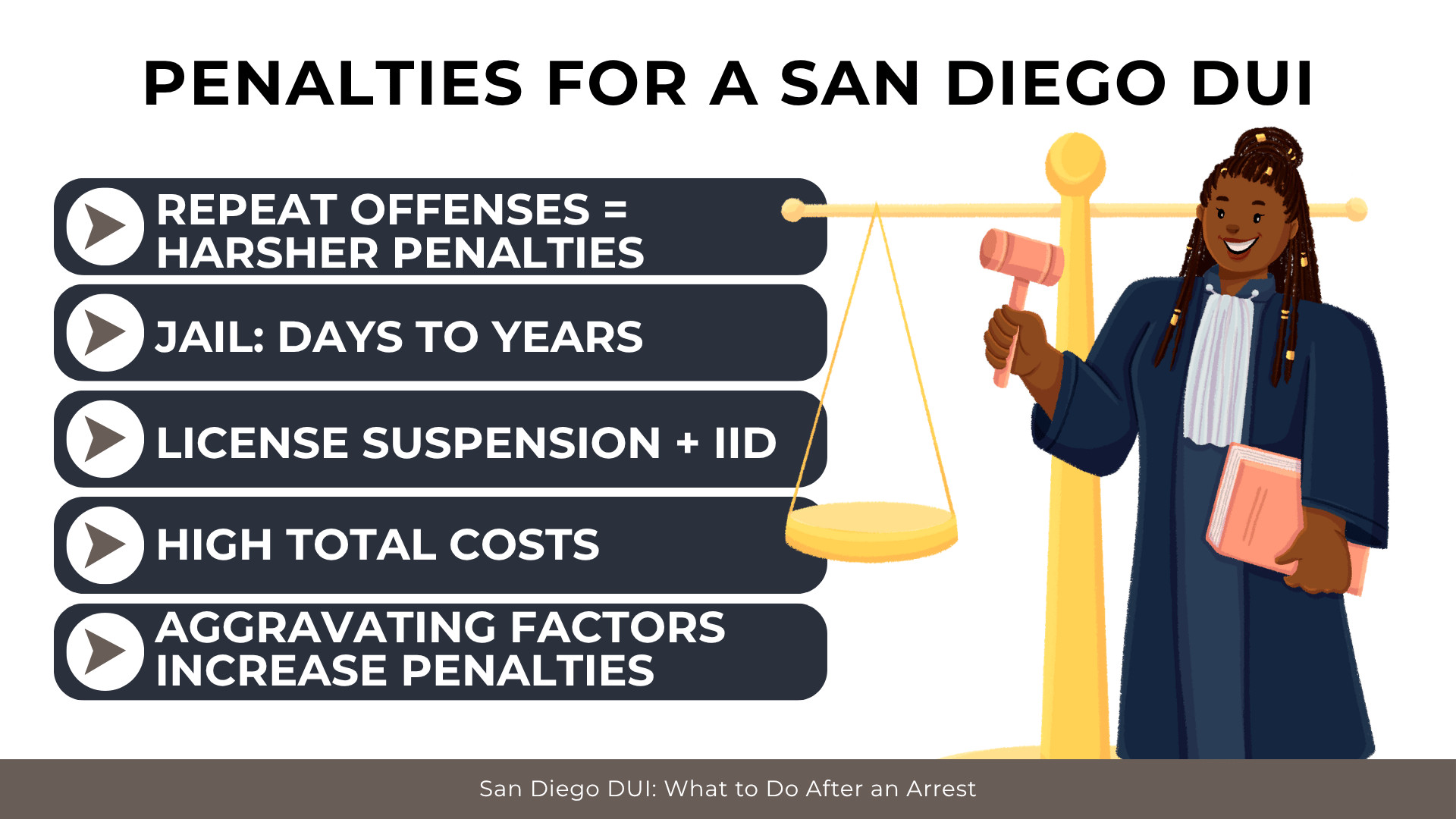
California DUI penalties escalate based on how many prior offenses you have within a 10-year lookback period, measured from arrest date to arrest date. Here is what the statutory framework looks like, along with what it translates to in practice.
First offense. Under Vehicle Code § 23536, a first DUI carries 96 hours to 6 months in county jail (with 48 hours served continuously), fines ranging from $390 to $1,000 plus penalty assessments that multiply the base fine significantly, a 6-month court-ordered license suspension under Vehicle Code § 13352, a separate APS suspension from the DMV under Vehicle Code § 13353.2, and 3 to 5 years of informal probation under Vehicle Code § 23600(b)(1) with zero-tolerance alcohol conditions. If your BAC was 0.20% or higher, Vehicle Code § 23538(b)(2) mandates a 9-month DUI education program. The IID requirement under Vehicle Code § 23575.3 is 6 months for a first offense involving injury.
But the statutory fines don’t capture the real financial picture. When you factor in penalty assessments, insurance increases, attorney costs, DUI school, and lost wages, the total financial impact of a first-offense DUI in California far exceeds the base fine.
Second offense within 10 years. Vehicle Code § 23540 raises the jail range to 90 days to 1 year, with fines of $390 to $1,000 plus assessments. The court-ordered license suspension extends to 2 years, the DUI program extends to 18 or 30 months, and the IID requirement is 12 months. Statewide data shows that 95.2% of repeat offenders are sentenced to jail time, compared to 66.3% of first offenders.
Third offense within 10 years. Under Vehicle Code § 23546, the mandatory minimum jail time rises to 120 days, with a maximum of 1 year. The court suspension is 3 years, and the IID requirement extends to 24 months.
Fourth offense within 10 years. This is where DUI crosses from misdemeanor to felony. Vehicle Code § 23550 authorizes 16 months, 2 years, or 3 years in state prison, or 180 days to 1 year in county jail. Fines remain $390 to $1,000 plus assessments, and the court suspension extends to 4 years.
Aggravating factors. A BAC at or above 0.15% triggers a discretionary sentencing enhancement under Vehicle Code § 23578. If a child under 14 was in the vehicle, Vehicle Code § 23572 adds mandatory consecutive jail time: 48 hours for a first offense, 10 days for a second, 30 days for a third, and 90 days for a fourth or subsequent. DUI causing injury under Vehicle Code § 23153 is a felony wobbler. And in the most serious cases, the California Supreme Court’s decision in People v. Watson established that drunk driving with conscious disregard for human life constitutes implied malice sufficient to support a charge of second-degree murder. A great bodily injury finding under Penal Code § 12022.7 can add 3 to 6 years consecutive to the sentence.
How DUI Cases Get Fought
Several established defense approaches may apply depending on the facts of your San Diego DUI case. These include challenging whether the officer had reasonable suspicion for the traffic stop, contesting whether your BAC was at or above 0.08% at the time of driving (the rising blood alcohol defense recognized in People v. McNeal), scrutinizing chemical test procedures and calibration records, questioning whether the prosecution can prove you were actually “driving” the vehicle (which requires volitional movement under Mercer v. Department of Motor Vehicles), and challenging the subjective officer observations that support the impairment theory under § 23152(a). Each defense depends entirely on the specific facts of your arrest — the location, the officer’s conduct, the testing timeline, and the evidence collected. A San Diego DUI attorney who knows the local courts, the agencies running enforcement, and how specific prosecutors handle these cases can identify which defenses are viable in your situation.

Consequences Beyond the Courtroom
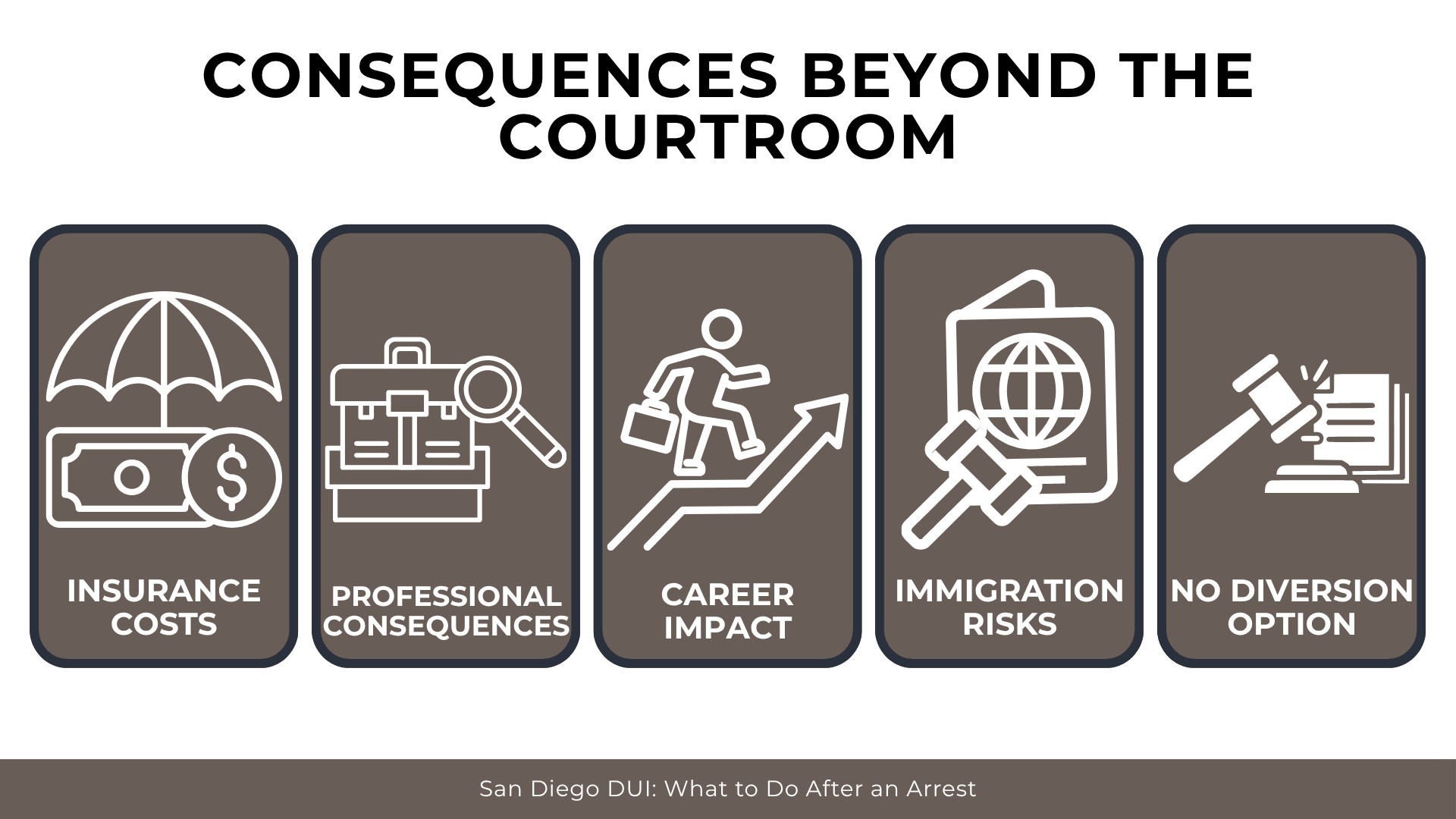
The penalties described above are what the court imposes. But a San Diego DUI conviction creates consequences that extend well beyond the courtroom — and understanding them is important for evaluating what’s at stake as your case moves forward.
You’ll need to file an SR-22 certificate of financial responsibility for 3 years following license reinstatement under Vehicle Code § 13352.4, which substantially increases your insurance premiums. Commercial drivers face CDL disqualification under federal law — a career-ending consequence for many San Diego residents who drive commercially. Licensed professionals face mandatory reporting obligations to their respective boards. And non-citizens face immigration consequences that require specialized analysis.
One more point that shapes the San Diego DUI landscape specifically: DUI offenses are categorically excluded from judicial diversion under Vehicle Code § 23640. Unlike many other misdemeanors, a DUI cannot be diverted away — it must be resolved on the merits through the court system. The only exception is military diversion under Penal Code § 1001.80, relevant for San Diego’s large military community around Camp Pendleton and the naval installations.
Why San Diego DUI Cases Need Local Experience
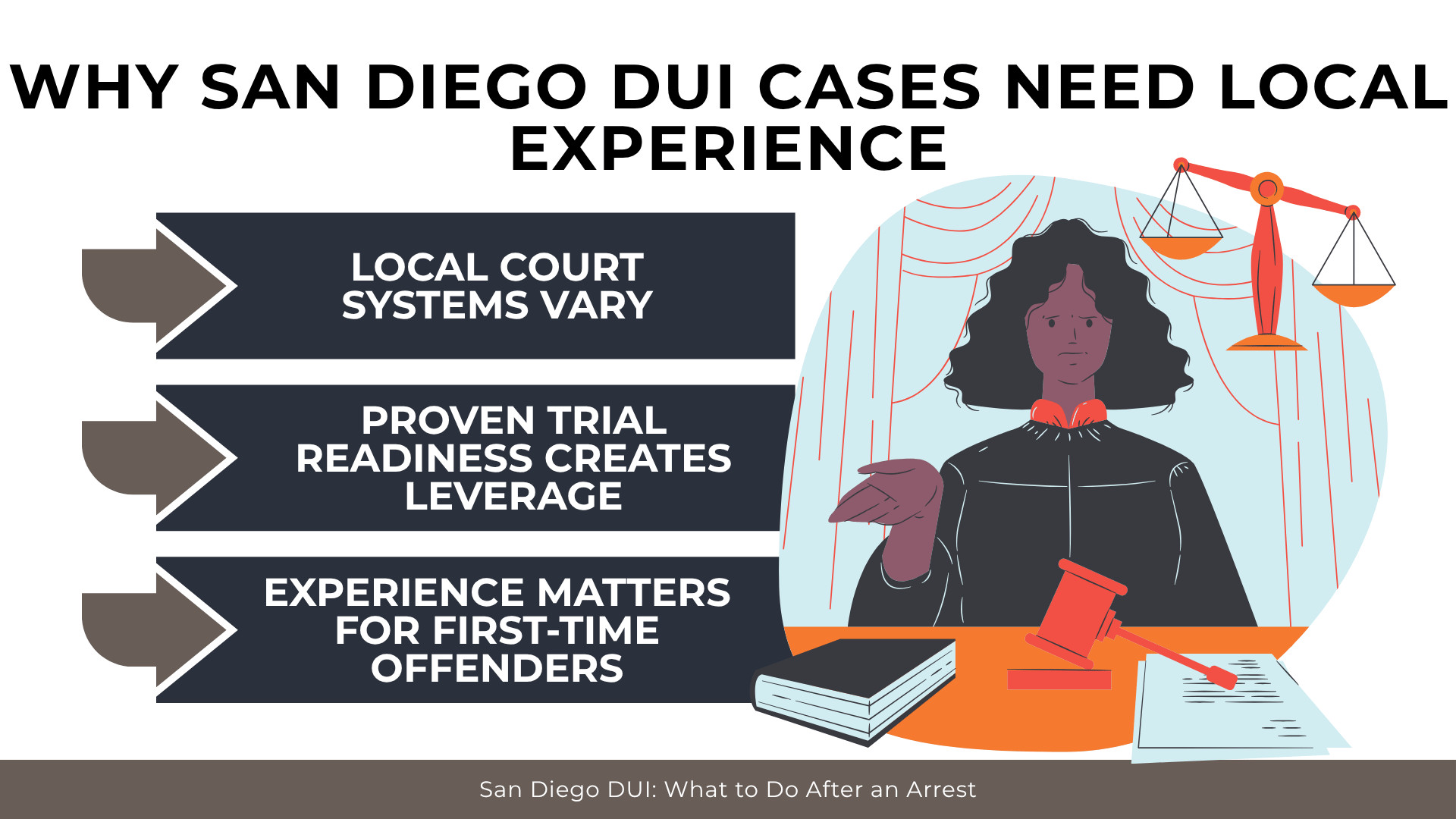
San Diego County has its own courthouses, its own prosecutors, and its own patterns for how DUI cases are charged, negotiated, and tried. The way a case moves through one courthouse is different from how it moves through another, and those differences affect strategy.
Law Office of Angelo Reyes, APC is based in Carlsbad and serves clients throughout San Diego County. Attorney Angelo J. Reyes is a San Diego criminal defense and personal injury attorney admitted to the State Bar of California and the U.S. District Court for the Southern District of California, recognized by the National Trial Lawyers as a Top 40 Under 40 attorney. With extensive trial experience, Angelo handles complex, high-stakes cases as a courtroom advocate who prepares every matter for trial. When the prosecution knows that the attorney across the table is genuinely prepared to take the case before a jury, the negotiation shifts. That preparation — reviewing every piece of evidence, challenging every procedural step, identifying every weakness in the prosecution’s case — is what creates leverage.
Roughly 72.8% of people convicted of DUI in California are first-time offenders. Most people going through this process have never been inside a courtroom. Having an attorney who has been there — repeatedly, and recently — matters.
What to Do Right Now
If you were recently arrested for a DUI in San Diego, the most important thing you can do today is protect the deadline. You have 10 days from your arrest to request a DMV hearing, and that clock is already running.
Contact Law Office of Angelo Reyes, APC for a consultation. The sooner you act, the more options remain available — both at the DMV and in court.
