California law recognizes self-defense as a complete legal defense to domestic violence charges. If you used force to protect yourself during a domestic incident, you can raise self-defense under the same legal framework that applies to any assault or battery case. California also has a specific evidentiary statute, Evidence Code § 1107, that allows expert testimony about intimate partner abuse to support that claim — in ways you may not know are available to you.
Whether self-defense succeeds depends on what the law requires, what evidence exists, and how early the defense strategy takes shape. This page covers all three.
Why am I being charged if I was the one defending myself?
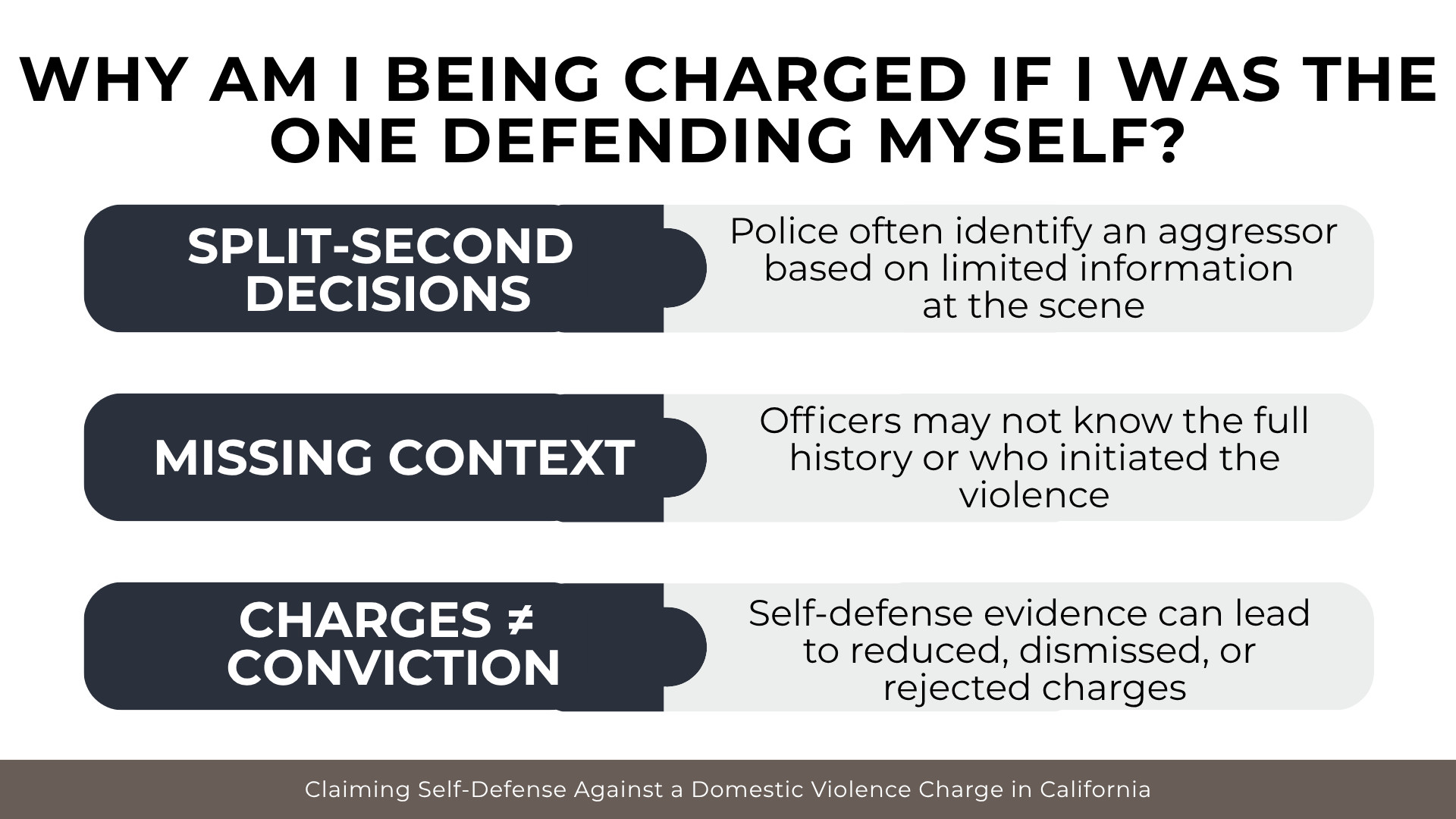
When law enforcement responds to a domestic violence call, officers make rapid judgments about who the aggressor was. Those judgments are based on what’s visible when they arrive — injuries, demeanor, who called 911, relative size of the parties — not necessarily on what actually happened before they got there. You can end up arrested and facing charges based on a quick scene assessment that missed the full picture.
This happens at scale. California law enforcement responded to 163,024 domestic violence-related calls in 2024. Each one required an on-scene decision about who did what — often within minutes, often without the benefit of context about the relationship’s history or who initiated the violence.
An arrest, though, does not mean a conviction is inevitable or that the prosecution’s version of events is strong. When officers conduct only a basic investigation, prosecutors decline to file criminal charges approximately 70% of the time. The gap between an arrest and a filing decision is where the defense narrative can take hold — particularly when self-defense is at issue and the evidence supports it.
Does California actually recognize self-defense in domestic violence cases?
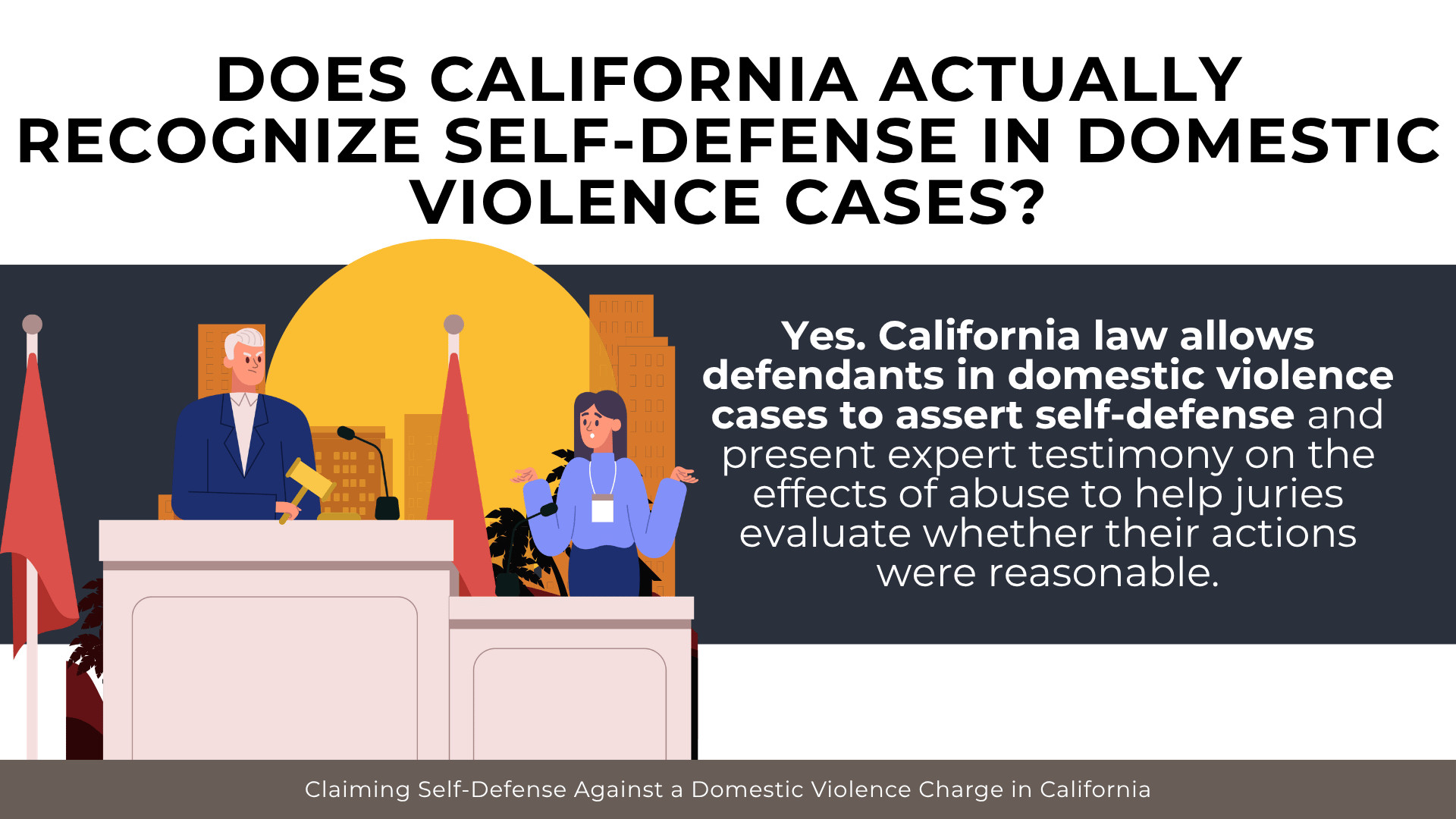
Yes. California’s standard self-defense jury instructions — CALCRIM No. 505 for justifiable homicide and CALCRIM No. 571 for imperfect self-defense — apply in criminal cases involving domestic violence. The self-defense principles they reflect extend across charge levels.
California goes further than that. Under Evidence Code § 1107, expert testimony on “intimate partner battering and its effects, including the nature and effect of physical, emotional, or mental abuse on the beliefs, perceptions, or behavior of victims of domestic violence” is explicitly admissible in criminal cases. The legislature also declared in subdivision (b) that this testimony “shall not be considered a new scientific technique whose reliability is unproven.” That declaration shields it from the reliability challenges that can block other forms of expert testimony.
Self-defense claims in DV cases raise issues that don’t come up in other contexts. The history between the parties, the pattern of abuse, and the way prolonged violence reshapes a person’s ability to read danger signals are all central to whether the use of force was reasonable. Section 1107 is the law that allows that context into the courtroom. CALCRIM No. 851 instructs the jury on how to consider it when evaluating a self-defense claim.
What do I have to prove for self-defense to work?
The key authority is the California Supreme Court’s decision in People v. Humphrey, 13 Cal.4th 1073 (1996), which established that intimate partner battering evidence is relevant to both prongs of California’s self-defense analysis.
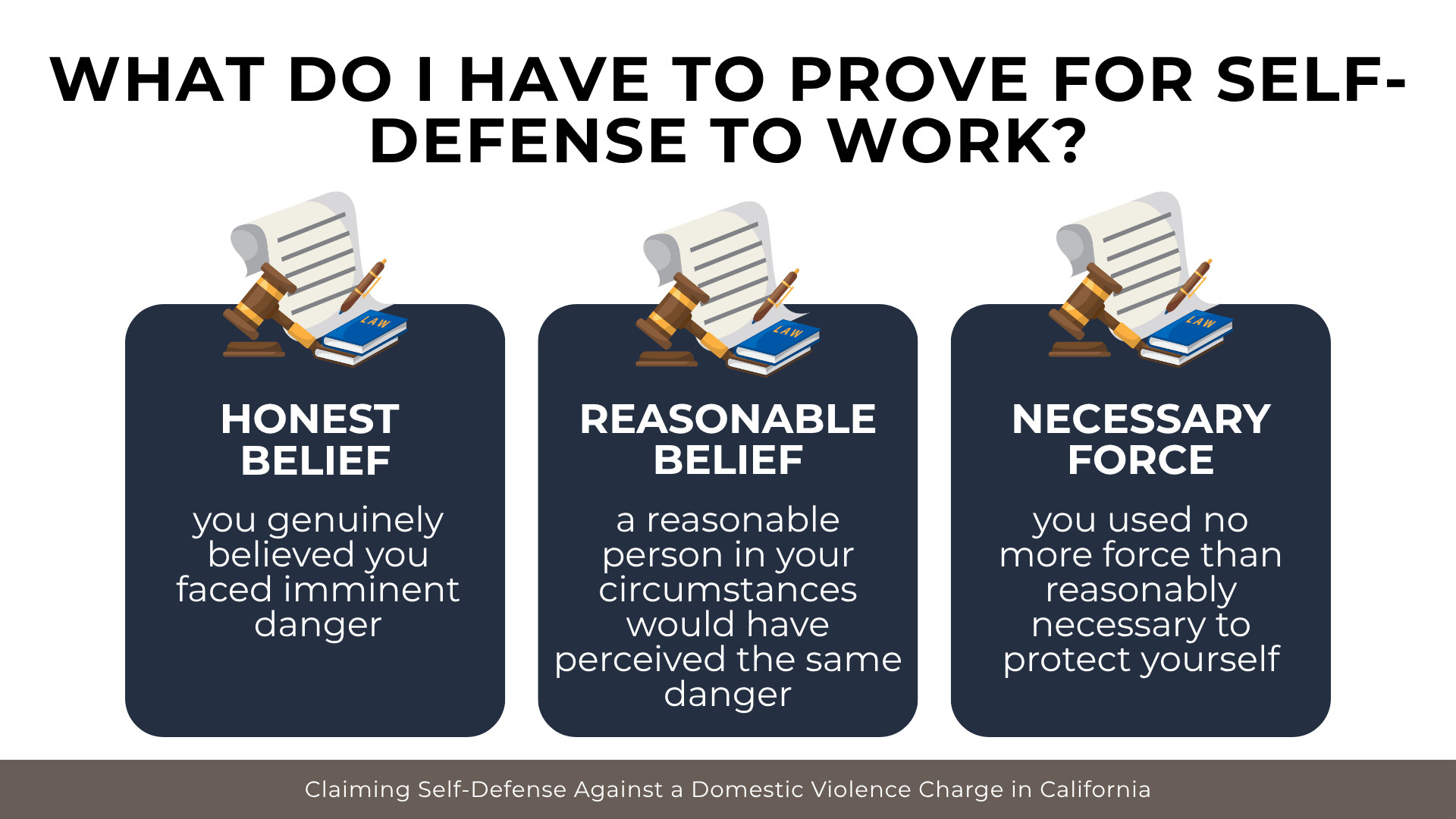
The subjective prong asks whether the defendant genuinely believed they were in danger and needed to use force to protect themselves. This is about actual, honest perception at the moment force was used — not about what an outside observer would have concluded.
The objective prong asks whether that belief was reasonable under the circumstances. Before Humphrey, trial courts had restricted intimate partner battering evidence to only the subjective side of the analysis. Juries could consider the abuse history when deciding whether the defendant felt afraid, but not when deciding whether a reasonable person in that situation should have felt afraid. The California Supreme Court reversed that limitation, holding that expert testimony on battering is relevant to both the subjective existence and the objective reasonableness of the defendant’s claimed need for self-defense.
That ruling changed how DV self-defense claims work in California. A jury is now entitled to hear expert testimony explaining why someone who has lived through repeated abuse may recognize danger in circumstances that an outsider — with no knowledge of the relationship — might not perceive as threatening. A shift in tone, a specific physical gesture, a sequence of behaviors that has preceded violence before — these can be genuine signs of imminent harm to someone whose experience has taught them what comes next.
When the belief in danger was genuine but not objectively reasonable, CALCRIM No. 571 provides for imperfect self-defense. This does not produce a complete acquittal, but it can significantly reduce the severity of the offense. That distinction matters when the difference between charge levels affects whether someone faces a misdemeanor or a felony with years in state prison.
What is intimate partner battering evidence and how does it help me?
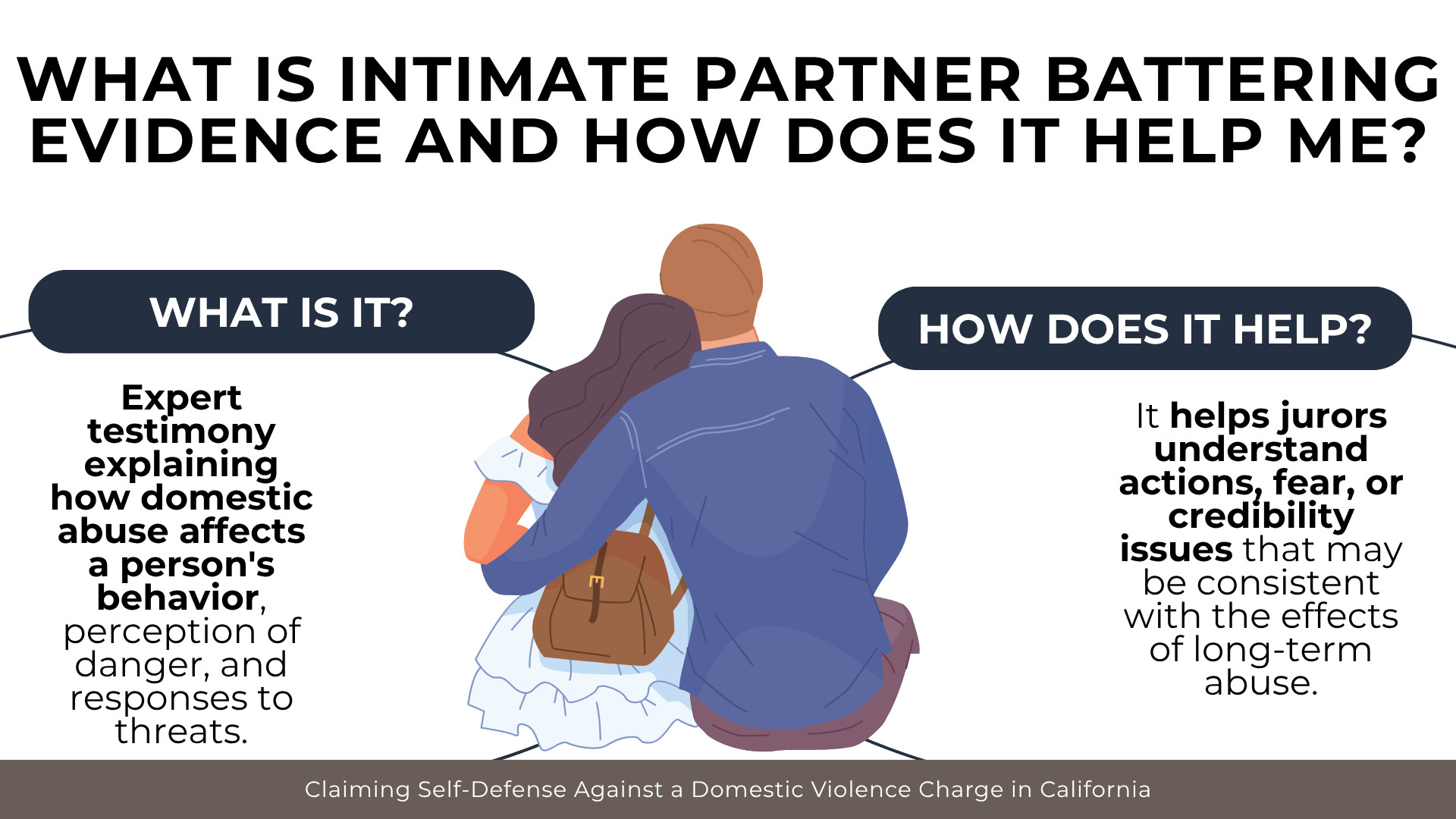
Evidence Code § 1107 authorizes qualified experts to testify about general patterns of abuse — the cycle of violence, how escalation works, why victims stay in abusive relationships, how prolonged abuse reshapes perception and decision-making, and why a person subjected to domestic violence may use force in situations others might not immediately understand. The statute was broadened from its original “battered women’s syndrome” terminology to “intimate partner battering and its effects,” so it covers all genders and relationship types. Subdivision (f) confirms that earlier case law under the original terminology remains applicable.
In People v. Brown, 33 Cal.4th 892 (2004), the California Supreme Court held that expert testimony on battering patterns is admissible even when there is no evidence of prior violence between the specific defendant and the alleged victim. The condition is that the testimony must be relevant to explaining witness behavior. This means the expert’s testimony isn’t limited to relationships where abuse has been formally documented. It can also help a jury understand patterns such as recantation or other conduct that might otherwise undermine a party’s credibility.
There is, however, a firm boundary on what the expert can say. In People v. Erickson, 57 Cal.App.4th 1391 (1997), the Court of Appeal drew a line. An expert may explain how a defendant’s perception of danger would reasonably follow from their experience as a battered person. But the expert may not testify that the defendant actually perceived danger or possessed the required mental state. This limitation comes from Penal Code § 29, which prohibits expert opinion on a defendant’s actual state of mind.
In practice, the expert builds the explanation: what abuse does to a person’s ability to perceive threat, how the cycle of violence operates, and why this type of response is consistent with someone acting out of genuine fear. The jury then applies that explanation to the specific facts. The expert sets the context. The physical evidence, the documented history, and the defendant’s own account fill it in.
What evidence do I need to support a self-defense claim?
A self-defense case in a DV context depends on two things: evidence of what happened during the specific incident and evidence of the relationship’s history of abuse.
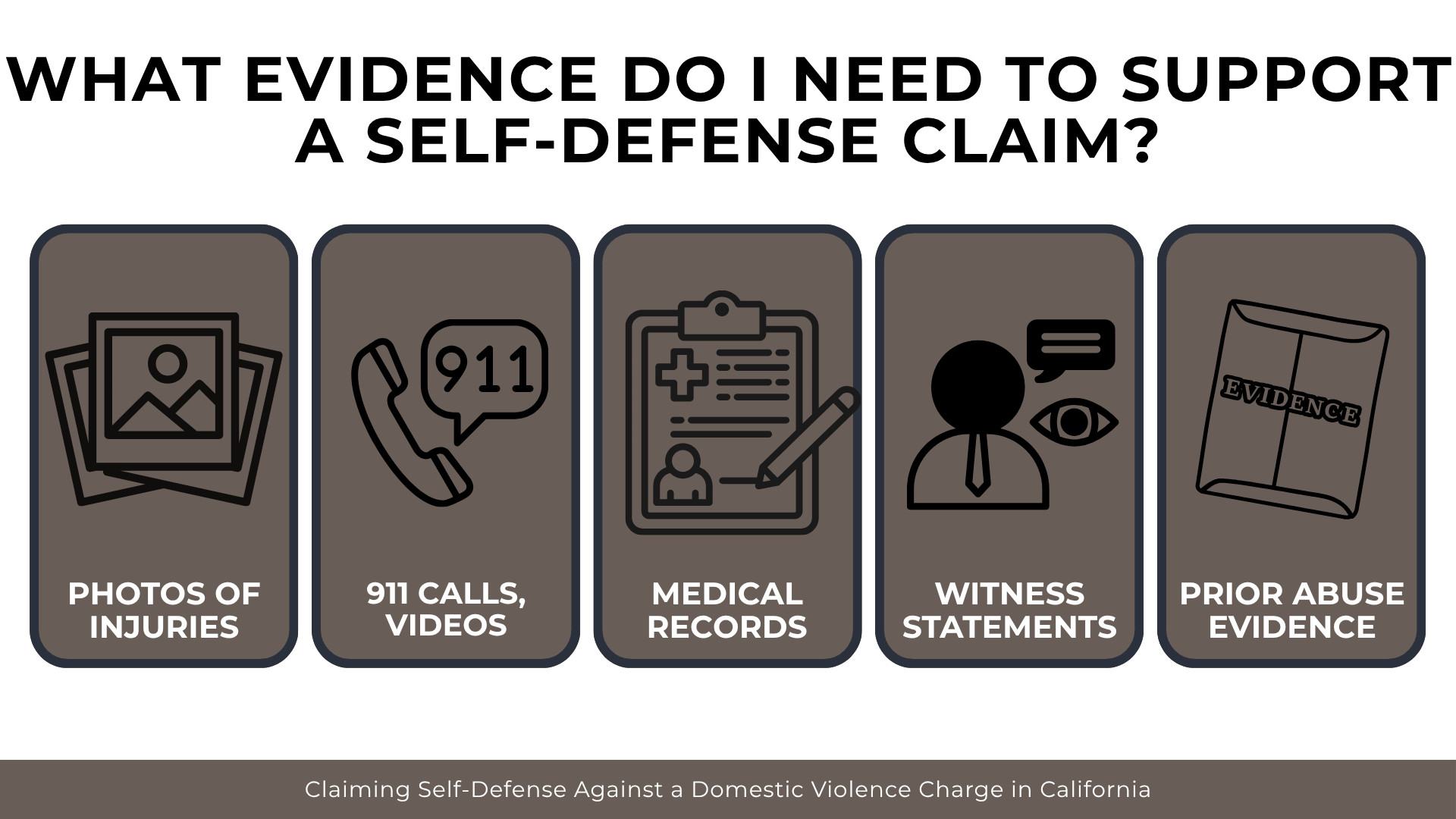
For the incident itself, the strongest evidence includes photographs of injuries — taken both immediately and several days later as bruising develops — along with 911 call recordings that capture events in real time, medical records from any treatment sought after the incident, witness statements from people who saw or heard the incident, and any existing video or audio from the scene. Physical evidence showing defensive injuries, such as bruising on the forearms or marks consistent with blocking strikes, can distinguish protective action from aggression.
For the relationship history, the key types of evidence include prior police reports, prior emergency room visits, text messages or voicemails containing threats, evidence of controlling or coercive behavior, and testimony from people who were aware of the abuse. These matter because they provide the factual basis that Evidence Code § 1107 expert testimony builds upon. While People v. Brown confirmed that battering evidence is admissible even without documented prior violence between the specific parties, your self-defense claim is much stronger when the pattern of abuse is supported by a record created at the time rather than testimony alone.
Evidence preservation is time-sensitive. Injuries heal. Bruises that haven’t fully appeared on the night of an arrest may be visible two or three days later but gone within a week. Text messages get deleted. Witnesses’ memories become less precise. The earlier the documentation process begins, the stronger the evidence.
What can go wrong with a self-defense claim in a DV case?
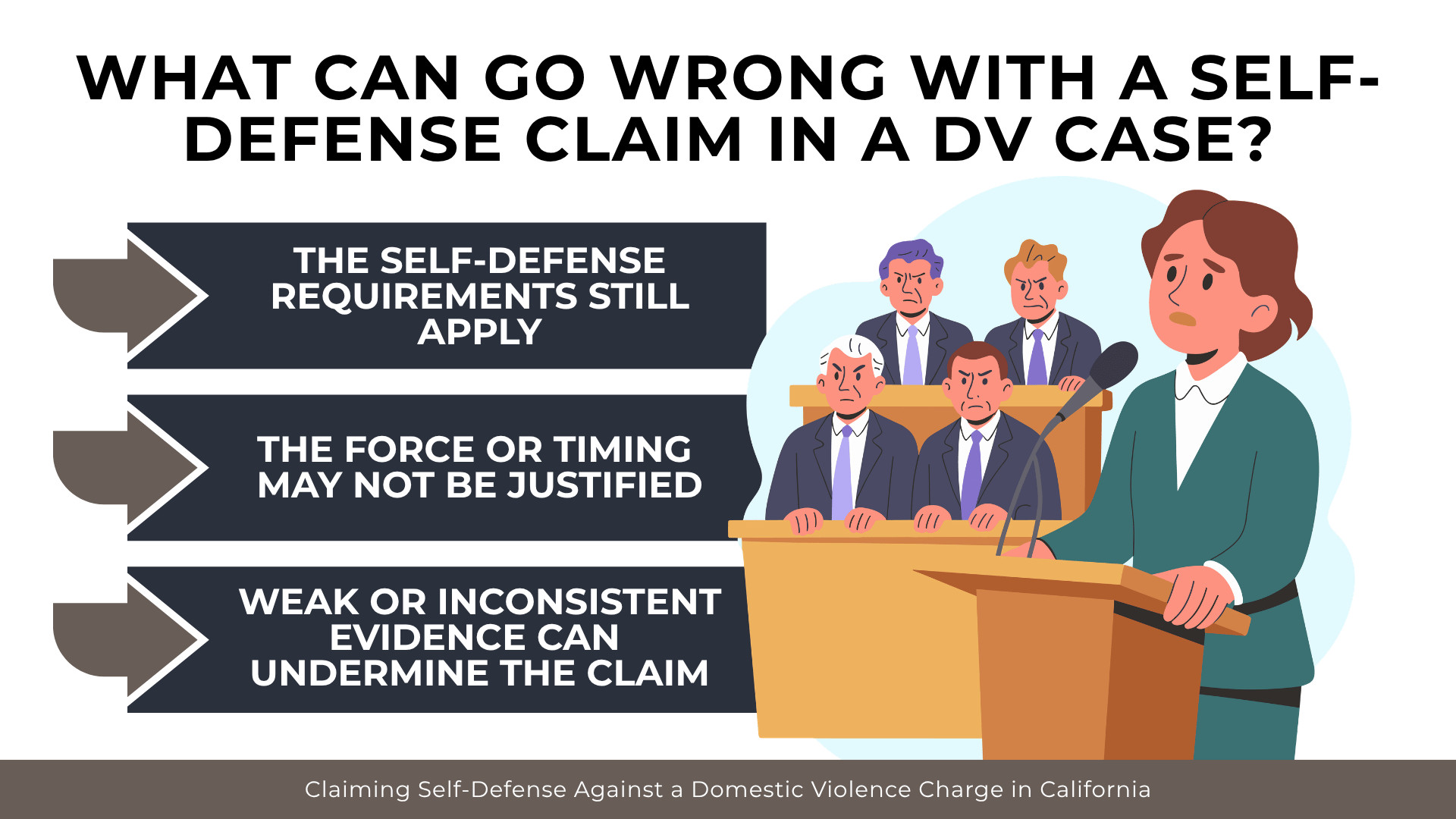
The most important limitation is built into the statute. Evidence Code § 1107(d) states that the provision is “a rule of evidence only” — it creates no new independent defense within the Penal Code. There is no standalone “battered spouse defense” in California. Intimate partner battering evidence supports the existing self-defense doctrine, but it does not replace its elements. You must still establish that you believed force was necessary and that the belief was reasonable.
Several patterns commonly undermine self-defense claims in DV cases.
Force that exceeded what was reasonably necessary to address the threat is the most frequent problem. Self-defense authorizes the level of force needed to stop the danger. When the threat has ended and the defendant continued using force, the justification collapses — and the prosecution will point to any evidence of continued aggression after the danger passed.
A gap between the threat and the response weakens the claim. Self-defense is tied to an imminent danger. When force is used hours or days after the alleged abuse, connecting it to a present threat becomes difficult. Expert testimony under § 1107 can help explain why someone subjected to ongoing abuse may perceive danger as continuous. But that explanation has to overcome the prosecution’s argument that you had time to leave, call police, or seek other help.
Inconsistent statements to law enforcement create problems that get worse at every stage of the case. What you say at the scene, during booking, and in follow-up interviews becomes part of the record. Statements that shift or contradict your self-defense account give prosecutors material to argue your claim was constructed after the fact rather than reflecting what actually happened.
Lack of supporting evidence turns the case into a credibility contest. Roughly 92.9% of domestic violence aggravated assault convictions are obtained through guilty pleas rather than trial verdicts. When a self-defense claim depends entirely on one person’s word against another’s, with no physical evidence, no documented history, and no independent witnesses, the pressure to accept a plea rather than risk a trial conviction increases substantially.
How soon do I need to talk to a lawyer about this?
The earlier, the better — and the difference matters. Evidence degrades. Injuries heal. Witnesses’ accounts become less specific with each passing week. And the statements made to police in the hours after an arrest often define the prosecution’s case in ways that are difficult to undo later. Whether charges are filed, reduced, or rejected can depend on what the defense presents to the prosecutor’s office before a filing decision is made.
At Angelo Reyes Law in Carlsbad, California, every case is prepared as if it’s going to a jury — a trial-first approach that creates leverage whether the matter resolves through negotiation or at trial. Clients work directly with attorney Angelo Reyes, not a paralegal or associate. Angelo Reyes has handled thousands of criminal cases across San Diego County, with results that include felony strike exposures reduced to simple misdemeanors, serious charges dismissed, and cases taken to jury verdict when the case called for it.
Self-defense is a recognized, evidence-based legal strategy in California DV cases. But it depends on the facts, the documentation, and the quality of the defense built around it. If the facts support it, the time to start building is now. Contact Angelo Reyes Law to discuss the specifics of the situation.