Can I Lose My Guns Over a Domestic Violence Case in California?
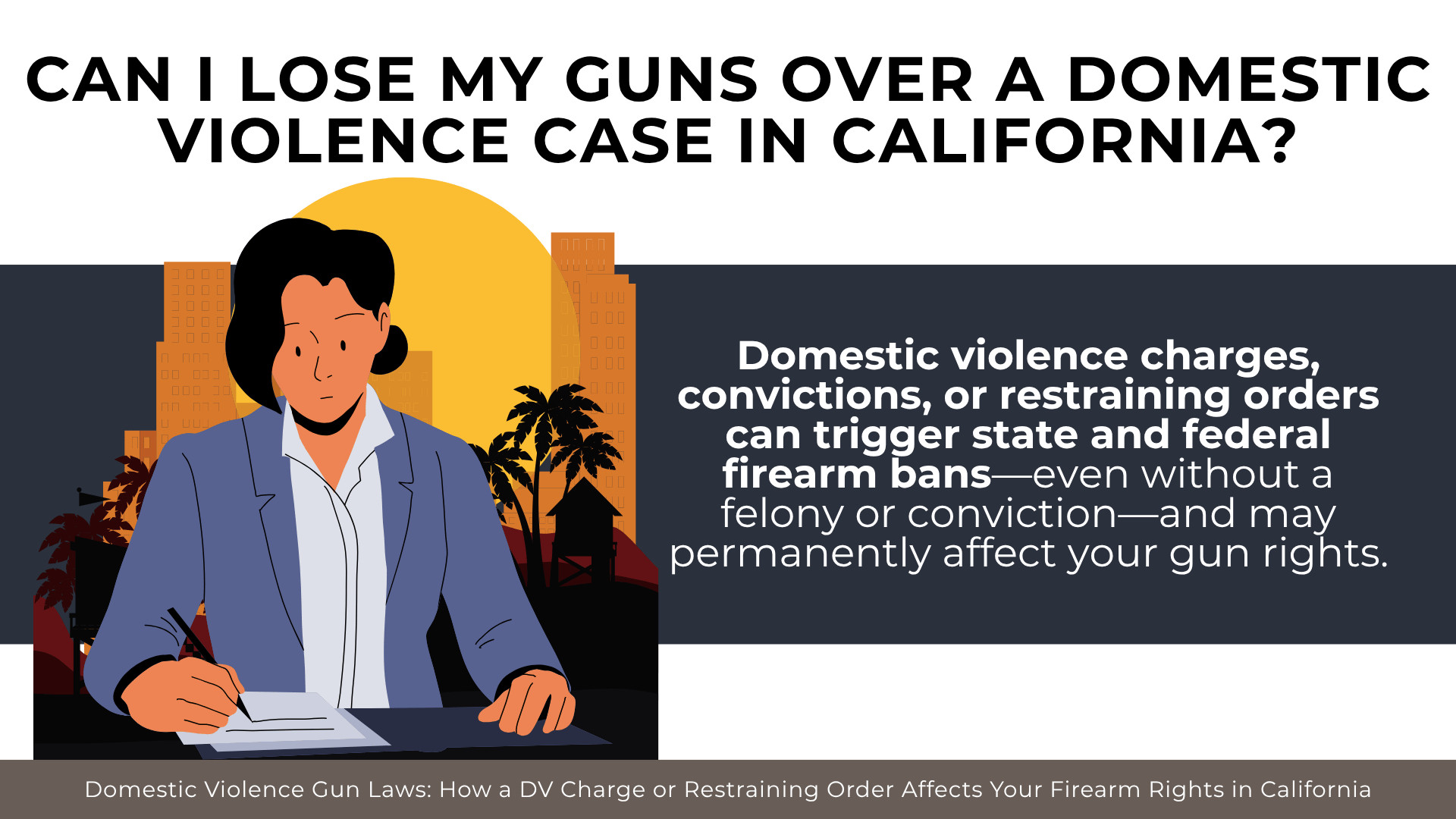
A domestic violence charge, conviction, or restraining order can result in the loss of your right to own or possess firearms — and in many cases, that loss is permanent. Both federal law and California law impose independent firearms bans triggered by domestic violence proceedings. The two systems don’t operate on the same rules.
What surprises most people is that these bans don’t require a felony. They don’t always require a conviction. In some cases, a civil restraining order alone — issued in a family court proceeding that has nothing to do with criminal charges — is enough to make it illegal for you to possess a single round of ammunition.
This page covers how domestic violence firearms bans work at both the federal and state level, what triggers them, what the surrender process looks like, and what it realistically takes to get gun rights back once they’re gone. If you’re facing a DV-related charge or protective order in the San Diego County area, understanding these rules before your case resolves is critical. The legal strategy chosen now often determines whether your firearm rights survive.
Can a Restraining Order Take Away My Guns Even Without a Conviction?
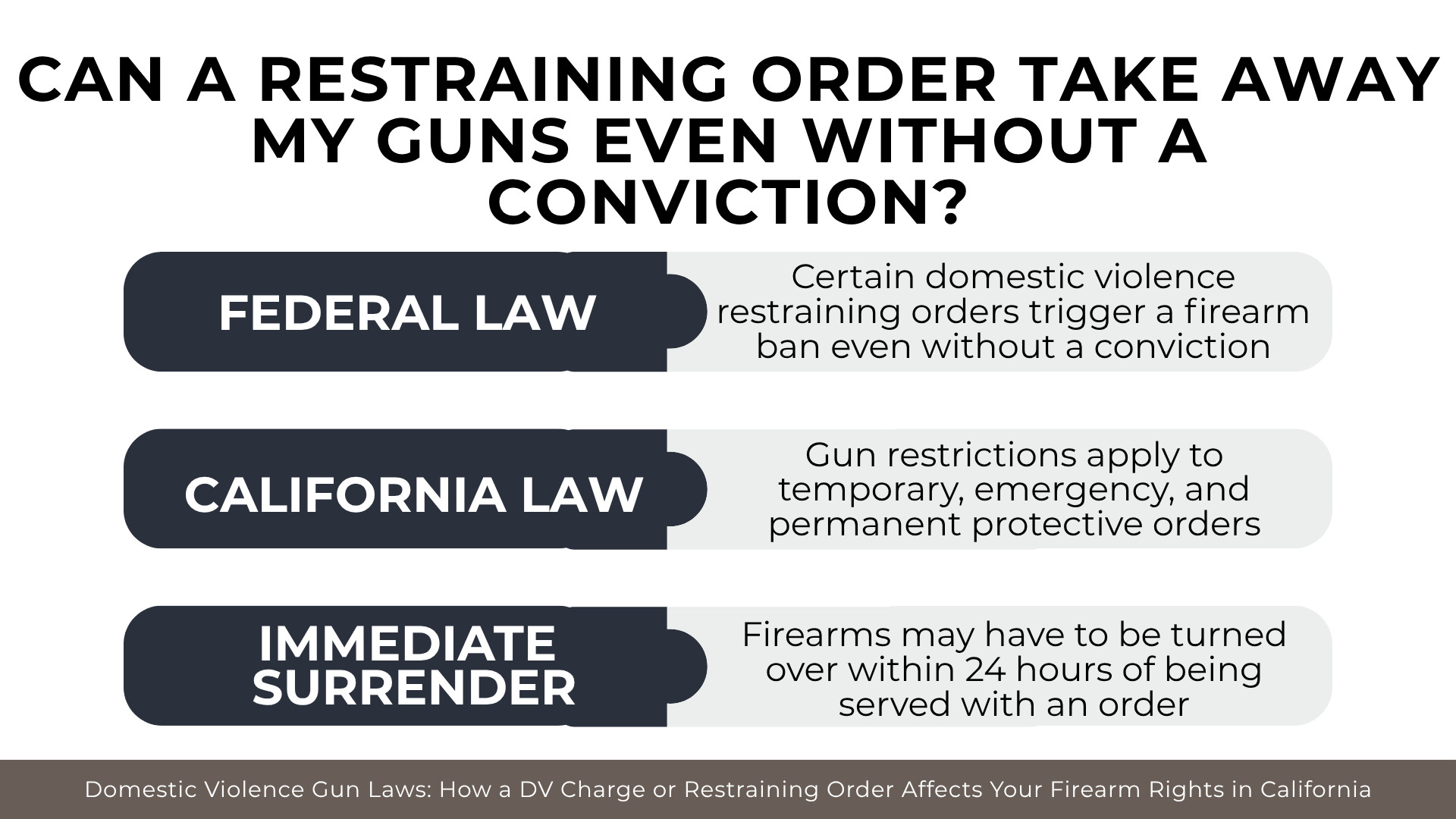
Yes. Federal and California law both impose firearms bans on individuals subject to certain domestic violence restraining orders, regardless of whether criminal charges have been filed or a conviction has been entered.
Under federal law, 18 U.S.C. § 922(g)(8) prohibits firearm possession by any person subject to a qualifying court order. A restraining order “qualifies” under the federal statute only if three conditions are met. First, the order must have been issued after a hearing of which the person received actual notice and had an opportunity to participate. Second, it must restrain the person from threatening, stalking, or harassing an intimate partner or child. Third, it must include either a finding that the person represents a credible threat to the physical safety of an intimate partner or an explicit prohibition on the use, attempted use, or threatened use of physical force.
The U.S. Supreme Court upheld this provision as constitutional in United States v. Rahimi, 602 U.S. 680 (2024). The Court held that an individual found by a court to pose a credible threat to another’s physical safety may be temporarily disarmed consistent with the Second Amendment.
California’s ban is broader. Cal. Penal Code § 29825 makes it a wobbler offense to possess a firearm while subject to a qualifying protective order. Unlike the federal statute, California’s law applies to ex parte and temporary orders — not just orders issued after a noticed hearing. That means a Temporary Restraining Order under Cal. Family Code § 6300, which can be issued without notice to the respondent upon “reasonable proof of a past act or acts of abuse,” triggers California’s firearm ban immediately. So does an Emergency Protective Order under Cal. Family Code § 6250, which law enforcement can obtain from a judicial officer at any hour of the day.
Cal. Family Code § 6389 creates similar firearm surrender requirements for civil Domestic Violence Restraining Orders. Cal. Penal Code § 136.2(d) requires surrender when a Criminal Protective Order is issued in a DV case. The practical result: you can be legally required to surrender all firearms within 24 hours of an order being served — before any criminal case has even been filed, and before any court has made a finding of guilt.
This is not a theoretical risk. According to the California Department of Justice’s 2024 Armed and Prohibited Persons System report, over 50% of individuals disarmed through APPS enforcement were prohibited at least in part due to a restraining order.
What Happens to My Guns If I’m Convicted — Even of a Misdemeanor?
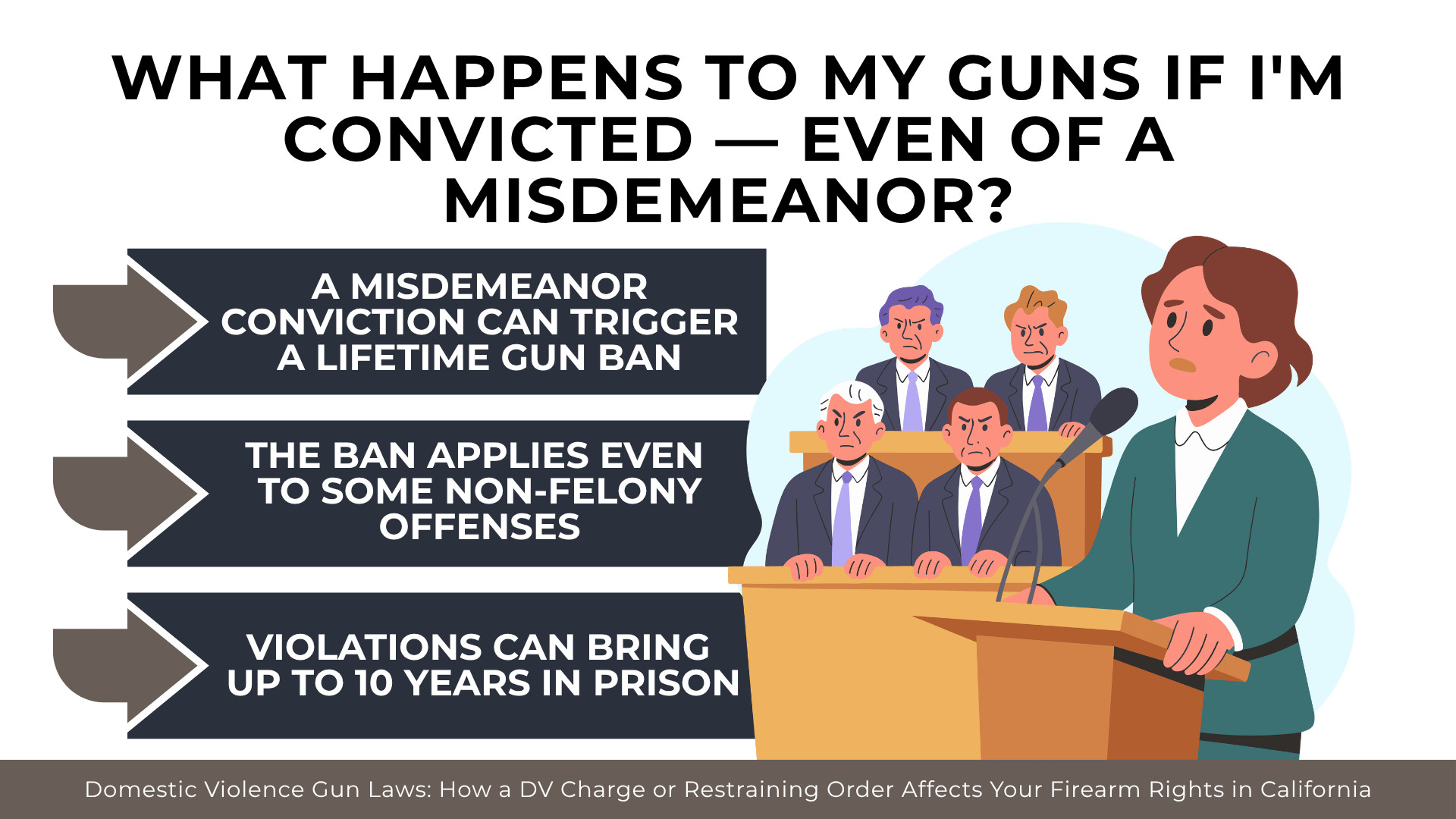
This is where the consequences become most severe and least understood. Under 18 U.S.C. § 922(g)(9) — commonly known as the Lautenberg Amendment — a conviction for a “misdemeanor crime of domestic violence” triggers a lifetime federal ban on possessing firearms or ammunition. There is no built-in expiration. There is no automatic restoration process. The ban applies equally whether the underlying conviction was a felony or a misdemeanor.
The federal statute defines “misdemeanor crime of domestic violence” at 18 U.S.C. § 921(a)(33)(A). The offense must have, as an element, the use or attempted use of physical force or the threatened use of a deadly weapon. It must also have been committed against a qualifying domestic victim — a current or former spouse, a parent or guardian of the victim, a person with whom the victim shares a child in common, a person cohabiting or who has cohabited with the victim as a spouse, parent, or guardian, a person similarly situated to a spouse, parent, or guardian of the victim, or a person in a current or recent former dating relationship with the victim.
The 2022 Act expanded coverage to include dating relationships under § 921(a)(33)(C). There is a narrow exception for dating partners: a person with no more than one MCDV conviction involving a dating partner may have the ban lifted after five years from the later of the judgment of conviction or the completion of the custodial or supervisory sentence, provided they have not been convicted of another qualifying offense.
Two Supreme Court decisions define how broadly this ban reaches. In United States v. Castleman, 572 U.S. 157 (2014), the Court held that “physical force” under the MCDV definition includes any offensive touching under common-law battery principles — not just violent or substantial force. In United States v. Hayes, 555 U.S. 415 (2009), the Court held that the predicate offense need not include a domestic relationship as a statutory element of the crime. It is enough for the government to prove that the conviction was in fact for an offense committed against a spouse or other domestic victim.
What this means in California terms: a misdemeanor domestic battery conviction under Cal. Penal Code § 243(e)(1) — which requires no physical injury, only a willful and unlawful touching — can trigger the lifetime federal firearms ban. So can a misdemeanor conviction under Cal. Penal Code § 273.5 for corporal injury to a spouse or cohabitant. The Lautenberg Amendment contains no exception for law enforcement or military personnel. Congress specifically removed the official-use exemption, meaning a qualifying conviction can effectively end a law enforcement or military career by making it illegal to possess government-issued weapons. Violation of the federal ban carries up to 10 years imprisonment.
A felony conviction under Cal. Penal Code § 273.5 carries its own California firearms ban as well. But the critical point is that the “lesser” misdemeanor charge — the one that might initially seem like a favorable outcome — carries the same permanent federal consequence.
How Does the Firearm Surrender Process Work in California?
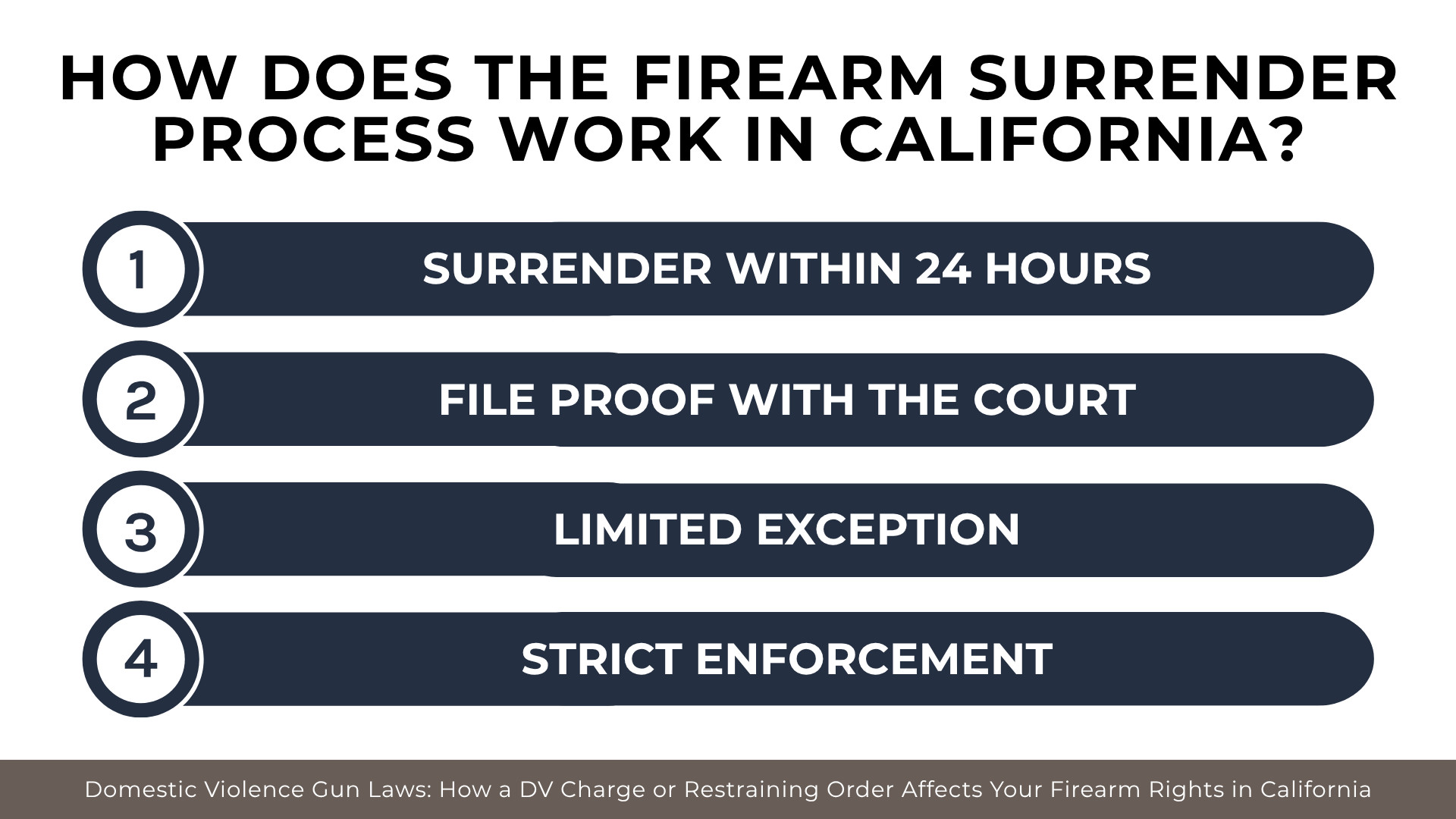
When a Criminal Protective Order is issued in a DV case under Cal. Penal Code § 136.2(d), you must surrender all firearms and ammunition within 24 hours of service. Surrender can be made to local law enforcement or to a licensed firearms dealer through sale, transfer, or storage. You must then file proof of compliance with the court within 48 hours, including a copy of the receipt, with the law enforcement agency that served the protective order. The statute requires additional forms and filings beyond the initial proof of surrender.
Cal. Family Code § 6389 creates similar requirements when a civil DVRO is issued. A narrow employment exemption exists under § 6389(h), where you can demonstrate that a firearm is necessary for continued employment and reassignment to a position that does not require a firearm is not possible. Outside of that limited exception, the requirement to surrender is absolute.
California has invested heavily in enforcement systems to ensure compliance. In 2022, the state allocated $40 million to establish the nation’s largest court-based firearm surrender program for DV-prohibited individuals. The Armed and Prohibited Persons System tracks individuals who acquired firearms legally but later became prohibited. As of January 2025, 25,911 prohibited persons remained on the APPS list. In 2024, the DOJ recovered 1,520 firearms from illegally armed individuals and removed a record 4,058 individuals from the system through enforcement.
Noncompliance with a surrender order is not something that goes unnoticed or unenforced. It is actively tracked, and it creates independent criminal liability on top of whatever DV case prompted the order in the first place.
Can I Get My Gun Rights Back After a Domestic Violence Conviction?
This is the question most people arrive at once they understand the scope of the ban — and the answer is difficult. The paths to restoration exist, but they are narrow, and the most common post-conviction remedy in California does not work.
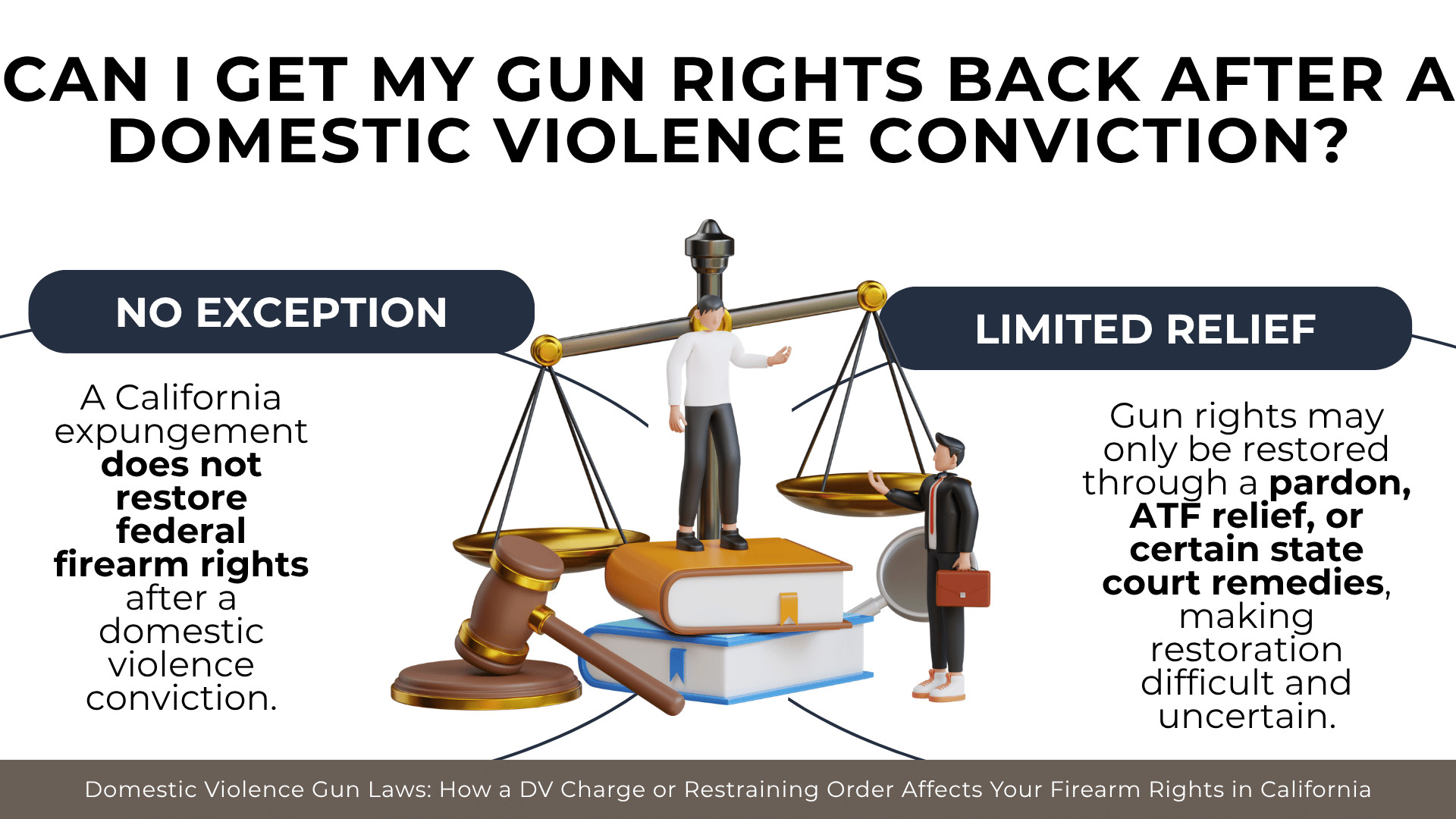
California expungement under Cal. Penal Code § 1203.4 allows a court to withdraw a guilty or no-contest plea, or set aside a guilty verdict, after the defendant has completed probation. But § 1203.4 explicitly does not restore firearms rights. Because of that limitation, the federal exception for expunged convictions at 18 U.S.C. § 921(a)(33)(B)(ii) does not apply. Even if you successfully obtain an expungement of a misdemeanor DV conviction in California, you still cannot legally possess a firearm under federal law.
The reliable paths to restoration are a full and unconditional governor’s or presidential pardon, administrative relief from the Bureau of Alcohol, Tobacco, Firearms and Explosives, or in limited cases, court-based relief under a specific state program.
This is why the defense strategy matters most before a conviction is entered. Once a qualifying conviction is on the record, the federal firearms ban takes effect immediately, and removing it becomes an uphill effort with no certainty of success.
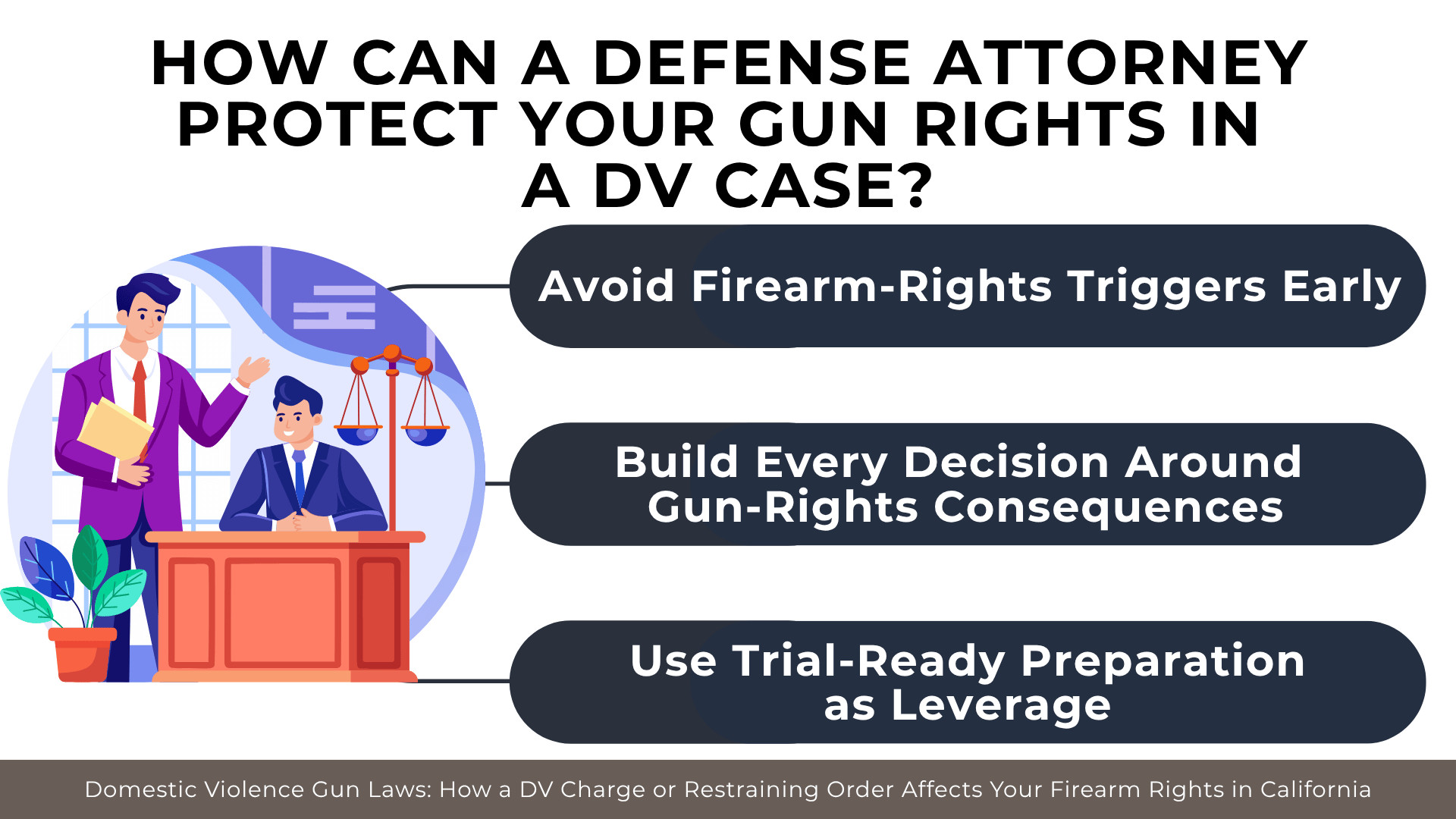
How Can a Defense Attorney Protect Your Gun Rights in a DV Case?
Domestic violence firearms bans are triggered by specific legal outcomes — the type of conviction entered, the type of protective order issued, the specific findings contained in an order. That means the defense strategy must be built around avoiding those triggers. This is not a case where “getting the best deal” in the traditional sense is enough. A plea to a lesser charge that still qualifies as a misdemeanor crime of domestic violence under federal law carries the same lifetime firearms ban as the original charge.
Protecting your firearm rights in a DV case means evaluating several possibilities. Can the charges be negotiated to a non-DV offense that doesn’t trigger the Lautenberg Amendment? Is pretrial diversion available, which would avoid a conviction altogether? Can the specific language of any protective order be contested to prevent it from meeting the federal qualifying criteria? Each of these decisions has to be made with the firearms consequences in mind from the beginning — not addressed as an afterthought after a plea has already been entered.
At Angelo Reyes Law in Carlsbad, every case is prepared as if it’s going to jury. That approach creates leverage — not just for trial outcomes, but for the negotiations that resolve most cases before they reach a jury. In domestic violence cases where firearm rights are at stake, that leverage can shape whether the resolution carries a temporary restriction or an effectively permanent ban.
If you’re facing a domestic violence charge or restraining order and you own firearms, the window to protect your rights is now — before a conviction is entered, before a plea is accepted, and before an order is issued with language that triggers consequences you can’t undo. Contact Angelo Reyes Law to discuss your case.